Somebody just back of you while you are fishing is as bad as someone looking over your shoulder while you write a letter to your girl.
– Ernest Hemingway.
I’ve had the pleasure of knowing the high quality of Dominic Garnett’s writing for some time, but have only recently discovered the excellence in its fishing focus – and much else – when I read his wonderful piece Memories of Manhattan in Fallon’s Angler, that article included now in this superb collection.
I’ll start my review of Crooked Lines by returning to the article, it exemplifying all that is engaging about these stories as it is a fine mixture of travelogue and fishing emphasis wherein observations about people, culture, environment, emotion, discovery, and naturally the actual fishing coalesce into vignettes of personal experience that appeal precisely because of this expansive canvas – and that writing quality.
Memories of Manhattan begins with a walk through Harlem to Central Park, …an Englishman carrying a fishing rod and it is the dual sense of being an outsider as foreign visitor but then belonging as a member of the universal fishing fraternity that absorbs. There is, respectively, that experience of being new to the place, Some smile, others just look quizzical, and the eventual fishing where observation is then on a comfortable par with his surroundings, A stocky, baseball capped man is hurling out a gaudy red spinnerbait in the hope of bass. On route to Harlem Meer, Garnett has discovered, It is a minor revelation just how green and calm it is here, and once fishing, the expertise assumes its descriptive certainties, but also does so with the vivid precision of his describing eye and voice, The rod rattles pleasingly and I bring in a pretty little bluegill, a fish which shares the spiny dorsal fin and bold biting characteristics of our perch, but with beautifully marbled cheeks; the perfect catch for a sunny afternoon in Manhattan.
The collection opens with A White Van in Wales and the witty description of Norbert Darby’s shambles of a van has a brighter humour compared with Hemingway’s bitterer comic line used to preface this review. For Garnett, arriving safely at a place to fish is a more critical requisite than the protocol of how near one fishes to another, My head is scraping the roof because, naturally, the seats don’t work. I try wrestling with the wheel thingy at the side, thrash backwards and forwards and search for non-existent levers. I’m beaten so I ask Norbert “So how do you adjust the seats?” He just chuckles. “You can’t. I mean…they don’t,” he admits. So I just sit there, head wedged in place. And again, within the general and wider evocation of the framing narrative, there is always a spotlight on fishing and fish, The wild carp is a very different creature to the fat, farmed fish we know from home. While the big mouth and whiskery barbules remain, it is a longer, sleeker creation of leathery gold scales and raw power. A strikingly long dorsal fin reaches almost right to the tail.
Elsewhere the vignettes focus more narrowly, for example on fly-tyer Leon Guthrie in Fly Life on Mars. Having established Leon’s idiosyncrasies with more descriptive bright humour – but always respect – Garnett tells us The flies themselves are random, manic treasures. They delight and baffle you in equal measure. There are flying insects, trapped in time; rows of salmon and trout flies sitting like birds. But look closer and you might also find an Earthworm, a Haggis or a Fried Egg. In The Curse of the Towpath the philosophy of angling gets its apt aphorism, As any diehard angler understands, for the possibility of sudden elation to exist there must also be the possibility of failure. There is a valiant defence of skive-fishing in Sick Leave. The closing article Escape from Dartmoor continues the successful symbiosis of finely judged description with aspects of fishing, this evoking the interest of all readers rather than just those with the topical attraction. In addressing the angler Garnett is addressing all by, in this case, linking activity with place – as he does throughout his writing – and making it clear that nothing of value to an individual takes place in a vacuum, and here the landscape is a shared significance, For the angler though, Dartmoor has a simple, primal appeal. Its boulder-strewn rivers and savagely beautiful trout take fishing back to its fundamentals: a fly rod, a few basics, miles and miles of stony solitude. The fish are easy to catch but even easier to spook, perfectly adapted to their craggy ancestral home.
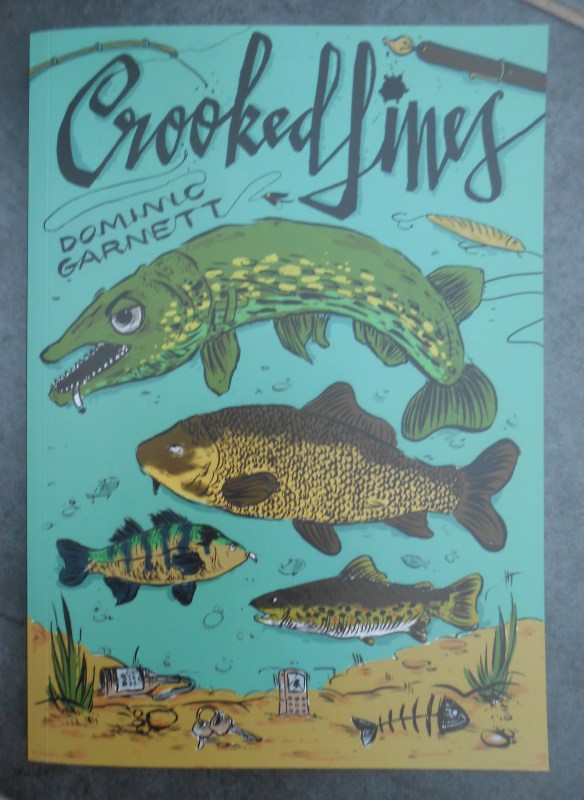
This is a beautifully presented book: a great cover illustration by Lord Bunn and fantastic photographs as well as excellent production throughout. I wholeheartedly recommend to anyone who appreciates honest and skilled writing, and obviously those who know with an angler’s heart and knowledge just how near to stand next to a fishing comrade.
And what a great Christmas gift! Details for buying can be found here.
 gravyfromthegazebo