
I have been dogged in my response to the sample KS2 English grammar, punctuation and spelling tests [or SPaG as they were previously arranged and therefore abbreviated – and those of us in the know, know they were terrible then, as now, as if a new acronym of GPS helps designers to ‘navigate’ to a brighter territory…], but Michael Rosen has been hounding these with a bark and a bite that has already achieved Crofts Championship Super Supreme status.
Through Twitter, Facebook and his personal blog postings, Rosen has mounted a sustained rationale against this primary school test regime. With Twitter he has satirically posed brisk teasers to expose the nonsense of so much of this, and on Facebook and his MR blog he has provided detailed, informed and instructive grammatical and linguistic analysis to not only counter the aims and purposes of these tests but also their accuracy. Yes, their accuracy!
His latest convincing argument is a 13 part collation and summary of the points and evidence he has marshalled against the English test, and it should and can be read on his blog here.
In a further nutshell, I think the simplest objection [though it requires these detailed background arguments] can be summarised by three points:
1. These tests are too complex and difficult for 11 year olds
2. These tests only exist to provide a simplistic means of measurement as a performance in these, and only these, tests
3. These tests have nothing whatsoever to do with the teaching and learning of how to write
Whilst I have constructed my own arguments against the testing principles as a whole and then particular test questions – challenging these as educational tools – I have also mounted my own satirical dismantling. However, much of my satirical reaction has been in providing alternative approaches to actual test questions. I am considering working more carefully on these to see if they could provide an actual substitute set of questions/tasks that could be used to aid student learning about aspects of Writing [including grammatical and linguistic choices].
I know there are immediate dangers/divergences in this: using original questions, even in subverting them, somehow still provides credence to their existence; my ideas are generally to encourage actual writing rather than discrete ‘answers’ about writing, and my ideas usually encourage group work rather than individual student questioning.
But I am considering…
Below are three ideas already posted on this blog and which I will use as models should I continue to explore this idea:
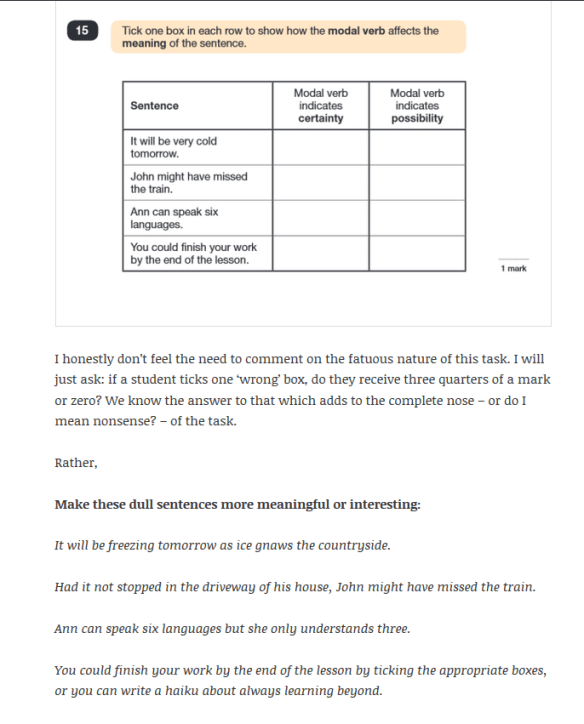

Of further interest, there are two points in Rosen’s list of 13 that are personally poignant, for different reasons:
No. 5 about Michael Gove’s insistence, when he was Education Secretary, that questions about ‘subjunctives’ having to be including in the tests – against informed advice – could seem unbelievable [it is certainly ridiculous] but as I have argued so often on this blog that he is solely responsible for the banning of American authors for study in GCSE English Literature, I found this both appalling and yet reassuring because I don’t think enough people believe he wielded this kind of crazy dictatorial power.
No. 7 because I used to have and teach from a red binder Language in Use when I started teaching English in 1980 in my then secondary school [later a comprehensive] and my recollection is of how purposeful and informed it was about exploring and teaching language usage through a wide range of contextualised and meaningful ideas and tasks.
Finally, it is absolutely clear that the only effective fight against the existence of these tests will be in a boycott of them. Whilst of the utmost importance to have argued convincingly against them – and I think that has already been achieved, surely – we know [take the Gove interventions as evidence; and the current White Paper on national academisation of all schools] that no amount of truth will alter that myopic and arrogant course of this government on education policies.
 gravyfromthegazebo