It is timely that the natural phenomena of today’s complete solar eclipse of the sun in America takes an ‘ideal-view’ trajectory across the states of Nebraska and Illinois, for reasons that will be clear and relevant in a moment.
The linear path across the states wherein you would have the best view is both south of Omaha, the place of my birth, and Normal, the place of Carrie Etter’s: these two landmarks – for the sake of this review – on a reasonably close horizontal plane, interestingly.
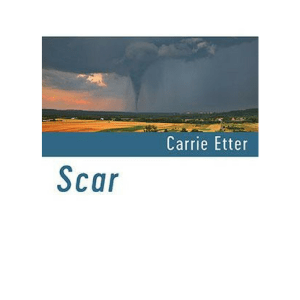
The link? I had originally made a seemingly superficial decision to buy and read Etter’s poetry chapbook Scar because she is a fellow Midwest American ex-pat living in England, and the sample of work I saw from the book had that freedom of form – not experimental as such – which I so often enjoy in reading poetry. That her theme was exploring the effects of climate change on her hometown roots was of interest, partly for a shared environmental concern, but also because of my anticipating that writer’s nostalgic referencing of and concern for her origins with which I share a regular and profound personal preoccupation for my own.
In all respects, my instinct for seeking out Scar has proved a sound one, whatever the reasons. Further made relevant by President Trump’s arrogant and dumb decision to withdraw America from the Paris Climate Accord, the opening has on its second page a now ironic reference to
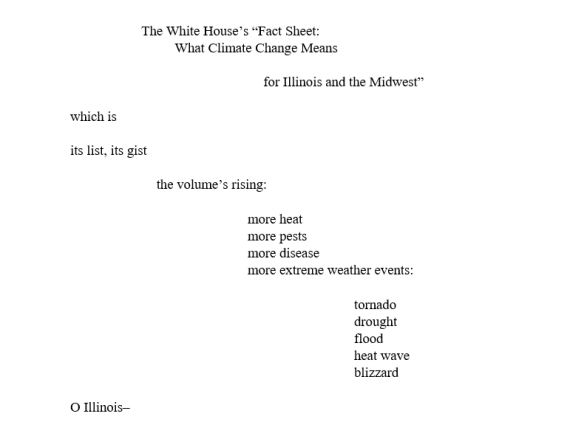
and one can see immediately how that use of line space [‘freedom of form’] is used purposefully to draw the reader’s attention to and across the gradations of revelation and predicted impacts – ending on the page as it does with the simple but heartfelt lament for her home state [and of course everywhere else].
Further references strike a familiar, nostalgic chord:
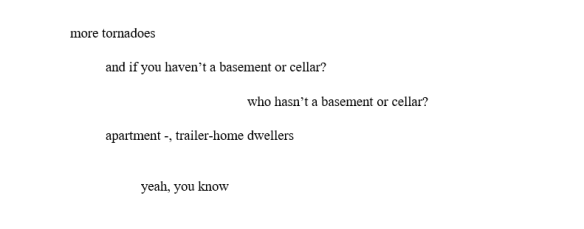
and the apparently casual sprawl of language and lines belies the serious reality where comfortable notions of safety from ‘more tornadoes’ are naïve as well as dismissive, for example, of those without and, again ironically, especially those ‘trailer-home dwellers’, Trump’s notional support base – excusing the stereotype but acknowledging a complex socio-economic factor.
I suppose the ‘superficial’ connection does get its fuel when such references do remind of the extreme weather and tornadoes of my childhood: living in Norfolk I remember once in 1965 when summer hail stripped virtually the entire town’s trees of their leaves producing an immediate winter landscape; on another occasion when cowering in my basement during a tornado warning [the town siren blares] a tree was blown down in the garden and crushed my boyhood swing-set.
And yes, there is a normality to these weather conditions, Norfolk and also Omaha in a geographical cyclonic zone, and any google search will reveal other continued, contemporary storm disasters – e.g. the Norfolk hail storm of 2014 – but the warning point highlighted in Etter’s poem is there will over coming years be much more of this.
The point is also how the warning recognises the relativity, but addresses America’s dangerous complacence, one again exemplified in Trump’s stupidity,
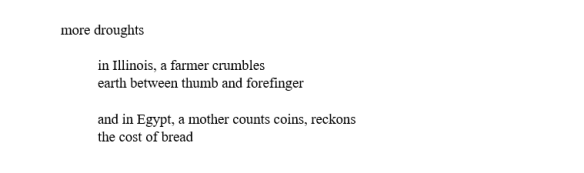
It is a global climate problem [that platitude directed at the Donalds of the world].
One of the most powerful poems is a remembrance from Etter as a young girl of nine or ten in the midst of a blizzard, her father on the CB radio trying to find the whereabouts of someone – maybe a family member – and the palpable fear recalled is also a foretelling of further worse fears in a future of climate change unchecked.
There is an emotive crescendo as the poems and their recalled/imagined stories continue, and it is genuinely sensitive, that seemingly simple arrangement of lines with their paces and pauses and projections avoiding the melodrama of a more blatant poetic diatribe but instead more disturbing in the building outlining of the whole.
Like the puissance of a memorable short story, this poem is a one-sitting read and all the more impactful for that. You will return because it is also crafted to endear as well as inform, and that is its literary significance.
In conclusion, another incidental, surprise connection for me was reading the chapbook’s ‘i.m.’ to Peter Reading, my favourite contemporary British poet, and another writer deeply concerned with the environment and its impact on us culturally as much as in the reality of its physicality. But even stripping away all of this personal linkage, this is a book I do recommend highly for its crafting and its meanings.
 gravyfromthegazebo
Pingback: Poetry Reviewed 2017 | mikeandenglish