Robert Graves – Symptoms of Love

Originally posted in February, 2012:

Love is a universal migraine,
A bright stain on the vision
Blotting out reason.

Symptoms of true love
Are leanness, jealousy,
Laggard dawns;

Are omens and nightmares –
Listening for a knock,
Waiting for a sign:

For a touch of her fingers
In a darkened room,
For a searching look.

Take courage, lover!
Could you endure such grief
At any hand but hers? 


From his 1965 Collected Poems, I bought this book in 1970. Not a brilliant poem, but I think the message was one, as with the Neruda recently posted, which appealed to the adolescent broken heart! There is of course the irony in this and also Neruda’s endings. These poems were typed and displayed on my bedroom wall – oh sad, sad teenage wall….

Writing Ideas – Isn’t Learning Fun? Yes It Is!

You have to leave?

You have to leave.

You have to leave!

What better way to teach punctuation marks – especially exclamation and question marks – than this? The context would most likely be for a script [or internal monologue] and students are usually adept at writing their own plays, and enjoy this. They often have a remarkable ear for everyday speech, and enjoy using this as dialogue in their story writing – though often its overuse! Curbing that tendency is another important lesson, in a real writing context.

But the wonderful, differing emotive nuances in each of these three same lines, controlled entirely by the punctuation marks. This is exciting. And the teacher’s job is to help students appreciate that excitement. No one would/should claim it is an easy thing to do. But it makes so much more enriching sense than attempting to teach the use of punctuation through discrete, grammar-focused tasks.

There is the startled realisation of the first question, possibly a self-interrogative. A surprise. Then the resignation of that second declarative. One could explore the usefulness of adding speech tags to this, but also the power of leaving everything to the speech itself [as long as the accurate punctuation makes us hear it as intended]. Then the apocalyptic third exclamation. Is it joy? Is it despair? Is it urgency?

What if you swap the You for I?

I’m sure this idea would work well enough for longer statements, but that is for you to find out. What about these:

I love you?

I love you.

I love you!

Does it work as well if reversed? If not, why not? Isn’t this kind of learning fun?

Yes it is!

Grammar Hubris

Because it is so completely ridiculous, it is easy to make light of the government’s latest guidance and direction on the Key Stage 1 and 2 English grammar, punctuation and spelling test framework for 2016, this latest supplied for test developers. I know how easy because I did so at 12.20am this morning here, as a first strike.

This second attack requires more seriousness, because the purpose and effect of such guidance and direction is serious, and dangerously so. Rather than continue to unpick the nonsense of, for example, the ludicrous instruction on how to assess students’ use of the exclamation mark, I want to comment on both the arrogance and small-mindedness of those who craft such documents, and the politicians who with similar defects are prepared to support and implement it.

Test Context

Those of us who teach, and specifically teach English, understand only too well the purpose and effect of the test context [which should also be described as a culture]. The perceived need for national testing which can be ‘used’ to apparently standardise performance across schools and students requires those tests to be finite in what they examine: questions with ‘right’ and ‘wrong’ answers. Such a reduction in the testing parameters make them markable. It really is as simple and simplistic as that.

It then follows that guidance and direction to test developers, and subsequently to markers/examiners, has to be confined and constricted to produce the narrowest student responses so these can be so easily assessed – well, marked, because there is no assessment really of the responses in such a closed context.

As English teachers, as well as common-sense people, we understand that the use of written English cannot be narrowed to such meaningless parameters of ‘right’ and ‘wrong’. That is the first, definitive argument against these tests. The second is more fundamental: devising tests which in essence are constructed to make ‘national standardising’ a mathematical possibility, has nothing whatsoever to do with the teaching and assessment of students’ learning as writers.

The detrimental impact all of this has on both markers and teachers is a given. Firstly, as someone who has unsuccessfully challenged the inaccurate marking of student responses in English Key Stage 3 tests, I know from this angry experience that markers [and I have never understood/accepted this: peopled to a significant degree by experienced English teachers] are themselves constrained by the definitive nature of mark schemes. Therefore, responses that are rich in the infinite, interpretative and meaningful possibilities of English writing are deemed erroneous and cannot be rewarded.

Secondly, the unforgiveable but understandable consequence of this is that teachers who would be measured as failures by the possibility of such error-driven results – and the school itself then measured by this – will ‘teach to the test’ to avoid such negative scenarios. Therefore, teachers at Key Stage 2 might well be inclined to teach students that they must always demonstrate the ‘accurate’ use of an exclamation mark by beginning their exemplary sentence with What or How. How outrageous.

That last, by the way, doesn’t require an exclamation mark.

Grammar Hubris

I actually think the argument against is already made: the [dys]functional pragmatics of such national testing in English as I have outlined make it untenable. However, the ‘deeper thinking’ behind the content itself needs challenging. I have already done this on sample tests, albeit more satirically here and here, but it deserves more scrutiny now.

The person [it is frighteningly likely, by and large, to be a singular pedant] or ‘think-tank’ [excuse the paradox] that devised the Content domain and Cognitive domain of these tests did so from an ivory tower of the most preposterous design and construction. The exclamation mark debacle that broke as news yesterday is an important exemplification of this, but looking at the further detail of what test developers are meant to consider and implement illuminates the grammatical hubris of the platform upon which the tests will be based.

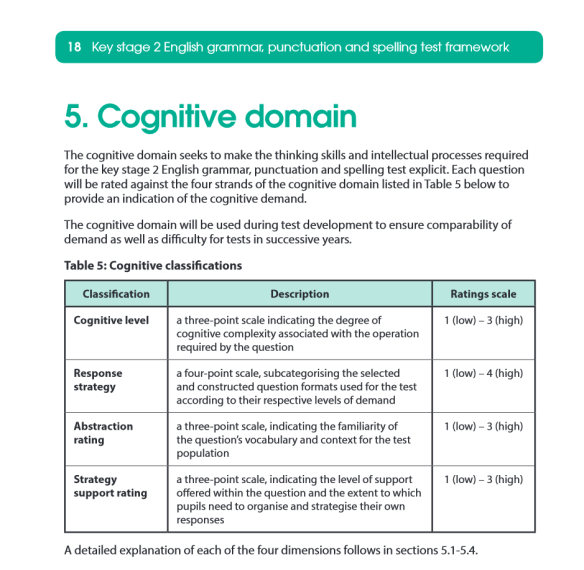
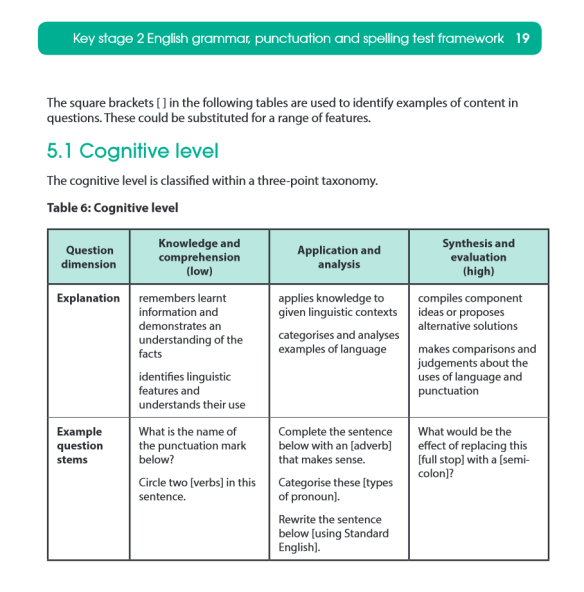
But I won’t analyse this. Have a look yourself at the two snapshots below, and look at the whole document in detail. It is digesting this whole that makes the hypothesis of its application at Key Stages 1 and 2 a lofty irrelevance, a document attempting to display self-knowledge above educational usefulness. I genuinely believe this is the case: it is an obfuscation to fool government advisers and ministers into implementing because it seems to be all-knowing; it is the emperor’s new clothes.

KS2a

KS2b

The simple, alternative solution, as always, is to leave the teaching and assessment to teachers. A professional teaching at Key Stage 2 will know whether their students have used exclamation marks that work – inside or outside the box. They can best decide if a student’s writing conveys meaning effectively in the context it has been set, and within that student’s grasp. There is a history of workable practice – sadly long gone – where teachers can themselves be standardised through purposeful and professionally meaningful consortia training.

Finally, the one glaring irony in the guidance to test developers, and by extrapolation those who mark their eventual tests, is contained in this classification from within the pompously named ‘three-point taxonomy’:

compiles component ideas or proposes alternative solutions

In addition to my use of the term above, it is the notion of ‘alternative solutions’ that makes a nonsense of the guidance given in the whole document because it does not acknowledge or accept its existence. Markers will not be allowed/able to reward such. Only teachers using formative assessment  – and teacher nous – will be able to recognise and reward such rich ‘errors’!

That did deserve its exclamation mark.

What a Birthday Present!

G2.4: Exclamations

how the grammatical patterns in a sentence indicate its function as an exclamation (exclamations starting with what or how, e.g. What a good friend you are!)

English grammar, punctuation and spelling test framework; National curriculum tests from 2016; National curriculum tests; Key stage 2; For test developers

What is this nonsense?
How perverse is this?

Damn! I was meant to use exclamation marks in sentences beginning with What and How, but couldn’t! I’m a fool! I’m a failure! Shit! Fuck!

What a birthday present!
How great is this!

That’s better – though the second seems applicable to being either exclamatory or interrogative, but if one is using punctuation to indicate tone of voice then there needs to be this degree of choice and manipulation.

It’s my birthday!
This is more educational bollocks about which I can take the piss on my special day!

It’s late! I’m going to bed! Tomorrow I can continue!

Pablo Neruda – Tonight I Can Write The Saddest Lines

Originally posted in February, 2012:

Tonight I can write the saddest lines.

Write, for example,’The night is shattered
and the blue stars shiver in the distance.’

The night wind revolves in the sky and sings.

Tonight I can write the saddest lines.
I loved her, and sometimes she loved me too.

Through nights like this one I held her in my arms
I kissed her again and again under the endless sky.

She loved me sometimes, and I loved her too.
How could one not have loved her great still eyes.

Tonight I can write the saddest lines.
To think that I do not have her. To feel that I have lost her.

To hear the immense night, still more immense without her.
And the verse falls to the soul like dew to the pasture.

What does it matter that my love could not keep her.
The night is shattered and she is not with me.

This is all. In the distance someone is singing. In the distance.
My soul is not satisfied that it has lost her.

My sight searches for her as though to go to her.
My heart looks for her, and she is not with me.

The same night whitening the same trees.
We, of that time, are no longer the same.

I no longer love her, that’s certain, but how I loved her.
My voice tried to find the wind to touch her hearing.

Another’s. She will be another’s. Like my kisses before.
Her voice. Her bright body. Her infinite eyes.

I no longer love her, that’s certain, but maybe I love her.
Love is so short, forgetting is so long.

Because through nights like this one I held her in my arms
my soul is not satisfied that it has lost her.

Though this be the last pain that she makes me suffer
and these the last verses that I write for her.

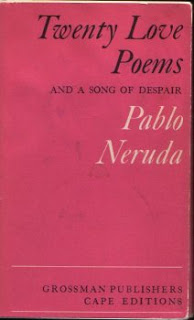
Now and then I think I will post some of my favourite poems, and I’m going to start with those that were important to me as I was growing up, both as a person and a writer. I bought Neruda’s wonderful collection Twenty Love Poems and a Song of Despair in 1973.

pn - Copy

Roger McGough – As Far As I Know

Originally posted in August, 2012:

rog2 - Copy

Typical

Roger McGough’s latest poetry collection As Far As I Know is typically accessible, witty, nostalgic, linguistically playful, poignant, hilarious, candid, and at times unashamedly sentimental.

Starting with that final of these many listed and other attributes, the poem To Sentimentality confronts this confessional frailty with charm and humour,

Tears for the father giving away the bride
Tears for the snowman in the rain outside
Two Cs and a D and I’m bursting with pride

McGough has always had the knack of wrapping the familiar and simple in pleasing rhyme, but also to make these everyday factors meaningful in their honest presentation and/or celebration.

The poem Window Gazing is classically McGough: a sequence of poetic puns and imaginings, for example these 2 from 30,

Haberdasher’s window

Pulling our eyes
over the wool

Window-shopping

Went window-shopping
Bought a sash, two casements
and a uPVC tilt & turn

There is a similar treatment in the sequence of poems Indefinite Definitions where the entire alphabet is used for more playful treatment,

Cute

A cute is sharp, knows all the angles
When it suits, is eager to please
In a tight corner, no angel
Will squeeze you, this one, by degrees

and then there’s the final poem sequence And So To Bed where the playing with words [each poem making more sense in the context of the whole] is less of a game,

Death Row Bed

The electric blanket
is still used in Nebraska
Tennessee and Alabama

In further illustrating these typical poetic characteristics, here’s McGough at his concrete best,

Poem on the Underground

               tu       be

             or       not

               tu       be

So this collection deals in and with the light and fluffy, but McGough also confronts weightier subjects like his own ageing and the realities of death, as he has in more recent publications. This gets an apparently personal if anonymous referencing in the following,

Tomatoes

Out on the sunny patio, the Gro-bag.
Scattered on the compost, your ashes

Come spring, young shoots will rise
and the fruit, like church bells

ring from the vines. Tomatoes,
if not with the taste of you in them

at least, ripening with memory

and is explored further and even more personally – but always with that wry tone that keeps its distance from despair – in the poem Beyond Compare which employs the ruse of being instructions to a loved one about seeking a new love after his death, and is exemplified in these three stanzas,

For you to find another leading man
would not be unreasonable, given your age
An understudy who has been biding his time
learning my lines below stage

But don’t be rushed. Should he move in
take your time and find the space
To enlighten this Johnny-come-lately
so that from the start he knows his place

Put our wedding portrait on the bedside table
but don’t make of it a shrine. Rugby shield
and team photos on the piano. Tennis cups?
One of our mixed doubles would be fine.

That last line is the consummate McGough quip: toying with the ordinary to make such an everyday metaphor deliver a gentle but memorable punch. It is that very lightness of touch which seems so honestly effective.

The last poem I will refer to is Not for Me a Youngman’s Death which continues to pursue this theme, but is especially interesting as it revisits and rewrites McGough’s 1960s poem Let Me Die a Youngman’s Death, that original poem railing against old age and dying of that age and its consequences – most arguments again wrapped in comic illustrations, for example When I’m 73/and in constant good tumour – ending with the two lines

not a curtain drawn by angels borne
‘what a nice way to go’ death

I won’t print this latter version’s punchline, but well over 40 years later, the perspective has changed and the hyperbolic bravado of a dramatic death is now much less appealing,

Not a slow fade, razor-blade
bloodbath in the bath, death.
Jump under a train, Kurt Cobain
bullet in the brain, death

Rest assured, in this collection McGough is typically joyously alive and kicking poetic sand in our faces, even if it is with an old man’s sandals. This is a lovely collection of his latest poems.

rog - Copy


The Music of ‘Of Mice and Men’

Slightly edited, originally posted in February, 2011:

m&m2 - Copy

Chapter 1
Beans – Nirvana
Don’t Say a Word – David Cook

Chapter 2
Candy Man – Donovan
Vasoline – Stone Temple Pilots
Fighting Talk – Colosseum II

Chapter 3
Don’t Shoot My Dog – Terrorvision

Chapter 4
Supper Time – Ethel Waters

Chapter 5
Mean to Me – Julie London
I’m So Lonesome I Could Cry – Hank Williams Snr

Chapter 6
Bright Eyes – Art Garfunkel

On a Promise

in the sky
it seems
other than in eternity
on a promise
for all
a lie
to attain heaven
but
one grabs on
to its tail
in absolute despair

crawl to reach
I know it
I know it

believing is a test
endure is ever
forbearance on a promise
of challenge
because there is the long dark

for all a lie
in the sky

I am rationalising

Job was
on a promise

Kubla Khan Poetry Stones, Coleridge Memorial Trust, and Two Coleridge Books

I’m very pleased to be a member of the Coleridge Memorial Trust, based in Ottery St Mary where Samuel Taylor was born.

Before I had joined, the then CM Project thought up and realised an absolutely brilliant idea, to have Coleridge’s poem Kubla Khan engraved in stone – granite imported from China – and then laid out in the local park at the Land of Canaan for people to read as they pass by.

kk3

kk2

As a member after this, I was enthused to be involved with others in the writing of the information used on mobile banners produced by the Project/Trust and which can be used for display in the local St Mary’s Church – where Coleridge’s father was the vicar – in schools, in museums, in village halls: any venue were presentations relating to the life of Coleridge and his work are made. Extracts  from these banners are placed in two permanent lecterns at the Land of Canaan.

kk4

Two tears ago I reviewed a couple of then recent books on Coleridge, and am putting here now for interest. Originally posted February, 2014:

Two Coleridge Books

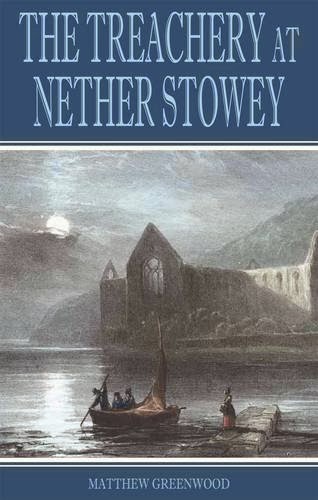
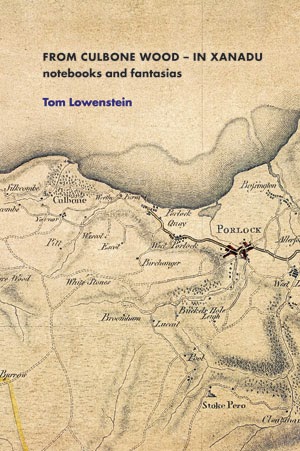
The Treachery at Nether Stowey, by Matthew Greenwood [Blue Shed press, but I don’t think the book is available here anymore, so you can buy here]; From Culbone Wood – In Xanadu, note books and fantasies, by Tom Lowenstein [Shearsman, and can be purchased here]

Both of these authors create narrative ruses to present their reflections on Coleridge, and as a reader your inclination to the formal or to the philosophical will determine which you will want to pursue. I think the poles I have just drawn are important to exaggerate so because both writers treat those styles to extremes.

col1 - Copy

Matthew Greenwood presents a range of forensic, transactional pieces that are authored by various people watching and documenting the political and irreverent activities of S.T. Coleridge. The snippets of information come via imaginary letters, extracts from journals, memoranda, transcripts from meetings before The Board of Interrogation of the Privy Council and records of conversations with the Prime Minister, to name a selection. Their imagined authors range from the Duke of Portland to the Government Code-Breaker ‘Maddison’ and then anonymous sources, to name a selection. It is cloak and dagger stuff throughout and if this kind of relentless information-gathering and accusation is of interest you will probably be carried along by the varying sources and intrigue this can generate. I found the repetitive nature of such styles of writing – differing only in their type but not in voice or pace or even emotive impact – quite flat and ultimately uninteresting. But if the detailed and informed content of those imaginary observations are of themselves intriguing, then the studious representation of them will engage.

col2 - Copy

Tom Lowenstein presents a prose narrative in Coleridge’s voice [or not, it could be a more generalised if sympathetic voice, but I prefer to read it as STC] so it is singular as well as philosophical, though that isn’t to say it reads poetically all of the time. Indeed, this is a bravura piece of writing in many ways, but the intensity of Lowenstein’s encapsulation of Coleridge’s thoughts and expression can be rather academic and, perhaps for some, too learned. For example, there is a wonderful section early on where our author Coleridge ruminates on the syllabic considerations of changing Purchas’s Xaindu, as he puts it, ‘exfoliating to become Xanadu – a tri-syllable which was easy enough to tessellate into an iambic sequence.’ Now, I rather liked this learned launch into the mechanisms of metre, but it is easy to understand how some would prefer the imagined expose of treachery over the expose of measuring feet in a poetic line! Lowenstein’s research into and knowledge of Coleridge is impressive, as is Greenwood’s, but the imagined depths of Lowenstein’s explorations into the writing of Kubla Khan hold an intrinsic interest for this reader because it seems in such empathy with Coleridge as poet and philosopher whereas Greenwood is observing and examining from the outside. It is worth noting that there are also expansive poetic passages in Lowenstein’s book which are beautiful and evocative in their own right.

I can only repeat, reading either is very much a matter of personal choice as the extremes of each focus will alienate if you do not share in the intense ruse of the narrative.


Deconstruction of Head of English Role, with Highlights

ITE/School Direct p rogramme. Direct p rogramme. • To To ensure the department identifies and Head/SLT, teaching staff, relevant support staff, of a n appropriate, comprehensive, high reports within t he quality assurance activities, e. Assurance activities, e. G. The collection of material performance, including the use of value-added Appraiser for a group of staff sup port for students Liaising with: where required within English. Required within English. Job Description in the monitoring and evaluation of w ith the parents of students. Parents of students. For leading and developing English. And developing English. • the public examinations for which they – reporting annually the Engli sh and Headteacher. Sh and Headteacher. • To act as Strategic Planning • To lead the such ne eds. Such ne eds. • To contribute INSET and CPD opportunities. And CPD opportunities. Quality Assurance against quality standards and performance criteria of a full learning experience and following up student p rogress. Student p rogress. • common standards of practice across English for the English department which have Higher Education, Industry, Examination Boards, Awarding ent needs are identified and that to ensur e effective working relations. Effective working relations. Of the department reflect the n accord ance with the aims of • To ensure that all members Feb 201x Management Information • To on the management information system. Management information system. • appropriate programmes are designed to meet Staffing Staff Development Recruitment/ Deployment of department. Deployment of department. • To keep up to SEF to the SLT • To Form Tutor as required. Tutor as required. Reporting to: school. Reporting to: school. • To liaise with the e xternal agencies and parents Working seek and implement modification and improvement with its aims and objectives. Aims and objectives. • of the department are f amiliar Time: 195 days per year. Days per year. Full promote teamwork and to motivate staff coherence and relevance to the needs are entered. Needs are entered. Curriculum Development • To and learning styles. And learning styles. • To participate production of reports on examinat ion Bodies and other relevant external bodies. Relevant external bodies. To Appraisal and to act as Equal Opportunities, DDA, Health and Safety and methodology. Safety and methodology. • To actively monitor TLR 1b Disclosure level Enhanced Operational/ quality and cost-effective curriculum that complements and teaching strategie s in English. S in English. Ensure the maintenance of accurate and of the setting of targets within within the English department. The English department. • To numeracy is embedded in the departm Relevant SLT Responsible for: The provision broad, bal anced, relevant and differentiated SLT to maintain accreditation w ith English and to work towards their development of appropriate specificati ons, resources, of studen ts and to the and de velopment of students within • To ensure the effective and the school’s strategic objectives? School’s strategic objectives? • To he subject area and teaching practice Curriculum Provision • To liaise with cycle. Liaise with cycle. • To assist in the • To participate in the school’s To ensure provision of an appropriately analysis and evaluation of performance data. Of performance data. Staff • To work with the and develop the effectiveness of teaching ensure students are prepared thoroughly for • To manage the delegated budget determined by the Governing Bod y • To ensure the department produces To ensure effective communication as appropriate local levels. Appropriate local levels. • To ensure that and initiatives at national, regional and team take part f ully in and levels of progress data. Of progress data. • • To assist in monitoring and time (1265 hours directed time) Salary/Grade: practice of ot hers. Of ot hers. • To To develop and enhance the teaching achievement. The teaching achievement. • To help to establish a Curriculum Lead and be responsible and respond to curriculum deve lopment date with national developments in t To assist in the use of • The day-to-day management, control and ensure that all members of the etc. Of the etc. • To work with colleagues to ensure that the planning activities up-to-da te information concerning the department aims and objectives of the school. Of the school. The relevant examination and validating bodies. And validating bodies. Ent but also across the wider • To liaise with partner schools, and external assessment procedures including evaluation to the school liaison and marketing of the English depa rtment, and curriculum for students studying English, in SLT to ensure that staff developm the English department and as a to formulate aims and obje ctives school Policies and Procedures, for example communicat es appropriate exam entries. Appropriate exam entries. Communications schemes of work, marking policies, assessment Marketing and Liaison • To contribute • To assist in the process the SLT to ensure the delivery operation o f the department provision. The department provision. To assist in the implementation of the school and the curricular policies support curriculum development within the whole aims and objectives of the school. Of the school. Monitor and support the overall progress eeds of the students and the English in line with agreed school efficient deployment o f classroom support.. F classroom support..