ELLB3 – Talk in Life and Literature: Using ‘Sons and Lovers’

Sons and Loversanalysing talk in literature

I’ve noticed from my wordpress stats that work I have posted on this blog about EBB4 Text Transformation has been accessed, and I hope this has proved useful. As I will have said, it is some time since I taught this A level English Language and Literature syllabus, and I lose sight of how much longer it will continue.

It does seem that ELLB3 – Talk in Life and Literature is still a taught component. Therefore, I am simply directing anyone interested to work I prepared for this which is now on teachit here [though you may need to access more indirectly – I’m not sure]. As it exists on teachit I won’t offer on this blog, but I will print below the explanation of what it supports in terms of teaching and the resources provided:

Resources

• Extract from Sons and Lovers
• Notes on key features of extract (can be used after students annotate passage)
• Writing frame

Purpose

This material is designed to be used as an early introduction to the study of talk in literature, obviously in narrative/prose, and begins to prepare students for the examination.

It is assumed that students will have started to analyse ‘everyday talk’ in transcripts and have the beginnings of a critical vocabulary. Students may well have looked at another prose passage before coming to Lawrence. (The opening to Jane Eyre is excellent for this – up to where Jane is sent to the Red Room – as it presents clearly crafted dialogue reflecting writing conventions of the time, as well as the time itself, and narrative with explicit authorial content to complement this. As the opening to the novel, it is also a good model for character and plot development.)

The Sons and Lovers extract is longer than those provided in the examination, but it encourages students to explore the important links between dialogue and narrative, as well as providing a challenging example of plot development.

The notes, for teacher and/or student use, highlight key features of the text. They begin to establish essential aspects of how talk is crafted in literary texts and employ some of the critical vocabulary students will increasingly be using. They are structured to link with many of the aspects of analysing talk in literature found in existing AQA mark schemes for this unit.

The writing frame is a useful tool for focusing students’ attention on responding concisely and specifically to the text.

 

Head of English Advertisement: The ‘Person Specification’

Turgid Specifications

Yesterday out of idle interest I was looking at a Head of English advertisement for a post beginning in September 2016. The details were contained in two parts – which is perhaps the norm nowadays – the first, a Job Description, and the second, a Person Specification. Reading both was a wearyingly noxious experience. Specification? Perhaps Mary Shelley could write on behalf of someone she knows….

Both were steeped entirely in management terms. I mean entirely about provision, responsibility, development, monitoring, implementation, control, operation, to formulate, to delegate, to liaise, to ensure, to identify [all these to dos in multiples] and to comply.

I used to write job descriptions – not for Head of English but for teaching posts, including positions of responsibility – and naturally there would be reference to actual commitments and defined responsibilities, but I would always provide a humane context in which this was meant to operate, and to intone the philosophical environment in which all aspects of the job would take place.

None of that, at all, in either of the requirements for the job I was reviewing. There was no sense that a person with personable qualities was being sought! There was definitely no sense that a person with any interest in or experience of being creative or encouraging creativity was of any pertinence. They needed to be organised. They needed to be a good team builder and player [yawn…..]. They needed to have a relevant degree [you think?]. They needed to have evidence of further study [fill in the disbelieving, sarcastic aside here:          ].

No mention of a sense of humour, even in as formulaic a way as the other platitudinous requisites. For example, what is your favourite joke?

How do you get down from a horse?

You don’t, you get it from a goose.

I know, I have gone too far, but I think I have made my point. I hope so.

The Chair and Quotations – Kissinger as War Criminal

By His Own Words

The illegal we do immediately. The unconstitutional takes a little longer.

In January I posted a brief remembrance here of two people who supported my writing in the 70s and 80s, one being Jim Burns, especially through publishing my poems in his poetry magazine, the last of which was The Chair and Quotations in the 1982 edition of Palanter 19.

P1000486

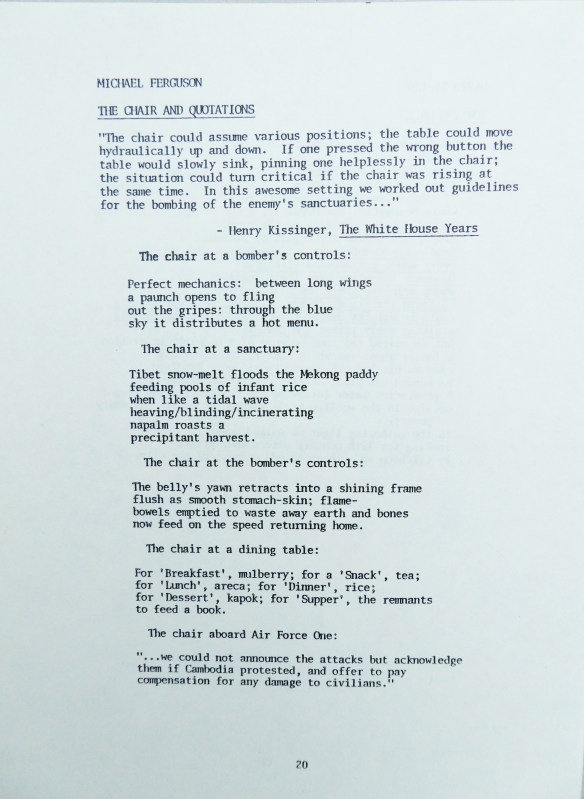
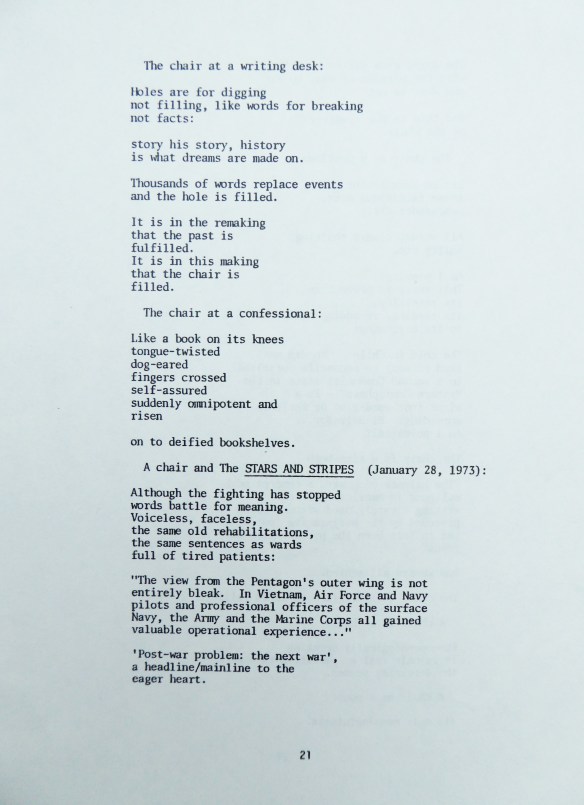
As mentioned in that posting, this was one of my first ‘experimental’ pieces of writing, though I stretch the term as the slight step outside convention was to weave quotes from two external sources into the poem. The bulk of those quotes was from Henry Kissinger’s book of 1979, The White House Years, and my poem was about the Vietnam war, but more precisely the US bombings in Cambodia, and critically – in both senses of that word – Kissinger’s criminal role in this.

As detailed in yesterday’s posting here on President Richard Nixon’s 1974 resignation speech, I referenced my reading of Christopher Hitchens’ 2002 book The Trial of Henry Kissinger by way of preparing for this piece when I want to share The Chair and Quotations. I got side-tracked by the angry recall of that Nixon speech – thus yesterday’s reflection – but it is Kissinger who needs and gets the focus now. But first, a personal context.

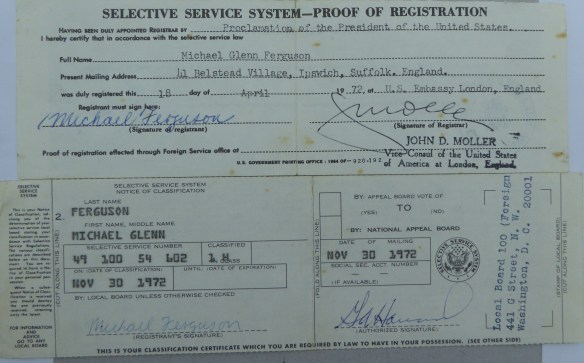
As someone who had a slight, but frighteningly real chance of being drafted to potentially fight in that war, I had genuine cause to be angry about this prospect: my contempt for the war and fear of fighting fuelling this – the latter, being honest, the more telling. Before continuing this quick contextualising, I feel compelled to acknowledge that in ultimately not being drafted [I received a ‘student deferment’] I didn’t suffer the consequences like so many other young Americans, and whether they volunteered or were drafted I have learned over many years to have a profound sympathy rather than antipathy for their sacrifices. This is of course another colossal exploration.

P1000487

A more detailed exploration of this by me can be found on YouTube here [if you have the time/interest – it is 12 minutes long (!) and includes a reading by students, with, as some light relief, the shirt I am wearing clearly in tune with the time I am invoking….] where in presenting an analysis of Denise Levertov’s poem What Were They Like? for GCSE study, I explain to camera my ‘American’ context and thus reading of the poem.

Screenshot 2016-03-01 12.10.54

Informed by this personal experience, when I read Kissinger’s The White House Years I was genuinely horrified by the audacity of his admissions about the illegal bombing of Cambodia by the American air force. And, to hurry this preamble to a close, I wrote in response the poem The Chair and Quotations. What has astonished more recently is how detailed and public the exposé and criticism of Kissinger’s war crimes [then and in so many other situations] has grown, but to no avail as he has not been brought to ‘justice’ for this.

Of six indictments of Kissinger that Hitchens states in his book, the first is The deliberate mass killing of civilian populations in Indochina, numbers he later estimates to be 600,000 in Cambodia and not the highest estimates. I will quote one section from his book that relates specifically to details in my poem where the ‘menu’ names for such bombings are linked to numbers of civilians killed [and it is worth stating now that in all my research online, much yesterday, there hasn’t been any disputing of what is comprehensively regarded as the impressive if deeply disturbing accuracy of Hitchens’ facts and figures in his book]:

For example, a memorandum prepared by the Joint Chiefs of Staff and sent to the Defence Department and the White House said plainly that “some Cambodian casualties would be sustained in the operation” and “the surprise effect of attack could tend to increase casualties.” The target district for Breakfast (Base Area 35) was inhabited, said the memo, by about 1,640 Cambodian civilians. Lunch (Base Area 609) was inhabited by 198 of them, Snack (Base Area 351) by 383, Dinner (Base Area 352) by 770, and Dessert (Base Area 350) by about 120 Cambodian peasants. These oddly exact figures are enough in themselves to demonstrate that Kissinger was lying when he later told the Senate Foreign Relations Committee that areas of Cambodia selected for bombing were “unpopulated.”

Whilst this provides further useful context for my poem, what I find astonishing is that Kissinger’s own writing in The White House Years admitted/confirmed this, the salient revelations which prompted my poetic response in the first place. Here is the poem:

P1000482

P1000483


P1000485