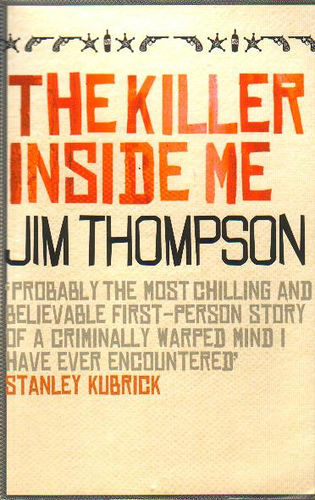
Written in 1952, this first person portrayal of the behaviour of a sociopath/psychopath in small-town America must have been then, and still is, both a frightening insight into the mind of a killer as well as a metaphor for the evil that can exist within an ostensibly ‘normal’ person and place, anywhere.
Cited by many as Thompson’s best work, I had to take a second run at reading in order to become wholly involved and to finish. I’m glad I did. I think my initial hesitancy was much to do with having seen the film version near that first reading. Even on the second successful one, the impact of seeing the film was destructive: [significant spoiler alert, so consider going to the fourth paragraph if…] because the critical narrative ruse is the fact that Deputy Sheriff Lou Ford thinks the first woman he brutally assaulted is dead, told so by his friend and the sheriff Bob Maples, and this is what gives him the confidence to carry on killing because he has not been linked to her death. Such foreknowledge from the film that she isn’t dead obviously destroys the twist at the book’s end: this is when we should find out Joyce is in fact alive, dramatically if deeply disturbing by her entry and what she says to Lou.
With Thompson’s penchant for peculiar/disturbing endings [Savage Night and The Getaway] it is fair to question the reality of the finale in this book. It could be that Joyce is dead – she should be after Lou’s ruthless beating of her – and he just imagines her return, especially as it is in his own home having been released from an insane asylum in an almost farcical legal scenario with the outrageous lawyer Billy Boy Walker. A house he has just primed to be torched and does. And all of this after he has spent a night watching images of his girlfriend Amy who he also viciously killed, these having been projected onto his sanatorium bedroom wall, though he is told later this never happened. But I think it did all happen, even though Ford is clearly insane.
Or is he? This is the wonderful dilemma for the reader, though ‘wonderful’ seems an oddly positive word to use for such a sinister suspense story. But that is its great appeal. We are drawn into Lou’s personal charm as both a person and lawman, a little dull but well-liked in his small-town community, and certainly highly intelligent: his reading of his deceased physician father’s medical, philosophy and other books is impressive. The possibility that he isn’t insane is more troubling than if he is, and this is the huge part of that attractive dilemma – which do we think, perhaps prefer, and probably need to prefer? Thompson toys with us brilliantly in the latter part of the book, and near the end he has Lou reference a book by Kraepelin which
…was written about a disease, or a condition, rather, called dementia praecox, Schizophrenia, paranoid type. Acute, recurrent, advanced.
Incurable.
It was written, you might say, about –
But I reckon you know, don’t you?
And the fact Lou addresses us as readers like this, his own toying throughout the story, means we question whether this too is just an excuse, a manufacturing from his cleverness and ideas gleaned from his wide reading.
I did find the book dragged through much of the middle, though this might be a natural – maybe purposeful – bathos after the early graphic violence and revelations of Lou’s past. But Thompson does build the suspense cleverly in the final quarter, or maybe even third. There is a brilliant procrastinated narrative as Lou teases with his telling of what he has done to his girlfriend Amy Stanton. Chapter 25 is an artistic gem in the way it becomes a ‘list’ narrative, all thirteen of its paragraphs beginning with the apparent direct address of You or You’ve, speaking actually about himself in this generic third person, but also us, it seems, drawing us into his vision and explanation and justification, and the repetitions make it hypnotic and controlling. But of course the big tease here is what it predicts about the final chapter and story’s dramatic conclusion.


 gravyfromthegazebo