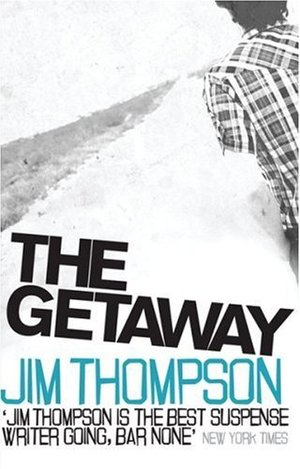
‘The Getaway’ – Jim Thompson: book review

getaway

I am enjoying the reading ride on my Jim Thompson-as-writer learning curve, and having just finished The Getaway I now better understand the praise he has received from critics – as well as fellow writers, for example Stephen King – and of the three novels I have read this is clearly the best.

Calling a book the ‘best’ is simply an expression of opinion, but it seems to be the most assured of the three I now know [those other two being, as previously reviewed, Savage Night and The Grifters]. Its most impressive feature is the plot with its clever twists and turns, these still surprising despite my having seen the film versions [both the Baldwin/Basinger remake and the more notable, original McQueen/MacGraw]. I mention for obvious reasons: with reading The Grifters, I found my memory of that film version produced a slightly negative impact, with the role of Roy played by John Cusack and retaining in my mind’s eye too much of that actor’s disarming charm and amiability in the context of the book’s more discomforting context; whereas with the original film The Getaway the variances in that and the book’s storytelling/events were enough to differentiate, thus keeping the reading largely fresh and immediate, though it was at times still impossible to disassociate film characterisation and memorable scenes completely from the book’s originals.

I will begin my comments on the writing by looking at the book’s end because this is the most unusual, perhaps disturbing – though the nastiness of the killing throughout is hard to trump in this respect – and it is certainly an aspect of the novel that generates much critical discussion. Without spoiling for new readers, the ending presents a scenario that surprises by its existence as much as it insinuates an otherworldliness. It is without question narratively at odds with what precedes this, even though Thompson has indulged similar in the other novel I have read Savage Night, accepting here the peculiarity is an extension of the first-person corrupted narrative. In The Getaway, there is an unsettling move at the end of the story to a resolution that will fully challenge readers’ varying expectations and desires.

In other ways the assuredness of the writing is evident in the actual lack of quips I have been highlighting in his other work. There is one, however, that stands out when we first meet Mrs Clinton [Fran, the veterinarian’s wife], and it reflects similar sexist descriptions/assertions Thompson has written elsewhere – a vestige of the gangster noir/pulp fiction in which all his books reside. I quote as a striking contrast to the other kind of writing that will follow as illustration:

He’d seen this babe before – her many counterparts, that is. He knew her kin, distant and near. All her mamas, sisters, aunts, cousins and what have you. And he knew the name was Lowdown with a capital L. He wasn’t at all surprised to find her in a setup like this. Not after encountering her as a warden’s sister-in-law, the assistant treasurer of a country bank, and a supervisor of paroles. This babe got around. She was the original square-plug-in-a-round-hole kid. But she never changed any. She had that good old Lowdown blood in her, and the right guy could bring it out.

As I build up my personal view of Thompson as writer – still only based on three texts – another aspect I will comment on here, but referenced before about The Grifters, is his cynicism, a little of that evident in the quote above. Whereas I have called it ‘redneck’ before, I do sense a wiser and more universal, psychological expression in the extract that follows, and it is more knowing about the human psyche than cynical about the human condition. Here is the passage about Doc’s wife Carol, and the complexity of its thinking, reflected in the complexity of its structuring, demonstrates that stark contrast when compared with the preceding quote:

Her mind moved around and around the subject, moving with a kind of fuzzy firmness. With no coherent thought process, she arrived at a conviction – a habit with the basically insecure; an insecurity whose seeds are invariably planted earlier, in under- or over protectiveness, in a distrust of parental authority which becomes all authority. It can later, with maturity – a flexible concept – be laughed away, dispelled by determined clear thinking. Or it can be encouraged by self-abusive resentment and brooding self-pity. It can grow ever greater until the original authority becomes intolerable, and a change becomes imperative. Not to a radical one in thinking; that would be too troublesome, too painful. The change is simply to authority in another guise which, in time, and under any great stress, must be distrusted and resented even more than the first.

This is I feel a compulsive authorial expression of knowing. It isn’t critical to the storyline at this moment. Far from it. That storyline, by the way, with its exploration of confinement, is one of the most gripping in the whole novel. There is no need to understand the human condition as reflected in this: the vivid description of that internment shows us all we need to know, though we might wish it hadn’t.

There are many more telling, understanding observations in this book as Doc and Carol in particular make their getaway journey [Rudy’s is more rudimentary; his behaviour as inexcusable but I think we care less] and one of the other memorable ones is when Thompson spends narrative time with the sharecroppers. The brutal world in which they live is one of many presented in the story, but theirs is in a number of ways made appealing.

Savage Night was written in 1953, The Getaway in 1958, and The Grifters in 1963. The ten years between the first and third wouldn’t seem to account for the narrative differences between those two, considering how The Getaway is, as I have stated at the start of this review, superior in style and effectiveness – though one could argue that the at times superficiality in Savage Night is the very essence of Carl Bigelow.

And now having arrived at this surer appreciation of Jim Thompson as writer – though still early days in overall reading of his output – I have returned to reading The Killer Inside Me. I said in a previous posting that I couldn’t get into this novel. I have now. Very much so.

getaway2

The Haggard President

This Sunday’s Observer – The New Review has a collection of commentaries on the Obama presidency by five authors who deliver a collective, uplifting read. Each is essentially positive about Barack Obama as president, but they are not by any means totally uncritical.

I want to entice with three brief quotes that provide a succinct narrative thread for the whole. Presuming you too would be a fan, or at least supporter of Obama’s time as President, they offer honest and knowing affirmations of what we all share as fond and respecting regard, but also a sense of what is bound to be lost when he is no longer in office. Especially if…

Above and beyond the sad reality of losing Obama as a memorable leader, the first quote sets the incredulous setting for this imminent change to the presidency when Jayne Anne Phillips observes how this election year has been a psychedelic nightmare. The next by Hari Kunzru, the more ‘critical’ in the context of generally positive observations, is a comic but also incisive comment on Obama and how out of his extensive rhetorical tool kit, the president pulls a weird folksy tone, a subliminal suggestion of Merl Haggard, designed, no doubt, to sooth the terror induced by his blackness. The final quote is from the last author writing in this feature, Attica Locke, and it resonates having read the others because she offers us the most hope about Obama and after he leaves the presidency with We’re just seeing the beginning of Obama’s power as a human being.

Nick Clegg on Michael Gove – Is he Joking?

He Thinks He Is

Extracts from Nick Clegg’s book Politics: Between the Extremes – No Mea Culpa [or something like that] are published in today’s Guardian, and these focus on then Education Secretary Michael Gove, as if Clegg’s self-righteous and self-excusing revelations that Mikey was a Machiavellian megalomaniac need telling since the very public Brexit-Boris stabbed-in-the-back treachery. How Clegg must have winced when this occurred and he knew his observations in the already completed book had instantaneously become redundant.

Of course, I have only read today’s extracts, and I can’t imagine I will want to read any more of the whole book. Part of that reason is for a couple of illustrative examples I will mention shortly, but the other is the expectation that this tome is in essence a self-indulgent self-justification for being an alleged radical coalition partner ultimately helping to support the Tory government [despite the claims otherwise] and by doing so to make their current and future existence secured. I do accept that Labour of late has helped considerably to also consolidate this likelihood.

What I found boorish in these few extracts were Clegg’s little humorous asides about Gove whilst essentially sticking his own knife in the man – though Mikey deserves whatever corrective stabs he receives. The first of these is when Clegg writes about the pair disagreeing over the future of A levels, and Nick observes of Gove: He didn’t agree – but he disagreed with amusing verve and flair, over a couple of bottles of wine. So Nick gets a little pissed and finds Michael attractive. It always seemed to me that an element of this kind of excusing caveat about Gove was consistently the significant problem: he was known to be a bastard, but he had such wit and charm and intelligence…. Yet now we all know with absolute certainty the Bastard was the primary personal characteristic.

The other attempt at comic deflection is an observation about Gove in Cabinet: Gove provided regular entertainment at cabinet meetings, with his florid, if unreasonable condemnations of the civil service. Well, yet again we all now know how much more than ‘unreasonable’ Mikey’s thoughts and feelings about others would manifest themselves. This is exactly the ruthless way in which Gove behaved when legislating for his education reforms without any regard whatsoever to opinions other than his myopic own.

No Nick, I don’t find any of this amusing. The nation’s students will always be held to account for changes Gove made to what they study, but as you are no longer in government, you would appear to feel absolved from any such responsibility.

Manchester Metropolitan University: PGCE Secondary English E – Subject Guide

mmu

I was surprised and pleased to see a book of mine suggested as useful reading in the ‘Section 6: Literature’ part of the current MMU PGCE English Subject Guide.

Referenced as ‘Ferguson, M (2000) Poems in your Pocket: Imaginative Approaches to GCSE Poetry, Longman’, I am proud of the poetry I was able to have used as stimulus and illustration for teaching. There is more than in most similar texts [at a huge cost to the publisher] and I believe a true eclectic mix, though this was also necessarily linked to familiar poems used in examination. The focus then was on approaches to teaching in preparation for students having to tackle a significant amount of poetry in their English Language and Literature GCSEs.

This genuinely isn’t intended as a sales pitch, but in many ways what I was presenting then is going to be very relevant to the commitments students have under the new curriculum to respond to poetry in examinations that are closed-book and entirely terminal, no clever pun intended.

I was most pleased with the Teacher’s Guide that accompanied the student book, not least the creative writing ideas, though I am only too aware that there will be even less time now in a GCSE course to feel able to spend any on this – if there ever was.

pop

Nebraska 15 – ‘Portrait of Viola’ by William Reichard

They lived without electricity.
Their water came from a hand pump
at the base of the windmill.
A Nebraska farm, 1935.
She said, you can’t miss what you
never had. Drugstore goldfish
in the water tank turned into
giant orange and white carp,
Koi prized in another country,
another class. Her father threw them
out into the prairie claiming
they’d poison the cattle.
Rattlesnakes, a way of life,
careful checking before eggs
were gathered from the darkness
of nesting boxes. Everywhere, heat.
Gone with the Wind
in 1939. She was fourteen.
During the war, she looked like
one of the Andrews Sisters.
First child at twenty, last at thirty-nine.
All survived save one, gone
at thirty. The death of her daughter
turned her hair white.
Eighty-four and she’s lived alone
for longer than she was married,
her husband a man with a wild imagination
but a weak mind. He was born
the year the Titanic sank.
That should have told me something.
Now, central air for the worst
of the heat. In her lifetime:
organ transplants, space flight,
television, artificial hearts.
On still nights she sleeps with
just a sheet, the window open wide,
summer’s heat hard and dry.

 
– from Two Men Rowing Madly Toward Infinity © Broadstone Books, 2016

I like this poem, as with so much of the best poetry, for its apparent simplicity. This is indeed a portrait, one that is swelled with detail prompted by its many specific references: the ‘Koi’ carp that signify insularity and stubbornness; ‘Andrews Sisters’ and their wholesome personas; births and death; the uncertainty of her husband – and throughout this, Viola as a still-point of endurance, carrying on and on like the expansive landscape that doesn’t change.