In the Desert

The desert is as it is when it sleeps, and dogs that yelp at any noise have its attention. And mine. The dog next door yelps. Tonight – I’ll say it in a few nice words – a man wants to sit in it all for pleasure. And people who have dogs that yelp at any noise need help.

I pissed tonight in a royal way from my house into my double peanut-butter-on-toast yard. What kind of noise does that make? Will the dog next door think that’s the kind of sound it makes?

In the morning I sit and have a cup of coffee and the dog yelps again. I later stand on my three steps and let the entire neighbourhood know how I felt last night. I let loose on the lady next door. I said a lot but I kept from saying those words that I wanted to say about her dog yelping.

I asked if she had heard any uncomfortable noises from my house that would make her feel it was necessary to call the Association. Any screaming from pleasure or pain?

All this retired old man wants is to sit outside in the morning with his coffee and toast and without noise. And in the evening with his 9 to 12 ounce cocktails and just listen to the desert go to sleep.

I don’t hate dogs. I hate people who don’t give a shit about others and their comfort in life.

The lady’s dog next door needs help. People who have cocktails and listen to the dog like it belongs in this desert need help. Tonight I’ll piss in a royal noise from my house. Without making a sound. I’ll toast the yard. I’ll yelp my cocktails for pleasure or for pain. I don’t care how uncomfortable it is for the neighbours.

And I’ll be an ass if it should all kick off again.

Christmas Ode IV

(after Arnold)

Had we but World enough, and Time
This joyless Blair were no crime.
We would sit down, and think slowly which way
To make his parliament more au fait.
He by the River Thames’ side
Should’st humility one distant day find: I by the Tide
Of Clyst would complain and complain. I would
Barrack him ten years before the Flood:
And he should if he please refuse
Till he walked again in Socialists’ shoes.
My vegetable garden should its metaphors grow
Vaster than Millennium domes but much more slow.
An hundred years should go to raise
My fists and on his forehead graze.
Two hundred pummels on his hairless chest:
But thirty thousand to the puny rest.
An age at least to every part
And the last age should reveal him as The Grand Old Fart.
For Blair, Sir, you deserve this from the State
Nor would it reward you yet at any higher rate.
But at my back I always hear
Times winged chariot flapping near:
And yonder all before us Schools will be
In Deserts of vast Insipidity.
Thy intellect shall no more be found;
Nor, in number 11 (despite the move), shall sound
My echoing of being wronged: then Worms will eat
That long preserv’d Tory policies’ Repeat:
And Blair’s faint Honour turn to dust
And into ashes all my disgust.
The grave’s a very final place
But not where we should bury Education in disgrace.
Now therefore, while his youthful hue
With a few strands of manicured hair still seems new,
And while the suppressed Socialist nearly transpires
At every mention of the poor with aroused Fires,
Now let us do good while we may:
And now, like we mean what we say
Rather at once the Time devour
And begin to use what the people gave him: Power.
Let us roll all our Principles, and all
Our Convictions, up into one Ball:
And tear up Tory Blueness with rough strife
Through the School Gates of Life.
Thus, though we cannot make our Sun
Stand still, yet we will once again make Learning fun.

– 1997 –

This is the first of my six blasts from the past ‘education’ Christmas poems. For those who don’t recall the context: whilst Blair’s Labour government provided significant, real and purposeful financial investment in education, there was never any insightful curriculum development. Nor was there an alternative provided to the previous Conservative government dictates: indeed, on Labour’s first day in office in 1997, it re-appointed Chris Woodhead as the Ofsted chief – a withering, arrogant man – and it continued with and made even worse the target culture and the testing regime that had already begun to cause such damage and diminishing.

Post-Trump Poems at Stride

In reviewing a recent reading by the American poet David Baker here, I referred to his comments then on the seeming inability to account for Trump’s election in America, both as being unable to explain its shocking reality in everyday conversation or the formality of a reading, but also, by extrapolation, as a writer who will need to deal with/assimilate/reflect on this in poetry.

I picked up on that ‘anxiety’ [not wishing to overstate], but certainly haven’t felt entirely able to write a wholly successful post-Trump poem. I have written two responses, one that is posted on this site here, and the other here at Stride. This latter one does pick up on Baker’s comments, having been prompted by them: the reference to birds is because he had written about them so much in the poetry he read aloud, and also the reference to syllabics because he referred to this in talking about his stylistic approaches to writing.

There are at least two excellent post-Trump poems at the online magazine Stride that I would have liked getting nearer to writing myself. The first is Tim Cummings’ Moon Weight here, and it is wonderfully oblique, humorous but also lyrical in accounting for this, though the following coalesces such various tangents more directly,

Here’s a man whose eyes are full of property.
The sense of loss at his arrival is like a flood of moonlight
on a patch of serious poetry.

The other is by Martin Stannard, Mrs Baxter Bakes a Pie, posted here yesterday, and as the title suggests, it is a typically satirical Stannard exposé, the opening Dickensian miscue the intentional start to its witty if despairing judgement,

It was the worst of times preceded by the worst of times
Although we should have known that looking back
Nobody would agree which was which.

All Mrs Baxter can do when considering the ramifications of Trump’s election is to bake more pies, perhaps an example of Beckett’s habit is a great deadener, but I suspect Stannard sees it as just baking, a simpler explanation for evasion and coping. You’ll need to read the whole to decide for yourself.

More Christmas Poems

Last year around this time I wrote briefly about and posted four examples of Christmas poems I had written over the years for teaching colleagues at this festive time, though their content would stretch the notion of December’s festivities as a celebration! Those selected poems can be found here.

I began writing these in 1993 to include in my Christmas gift Stocking Fillers for staff at my school. Added with other poetry and, later, prose pieces, I would always write a ‘political’ poem as a pastiche of a famous writer’s work and this would focus on education issues of that year. Always irreverent and I hoped amusing, they were nonetheless quite dark as they necessarily reflected on struggles in the job caused invariably by the government and its Education Secretary of the time, often named in the poem, though not always. The fact these began in 1993, thirteen years into my English teaching career, and were usually complaining and often miserable [!], it is both sad in the way they do convey disenchantment as a teacher and also the way this tallies with the time – midway through my 30 years of teaching English – when the hitherto relative bliss of professional independence and creative energy became challenged and changed by government interference and its withering initiatives.

That is a seemingly inauspicious prompt to continued reading, but I hope the further selection of poems I will post over the coming days before Christmas does continue to have value for whatever engagement the pastiche of each provides, as well as empathy as an account of a teacher fighting to cope then who thinks of those continuing to do so now.

ode2

Tree Feller

With a billhook and a pruning saw
I took down the tree, an ash not
fully grown, obviously, but enough
to be sweaty work on a frosty day.
The hook is over forty years old in
my possession, and I am sixty two
trying to be the young man I was back
then, but the racing heart and rests in
the patio chair put that ambition to
shame. I have a chain saw but it is still
boxed after many years, too afraid to try
and swing the same as I did when
wooding on the farm. This morning was
not as reckless as the last time I tackled
the tree, falling down the ladder and
holding on to rip muscles in my arm,
soothed with pain-killers for some
time afterwards until another ache
refrained. Today was well prepared
with rope and props and calculations
for the cut, stopping to survey instead
of running ahead, and in the end it fell
exactly where I had planned and not
reduced the rhododendron to mush
or swiped me across the back, dead.
I’ll have to keep an eye on the stump
as ash grows back quickly, long young
shoots I might allow to try and then
sever to weave in another rustic fence.
It is a cycle, and I survive, so far, like
not tumbling from the high hedges too,
all this existential gardening with a look
to being more careful with a swung hook,
but a trimmer cord is cut to its death
by circuit breakers that save and protect
me, still life in this older feller yet.

outside

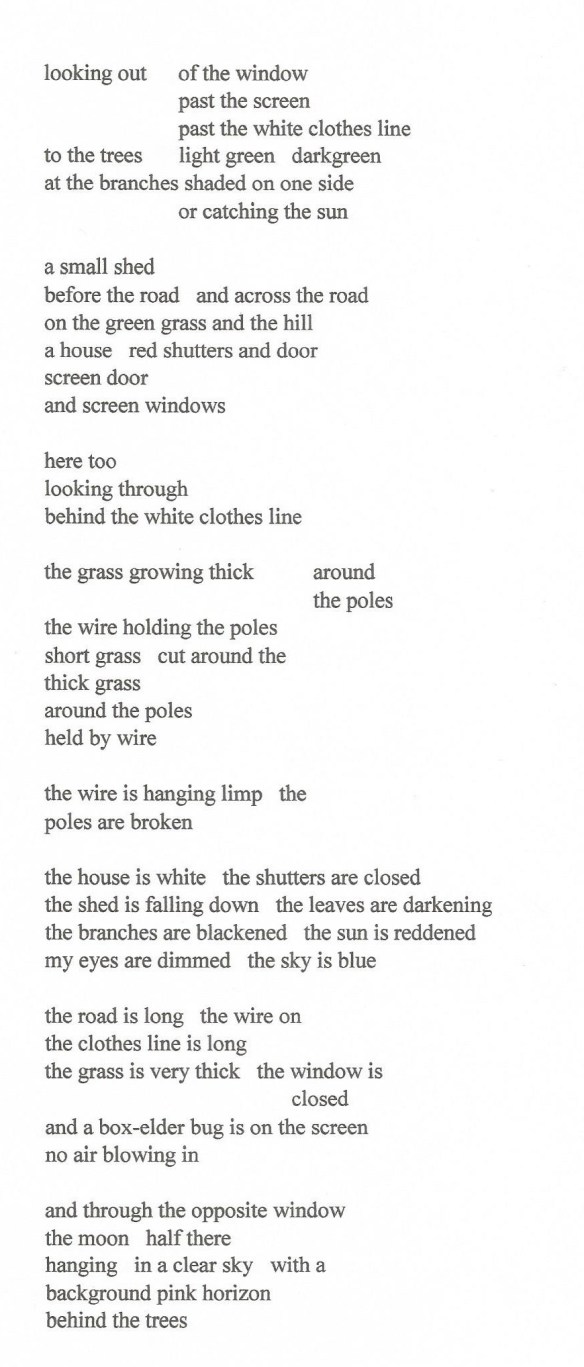
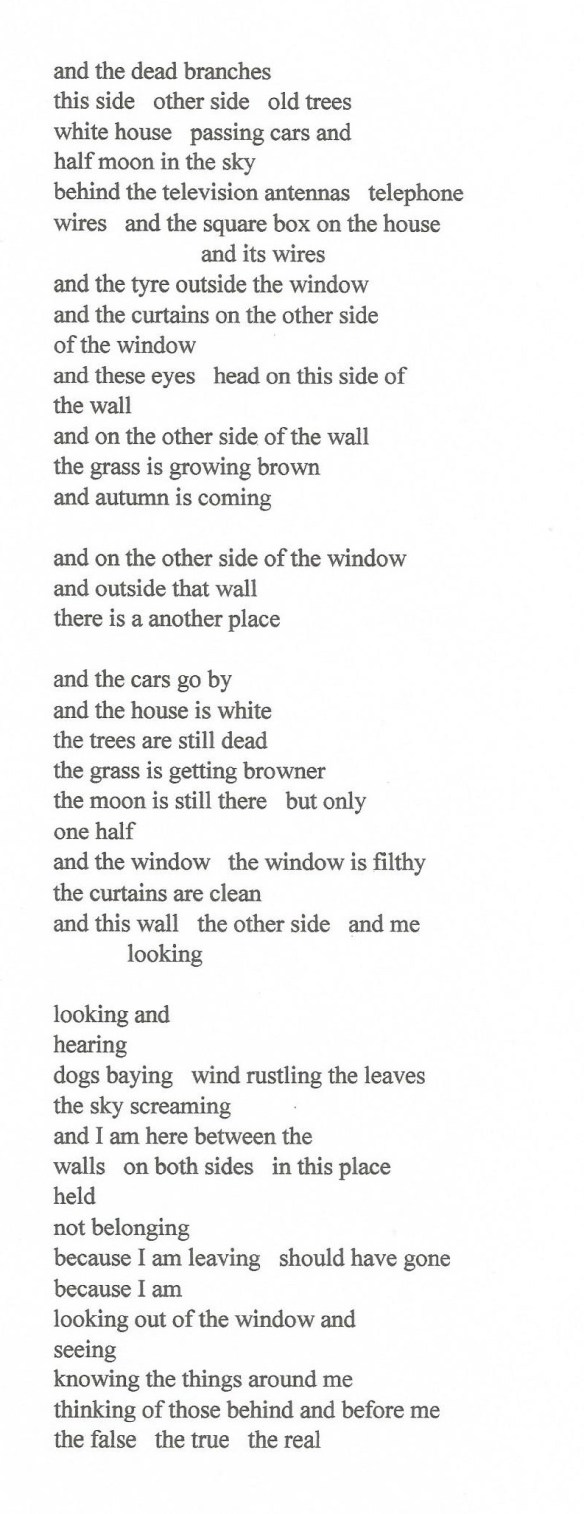
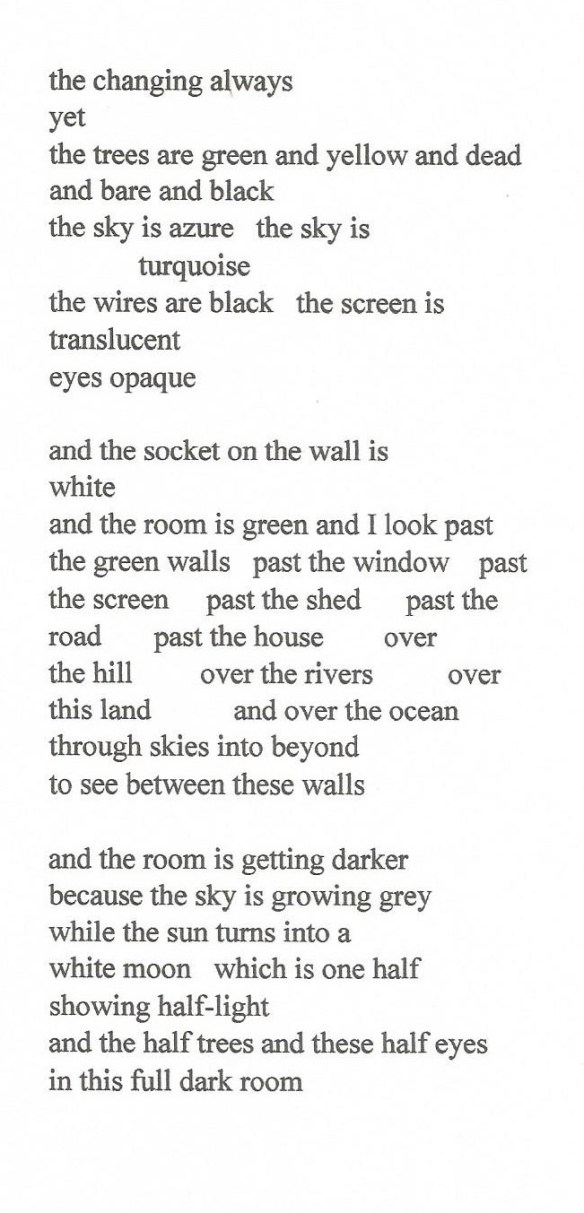
I wrote the following poem 46 years ago in September, 1970. I have never presented it before, but do so now having re-visited yesterday and tidied up a little [no more, really, then correcting some errors]. It is personally interesting for a number of reasons: it is a poem I recited/composed into a cassette tape recorder and later transcribed; it is during a brief period of living in Oakland, Iowa, as I was waiting to return to the UK to study, not realising then I would stay in England for the rest of my life; I remember precisely the time as it is just a few days after Jimi Hendrix died; my experience of dislocation and anxiety is the result of previously living, very briefly, in a small town in Michigan where I encountered such direct redneck hatred for me – because I had the beginnings of long hair [!] – that I decided to definitely leave the USA; it reminds me in a palpable way, though the poem does not address that Michigan experience, of the same redneck stupidity and hatred I have experienced more recently and which was and is so evident in this post-Trump election period, and finally because it captures a simple style of writing I have tried ever since to acquire and maintain, though this long paragraph would suggest otherwise,

outside1

outside2

outside3