Nebraska 25: ‘Walking at Noon Near the Burlington Depot in Lincoln, Nebraska’ by Ted Kooser

On the rat-gray dock
of the candy factory,
workers in caps and aprons
as white as divinity
sit on their heels and smoke
in the warm spring sunlight
thick with butterscotch.

In the next block down,
outside a warehouse,
its big doors rolled and bolted
over the dusty hush
of pyramids of cartons,
two pickets in lettered vests
call back and forth, their voices
a clatter of echoes.

A girl sits in her car,
an old tan Oldsmobile
broken down over its tires,
and plays the radio.

On the grill of a semi
smelling of heat and distance,
one tattered butterfly.

And an empty grocery cart
from Safeway, miles from here,
leans into its reflection
in a blackened window, a little
piano recital of chrome
for someone to whom all things
were full of sadness.


Wonderful, unconnected snapshots of five observations about an ordinary town on an ordinary day, made special by their poetic honesty and simplicity, but also that closing stanza where the line ‘a little/piano recital of chrome’ suddenly shines, and just before the sudden melancholia is referenced.
Ofsted Blessing

One further item from Schools Week yesterday reporting on the ResearchEd conference attended by Gibb and Spielman, where the latter is stated to have indicated that schools’ book scrutiny will soon be conducted off-site with scanned examples sent to remote Inspectors, if you’ll excuse the pun, not that The Spiel noticed when it slapped her in the face. She is quoted as saying,

“There’s rather good scanning quality now, so the views of other inspectors, remote from the live inspection, could be drawn in to test out the judgments of inspectors on site,”

For someone who seems to want to play-down the reality of the tensions in being tested, it is a contradictory selling point to laud this as a means also of inspecting the Inspectors.

Ofsted Blessing

Your books are being scanned from afar
by the Ofted shine-a-light inspection star.

This is the New Age check on your marking,
and while it might seem like a scary barking

up Big Brother’s watching, withering tree,
think of it as a techno-blessing of scrutiny.

The Glib, The Spiel and ResearchEd

Schools Minister Nick Gibb and Ofsted Chief Amanda Spielman speaking at this weekend’s ResearchEd conference: here’s a duo of enlightened [wait for it] speakers to set the sprinkler system into overdrive in a room with even the remotest spark of interest in what either might have to say about education.

My main wonder is if The Glib had waited around for The Spiel to deliver the line about her ‘tear my hair out’ angst when schools still refer to grading a single lesson – The Glib, if indeed there, blushing bright red from the bald top of his ignorant head.

Earlier, The Glib had complained about teachers in their ‘ivory towers’ not coming to/taking an interest in a conference run by the organisation set up by the [former?] DfE fake-guru Tom Bennett – he of the banning films and banning making posters and banning anything he just happened to dislike in classrooms because he was in a position to say daft things as if they made eminent sense even when they didn’t.

‘Ivory towers’? Oh the irony knelling from the ding-donging of Gibb’s polished turd of great height.

I can only react to reports of these stupid things said by stupid people [today’s Schools Week and TES], but without having any sense that I need to be any more considering than this, I genuinely detest the drivel of these kinds of pontifications.

The Spiel has been here before: saying things that sound sensible when they are loaded with the most grotesque irony because it attacks schools and their teachers and leaders who have suffered the nonsenses of years and years of various government and Ofsted dictates about the very things she now rejects – with good sad reasons for them to tear out more than their hair at the diminishing and destruction of this – and so saying such offensively ironic things now is truly, truly dreadful.

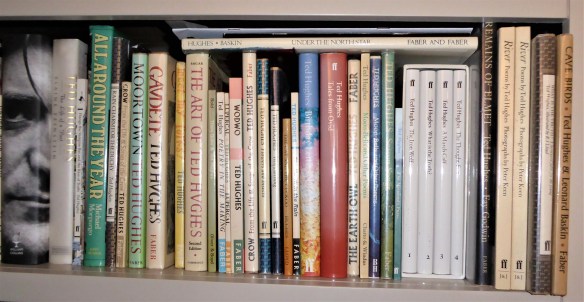
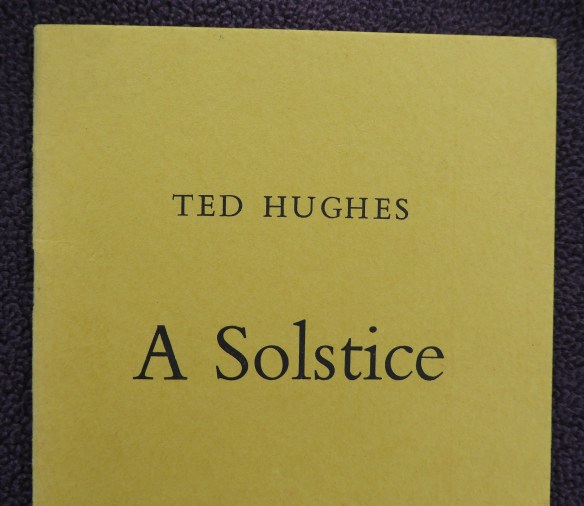
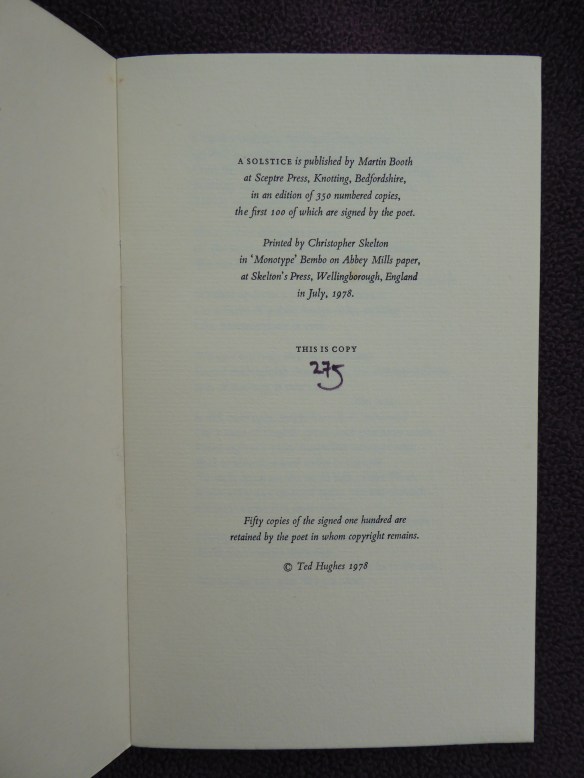
Ted Hughes – A Solstice: The Sceptre Press, 1978

P1010499

My copy isn’t signed, but it is numbered,

P1010500

Where The Thought-Fox is such a memorable metaphor for the creative spirit and act of writing, this poem about the killing of a fox is brutally extravagant in its description. I don’t believe there is any irony in that description and in the beauty of the fox as portrayed, even after its death,

Then bundle him and his velvet legs
His bag of useless jewels

The poem is classically Hughes: the excess of compound words shooting out its salvo of detail,

P1010501

and the absolute poetic capture of the sound of a jay,

P1010502


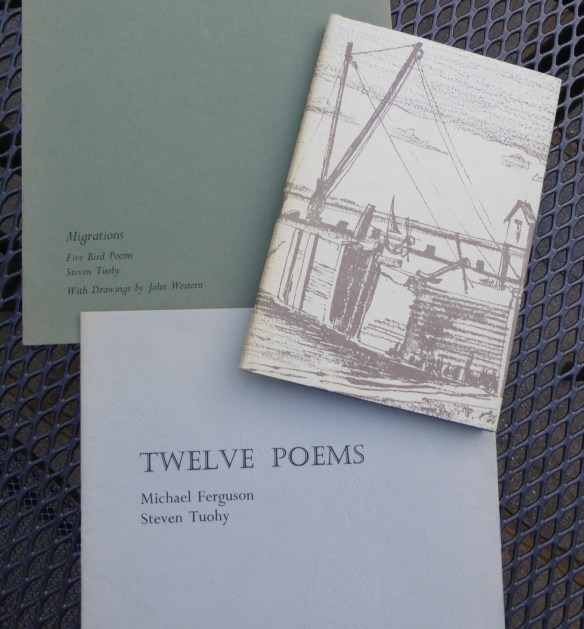
Steven Tuohy, John Western and Me

P1010492 - Copy

In browsing and revisiting my poetry books, especially from the past, I have dusted off these entirely personal works and recall fondly those early days of my poetic beginnings.

I came across the work of Steven Tuohy whilst we were both at college. A local writer, his work with Suffolk artist John Western was concerned almost exclusively with water and birds: Steven writing that muscular, descriptive poetry of Hughes [and a little of Gunn] so popular and influential at the time; John with his pencil drawings of the Suffolk landscape as well as the birds. Their two books that I have are Migrations, self-produced 1972, and Estuary, Oxford Polytechnic, 1977.

P1010493

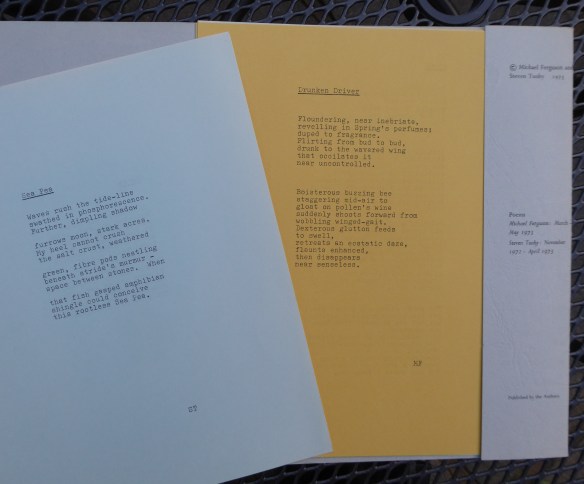
I was a novice, and Twelve Poems is both my first ‘published’ work and an example of a naïve style: trying to ape some of Steven’s crisp captures of the natural world while at the same time transmitting, oddly, an archaic style – a love of the Romantics and a fair degree of 1970’s poetic romanticism where I couldn’t even spell ‘oscillate’ correctly, but the meaning was all that mattered…

P1010496

Steven and I self-published, and though I have not been in contact since then nor able to find any more recent information online [John Western drowned in the River Deben in 2003], I am grateful for the support he gave me at the time, not least allowing his mature work to appear with my fledgling attempts. As Chairman of our college Literary Society I remember we used our funds to pay for the cover, and printed from a Gestetner [or similar] for the inserts – I was also involved in producing the college magazine – and I recognise the typeface from my typewriter of the time where a bit of nous and Typex on the stencil could have sorted that spelling error. Money for the sale of the pamphlet went to a charity.

Fox News List Sonnet

I knew Fox News was being removed from showing in the UK, but I hadn’t realised it is already gone. Obviously good, though I did dip in now and again to see what the rednecks were thinking and saying. However, at the risk this could have ever persuaded someone vulnerable, it is best disappeared from here at least. With today’s news about National Action, this load of noxious gas doesn’t need any further fueling.

It does give me the opportunity to reprise my poem about Fox News, first published at International Times in April, 2015. Eschewing the Shakespearean or Petrarchan models, I went instead for the more apt Scatological:

Fox News List Sonnet [*]

Fox News: shit that sticks to the bottom of shoes
Fox News: facts and figures to ignore and abuse
Fox News: slobber at the end of an afternoon snooze
Fox News: sensationalist suggestion that simmers and stews
Fox News Deadline: better on time than the truth you lose
Fox News: aberrant cell from the primordial ooze
Fox News: detection that ignores all of the clues
Fox News: bits and pieces a piss-artist spews
Fox News: polka appropriation of genuine blues
Fox News Headline: Terrorists Not Iceberg Sink Titanic Cruise
Fox News: candourless in cunning this Canidae eschews
Fox News: determined only in the lies they choose
Fox News: whose existence corrupts poetry’s muse
Fox News: so shit lining bowls of unflushable loos

[*] News Flash: Karl Rove adamant he has irrevocable proof that sonnet is 13-line poem that never rhymes;
[*] writer cites penultimate line as ultimate disclaimer

Stanley Cook – Teaching Poems

P1010470

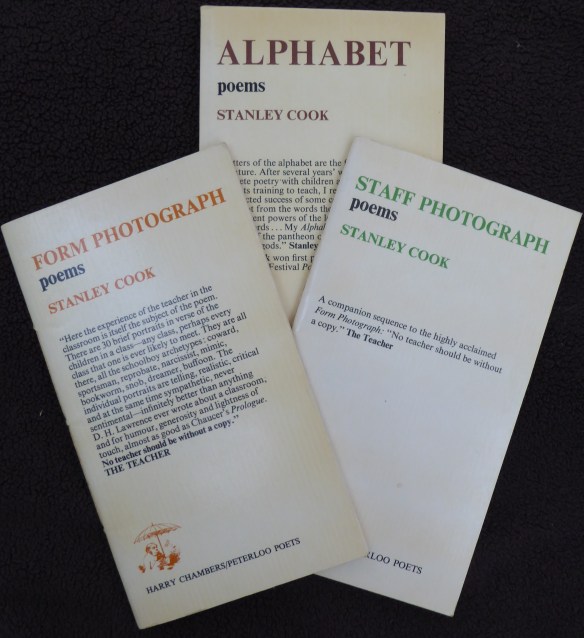
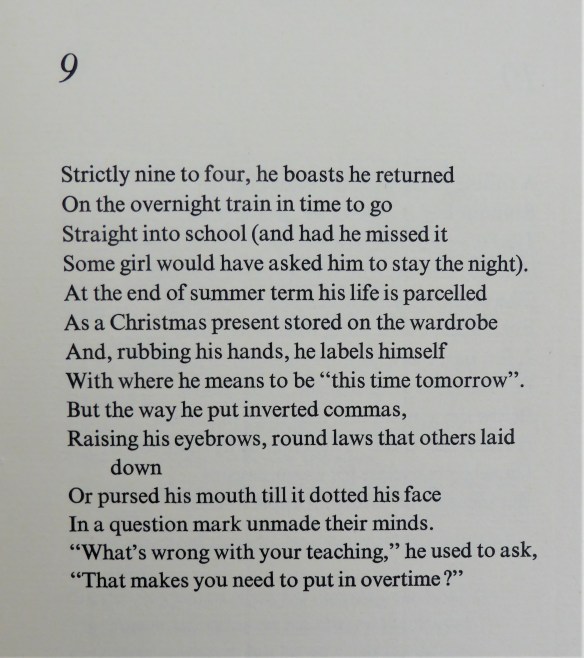
Form Photograph was first published in 1971, but reprinted in 1976 when both Staff Photograph and Alphabet Poems were published. I used examples from Alphabet Poems on some of my teaching practices in the late 70s, so probably 1977-78, prompts for student writing and this is where it all began. I also presented poems from Peter Redgrove’s From Every Chink of the Ark, 1977, where he too employed the alphabet as stimulus for his own writing [and I think I was quite adventurous using all of this: the energy and enthusiasm of the newbie!].

Cook’s staff and student poems reflect their time and are honest and direct to reflect realities one might avoid addressing so confessionally today. That’s probably as it should be, but I admire the openness of its era.

I’ll post one poem about a teacher, real or composite. As my former teaching colleagues return this week to work after their well-earned summer holidays, this one struck a chord even if it is about the end of summer term rather than a return after the break [and re. ‘had he missed it’, I recall a colleague and friend who claimed a few years ago he ‘missed’ the ferry and thus the first training day* at the beginning of the autumn term]. There is a little criticism in the stereotype presented, but the last two lines make some sense when I think of the huge extra commitment teachers have always made but especially so over recent years.

Today it is raining and I’m sure if I was returning to the job I would want it to continue. I always hated the first day back when the sun would suddenly decide to rage down, especially if I had just returned from a holiday saturated by a typical English summer. *Training Days: what a monumental waste of time when all you wanted to do was get ready for the immediate days to come: meet with the team, get the classroom sorted and the resources organised. All those presentations of ‘we have done well, but…..’, that dreadful and diminishing caveat, and the invited guests to demonstrate how they couldn’t do the job themselves and now instruct as invited guests.

P1010471

This is an wonderfully assertive appraisal of the life and work of Stanley Cook here.

Water and Waste by Peter Reading, Outposts Publications

As I started browsing [see previous post]…

P1010465

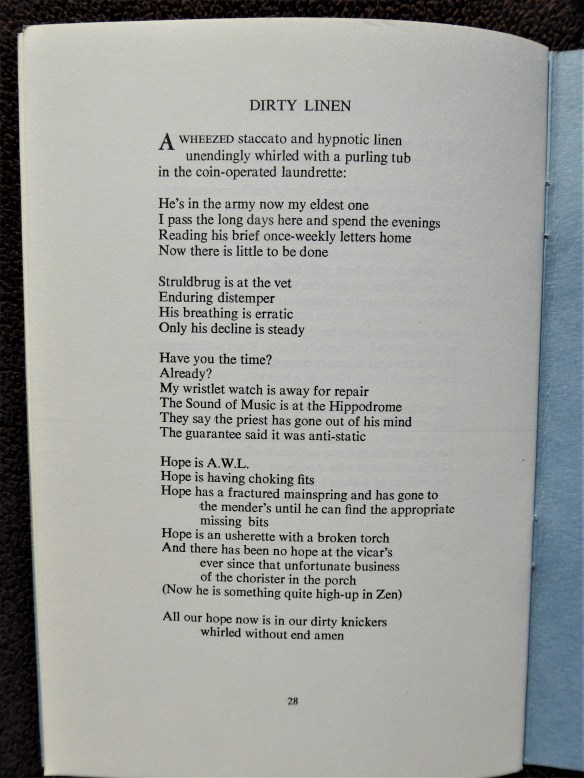
This is the wonderful Peter Reading’s first collection of poems, published in 1970 when he was 24 years old. Outposts Publications was run by Howard Sergent, himself a wonderful man and supporter of poets: as I have written here, he was always kind and supportive of me as a young writer, though he never published my poetry and instead took one of my reviews. I thought this statement from Sergeant neatly exemplifies his sense of engagement with contemporary writers, and it is impressive to look at previous Outposts magazines to see its many now famous and respected poets,

P1010467

The poems in this collection from Reading demonstrate much of what his work would mature into – the playfulness with but also knowing use of complex language, the knowing references too – though overall they have a formality of form which of course he would employ later on for precise purposes but which here reflect some adherence to expectations. Just a little. The poem Dirty Linen is the last from this booklet, and it does present Reading’s trademark telling wit,

P1010466

reading - Copy