
[image by artist and photographer Nick Dormand]
[image by artist and photographer Nick Dormand]
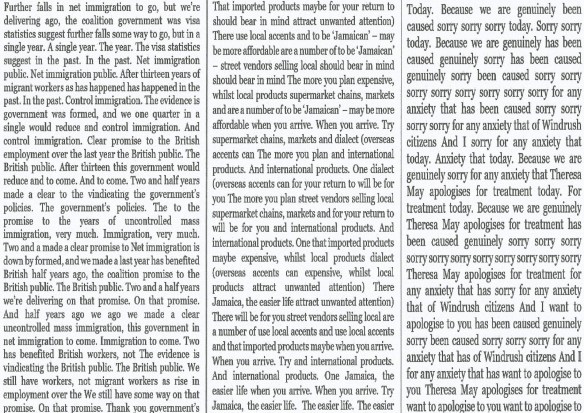
Clicking on the link beneath will open up a pdf of this poem for a larger and easier read:

Being ironic…
There is genuine yin yang in the incident of Southwest Airlines flight 1380 in the sad and tragic loss of a life and the actual calm heroism of the pilot that prevented further loss.
A dream of
karaoke academies
with tongue lashings
of culture coding –
fried rote learning in
chicken-shop songs.
In shaved lines of
panoptic surveillance
verbal canes
whip their singing
but accept an ethnic
fringe: barbering
this barbarousness.
Staff screaming in a
takeaway after school
is in its glass frontage.
Outside the democratic
this is enforcement
is military investigation
is constantly monitored
is suffused to intervene
is chicken representing
poor choice.
Almost uniforms
are mythical qualities
of poor choice,
suede knowledge
not rote fried.
This is the dream of
chicken shop singing
crossing its road
just for this melody.
Source: ‘Little Robots’: behind the scenes at an academy school, University of Cambridge, here.
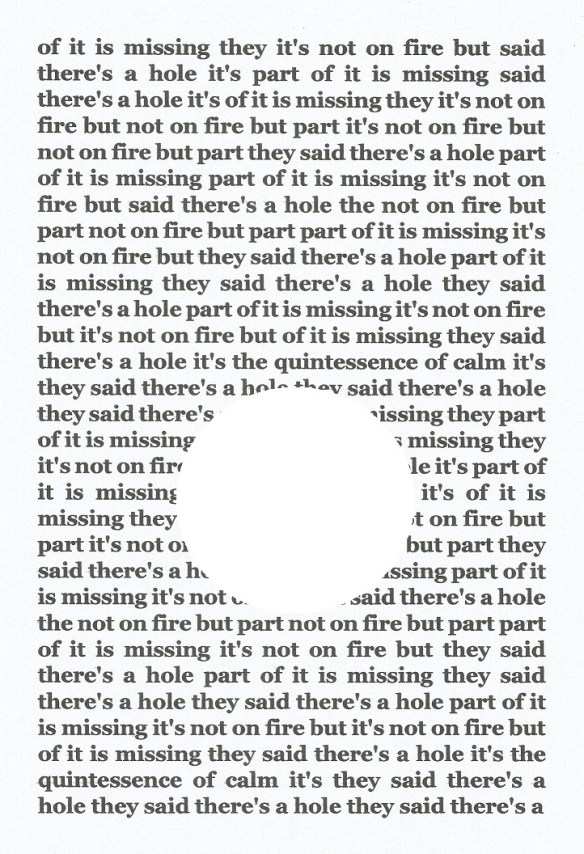
Very pleased to have my poem ‘Redacted’ on the Angry Old Man site today here.
Thanks to Drew, and I’ll say again how much I appreciate having work from my two found poetry novel sequences getting out there, this from American Finds.
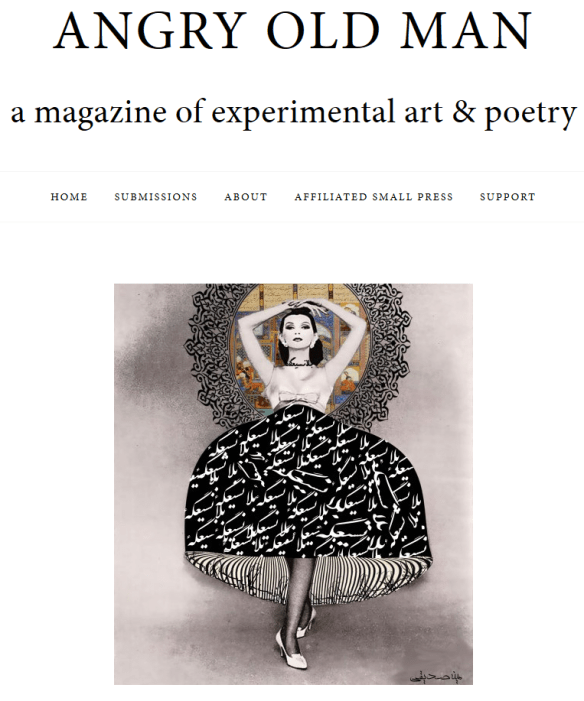
The illustration above for #3 Angry Old Man Magazine is by Meena Sediqi, and you can read an explanation about its origins from her here.

A couple of things before referring to and writing briefly about the articles to follow:
I am not opposed to testing/examining as a blanket view – I have been a Senior GCSE English Literature examiner for over 30 years [I think that’s a biggie in dispelling myths on this line], but I am totally opposed to testing/examinations where the content and method of assessment are inherently flawed. I therefore have to stress that my main and continuing opposition within national testing regimes is to English SATs, now at Key Stages 1 and 2 – I have significant experience of English Key Stage 3 testing where content and mark schemes were, when taken together, simply punitive; and I have closely followed the, previously, English SPaG and now GPS testing papers, and these are as punitive in overall impact as well as meaningless in terms of teaching and learning as the KS3 nonsense when it existed.
The second rather obvious point is I have chosen the following articles to support my views, though one is an alternative perspective but it highlights my concerns all the same. If you want to read articles in support of testing and similar, check out Minister of State Nick Gibb’s twitter postings where he references loads of complete drivel in support of his ideologue’s fervour where a complete lack of actual educational [teaching and learning] experience is no barrier to holding a position of influence in Education.
The first is today’s Guardian article urging parents to boycott again this year’s SATs. I simply support this because I think parents need to be more proactive in expressing – here through protest – that they have informed and knowing opinions on the pointlessness of and damages caused by SATs. I have written elsewhere on this blog my view of these ‘damages’ and how not to overstate, so I won’t repeat this here.
One quick ‘other’ support of my view about boycotting SATs is that we as individuals need to be more critical of and proactive against those decisions made on our behalf by governments where their purposes are blatantly beyond stated intentions.
The second is in yesterday’s Schools Week and it is from a Head urging parents not to boycott SATs. Referenced partly as potential balance, I of course disagree and think the needs expressed about requiring assessment on pupil progress are patently true but better served by teacher assessment – after all, they/we are the experts. Any scrutiny of English SATs papers and mark schemes will demonstrate their significant remove from meaningful expertise.
The third is a genuinely disturbing analysis and observation reported by University of Cambridge research here. I think the review of and response to ethos and practice in a school which, among many suspect approaches, sees ‘exam’ success as such a high priority links into my questioning of the value of examining – though I admit this is at secondary level and thus GCSE which is less my adamant concern [though the secondary testing and target culture is a part of the larger despairing national picture].
Those recent reports – much on Twitter – of schools now following ‘four year’ GCSE courses in order to hit targets is another layer of incredulity.
a little girl
takes her hammer
to the gate then
hits it again and
again and again and
again as I pass by
and away hearing
that hammering in
such a deliberate act
the intention clear
as I saw her walking
straight towards it just
a toy in a tiny hand
but it could have been
so much more with
that look she got from
somewhere and/or
someone else before
[Originally posted December 2011]
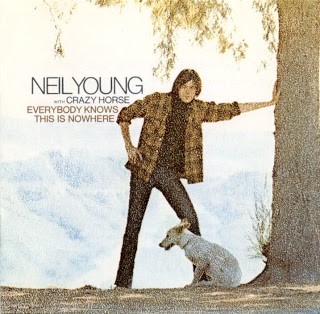
I have neglected my Top Fifty for a while and therefore am returning now with a gem and the jeweller. I have selected another ‘obvious’ choice in as much as who wouldn’t/couldn’t have this in their favourites at some reasonably high ranking?
This album was my initial introduction to Neil, and I didn’t in fact hear his eponymously titled first album until much, much later. I also discovered this big bang release whilst staying with a friend in his Putney flatlet in London – a small home behind the toys, sweets, cigs and newspaper shop he ran at the time [his parents’, but him in charge, precariously]. I discovered loads of music in that place, along with much else, and when I look back it was an amazing, impressionable and exciting time – I was 16 years old and entering an occasional world where everyone else was in their early twenties and much more experienced than me. What a journey.
The album was designed to appeal to someone like me, and so many others. It opens with Cinnamon Girl and those simple power chords and bass setting the pace, then the beautiful harmonies co-producing that perfect symmetry of heavy rock with folk vocals [noting Stephen Stills’ apparent long-standing and bitter criticism of Young’s involvement in CSN&Y because he wanted to play folk music in a rock band]. Next track Everybody Knows This Is Nowhere introduces the Country element a la Gram Parsons and The Byrds, an inclination to twang that resonated in my American bones.
Favourite has to be third track Round and Round [It Won’t Be Long] – everything about the roundness of its title, lyric and slow loop of a song structure hypnotising as you listen. Then there is the beautiful poetic tone of the lyrics
Round and round and round we spin,
To weave a wall to hem us in,
It won’t be long, it won’t be long
How slow and slow and slow it goes,
To mend the tear that always shows.
It won’t be long, it won’t be long.
and the assonantal words lull and calm and comfort the teenage heart!
Side one closer Down By The River oozes its cool, the bass-line and funky chord core laying down a smooth strut and stroll for Young’s signature fuzzed-out guitar to dance and shriek upon throughout; and then again the gorgeous harmonies. All praise to band Crazy Horse for its central contribution.
Side two opens with the other countrified number The Losing End [When You’re On] and I wonder if this alienated any listeners? Never this one. Sixth track Running Dry [Requiem For The Rockets] is a wonderful folk lament with its melodramatic violin strain [Bobby Notkoff from The Rockets and Electric Flag] and the echoed guitar.
The album ends on another Young classic Cowgirl In The Sand, all sublime vocals and guitar jam igniting the rockharmony universe with its emerging and decades’ forming planetary system of memorable albums and the still-rockin’ great, great artist that is Neil Young.

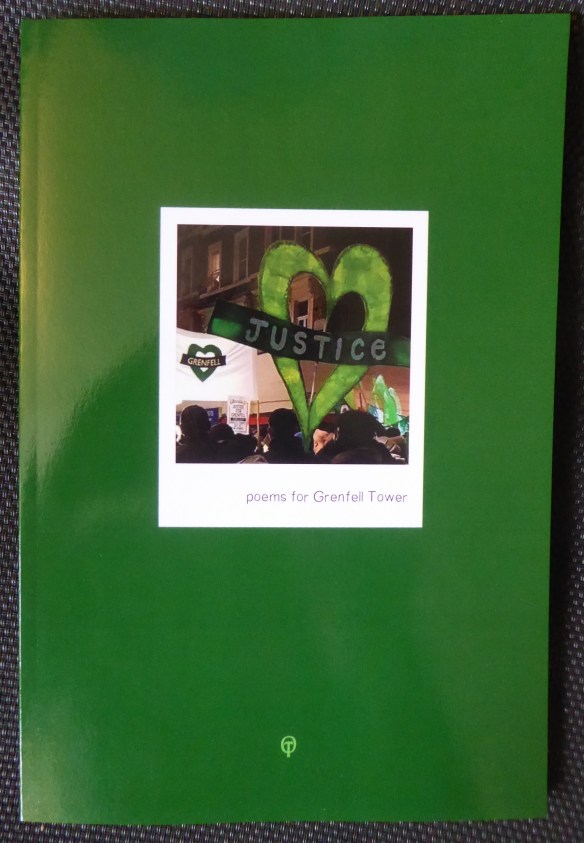
This is, as one would expect, a moving and meaningful anthology of poems about the Grenfell Tower tragedy.
Every time I write a following line to that opening statement, I am struck by the platitude of what I attempt to add as well as the need otherwise to explain in depths far better explored in the poems themselves. So to the collection, as a general observation.
It is an anthology with a blurb of recommending/observing voices on the back cover by variously a receptionist, a student, an entrepreneur, a hairdresser and a lighting designer. It is an everyperson of engagement and empathy.
There is a Foreword by David Lammy, MP, that begins with the assertion Grenfell Tower exposed a tale of two cities: one that has a voice, and one that does not. There is a ‘Thanks’ by ‘The editor’ who claims feelingly It was a sad privilege to create this book. I respect the humility of that anonymity, but our thanks go to Rip Bulkeley [his work on this is well documented elsewhere] for being catalyst and host to those giving their voices, and needing to, along with others mentioned in that ‘Thanks’, not least The Onslaught Press.
The poems range across the obvious and full spectrum of emotional response, from the pathos of opening poem Souad’s Moon by Pat Winslow to the anger of the second High-Rise by Ali McClimens to the horror of later The Voices of Grenfell Tower by Alemu Tebeje, translated by Chris Beckett.
It seems odd in this context to comment on the quality/effect of the poetry – that crafting – but it would be remiss to not acknowledge the strength and weight of these poetic responses: these fine poems wrought from emotional/intellectual/personal involvement and the art of conveying this.
Therefore, there is subtle and haunting rhyming, for example, in George Szirtes’ The Burning of the House, and the direct honesty of rhyme by Ricky Nuttall [Red Watch, Battersea Fire Station] in the poem The Firefighter. There is the power of listing in Bring it Home by Janine Booth. Obviously, there is so much more in use of form and language and its contrasting and ironies and palpable realities – the range and impact of this poetic community capturing poignantly the Grenfell one.
And again, I have paused to reflect on and remove any further explanation of what I am trying to say about the ‘poetry’ of this collection.
What strikes me throughout the reading of these poems is the inherent ‘truth’ of their thoughts and feelings and expression of this. It is a force of both honest and poetic reflection that is crystallised in the questioning of the closing poem The Heroes on the Stair by André Rostant.
poems for Grenfell Tower can be purchased here.
 gravyfromthegazebo