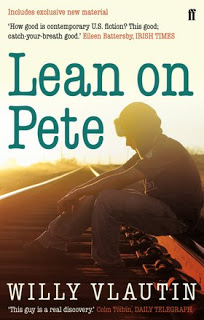
I’ve just read Mark Kermode’s positive, enthusing review of the film version of Lean on Pete in today’s Observer here, and it sounds like an empathetic presentation of the excellent third novel from Willy Vlautin. I look forward to seeing the film for myself, I hope soon.
I am therefore re-posting my review of the book originally written in 2011, and first placed on this blog in 2016:
Third Triumph
This third novel consolidates Vlautin’s skill and significance as a contemporary writer and it also continues the stylistic American tradition of simple storytelling in terms of naturalistic dialogue and straightforward expression. The honest and believable first person narrative of 15 year old Charley Thompson provides the perfect vehicle for such simplicity, but of course whatever the techniques and personas and situations used, the depth of feeling and meaning is conveyed with an immediacy and emotive impact that is compelling.
Charley’s story is similar in many respects to the themes and contexts of Vlautin’s previous two novels: journey as escape and self-discovery; damaged lives; hardship [against the self, both physical and mental, but especially loss and death], and the kindnesses, indifferences and nastiness of humanity.
It isn’t a significant difference, but I don’t feel this story is either as bleak or as hopeful – Vlautin’s potent novelistic paradox – as its predecessors. That isn’t to say it is neutral. Charley’s hardships are many and continue to come at him, but apart from two specific moments of violence he copes well [for his age] and we as readers are not made to dwell on these as Charley continues to move forward and beyond these quickly – though not in the physical reality of his trek across significant distances. Nor is it as thematically hopeful in as much as although Charley encounters many examples of kindness and support I don’t feel the book ends with such a certain affirmation of this – though the reader is allowed to decide/imagine for themself.
The novel is rich in its ensemble of characters with more variety and range than in the previous two books. Charley is, as I’ve said, totally believable and he is also hugely likable in his vulnerability, work ethic, survival instinct and youthful exuberance.
Horses and horseracing are an interesting contextual reality for much of the story and Vlautin has clearly used his interest in and knowledge of this to provide yet more credible and engaging settings for the book. There is also a brilliant pattern of experiences – many shown quickly or even just recalled by Charley in reminiscences with others – which seem to tumble out of Vlautin’s own actual experiences. That or it is just more from his rich and vivid imagination. It’s a wonderfully ‘easy’ read and in many ways for me as rewarding from that simple experience as much as the heartfelt tale.
NB: Last year I included an extract from this excellent novel to illustrate and teach the power of dialogue in my GCSE text Writing Workshops, see here, and subsequently had the great pleasure of interviewing Willy Vlautin and talking about this book, see here.
More of my reviews of Vlautin’s work here.



 gravyfromthegazebo