


…though a different one

That is, a different poster, not original, but a copy. My writing day profile with original [in two ways] poster is here, and you can read many other accounts of personal processes on this dedicated-to-writing-accounts site hosted by Rob McLennan.
That black and white poster is back hanging in the hall with others.

Playing around with text from W H Mallock’s The Human Document, the original source of Tom Phillips’ A Humument
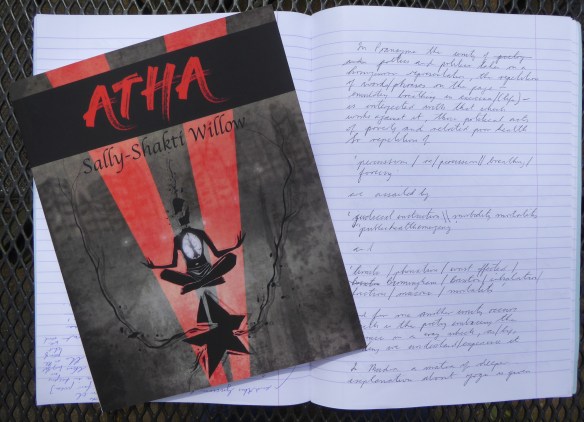
I have not in reading, and am not in writing about that reading, ignoring the poetics of this collection, that which explicitly makes up Part 1 of Atha but also necessarily/fundamentally informs all.
It is because I feel more comfortable writing about the poetry itself [with apologies for that glaringly paradoxical split] and it is the ‘comfort’ that is perhaps my most intuitive reaction to the poetics: the words that spread in fluid movements across the page are most yoga-like in my limited appreciation of yoga and complete physical/meditation inexperience of it. I think that is it by way of explanation/excuse – though as ‘reader’ reflected on in the Poetics I need not feel so contrite.
The control/comfort/oneness implied and achieved by the words and their instructions are, however, disrupted by the intrusions of the world outside – though, excusing paradox again, the poetics/poetry is all about being at one with all and everything – yet intrude it does because the world we live in is increasingly alienating and segregating. It is a destructive force to be reckoned with.
So at the beginning of Part 2 we have instruction [with another apology [!] for not representing here the exact fluidity of movement of the words on the page, as WordPress reformats what I type, even if I transfer out to Notepad, for example, and back again]*,
‘breathing is movement is / fundamental / of living things’
but throughout the opening there are physical realities that can restrict yoga’s and therefore ‘life’ processes, like
‘not advised / for people suffering’ // ‘high blood press’
and there are also other restrictions to this from the outer as opposed to inner world which are expressed ironically, like
‘freedom of / movement’ // ‘freedom of travel’ // ‘free movement’
and this results in the alienation/segregation and worse that these poems want to overcome,
‘You return & you are not /
one of
them
they
treat
you
with
indifference’
so while these poems are all about union and not excluding, there are forces [more than our own bodies] that can and will work against us. This is represented in spite of – though I don’t really mean that caveat – what the Poetics tells us: ‘IT DOES NOT SEEK TO CONSTRUCT FANTASY WORLDS’ and ‘UTOPIAN POETICS DOES NOT EXCLUDE’.
And there I am contradicting what I said at the beginning about not writing about the Poetics…and will continue to write so: one gets drawn into it naturally
Part 2 enacts this fundamental force against and recovery from alienation where at the close of its opening section Asana [though again unable to represent the fluidity of the writing], it states,
‘release / dormant energy / become light / creative / biorhythms of body / in positions that / cultivate’
In Pranayma the unity of poetics and politics takes on an homogeneous representation, the repetition of words/phrases on the page – emulating breathing in exercise/(life) – is interjected with that which works against it, those political acts of creating poverty and related poor health. So, repetitions of,
‘percussions / re/percussions’ // ‘breathing / forcing ‘
are assailed by
‘judicial instruction\\morbidity mortality “publichealthemergency”’
and
‘limits / phonation / worst affected / Birmingham / Brixton / inhalation / friction / mucous / mortality’
and for me another unity occurs which is the poetry embracing the polemic in a way which as/by reading we understand/experience it.
In Mudra a mantra of deeper explanation about yoga is given and this too is aligned to/contrasted with the outside/(affected inside) assault,
‘naked power / grab / by ministers’
In Part 3: Three Rituals for Theresa Hak Kyung Cha, a ‘ghostword’ is in many ways all the words that continue to explore the indirect world of these poems [and so by that determinate of being unified it also means all that preceded], a ‘nomenclature’ for tension/unity where ‘unconcluded exile’ is perhaps the existing hope.
This is a long piece and deserves reading rather than review, but what is interesting is how the poet enters more obviously the movement of the poem, the ‘I wonder / who…’ we now read about. It isn’t authorial so much as is.
There are visual representations to enjoy in the whole, by the way: the block writing of B&ha, the visual/found poems of Asana and infinite imperative [and others], and the faint text of Cha’s Hands, 1979 – this faint/bold typeface an increasing part of Part 4: Movement and Meditation [so often mesmeric] that closes the whole.
There are Notes at the end of the whole text to explain/offer citations and I haven’t read these [yet], my offering instead here a review/impression of a first reading. I have enjoyed/been affected by the symmetry/merging of the poetic and polemic in this work, noticing how my increased assemblage of words quite instinctively begins to emulate what I read and feel. It is very much a feeling/discovery rather than analysis and I want to leave it at that as the most organic reflection/celebration.
You can read more about and purchase Atha at Knives Forks and Spoons Press here.
*screengrab of the text from KFSP page to give [distant!] sense of appearance on the page:


Really?
my daughter, who turns twenty tomorrow,
has become truly independent.
she doesn’t need her father to help her
deal with the bureaucracies of schools,
hmo’s, insurance, the dmv.
she is quite capable of handling
landlords, bosses, and auto repair shops.
also boyfriends and roommates.
and her mother.
frankly it’s been a big relief.
the teenage years were often stressful.
sometimes, though, i feel a little useless.
but when she drove down from northern California
to visit us for a couple of days,
she came through the door with the
biggest, warmest hug in the world for me.
and when we all went out for lunch,
she said, affecting a little girl’s voice,
“i’m going to sit next to my daddy,”
and she did, and slid over close to me
so i could put my arm around her shoulder
until the food arrived.
i’ve been keeping busy since she’s been gone,
mainly with my teaching and writing,
a little travel connected with both,
but i realized now how long it had been
since i had felt deep emotion.
when she left i said, simply,
“i love you,”
and she replied, quietly,
“i love you too.”
you know it isn’t always easy for
a twenty-year-old to say that;
it isn’t always easy for a father.
literature and opera are full of
characters who die for love:
i stay alive for her.
‘No Longer A Teenager’ by Gerald Locklin from The Life Force Poems. © Water Row Books, 2002.
I’ve been a long-time fan of Gerald Locklin and his poetry, and this poem is a perfect example of his conversational writing that superficially has a casual chat with us as readers when it at the same time conveys deep truths about, in this case, a father/daughter [and more broadly parent/child] relationship.
It is largely the American colloquial style that prompts me to make this comparison, but he and his writing remind me of Charles Bukowski, but a much kinder and gentler version. That shouldn’t encourage too much analysis, so let me just say it as an off-the-cuff aside.
In my 1999 poetry teaching text Poems in your Pocket I included two Locklin poems, one that was a sweet whimsy of a piece – and there for that purpose – and the other ‘my son wants to ride the chairlift’ which is one of the most frightening stories I have ever read, telling as it does, and in that disarmingly casual Locklin way, about the fear and terror of his son falling from a chairlift, being so small when riding in it – ‘casual’ because it is anecdotal and the dread is really all in his imagination of likely events within the otherwise domestic situation, he also with his wife and youngest child, his daughter. She is one year old at the time/in the poem and I assume the daughter of ‘No Longer a Teenager’.
My other Locklin posts are here.

Here today. With my usual, genuine thanks, but also to Nick Victor for the illustration.
On the evening that Simon Armitage has been announced as the new UK poet laureate, my Twitter feed has been interesting on the subject – this feed [my following] predominantly to do with poetry from poets/writers to poetry magazine, online and book publishers and then to the retweeted items on poetry from all of these.
In most cases the response to the announcement has been gracious, though at the time of writing [and I will be positing this tomorrow at the earliest, so may be making amendments] the main graciousness has been from poetry publishers. But I have read responses from individual poets whose work I like and respect being gracious, and I have read a response from one other who I like and respect who wasn’t. This latter did make me laugh and I also agreed.
I have been generally ambivalent on such an appointment and the ‘institution’ of the laureateship itself in as much as on this blog I did state a poet preference for the job, which hasn’t been realised, obviously, but I have also expressed my complete agreement with the personal argument by Benjamin Zephaniah against ever accepting such an appointment were it offered.
I’m merely throwing my tuppence into the tote of afterthoughts on Armitage’s appointment because I have a couple. In the Guardian response this evening, soon after the announcement, it quotes the poet Sean O’Brien as saying Armitage was “the first poet of serious artistic intent since Philip Larkin to have achieved popularity” and this was the start of the ‘interesting’ things I read.
The assertion of ‘popularity’ is of interest here because for me this would actually be that of those people already reading and following poetry. I can readily see how Armitage will have engaged this existing, engaged readership to take on board his largely written [as in not performance] poetry and Faber published-to-boot promotion of that. And there’s nothing wrong with this. But it wouldn’t be my definition of popularising poetry.
Like a lot of English teachers – thousands – I came across Simon Armitage through his GCSE English anthologised poetry, as have GCSE English students – hundreds of thousands – by the same route. This is a significant audience generated by the poetry of Armitage. But I don’t think we can say this is because it was popular!
In my many years as a GCSE English Literature examiner I have read thousands of student responses to various poems of Simon Armitage and in most cases these have been informed and knowing because students have been taught well by teachers to be informed and knowing. I couldn’t characterise such in the hitherto same generalised, but totally honest way, as enthused or enthused by a ‘popular’ sense of the poems speaking to the students. But this is, of course, as much to do with the consequences of being taught poetry for examinations and being driven to ‘succeed’ in these responses as it is with enjoying them. Clearly more with the former, and obviously so.
I have no doubt Armitage will take this national post very seriously and will fulfil his commitment to reflect on national but also Royal events/occasions with an integrity which may not be poetically memorable – not that it won’t be. He will work to conventions of poetics with which those who are already engaged in poetry will read with interest and enjoyment. There will be some sense, in many if not most cases, that a poetic tradition is being sustained with the integrity I have acknowledge Armitage will apply.
That said, Armitage did some months ago in the Guardian make what I thought to be rather pedantic and even pompous assertions about how he felt the role of the poet laureate should be and I was critical at the time on this blog of those. I trust he won’t put into practice some of these ‘inclinations’ when he does get down to target writing for the ostensible role of the position: to engage with everyone. He is also reported in yesterday’s Telegraph as stating derogatory [and I think childish] observations about poets like Benjamin Zephaniah’s principled objection to any possibility of accepting the UK poet laureateship:
“I think it’s sometimes a human defence mechanism to say you don’t want something you’re not going to be offered. Get you retaliation in early,” Armitage said.
With the overwhelmingly gracious acknowledgements of his new position [this morning’s tweets in my feed seem to continue with such] I trust Armitage will return the good manners and apologise for his comments as reported in the Telegraph. Or deny them.

Most pleased to have the first of three found prose poems here today. Thank you Ian.
NB [This is later in the day]: Having written the poem posted a little while ago, and having taught and examined the book ‘Of Mice and Men’ for many, many years, I have just read the poem in situ and realised [appalling, embarrassing moment] that it should read ‘Curley’s wife’, not ‘Candy’!! How the hell did I make that mistake – and not see it?? Anyway, have asked editor Ian to change if he can.
Mea culpa!!!
NB [later again]: It has been changed. I could erase all of the above, but won’t! Perhaps it will remind me to pay attention…
 gravyfromthegazebo