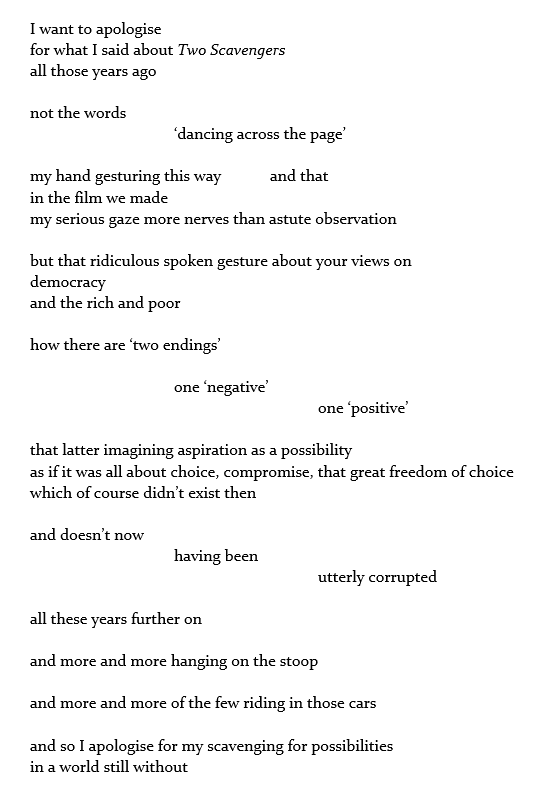
Further context here. In the great man’s 100th year I have again been thinking and regretting….

I could play the accordion
so I was selected for the amateur propaganda team.
It was very cold. I had to stop up the hole in my shoe.
I used the lid of a tin can.
As far as I can tell, there’s nothing
trustworthy about my experience of reality.
I stand on one leg. I stand on the other leg.
I rotate my arms clockwise
and call this exercise. In the home movie
I recognize my coat. Taking my turn
with the mechanical bull at Uncle Ron’s
Wild West Saloon I hold on for as long as a minute.
So little happens on a given day,
which is why I play the accordion
until I am riddled with someone’s applause,
which is why I drive to Arthur County to see
the hay bale church and the world’s smallest courthouse.
If I was a blue jay or some kind of robin
I would fly figure-eights over the cottonwoods.
Despite the wind, I would not curse the wind.
The future is a rumor like the past.
The new anxiety supplants the old anxiety.
The continent I stand my ground on drifts,
which is why I have asked you to marry me.
I am solid gold, I say, and I am capable
of loving you until the final asteroid
hides Omaha under an ocean of ash,
but you’re unavailable.
They were on their way to the ocean
when they made their minds up to stay here.
The grass was so tall they picked wildflowers
without stepping down from their horses.
We are all so lucky. It is terrifying.
It is a blue sky day for all the freezingness.
I blink into the chasm of sunlight endlessly.
I forget my life, but then I remember my life.
Copyright © 2016 Michael Dumanis
Returning to my Nebraska theme having come across this poem – I love the lines until I am riddled with someone’s applause and loving you until the final asteroid / hides Omaha under an ocean of ash.
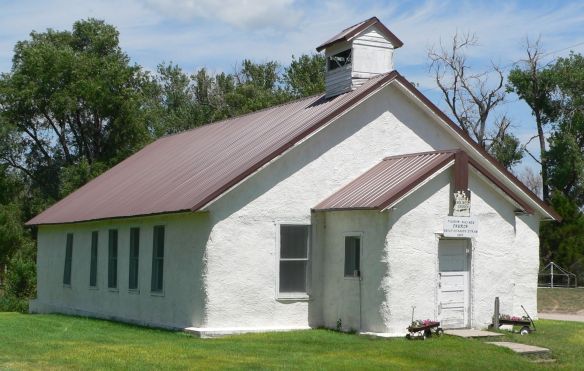
And learning: I have never been to Arthur – in my childhood of growing up in Omaha, Nebraska – so was unaware of the Pilgrim Holiness Church [constructed originally of hay bales, as, apparently, were around 70 properties in the Sandhills region between 1896-1945]
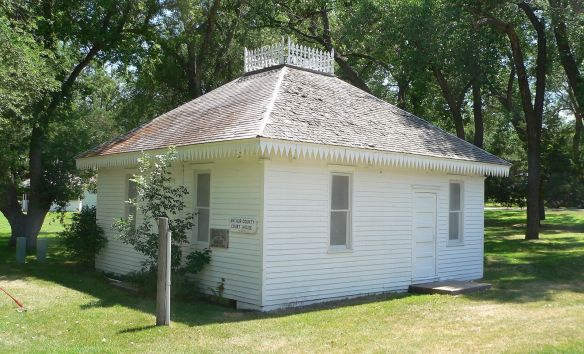
Nor was I aware of its other claim to architectural specialty, the First Arthur County Courthouse and Jail, built in 1914 and 1915, the world’s smallest, allegedly
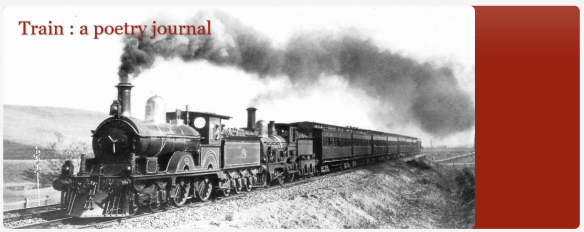
Most pleased to have my found prose poem ‘Prodigal Son’ posted today at Train: a poetry journal here.
It has been a delightful ride for a while to have four of these pieces pulled along the line for viewing – my sincere thanks.




It has been so far an ‘interesting’ BBC TV news analysis of the alleged parity between Conservative and Labour council losses, whether as number of seats and/or overall control. I am referring to both the lunchtime and 6pm news today. The 10pm one will be fascinating as I look for further evidence of what I am going to now outline.
The lunchtime news went with Norman Smith’s flamboyant summary of a voting public saying to the main parties ‘a plague on both your houses’.
Really?
There is no question whatsoever there is widespread public dissatisfaction with parliament’s handling [!] of Brexit, and both parties have their relative shares in the indecision and infighting and indelible loss of face.
But equally?
Who is the Prime Minister of the country?
Well, this was a telling ‘comparison’ of how similar the parties’ losses were:
In reporting the Chelmsford City Council move from Conservative to Liberal Democrat control, a graph was used that visually stated how the Conservatives lost 31 seats with the LDs gaining 26. Yes, this is significant.
In reporting the Wirral Council ending up with no overall control, the figures were presented as a Labour loss of 13%. That’s an interesting editorial decision in illustrating what had been claimed as a parity of losses and with a ‘plague on both your houses’ literary reference in support! As Labour were the ruling party before the vote by 1 seat, in losing 3 – 2 to the Conservatives and 1 to the Greens – this was presented as similar…
31 seats loss / a shift of 13%. The later equating to 3 seats. Parity? Mathematical shenanigans? Fake news? Misrepresentation? Bias?
Let’s be clear: both parties suffered because of Brexit. But on an equal footing?
At the time of writing this, these were the comparative Conservative and Labour losses of seats reported by the BBC:
Conservatives – 1,132
Labour – 100
Parity?
I think a plague on your reporting BBC.
NB. 10pm BBC News: Still essentially touting the ‘parity’ line – stating the Conservatives hemorrhaged seats, which as language at least acknowledges the colossal impact, and yet stating that Labour suffered losses too, quite implicitly suggesting this is similar. Of course it is suggesting this. If the BBC was being honest and factual it would state that Labour losses were significantly less – see below – and they could still maintain a view that this reflects voter dissatisfaction with both parties [but massively more for one!]:
Conservatives – 1,334
Labour – 82
Having succumbed to the use myself [feeling a need to explain to an editor who wouldn’t otherwise get it] I am still saddened to see the term erasure poetry replacing the term of its origins humument/s.
I have written on and about this before here, and I am in fact delighted to actually see the proliferation of this poetic technique under whatever name [there is also black out poetry and more I’m sure], but as Tom Phillips created it, I think we should celebrate this by retaining or at the very least referencing the name and its origins.
So I have:
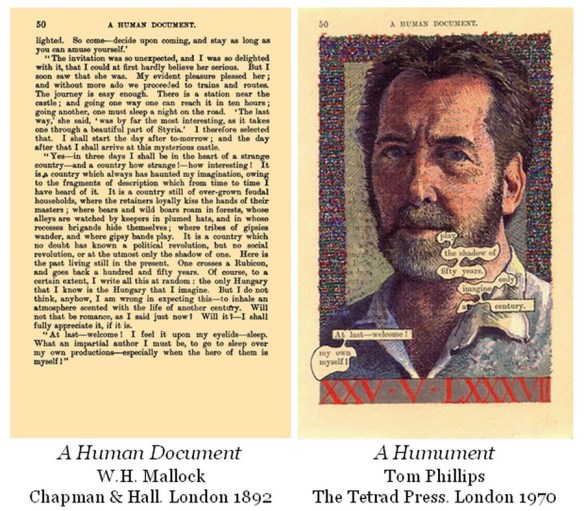
Visit here for further background.
In an Ofsted PowerPoint presentation on the Education Inspection Framework 2019, it gives a definition of learning which is
Learning is defined as an alteration in long term memory. If nothing has altered in long-term memory, nothing has been learned.
Now, and quickly, at my age I would appear not to have learned many things because I am always forgetting…
But that aside, two of the visual metaphors used to exemplify the meaning of their definition are confusing to me. Here is the first:
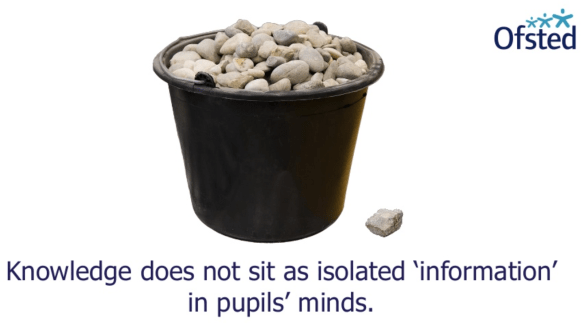
I do get the suggestion, but in portraying bits of knowledge as stones seems from the very start to characterise it/this as hard and finite and – well – not the precious commodity implied in the Knowledge Mantra of their current thinking/obsession. This also totally undermines the implied ‘criticism’ of it/this simply remaining static by being collected in a bucket. Are they meant to be thrown? At what/whom? And it is tautologous: these are stones and by their nature are static.
Here is the second:
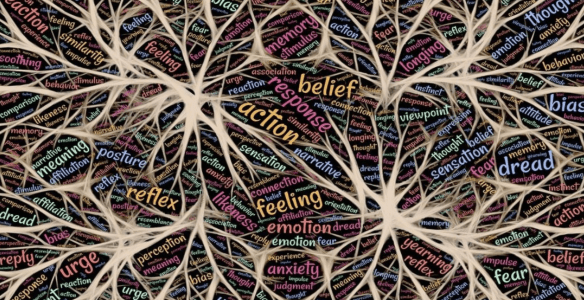
Again, I get the suggestion: this is vibrant and active and some kind of mesh so about interconnections and so on. And not a stone in sight!
But is ‘belief’ knowledge? Is ‘feeling’? ‘Emotion’? ‘Dread’? ‘Bias’? ‘Reflex’??
I can’t even find the word ‘stone’ in the image!
I don’t agree with Ofsted’s and therefore Gibb’s and therefore the DfE’s and therefore all the other acolytes’ and suck-ups’ foregrounding of Knowledge as the key/core ‘goal’ of teaching and learning, but given this bias [it’s a feeling really…] I still objectively don’t see how Ofsted’s visual metaphors in any way explain coherently or meaningfully what they mean by Knowledge, even in the way with which I disagree.
 gravyfromthegazebo