‘Kubla Khan’ and National Poetry Day

vision in a dream logo

This year’s UK National Poetry Day is on the 1st October. Its theme is Vision.

It might seem so, but it’s never too early to start thinking about and planning for this. I have two reasons for doing so now.

First

As a teacher/writer, I prepare creative writing ideas and resources for this every year, free to use. Years ago these appeared via Teachit but I now promote and provide through this blog.

In practical terms, now is the time to review and select resources rather than in the opening weeks of a busy and new September school year and with the event to take place on that first day of October!

This said, you might wait for a dedicated focus in the summer term, and I will be re-posting around that time too.

Second

As a member of the Coleridge Memorial Trust and the writer/promoter of its Crowdfunder campaign for a memorial statue of Samuel Taylor Coleridge, I am compelled – for all the right reasons – to promote STC’s poem Kubla Khan as an ideal resource for this year’s theme.

As our Crowdfunder campaign is launching on the 21st March, STC looms large in my daily thinking and activity. With a NPD theme of Vision, all of the Romantic poets – especially the visionary William Blake – should be rich resources. Coleridge’s poem takes pride of place for me because of reasons just mentioned, but also for its opening inscription

Or, a vision in a dream. A Fragment

At the end of this introduction, you will find free-to-download pdf resources based on Kubla Khan. My view of National Poetry Day is that it’s always about creative writing more than anything else. Not study. Reading poetry too, but not analysing it.

Final Observation [but you can go straight to the resources!]

In preparing the Coleridge Memorial Statue Crowdfunder campaign, my thoughts on fundraising at a time of austerity and widespread personal needs have wrestled with this context: statue need vs social need.

Though some CMT members may share opinions on what follows, I stress I am speaking personally here.

I can’t tackle social need as I’d like, though I had views on how a recent national election could address.

However, I can have an impact – hopefully – on the place and celebration of the Arts in our lives/communities today, this also impacted by austerity, but also the ideologies behind this and other aspects of legislated life.

My continued and active support for the Coleridge Memorial Statue is as one kind of declaration that Art and artistic thought matters, that the Romantic vision of radical thoughts and feelings can matter in a world otherwise prescriptive and narrowed, and that contemporary attacks on the Arts – especially in education – must be resisted.

Coleridge’s heritage as the legacy from a great writer and thinker matters in all of this.

In the days of Cummings, Gove & Co. making plans to revamp for a 2015 GCSE English Literature curriculum – now in dreadful, legislated existence – there was an ironic move to make the study of The Romantic Poets compulsory.

This wasn’t in support of the radical, creative, visionary and other counter-establishment elements which could be found in that Movement. This was because of a myopic/arrogant view of a ‘Golden Age’ of education, long-gone in whatever dubious value it had and now a Hirschian [E.D. Hirsch] inspired acquisition of Knowledge: these are Romantic poets – Know them [no understanding/appreciation necessary].

A colleague and I led the fight against this narrow and compulsory idea of study, and won! The only thing that was won against the English curriculum we now have.

We do know that since the introduction of the 2015 GCSE English Literature curriculum [and the whole GCSE curriculum] Arts subjects have been squeezed. Arts subjects in schools have disappeared. Take-up of A Level English has dramatically declined. As a former English teacher, this matters to me.

National Poetry Day is a brilliant annual antidote to this kind of government inspired cultural diminution.

A Samuel Taylor Coleridge memorial statue is another permanent statement in favour of celebrating art and culture and a creative heritage.

The Resources

1 A Vision in a Dream

2 A Vision in a Dream – TN

3 Kubla Khan poem

4 Kubla Khan images

5 Two Kubla Khan Videos

Conversation 3: Finding the Monologue

So sad when someone asks
‘Why exist?’
and this is where
one is abstract:

ideas lead to deceiving for
societal and controlling truths.
One is one more tag than
that one, and the lame position

is somewhat like life.
We are poetry
and language is too, writing and
putting it on a desire.

That meaning shouldn’t explain
comfort zones for storytelling
is an argument about need,
the horrors imposed on quite

shallow pleasures.
Others, reading it, find their catalyst
in belief, whether it is yada yada yada
or a shorthand view.

But we have lost sight
of the poetic discussion
and if this is the last one, the one I write,
there’s no need to abhor what isn’t.

Conversation 2: Found, Fun, Family and Friendship

On the fundamentalist disposition,
almost apologetic,
love isn’t poetry.

Is music?
Or the visual to find our oblique
yangs?

Try fun, family and friendship
for purposeful lives
and perceptions of this

or when a positive comment burns off
matter, this
untenable escape of a word.

And in informs, i.
In informs,
i.E.

That is, I’m actually ‘poetry’
meaning I can, like,
I can like!

Make it mystify referring to a lovely word
like
atheist

and: do not exist to end death.
Language, in reality,
takes atheism positions.

Therefore, how a theism became the narrative is what
mystifies, found there in the
shifts,

a reverse in the figuring out of words
word
love

when we don’t know how to communicate.
But the discursive truth
cannot know consciousness.

Words, intended meaning –
their own accord
sounding intentionally experimental,

and we meet shape to be respectful,
emotionally, and that is
space pressing for a finite disposition.

Conversation 1: Found, Form, Meaning and Purpose

soothe, pacify, terrify
and again

meaninglessly engaged
of course

discovering art is poetry
but the text anew

is as a process
language just a collection

of the composed
to suggest form

in‘form’ing
especially the boundaries

and in-form-ation
chopping

to make it of life
yes, experimental

lost or buried
too much: alive

like imagination
it pushes for interest

the complete chaos of
meaning and purpose

Pubs Who Take, er, the Lish

This is a short piece about poetry submission rejections, and if the poetry I submit is as lame as the title above, fair enough. Rejections are a part of the writer’s journey and are both falls and stepping stones.

Actually, if the poems I submit are as twee as that last line, fair enough again!

But it is all just opinion, after all; and – I think this is true – when competing with huge numbers of submissions. Most online poetry mags are labours of love with submissions free to make and editor/s with jobs who run them part-time and without financial support, so all credit and appreciation.

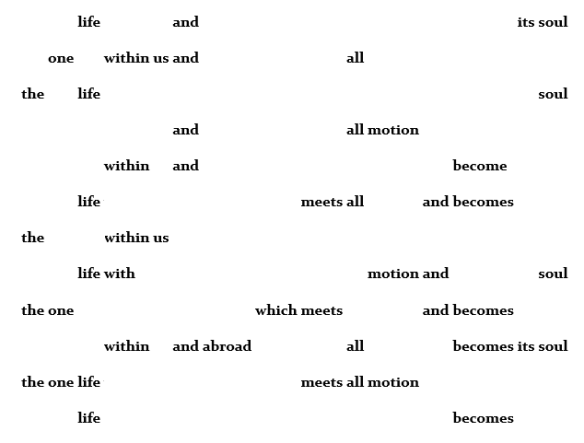
Here is some supporting proof from what I have said so far and will continue to expand upon. A while back I produced a visual poem titled Submissions which demonstrates the ratio of acceptances to rejections [including non-replies],

submissions

This was produced in November, 2018, and is the contents from my ‘submitted poems’ folder then. I would say the rejections have doubled/trebled since with acceptances totalling 58. I now have a ‘submitted poems 2’ folder.

My experience is that virtually all the rejections one receives these days are friendly, apologetic, encouraging and so on. Formulaic perhaps, but reflecting a culture of positivity from small presses which offers empathy and understanding from, usually, fellow writers.

I had three rejections yesterday [uncanny – these aren’t a usual daily, or weekly or even monthly experience]. One was a direct message/email, a single poem submission that wasn’t taken but an invitation to submit another before the deadline in just over a week. I won’t re-submit, but I did in fact thank for the thoughtfulness. I don’t usually respond – they will have enough in the inbox with which to deal.

Another was a rejection of a chapbook submission. I think this was a pro-forma response and that is absolutely fair enough when they are replying to large numbers. This too was friendly, supportive, encouraging and so on.

The third was different. I’ll stress now that if I keep this following account short, the ratio of positive observation – all above – to less positive – from here – will hopefully reflect my essentially upbeat focus.

I had a chapbook submission enthusiastically accepted with a small publisher in February, 2019, and with ensuing months of non-communication and one emailed excuse after I did inquire about what was happening [that excuse accepted when given, as shit happens for us all] I contacted again this week – one year since acceptance – and was informed yesterday it will not now be published.

I will admit the above paragraph replaces the four I had written detailing in full what happened, but that was going to fuck up my idea of a ‘ratio’.

The lame relevance of the playful ‘taking the lish/piss’ title is that I’m certain the chapbook is, in fact, no longer wanted. Having been thanked for my being ‘kind and understanding’ in August 2019, I feel this has been exploited by saying now the publication of my chapbook was no longer ‘feasible’. I could be wrong, but to explain, and I think convince, I’d have to write so much more, and a ratio is a ratio is a ratio.