
‘A row has broken out over the marking of this year’s primary school tests after teachers complained that their pupils had been unfairly marked down for the shape and size of their semi-colons and commas.’ Guardian, 10th July, 2017
‘A row has broken out over the marking of this year’s primary school tests after teachers complained that their pupils had been unfairly marked down for the shape and size of their semi-colons and commas.’ Guardian, 10th July, 2017
In media res
with the bullshitting it
for 45 minutes,
one question
to answer
in that cluster –
question one, a
mistake,
whatever:
the reality of war
as opposed to
effects of war?
Must remember
AABB rhyme
is fucking shite
if you are at war.
Running and lugging
his gun
is assonance?
Or is ass
thing to do,
the sibilance
ssssing
piss?
No, this is a
piece of piss
his exam and
I wouldn’t have minded
if ‘he’ –
personal pronoun –
took it himself.
No, a single charge
is a piece of piss
compared to the
six hundred
yet I proper good ignored
that part of the
comparing poems
[chaos can’t be
contained].
War poetry in my mock
got 28/30 –
piece of piss.
I did London with
Ozymandias in
Bayonet Charge,
to fit the
abruptful adjective
‘suddenly’
into the running:
three poems better
than two.
That was the prose?
:(:(:(:(

Pleased to receive my copy today, a 50th anniversary celebration of the iconic newspaper. It is sad to receive also so soon after the death of Heathcote Williams, a weekly contributor to the online magazine and cited as ‘Editor at Large’ for this newspaper edition, as well as an article included about him:
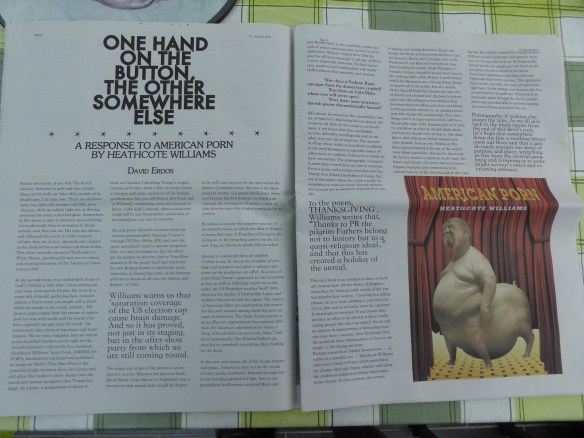
It is an engaging read of contemporary and nostalgic articles/images. I have always enjoyed the privilege of having the occasional poem printed in the online version.
There are poems in this edition from the likes of Michael Horovitz and Adrian Mitchell, and fittingly, as well as poignantly, from Heathcote Williams with his There has to be an Afterlife.
You can order your copy here.

Don’t get me wrong: I continue to be so impressed with the understanding and engagement of students responding to the tough, terminal, closed-book GCSE English Literature testing of this year’s cohort.
I have just read and assessed an empathetic, knowing and articulate account of a student’s understanding of having studied War poetry. This student grasped the poems’ themes with considerable independence of thought as well as display a critical appreciation of their crafting – this latter usually the more demanding to assimilate for oneself.
Then there is the relentless namings. The gerund verbs, in this repetitive case. I won’t exemplify more, and I have presented such in a more creative mode here, but this is a woeful distraction [though it does not impact on the grading]. Unless more time could be spent on expressions of appreciation rather than regurgitation, but that isn’t a real, pragmatic issue.
I am genuinely disgusted with this. What/who is responsible? Is it the Literacy Strategy? Is it the KS2 testing regime – the SPaG and now GPS element championed by ignoramuses like Schools Minister Nick Gibb? Sadly, one has to ask as well, is it the teachers? Why would any English teacher teach students to respond to poetry by an intense naming of parts? If these teachers understand how to write and how to read writing, why would they over-emphasise such superfluous – and ultimately irrelevant – feature spotting?
As any well-trained student would respond, that is a rhetorical question. It must be fear of failure, some notion that assessment objectives require such a prevalence of subject terminology naming. I get this. But surely it is time that English teachers behave like English teachers rather than technicians and stop drilling students in this level of mechanical response?
Yes, that was too. But I’m not going to name it. Just feel it, for now.
Delighted to have a prose poem here at unbroken journal, with a special thanks to the editors for forbearance on an embarrassingly errant spelling….

Pleased to have my poem ‘Falderal’ at I am not a silent poet here. Those who follow this blog will understand some of the genesis of this poem, though larger concerns have shaped it fully.

The following italicised section is straight from the horse’s mouth: Ofsted head Amanda Spielman speaking at the Festival of Education on 23rd June, 2017. For those of us who for many years knew Ofsted mainly as an instrument of policing successive government dictates about exam-based target setting and verdicts of school progress/success focused entirely on this – for example, arriving to inspect an establishment having already decided a judgement on the basis of pure data – this has all the sound of a classic snigger.
Speaking about her experience of inspecting schools, Spielman observes,
In some of those, I have seen GCSE assessment objectives tracking back into Year 7, and SAT practice papers starting in Year 4. And I’ve seen lessons where everything is about the exam and where teaching the mark schemes has a bigger place than teaching history.
That is not what will set our children up for great futures. Nor will the growing cannibalisation of key stage 3 into key stage 4. Preparing for GCSEs so early gives young people less time to study a range of subjects in depth and more time just practising the tests themselves.
We have a full and coherent national curriculum and it seems to me a huge waste not to use it properly. The idea that children will not, for example, hear or play the great works of classical musicians or learn about the intricacies of ancient civilisations – all because they are busy preparing for a different set of GCSEs – would be a terrible shame. All children should study a broad and rich curriculum. Curtailing key stage 3 means prematurely cutting this off for children who may never have an opportunity to study some of these subjects again.
It is genuinely repugnant for Spielman to act like an enlightened critic of such practice when she will know the dark history of its existence. Whilst making some comic capital out of this in my previous posting – though I trust the disdain underpinned – I do think this, and the rest of her observations which can be read here, take the art of patronising and platitudinous comment to obscene levels of contradiction.
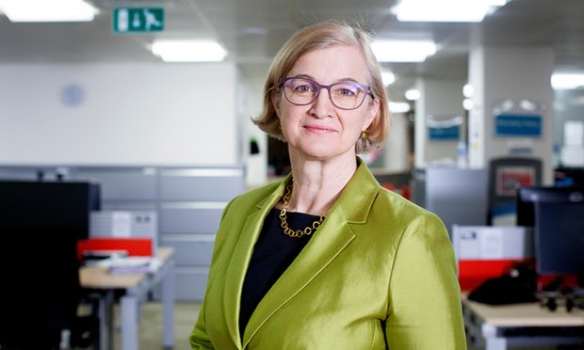
In the annals of being late – which is a litotes as well as a double entendre and also a straightforward exasperation – the announcement by Amanda Spielman, the head of Ofsted, that schools should not be exam-factories and will be inspected and reprimanded/punished/flogged/ridiculed or whatever if they are, because if they are, and I quote, This all reflects a tendency to mistake badges and stickers for learning itself. And it is putting the interests of schools ahead of the interests of the children in them has to be the most absurd about-turn, volte-face, U-turn, back-track, back-passage pontification of effluence from those responsible for decades of misery in education that I have heard for, well, decades.
I know there are knowing people out there in education who have said this might be a ‘groundbreaking’ announcement [teachers forever live in hope and fantasy and good intentions], but for all those students already harmed by years of exam-factory education, and all those teachers who have been harmed by exam-factory education [yes, my hand is waving in the air], this is the grossest example of a monumental dung-heap of irony I have smelt in nearly 40 years of being an educator and sniffer-outer of rank baloney.

There’s a sudden roll and roar
of percussion in media res on
Disc 6, which is Symphony No. 9
by Vaughan Williams, having
heard the 8th in D minor, this one
in E, the Moderato maestoso,
so just into the first movement,
yet it isn’t and instead a plane
passing overhead with the window
opened at the desk where I listen,
marking students writing in Latin,
yet they don’t and instead – like this
sound not in media res which would
be near the end of the 2nd, Andante
sostenuto, as if I understand
Italian – are playing with terms
like drum-thunder in a narrative
making noise flying above and so
unable to hear the real words below.

