On the one hand it proves they have lost the argument; on the other, we know it still moves those moved only by such spiteful nastiness:

On the one hand it proves they have lost the argument; on the other, we know it still moves those moved only by such spiteful nastiness:
In a
suffering life
pain is its
documentary
or music of
paint,
Monet cello
playing strains of
blue and
magenta –
some obvious
mood
as a bridge
reaching across
a pond
arched tragically.
What is
what flows
below,
lilies transported
along?
This is not
surreal.
Whether colours can
represent,
this is not
surreal.
It is the
opposite.
A suffering life,
palpable,
plays as a comment,
no more.
With the events of Saturday into Sunday in London, I did not post this yesterday.
I also do not want to enter the murky mire of too much analysis and commentary on the event itself, and its coverage in the national media. I have of late, however, with family and friends, been discussing the need to read beyond my regular The Guardian to gauge how other media outlets, but especially the newspapers, have differing views and opinions on aspects of terrorism and dealing with this, as well as broader political issues, not least the imminent General Election.
One clear statement before I proceed: I completely abhor and make no excuses for the recent terrorist attacks here in the UK, or anywhere in the world.
So, yesterday, I did go to read The Mail Online. If this is the moral compass that newspaper takes when commenting on these attacks – the Hopkins focus juxtaposed/joined with the trash of the sidebar – then I do not feel the need to explore any further than my regular liberal, yes, but sane read:


Delighted to have two poems from my found poem sequence American Finds in the current edition of After the Pause here.
I don’t remember exactly where I was on 1st June 1967. It was a Thursday, so under normal circumstances I’d have been at school in Penge. But as well as being the summer of love, 1967 was also the summer of O levels, so I might have been sweating in the hall of the grammar school, trying to remember what the annual tonnage produced by the Yorks, Notts and Derby coalfield was, or which French verbs conjugated with étre (and almost certainly failing on both counts).
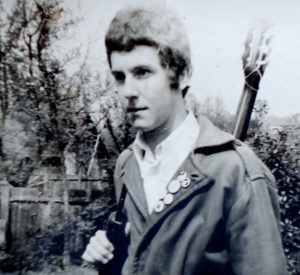
There wasn’t a Radio 1 for another month or two, so it was probably on Radio Caroline that I first heard the chords of track 1: “Sergeant Pepper’s Lonely Hearts Club Band”. From there on, it was impossible to escape the sergeant. Did we think it was the record that would change the history of pop music forever? No. It was just another Beatles album that would be the soundtrack of that particular summer. It was book-ended by two other great albums that have stood the test of time:“Are You Experienced?” released on 12th May (my 16th birthday) and “Piper at the Gates of Dawn” on 5th August. But the strongest memories of the summer of 1967 are jerked into life every time Mr. Kite, Lucy or the sarge get airplay.
We spent a lot of time at Linda and Anne Grant’s house in Eden Park that summer. I was in love with Linda, with her thick black fringe and wide brown eyes: but she had eyes only for a tall, skinny, taciturn guy, whose name was, improbably, Wit. We played the record constantly and I often sat on the sofa with a sister or two. I don’t remember spending much time there before or after those few months in 1967, but that modest suburban semi remains, for me, Sergeant Pepper’s house
The sarge’s summer was also the first one where we all had scooters. I remember an endless string of parties that we would go to because – well, with wheels, we could. Lawrie Park Road, for example. I have no idea who lived there, or how I ended up there on my Lambretta, along with hordes of others. But I remember “Lucy” playing while I sat on a broken garden chair swilling cheap, fizzy cider and looking up at a darkening summer sky, imagining the early stars were diamonds. Then there was a party at Sandra’s house in South Eden Park Road. I’m pretty sure it was just as O level exams had finished. Was that the one where Rob and Sandra’s long and winding road started? At that gathering I remember being in a brightly lit kitchen, with Sandra, Geraldine, Gordon and assorted (but unremembered) others, listening to “Mr Kite”, still my favourite sarge track all these years on.

For our post-exam bender, we didn’t get to Haight Ashbury, we scooted down to Herne Bay. Johnny and Jean’s aunt (or was it granny?) lived there and we all descended on her. I say “all”. I only actually remember Johnny and Jean definitely being there. I think Rob had also pushed his Tv 175 down there. (That’s a definite memory: Rob, with a little help from his friends, pushing the Tv further than he rode it that summer). I’d swapped my combat jacket with lapel full of CND badges for a paisley dressing gown (also not quite Haight Ashbury). Faded seaside suburbia Herne Bay was then. We were reminded what we would be like when we were 64. Bungalows on the Thanet Way depping for cottages on the Isle of Wight.
The Beatles weren’t at the main music event of the summer. That was the Windsor Jazz and Blues Festival. 13th August. Gordon and I went with Kelly in his bubble car, puttering along the A308 to Windsor racecourse. Gordon and I shared shifts curled foetally on the parcel shelf. Mayall’s Bluesbreakers with a newly recruited Mick Taylor; newly formed Fleetwood Mac; Chicken Shack; PP Arnold backed by The Nice; Jeff Beck; and the big one – Cream.

As that summer ended, so too did my Ld 150. Adrian and I had ridden up to see a girl from his school who lived on the Highgate side of Hornsey. We listened to Pepper in the front room of a large Victorian villa on a very swanky sound system. To date, I’d only heard the record on Dansette’s or radiograms. This was proper stereo with separate speakers. The final orchestral glissando of “Day in the Life” seemed to fill the whole of Hornsey. As I kick-started the Ld to go home, there was a death rattle from within the engine casing. There was no way I was going to be fixing the hole where the drive shaft used to be. It was temporarily the end of my wandering. It would be autumn, when Paul got caught carrying contrabrand goods on his pillion (John Boon) without having shed his L plates and got a ban, that I acquired his beautiful metallic green and gold series 2 Li 150. But by then we were driving towards “Magical Mystery Tour”.
Down the 50 years since, the sarge has appeared regularly, sometimes in the most unlikely places. A few years back the tinny strains of a battered ghetto blaster had “Getting Better” floating out of a tee-shirt shop in Kathmandu. “Good Morning Good Morning” on a chilly, early February evening in a deserted restaurant in Ayia Napa where I was holed up with just a surly waiter and a chiller cabinet full of squid for company. “She’s Leaving Home” appeared as a piece for analysis in a GCSE text book. (It’s got three narrative viewpoints you see: obviously a consciously constructed feature Paul had in mind as he wrote). And as I was writing this, with the vinyl gatefold cover propped up by the computer screen and the disc tracking round side 2, I got the news that my oldest friend had died. Johnny, who’d listened to “When I’m Sixty-Four” in Herne Bay and pondered that distant horizon of late middle age, crept past the milestone by two years. In two more days it would have been 50 years since Sergeant Pepper was released. So now, whenever I play “Sergeant Pepper’s Lonely Hearts Club Band”, it’ll be Johnny I think of alongside all those other flashes from a summer long ago.

The current edition of the excellent Decals of Desire is available and accessed here.
There is a set of glorious reflections on the life and work of the late Tom Raworth, articulating considerable respect and affection, and a fine set of paintings from featured artist Rupert Loydell.
There is a wealth of other interesting reads, including an incisive interview with Eric Eric. I am very pleased to have a poem there too, one from my found poem sequence Novel Finds.
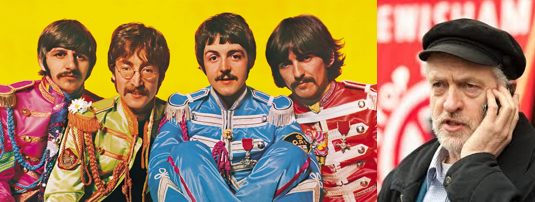
It just occurred to me, and this is probably not apocalyptic, but as we celebrate the 50th anniversary today of the release of The Beatles’ Sgt. Pepper’s Lonely Hearts Club Band album, and with its music all the peace and love and caring that 1967 offered – yet could not deliver – Jeremy Corbyn does embrace the echo of this in so many ways and thus he has a fundamental nostalgic appeal as well as resonance of the thoughts and feelings we have wanted from our leaders over the past fifty years though rarely received.

Very pleased to have my poem in Issue 13 of Allegro, with thanks to Sally for publishing. You can read it here, along with the eclectic range of other poems on this issue’s theme.

In a moment of rare tweeted self-awareness:
Cavorting in the mirror
Of gargantuan
Vanity, I barge through life,
Forging ahead in the
Emptiness of thought and
Feelings, the most
Egregious [that’s Bad] President, Ever

It has been a bad and good day for Jeremy Corbyn.
On the day David Dimbleby – an establishment figure – stated that Corbyn had been poorly served by the UK media, essentially a right-wing media, Jeremy had to endure this again with the BBC in both their lunchtime and early evening slots. His forgetting the figures for a commitment, if elected to government, to funding universal childcare in his Woman’s Hour interview grabbed all the negative headlines. Sure, he should have known them for the performance element of politicking, and in light of Diane Abbot’s appalling forgetfulness, but in reality it doesn’t matter. He was trying to get them from his tablet; trying to get the exact figures. Perhaps he actually did, but I don’t know and it doesn’t matter. What is worse: forgetting, or telling a lie? Which political party currently campaigning has a tight honest grip on reality and truth?
I think Labour does, in fact. Honest fallibility. Honest intention. Honest caring. That’s a magic three, by the way. I’ll take all of them for their humanity.
And that’s what came across on Corbyn’s ‘interview’ tonight for the One Show. The tweets [and I mean positive ones] are already referring to what a genuine nice person he is, and I’ll go for that too. But the Tories and other miserable strategists will ask: do we want a ‘nice’ person to lead the country, or do we want a ‘strong’ person to lead the country? Before I answer, note how the balancing act of the word ‘stable’ has disappeared from the former mantra. Another U-turn. Another quick strategic shift for politicking.
The answer is, of course, I reject the ‘nice’ tag because the important quality Corbyn demonstrated was his humanity. He is a genuine, humane person. Yes, yes, yes [not so magical, but honest], I’ll take that.
I have been totally reassured in my decision some time ago to join the Labour Party because of the honest integrity demonstrated by Corbyn. I have had my doubts about his ability to lead the Labour Party and the country – both pragmatic and political – and some of those doubts continue for many reasons, but I have no doubt at all that he deserves a chance in the same way that this country deserves a chance at a different kind of political leadership. I obviously agree entirely with his Labour ethos – the undeniable Socialism – but we also deserve that humane and honest and hotdiggitydog trio of attributes.
I put that last bit in because I am actually quite upbeat at the moment about Corbyn’s chances and also because he has shown his own sense of humour.

