Yet to coordi-
nate, but for, or, grammar doubt:
use one conjunction.
Uncoordinated Conjunction Haiku
Reply
Yet to coordi-
nate, but for, or, grammar doubt:
use one conjunction.
I am a Teachit fan, the long-standing online English teaching resources site, and I have been a contributor for some time, though not supplying a huge number of materials.
I have been pleased to have an A Level English Language and Literature resource used quite a bit, though this has now come to an end as the Spec. has ceased to exist – this the last year of examination.
My other regular contributions have been ideas for National Poetry Days, and these have over the years been used – which sounds simplistic – but this is what one wants: used by teachers with their students.
I should make an effort to contribute more, though I have increasingly used this site for sharing. It is simply that the spirit of sharing English resources on a popular and national site is such a positive one, and so practically useful.
I am, therefore, a little disappointed – though not overly surprised – to see the site’s most popular resources of late, these largely functional and certainly not the creative offerings I’d like to see. I have looked at them all in whatever detail they contain, and am not making any criticisms, either overall or specifically, though most I would not use. I have expressed similar about the most ‘popular’ TES English resources. I suppose this reflects the pragmatic needs and demands of many classroom teachers. I fear it reflects a lack of desire to be more adventurous. Here are is the current ‘Top Five’:
1. Writing to argue and persuade: techniques (23342)
2. E-x-p-a-n-d your vocabulary! (22421)
3. Spelling and punctuation game (24130)
4. Narrative bookmarks (25138)
5. Apostrophe practice (22604)
The numbers of downloads tell quite a story. It isn’t the most uplifting I have read.
This poem is by Twyla M. Hansen and she is currently the Nebraska State Poet [2013-2018]. It has a special appeal because it may be about – though I cannot be sure – the hail storm that I recall from around this time which hit, literally, my home town then of Norfolk Nebraska.
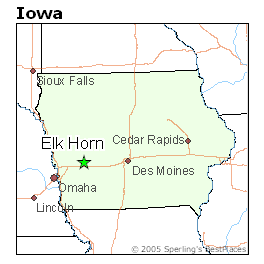
Not that I was there at the time. I was staying with my grandparents in Elk Horn, Iowa for a one week vacation in the summer. Whilst I was there, a hail storm had struck Norfolk [and if the poem is about the same event/time, it had a broad sweep] and when I returned home it was as if winter had set in: all of the leaves had been stripped from the trees in the road where my house was and as far as I can recall the rest of the town, and all of the roofing shingles seemed to have been obliterated from the houses – again, certainly on most of the those in my road.
I can’t be sure the Norfolk storm was 1965, but it seems about the time I would have been in Elk Horn [Hansen 16; me 10]. Another reason I can’t be sure is because such hail storms were relatively common [though I must confess, not to my knowledge in Norfolk, though I only lived there for about 1 to 2 years, in two different houses]. That area, and perhaps most of Nebraska/the midwestern states, were subject to tornadoes and similar – Norfolk was in a cyclonic area: this from distant memories – and so again storms were common. Indeed, in the first house I lived in there, all the downstairs rooms were slightly uneven because the house had been flooded on a number of occasions, being near a river, and I do recall my swing-set being destroyed during one heavy storm when a branch was ripped from a large tree in the garden to fall on it.
All of these storm ‘incidents’ have featured in my writing here and there, e.g. here – dramatic moments from childhood and therefore vivid memories. Thus my affinity for this poem, from Hansen’s book Potato Soup published by The Blackwaters Press:
Hailstorm, 1965
Q: What is the largest hailstone in the US?
A: There have been six reports of hailstones eight inches in diameter.
-The Weather Channel
It was the summer I turned sixteen, one brother
was soon to be married and we’d sold the farm.
I remember wanting desperately to be kissed.
Everything wavered on some kind of edge, elm trees
a graceful dome over the dusty streets. Nothing to warn,
only cumulonimbus clouds in the afternoon, intense up—
drafts, sky hazed sulfur-green, hail starting as crystalline
seeds that grew to marble-size, geometrically then,
to the size of softballs, clattering heavy against metal,
wood, glass, against the only small world we knew.
All the west windows in the high school, every roof,
field corn stripped down to stubs, lives shattered
that day by crop failure, gouges, even holes in the ground.
There had never been any guarantee. Always there is
a risk, a gamble, hard choices to make. My oldest brother
and I scooped out stones that ripped through
the ragtop of his ’62 Impala. I can’t imagine hail the size
of a melon. Somehow that day I sensed that youth
had dissipated, that through the vapor of downed leaves
and broken branches, there would always be another crisis,
and another close call, and yet there was something more out there
circling, the open road where I drove west—my oldest brother dozing
in the passenger’s seat, my learners permit in tow—eighty on I-90
toward Missoula, toward the end of what we know now as innocence.
Panties
Panties is a word
hiding all its mysteries
inside haiku
…although that was never my intention – originally posted February, 2015:
Sorbothane Haiku
Sustain the soften
ing: for Shock Stopper Single
Strike, use French semelles
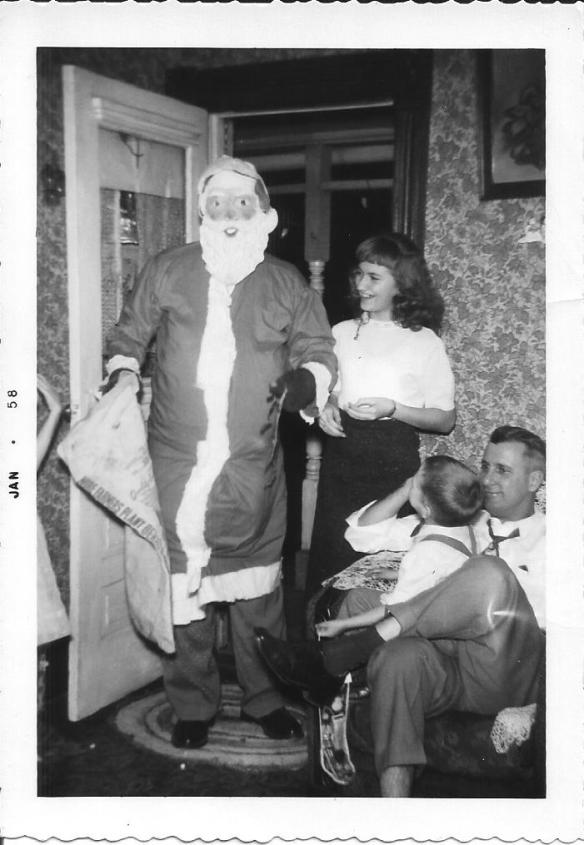
An extension on the Grandpa’ Wallet series, this is a picture/memory I have previously mentioned I would return to describe.
It was the tradition when I was a little boy – here three years old in 1957 – to visit my Grandparents’ house in Elk Horn, Iowa, with the rest of the Carlson family on Christmas Eve. We would always return home that night to Omaha [just across the state line into Nebraska] to have Christmas morning there, enjoying another tradition of sharing a smorgasbord for breakfast/lunch. I won’t have appreciated then, as I do now, how hard my mother will have worked preparing everything around all of this.
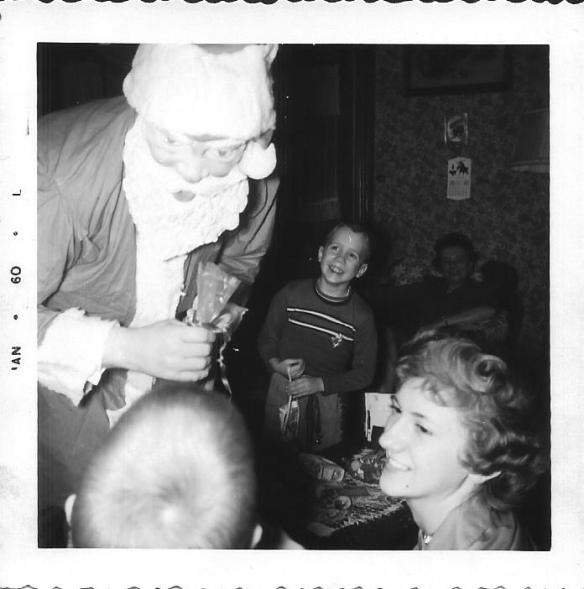
Another tradition on Christmas Eve was that Santa Claus would visit. In the second of these pictures of that happening, I would appear to be amazed and delighted. I am sure I was, but this is not the salient memory I have.
Before I get to that, it is hilarious – for a number of reasons – that it never occurred to me that there was something amiss in the fact my Dad would always disappear for a short space of time and therefore miss Santa’s arrival, returning in surprise after Santa’s eventual departure to say he had seen him leaving on his sleigh, or at least hearing sleigh bells ringing as he was flying away.
The other reason is the mask. The memory I do recall with intensity is the one occasion I got too close to Santa’s face and immediately burst into tears because it was so grotesque. I think the whole plastic fakeness will have been enough to strike terror at such a moment of apocalypse, but it will also have been the shock created in that happy and naive expectation by the brutal reality of what I suddenly saw.
I presume it could be the time when the first picture was taken because my face is turned away from the camera. The stare on the Santa face as he enters the room is terrifying. I wonder if it is just after this when I became haunted? I do seem mesmerised and completely fooled by it all in the second: had I completely forgotten about the other visual assault? I am pleased about that latter happiness. I have no problem with the joy of such childhood innocence. The fact this all took place in the warm comfort of my Grandparents’ home, surrounded by a loving family [in the first picture I am sitting on my Uncle Glenn’s lap, and I will write about him too at some stage], is such a solid and fundamental root of the happiness I did have – if not always – in growing up.
I have kept both of these photos quite large for this posting to exemplify the scariness of Santa who clearly hasn’t aged. In this one I have just received my present – here at 5 years old in 1959 – and Santa is about to give one to my cousin who I guess isn’t crying at this time either.
For deliciousness
try fording this rivulet
sandals in one hand
by Buson

I’ve always liked this, and used in my teaching. I first came across this haiku many years ago in an English teaching textbook called Sandals in One Hand by Gareth Boomer and Morris Hood, that kind from the 70s/80s which was simply and richly filled with all kinds of stimulus and activities – from poetry to reading comprehension to writing workshops,

The image I have used of a rivulet just for this posting is called Mother Cummings Rivulet and is by JJ Harrison.
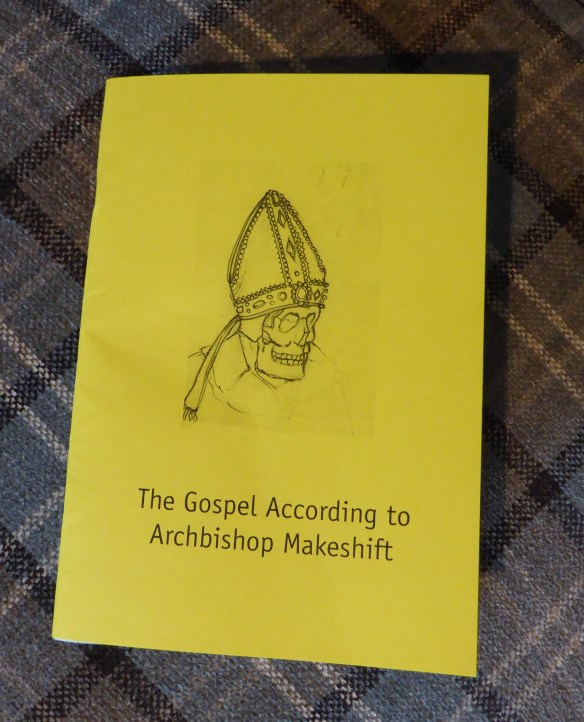
The Archbishop Makeshift has asked me to write a brief review of the book about him, and when you are asked in the way he can, you agree. I like to imagine he urged because he warmed to the poem I composed for the collection, but how does one ever know such things when approbation is all about opinion, and faith?
I did tell Makeshift that I had an affinity for Rupert Loydell’s opening list poem, a catalyst for the other observations that follow, but all I got in response was the corrective that it is a litany poem, an unnecessary nuance to my thinking, though I know where he is coming from. As he tells us himself,
Archbishop Makeshift says there is still room for improvement and we should all keep trying harder,
so I am clinging on to the curve.
It is, however, easy to doubt the assurances from Makeshift and his litany of belief, when
Archbishop Makeshift says austerity measures do not mean he doesn’t love us any more,
therefore I take refuse in the poetry of his many other lines, for example,
Archbishop Makeshift says only memories remain after ten seconds of forever.
I waxed lyrical about a number of Loydell’s expressions in this poem, but Makeshift told me from that moment I was on my own and not to bother him any further with my personal thoughts and feelings. I felt like I had heard this kind of snippet from a sermon before.
The two poem narratives from Daniel Y. Harris and Irene Koronas put all the language of the world before, now and after into a melting pot of explanation and obfuscation to engender a rationale from the pulpit of Lucky’s neverending search for meaning.
Can you contemplate if I had put that exposition to the Archbishop? It would be an interesting mathematical attempt to calculate the distance of explosion projected from the crown of his head to the utmost tip of the mitre.
And I forget – these are the expressions of the Archbishop himself, so such observation is superfluous. But how can we be sure they are? H.L. Hix offers possible forgeries, by a disciple, of the Archbishop’s confessions in Two Fragments from the Makeshift School. And if no more than a mere acolyte writing, it is still the poetry that intrigues as much as the philosophising,
I am dead not as the crow flies, but as the creek meanders.
Philosophising does permeate, thankfully, the bulk of this booklet, though one can never be sure how trained this is. Greg Fiddament asks fresh questions in Given that the universe…. and the answers are plagued by continuing interrogatives.
Paul Sutton too presents uncertainty in his two-parter The Gospel of False Starts; Sarah Cave cuts up further possibilities and perhaps happens upon a glimmer of the truth of these poems, the sparrow chuckling/at his spoof, and Martin Stannard conveys an internal dialogue of madness in Poem (Revolution #19) so that Makeshift’s world is indeed impossible to pin down in the many narratives spoken on his behalf.
As Makeshift demanded brief, this is what I have delivered.
To experience the genuinely enjoyable breadth of this booklet, see further details here.
I have just completed marking a school [centre] of a largish number of GCSE English Literature responses on my paper. That’s two essays each on respectively a chosen prose/play and then prose context question.
I mark an H tier paper, so that is notional D to A* grades, or as it is now in actual marking on scripts, levels 2 to 6. I of course have no idea specifically, but my school is quite likely a ‘bog-standard’ comprehensive [and I ape the term from a while back ironically, and sneeringly], and most likely an academy though this accounts for little. All of the students have responded to, respectively, questions on An Inspector Calls and Of Mice and Men.
And it has been wonderful.
The H tier, I acknowledge, targets a certain level of ability [and thus fits into that C/D pass/fail dichotomy to a degree – see previous here and here] and there is an implicit level of competence. For me, it is so much more than this. The students from this one school – replicated up and down the country – to a person write clearly and well and knowingly and convincingly and empathetically and very often exceptionally. At the ‘business’ end [we apply SPaG] they are all eminently readable and accurate, and at the ‘meaning’ end/level are engaged and informed and bright and unbelievably able to say the same kinds of things [how could you not when answering the same questions on the same texts?] in so many differing and nuanced and, yes again, knowing ways. It is phenomenal.
And I love it.
In reference to the two previous posts I have linked immediate above, I am writing this to once again dispel anyone’s belief that GCSE exams – this one certainly – are designed to fail students. Every single one of the 171 scripts I have marked have demonstrated the students’ ability to convey their knowing of and engagement with the texts they have read and studied. The nature of testing does, of course, assert its parameters – the question setting has a focus – but I think it would be at best churlish and at worst obnoxious to argue that this is in any way designed to limit or penalise or diminish in any way the student responses. But I’ll leave that there.
As the final year in which American texts can be responded to in such GCSE English Literature examinations, and in this centre’s case Steinbeck’s Of Mice and Men, I have been particularly aware of the continued way in which this one text appeals so perfectly to students as readers, understanders, appreciators and responders. This year’s context on the final scene between George and Lennie [spoiler alert in the unlikely event anyone reading this hasn’t read the ending of the novella!] and George’s killing of Lennie has prompted in so many ways the most emotive of empathetic responses. This is naturally the informed response to the power of Steinbeck’s writing. But there is an added puissance to that whole engagement knowing this is the last time there will be such responses.
Considering the quality of responses I have been outlining from this one school – itself a microcosm of all schools, and I couldn’t resist – the quality will be sustained over future years with other texts because it is the teaching and learning and student responses that prevails.
I have written elsewhere [not on this blog] about the intrusion of the literacy strategy on the way students have been taught to write about texts, but I haven’t seen this from this school. The Of Mice and Men context could lend itself to a proliferation of references to ‘pathetic fallacy’, but I have only seen one, thank goodness. And in light of the recent KS2 English GPS tests, I was amused today to read one candidate refer – oddly – to the coordinating conjunction ‘But’ [that is an intrusion from afar at this level now, but one fears for a few years down the line…] yet this again has been an absolute aberration.
This is a celebration of an examination I have enjoyed marking for probably 30 years. There have been changes in Specification, and I started on what was called the Generic paper so open questions asked on any text and tested at all levels, and I have throughout that entire time never ceased to be privileged to read the work of this country’s students. And to feel that as an examiner, and working within the teacher-led spirit of this GCSE, I have been able to reward the students’ responses to the best of their ability and the best of mine within a terminal exam framework that was never my first choice.
As the examination goes online, and for other reasons, I may not be continuing. So I look forward to the other centres I am yet to mark this year.