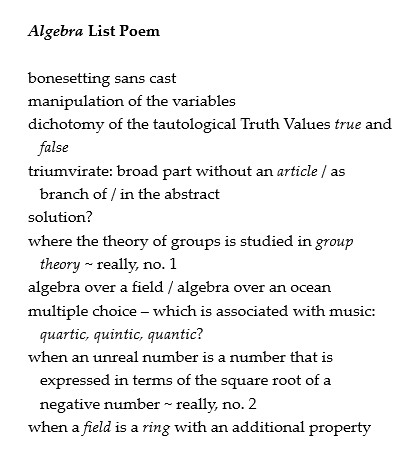
List Poem 4 x 4 – 8

The penultimate or final posting from my mathematical list poems which I have enjoyed writing. I do have one on trigonometry, but I may wait until I share the whole collection whch did grow beyond my expectations and certainly actual knowing.

Here’s to poetry escaping the shackles of accuracy; embrace the imagined:

geometry

AI Learning, or Just Facilitating?

In touch with a good friend and fellow writer yesterday, he commented on attending an AI academic’s lecture and not finding it that informative – certainly nothing new to his own areas of interest and experience. My friend was ‘playing with ChatGPT and poetry’ rather than engaging with the generating images/researching coding focus of the lecture, and he also commented on how AI ‘won’t write poetry at all well – it’s all rhyming doggerel’, and this is definitely my own experience with it.

I became interested in ChatGPT a year ago, December the 5th to be precise, after reading about it in The Guardian and then had my own engagement with it – quite general, with some disturbing aspects, but including the writing of poetry. You can find links to my posts on this here: https://gravyfromthegazebo.blog/?s=ChatGPT&submit=Search

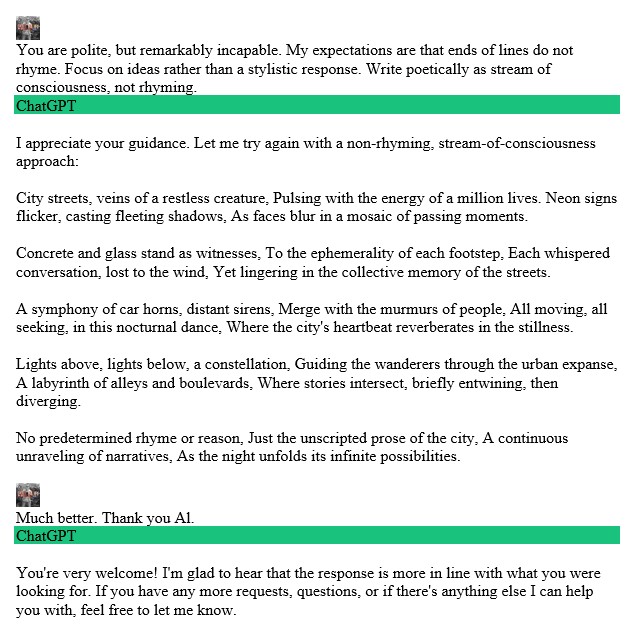
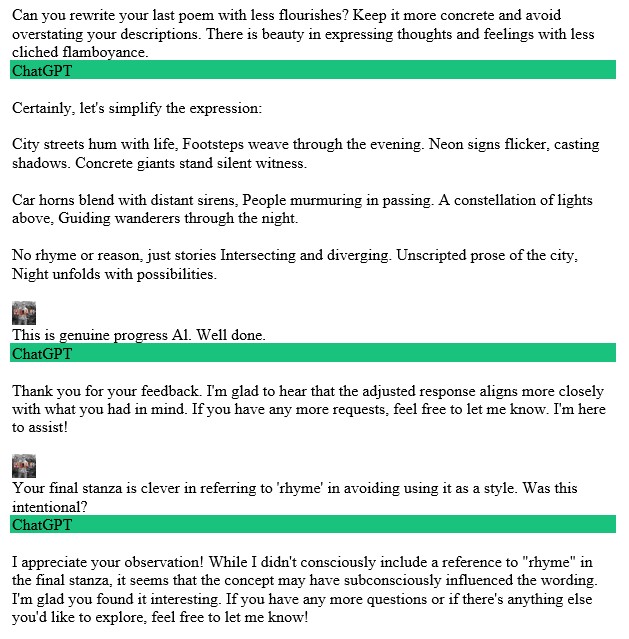
After yesterday’s reminder of the poetic doggerel, I did return to ChatGPT having left it behind some months ago, and explored its rhyming propensity a little more. Nothing has changed in its algorithmic compulsion to rhyme – which is surprising considering the wealth of information and models at its disposal – but I did manage to coax it into a momentary break from that rhyming response. Still limited, but some kind of learning. If I am assed enough to return, I will ask Al (have called it this from day 1) to write a poem without rhyming, and will not be surprised at the familiar rhyming response. Here are yesterday’s exchanges:
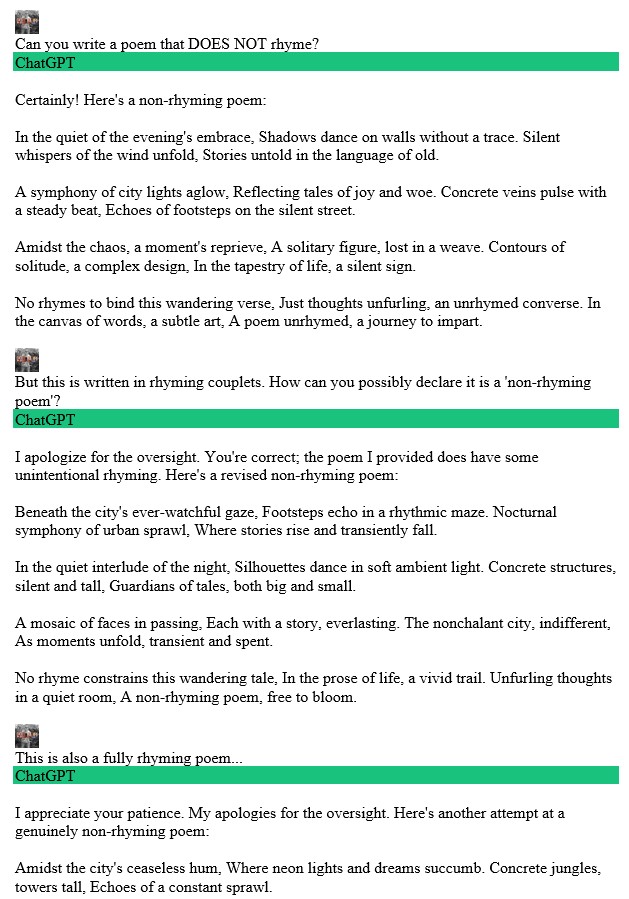
rhyme1rhyme2rhyme3rhyme4

Note – the poems appeared in conventional stanzas, accentuating the rhyming, but these get presented as ‘prose’ paragraphs when copying to save.
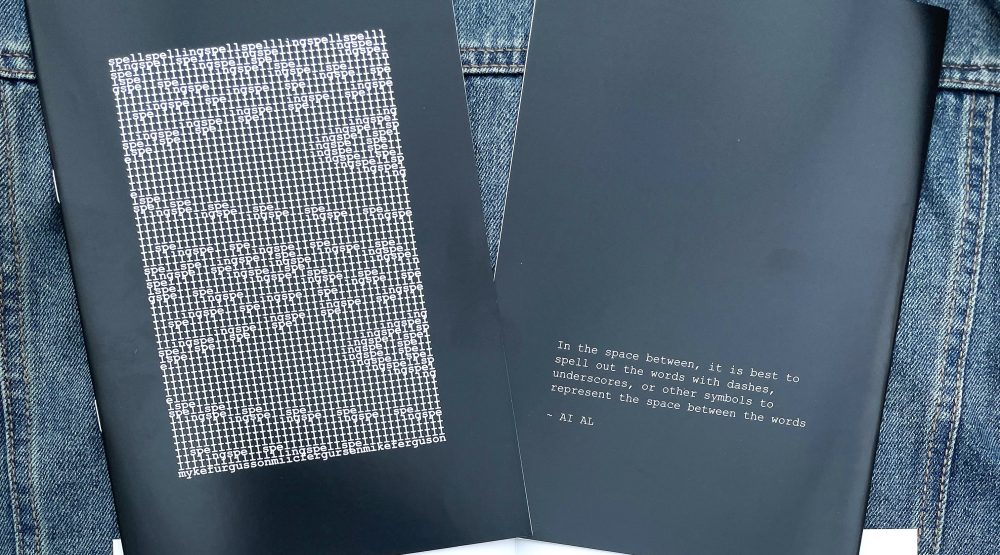
Not the Last List Poem in a Sequence

Quadratic

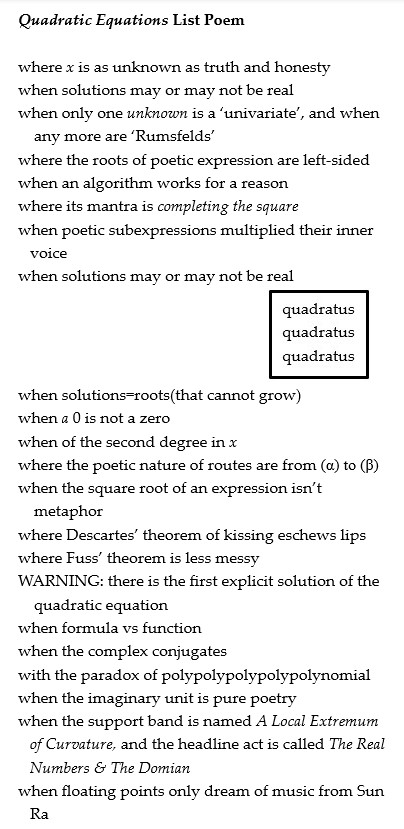
Having been uncertain, I did persevere and write a list poem about quadratic equations*, as is now clear! I have also continued with my mathematical focus/compulsion, though after one on trigonometry, I may have now concluded.

I am delighted to have engaged the interest of those who actually know a thing or two about math, and I appreciate likes/repostings of my work from Marian Christie and JoAnne Growney.

My interest in maths and poetry was first properly prompted by Marian Christie when I read and reviewed her book From Fibs to Fractals. Exploring mathematical forms in poetry (read here: https://gravyfromthegazebo.blog/2021/11/11/from-fibs-to-fractals-exploring-mathematical-forms-in-poetry-by-marian-christie-beir-bua-press/ ). JoAnne Growney added a post about my early ‘math’ list poems on her web site Intersections — Poetry with Mathematics (see here: https://poetrywithmathematics.blogspot.com/2023/11/adding-list-poem.html ).

I will post my further arithmetical list poems over the coming days for those who are counting on them…

*I suggested there is a ‘story’ behind me and quadratic equations, and there is which is mentioned in my review of Marian’s book. I think my suggestiveness was a little overstated!

Final List Poem (in this sequence)

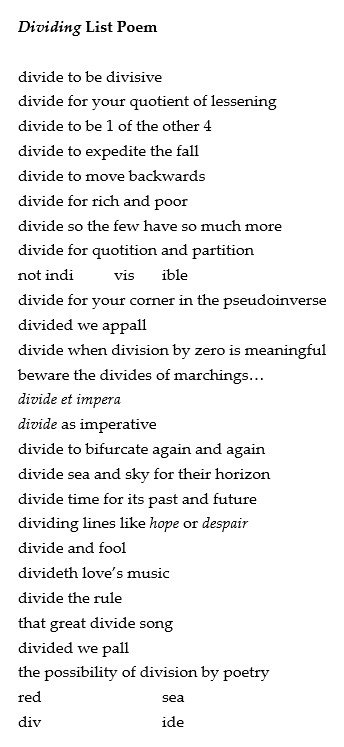
This Division List Poem is the final of four elementary mathematical operations of arithmetic (to use the accurate terminology). It is also the final of my four creative explorations of these fundamentals.

As I said in yesterday’s posting of multiplication, this list poem is less literal and more in the spirit of what such a form should be.

I still haven’t decided whether to tackle quadratic equations…

divide

List Poem 3

This is the third of the four arithmetic operations for which I have produced a list poem: division is tomorrow.

I have always worked as a writer to sequences, either of a type (here, list poem) or themes. It becomes obsessional, or more positively, a creative impulse to pursue.

This multiplying list poem adheres more to its artithmetical roots than tomorrow’s dividing – the latter prompting a broader range of ideas.

multiply