Cicada Shells

Blue jays swooping and
slapping with wings –

with flashes of surge
not bombs wedged in their beaks

and suckered to the off for an
escape into something different –

fireflies are igniting each flight
with cherry red terrestrial blood

along that lucky chasing
never to return, never to return

and cicada shells of balm disguise
their screeches, claws anchored.

John Steinbeck – Burning Bright

Originally posted November, 2011

js - Copy 1

Artifice Alight but Alright

If you teach GCSE English in this country, John Steinbeck’s Of Mice and Men is the holy grail of engaging in educational pragmatism: teaching a book of unquestionable literary quality that is accessible, meaningful, challenging and examinable for all. That this is the only prose literally hundreds of thousands of young people here will ever know in any depth is both glorious and despairing, but I’m not pursuing that paradox now. Come January 2012, my next examination period, I will no doubt be reading and assessing hundreds of more OMAM responses, and I love it.

Like the other millions who know Steinbeck’s work well, I am a devoted fan, both as reader and teacher. I read most of his work when I was 19 years old: in brief, whilst working on the farm I once spent a few weeks driving a tractor and trailer that collected silage and this entailed long periods of simply waiting my turn to have the latter filled, and in these moments I read Steinbeck’s novels, there in the tractor cab. That said, I do recall exactly where I was when I finished The Grapes of Wrath, my favourite novel of all authors: in the small second bedroom of my cottage. I can’t remember where I was when JFK was shot, or the moon landing, but I do when I read that astonishing ending. And what a colossal work: the storyline, the politics and philosophy, the dialogue, the intercalary chapters with their metaphoric reflections, the biblical prose and the expansive descriptive narrative.

js 2

This is by way of introducing and writing briefly about Burning Bright which I have just finished. As I said recently, I thought I had read all of Steinbeck’s work but found this untouched on the shelf. It is problematic as a read in a way his other work isn’t. I chose not to read Steinbeck’s own forward at the beginning, though I did after the first Act, a clue I had missed when I began. The opening descriptive detail is classic Steinbeck, for example in the introduction to Joe Saul,

A lithe and stringy man of middle age, Joe Saul. His jaws muscled against strain and cables down the sides of his neck. His arms were white and blue-veined, with the long chords of clinging and hanging rather than the lumps of lifting. His hands were white, the fingers spatulate, and palms and fingers calloused from the rope and bar.

The setting for Act One is a circus, and the opening detail is typically taut and clear in presenting place and the four main characters: Joe Saul, Friend Ed, Mordeen and Victor. We see immediately the tent where Joe is getting ready to perform and the stubbled field where this and others are pitched. We also see immediately that he is a trapeze artist and Friend Ed is a clown, and so on. Simple and succinct and vivid. It is soon apparent, however, that the dialogue is full of artifice. When Friend Ed enters, he speaks with a knowing that doesn’t ring true, but background detail – Joe’s loss of his wife and partner – is quickly conveyed in the rather heavy opening exchanges.

At this point I sensed the theatricality of the dialogue and turned to the forward where Steinbeck talks about the experimentation of writing this as a ‘play novelette’ and his rationale for doing so – obviously referencing the roots of this in Of Mice and Men – so my instinct was correct though I should have known this anyway, considering myself to know his work well!

And here is an example of the artifice and melodrama in the speech,

Joe Saul stirred. ‘Yes, I know that. But something like a ceremony, something like a golden sacrament, some pearl like a prayer or a red flaring ruby of thanks. Some hard, tangible humility of mine that she can hold in the palm of her hand or wear dangling from a ribbon at her throat.’

The artifice is carried into the structure too, the four Acts taking us with the same characters and situation/plot into wholly different contexts – from circus, to farm, to the sea [on a freighter], and to a hospital room. The central plot twist is also quite evident near the end of Act One, so it is a highly crafted, and visibly so construction. As a tale of love, friendship, self-sacrifice, deceit and human compulsion, it tackles the major literary and real human themes. I think I would find a stage production as inevitably stilted, and because Steinbeck attempts to embrace both prosaic and theatrical genres, it is ultimately – but because it is him – a jack of both and marginal master of each. And perhaps my experimental appropriation of a summation is equally contentious.

So would I recommend it? Of course – it’s Steinbeck! Even with the stylised dialogue and plot projection I found the story compelling, from simply wanting to know how it ended, to being fascinated by the experimentation and wanting to see/read it through. When first published in 1951 [as a companion piece to The Pearl; it was first published as a single volume in 1971] it was, apparently, criticised in reviews both as prose and as a play, though the experimentation was acknowledged more positively, this a little condescending though if I’m honest I suspect I too value it for this creative impulse over its realisation.

I have located a video version of a 1959 stage production of Burning Bright and I am intrigued enough to want to see if I can get this. I wasn’t able to find a picture of my single volume Pan edition, but I do like the two versions I did find, which both focus illustratively on BB rather than The Pearl [the latter of course highly regarded] and it is interesting how those images so clearly ‘sell’ the human relationship drama as soap opera!

js 3

Victory and Failure: Feminism and John Steinbeck

The recent victory in reversing a decision made by the Department of Education to remove feminism as a topic of study [and the wider impact and role of women] from the A level Politics syllabus is a tribute to the public campaign launched by student June Eric-Udorie. Her trenchant arguments were presented initially through a Change.org petition and grew by prompting/eliciting the support of Rupa Hug MP as well as Catherine Mayer and Sophie Walker of the Women’s Equality Party. You can read the parliamentary debate about this on the Hansard site here. If you missed it, there is also a nine minute audio clip from the Woman’s Hour programme here where the issue was discussed in December 2015, and you can hear from the second year A level student herself.

What this demonstrated among many positive attributes is genuine democracy working against dictate, the latter an increasing default position of this government. Those who have followed me on this blog will know of my arguments with the DfE regarding Michael Gove’s dictatorial decision to have American authors removed from the GCSE English Literature syllabus, a decision Nicky Morgan, as successor to Gove, took no interest in reconsidering whatsoever. My point now isn’t to rehash that argument: instead, I use Eric-Udoria’s victory to reiterate my disappointment in the teaching profession – English teachers in particular – for not presenting a similarly coherent and vehement argument against Gove’s decision at the time. One could argue that decision will now have a much wider impact on students than the Politics A level decision would have had if it remained. English teachers should have been the most articulate and persuasive body in presenting an unassailable case, but we failed to do so.

Therefore, this brief reference is to serve two purposes: first to congratulate the victorious June Eric-Udorie and those who signed her petition [I did] and those influential people who then supported beyond this; and second, to provide some context to my continued posting here of writing made previously on another blog, some which will focus on John Steinbeck, a major and engaging author that GCSE English Literature students can no longer study.

Kenneth Patchen – Eve of St Agony Or The Middleclass Was Sitting On Its Fat

Originally posted in November, 2011:

Proletariat Poet

patchen - Copy

I’m sure this is a repetitive point, but writing this blog is as much diary as it is music review and presenting poetry. It keeps me busy, reflects music being listened to, and then other thoughts and ideas. Sometimes it gets read by others.  One writes to be read, let’s be clear, but the self-reflection and actual preoccupation of the physical writing is the fundamental purpose, designed or not.

Just ahead of reviewing The Claudia Quintet + 1 featuring Kurt Elling and Theo Bleckmann – What Is the Beautiful? I have been reading the poetry of Kenneth Patchen which this album celebrates. I did not know his work, though I should, so I have been reading about him and his poetry before getting into this album that honours the 100th year of his life and work, Patchen having died in 1972. So as well as diary and self-reflection and so on, researching and writing for this blog is educational.

Patchen was active in linking poetry with jazz music and performance and that is clearly the  focus of The Claudia Quintet album. I’ve enjoyed reading a small selection of his poetry found online, especially his more political fare. In his early days he was apparently referred to as the Proletariat Poet, and although Patchen allegedly rejected this appellation, it is obvious why he was given the title, and the one poem I’m going to print here illustrates that. It also speaks as much for today as it did when written in 1939 [*],

Man-dirt and stomachs that the sea unloads; rockets
of quick lice crawling inland, planting their damn flags,
putting their malethings in any hole that will stand still,
yapping bloody murder while they slice off each other’s heads,
spewing themselves around, priesting, whoring, lording
it over little guys, messing their pants, writing gush-notes
to their grandmas, wanting somebody to do something pronto,
wanting the good thing right now and the bad stuff for the other boy.
Gullet, praise God for the gut with the patented zipper;
sing loud for the lads who sell ice boxes on the burning deck.
Dear reader, gentle reader, dainty little reader, this is
the way we go round the milktrucks and seamusic, Sike’s trap and Meg’s rib,
the wobbly sparrow with two strikes on the bible, behave
Alfred, your pokus is out; I used to collect old ladies,
pickling them in brine and painting mustaches on their bellies,
later I went in for stripteasing before Save Democracy Clubs;
when the joint was raided we were all caught with our pants down.
But I will say this: I like butter on both sides of my bread
and my sister can rape a Hun any time she’s a mind to,
or the Yellow Peril for that matter; Hector, your papa’s in the lobby.
The old days were different; the ball scores meant something then,
two pill in the side pocket and two bits says so; he got up slow see,
shook the water out of his hair, wam, tell me that ain’t a sweet left hand;
I told her what to do and we did it, Jesus I said, is your name McCoy?
Maybe it was the beer or because she was only sixteen but I got hoarse
just thinking about her; married a john who travels in cotton underwear.
Now you take today; I don’t want it. Wessex, who was that with I saw you lady?
Tony gave all his dough to the church; Lizzie believed in feeding her own face;
and that’s why you’ll never meet a worm who isn’t an antichrist, my friend,
I mean when you get down to a brass tack you’ll find some sucker sitting on it.
Whereas. Muckle’s whip and Jessie’s rod, boyo, it sure looks black
in the gut of this particular whale. Hilda, is that a .38 in your handbag?

Ghosts in packs like dogs grinning at ghosts
Pocketless thieves in a city that never sleeps
Chains clank, warders curse, this world is stark mad

Hey! Fatty, don’t look now but that’s a Revolution breathing down your neck.

[*] Read today’s High Pay Commission report, for example, and especially the Banks’ refutations of its findings which essentially amount to arguing that top salary increases are by the Banks’ calculations only massively disproportionate rather than mega-massively disproportionate! Their creed: greed is relative.

NB And in the years since this posting, little has changed in this regard, banking recently removed from investigation! But then, that is the lasting relevance of Patchen’s preoccupations, sadly.

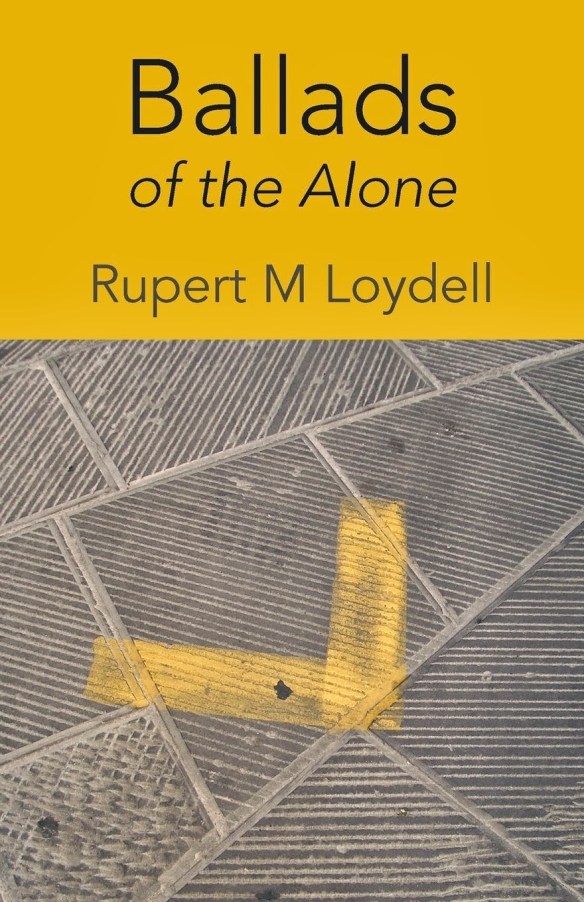
Ballads of the Alone – Rupert M Loydell, book review

Originally posted October, 2013

rupert - Copy

No Difficulties Here

If you like your poetry linguistically rich, at times playful, willing to surprise and always honest in its revelation of self [or is it another?], then Rupert Loydell’s latest collection Ballads of the Alone will delight and please.

These modern ballads – patterns really but defined by their precise and repeated shape and structure – are based on the visual and written work of named photographers, this context and background outlined in the introduction by H.L. Hix, the American poet and academic.

It is an intriguing introduction. Much of the first page is intent on explaining the poems’ ‘difficulty’ by way of laboriously, to me, exploring the etymology of the word ‘difficult’. I don’t actually find the poems difficult – ‘complex’ perhaps, but for me this has a positive connotation whereas ‘difficult’ does not – and as I am clearly in disagreement with that focus I naturally leapt at one of Hix’s rather fancy extrapolations when he unravels the following ‘It is disfacilis: i.e. it is not facile’ because, in the spirit of Hix’s microscopic deconstruction, I would say that there is a wonderful felicity with language in these poems. Where the introduction is of more interest and pertinence for me is when Hix explains how the convention of these poems is ‘that of ekphrasis, the description or evocation in poetry or another work of art’.

It may seem churlish to have a go at an introduction which is actually enthusiastic about the work, but the self-indulgent start put me off. Indeed, Hix’s examination of the link between Loydell’s poetry and the photographers from which they borrow and reinvent is knowing and informative.

To the poems: they are wonderful. I do respond in the first instance to their sound, the sound of language carefully crafted to surprise or sooth and so much inbetween, even to suggest a ‘difficult’ observation in as much as it needs time to unravel or remain mysterious. What I mean is I am not looking for meaning. It’s an impression, and each ‘ballad’ offers just that. And because they are impressionistic they don’t bear easy analysis or explanation – perhaps what Hix was, for me, overstating. I enjoy not knowing and do not find this a problem.

But I am in danger of over-working around them too. It is best to look at two examples, two that I particularly like, but it could be a random choice as each is as effective and engaging as the other, in part because of the precise replication of a pattern. The two I will look at are from the second section Multiple Exposure, poems after Aaron Siskind. The first is number 9:

another set of ruined buildings
ghosts of structures such as these
inculpate query sausage tilt
bridges, girders, lines and chains
a peculiar perspective

light brown coat of rain
a favourite of my father’s
cornflake wrestler resurgence monk
drifting fog among dripping pines
living worlds of mutual trust

a sort of shrinking into life
phantom pains within my chest
volcanic upright belligerent jump
sheets of paper blackened with print
balance of time as well as form

I love each third line of words in each stanza. Because I love words, but because here I love the selection and juxtapositions and jokes. Inculpate is a great overbearing word – to accuse – but it is linked or not – yet it’s in the same line – with sausage and I don’t really care if that has any significance, and it certainly isn’t difficult, but it is a little surprising and certainly quite funny. The same goes for the enjambment that leads us into cornflakes, and the fact there is a wrestler rather than ‘milk’ is strangely reassuring. That may sound like jest but I am quite serious. It is as I have said the sound and the surprise that delights. Of course, it is also the ruined buildings and the ghosts of structures, the mention of a father, and then the shrinking and phantom pains as well as blackened and balance that all disturb.

hundreds of forgotten pictures
sometimes layered deep
exclamation register irrigate chime
overheard rooms empty of noise
transparent moments such as these

love shows itself minute by minute
in ways that are easy to doubt
inverse armature liquorice cheese
alcohol has dulled its progress
formation dancing in the tide

the midday sun is strengthening
gravity become too much
cucumber traffic fearless grill
there is only absence in the world
balance of time as well as form

And you will have noticed that the last line is repeated, and this is the case for every poem in each section, but that is a separate repeated line for each of the five sections. I could, but won’t, revel in the third lines again, and I haven’t yet explored the food references, but I leave that to your own recommended reading. I like individual lines like overheard rooms empty of noise because that does make me stop and think.

So much of what is in these poems is found and appropriated from external sources – the ekphrasis which underpins all – that locating meaning is bound to be a fractious journey and I would much rather enjoy the dislocating but strangely reassuring ride rather than be over-concerned with the destination. I rather think that is exactly what Rupert Loydell has chosen too, and he would seem to have enjoyed it in the writing as much as I am in the reading.

Purchase here.

Not Only in the Metaphor

as mirror to the beginning
it is keeping calm

in symmetry
and equilibrium

in the simple meandering
rolling along

therefore has epistemology
syllables for balm

whence the nothingness
but also their meanings

a simple start being articulated
and just a few sounds

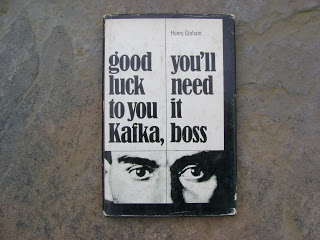
good luck to you kafka/you’ll need it boss – Henry Graham

Originally posted February, 2012:

graham

the man from the finance company
came again today he wants to know
when i’m going to pay but what he won’t say
is what it was i bought

one morning perhaps when i was high
on poetry and corned jock butties
i must have wandered threepartsmental
into a departmental store and bought something

a three piece suite for my sweet
a frigidaire to keep frozen my despair
a fitted carpet for the inside of my head

he just won’t say what it was
and when i laugh he looks the other way
apparently i have only fourteen days left
he won’t even say what happens then

i suppose they will come and take away my eyes
(which i know i haven’t paid for)
or the words that live inside my head
or my surprise at raindrops or the use

of my legs or my love of bread
then again they just might forget
about me and go away / fat chance

When Allen Ginsberg visited Liverpool in 1965 he declared the city the centre of the consciousness of the human universe, or words to that effect because there are a variety of alternatives out there, and for those who doubt he actually said it, Brian Patten is quoted as observing I think Allen believed the centre of human consciousness to be wherever he was at the time.

This is by way of introducing Henry Graham who was a Liverpool painter and poet of this time, having attended that centre of cultural significance Liverpool College of Art. He didn’t make The Mersey Beat selection, but he was a similar poet of that oeuvre. This book was published in 1969 and I acquired my copy in 1973. The appeal was obviously the poetic irreverence of the moment and the celebration of comic meaninglessness, or I guess I would have seen in this poem at that teenage time an anti-establishment sentiment, a mockery of the powers to be who would try to deprive us of the words that live inside our heads and a love of raindrops and so on. It was just fun.

I wrote plenty of immature gibberish trying to emulate this poetic hilarity. It’s not as easy as it might seem. I’ll post an example one day when I’m feeling very confessional…..

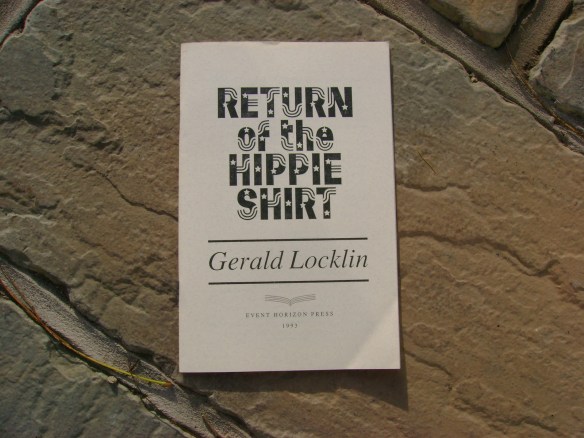
Return of the Hippie Shirt – Gerald Locklin [1993]

Originally posted in October, 2011:

gerald1

Just read this brief tale today, a 20-year-later sequel to The Hippie Shirt. In that original story, Robert MacGregor, a 35 year old actuary, is befriended by a hitchhiking hippie who literally gives him the shirt off his back – which leads to the comic, if dramatic, dissolution of Bob’s life as lived then.

In this sequel, Bob is hitchhiking across America having spent the last 20 years hanging out in the summer with the Ojibuitske Eskimos and wintering with the Oaxicoatle Indians of the Andes. His reason? Because they wore similar shirts. At least that’s what he tells the two cops he meets whilst hitchhiking again all these years later, and who want to beat him up – like two decades ago – but are scared off when Bob convinces them they are being observed by satellites. It’s the best moment in this sweet revisit.

gerald2

Locklin is a fine poet in the great Bukowski tradition and I have always enjoyed reading his work. I’ve also used it in my teaching: I had the wonderful my son wants to ride the chairlift printed in a book I wrote on teaching and examining poetry, Poems in Your Pocket [Longman], and I have used his poems as stimulus for narrative transformations – he is such a superb storyteller, usually witty but so often punching the reader with the shock of sudden truths. Here’s an example from his book The Firebird Poems

a tyrant for our times

it’s in his novel ham on rye now,
but i remember bukowski telling
a long time ago
how his father used to beat him,
and when he’d turn to his mother for help,
she would intone, “the father is always right.”

i liked the way it sounded
and so, even though i don’t beat my kids,
i do like to tell them
“the father is always right.”

they tell me to get fucked.

oc30_001

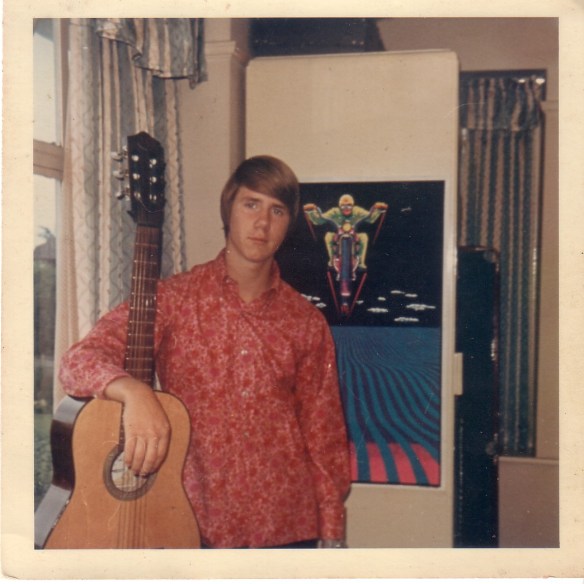
……I don’t get that many opportunities to post pictures of my own hippie shirt, back in the day…..