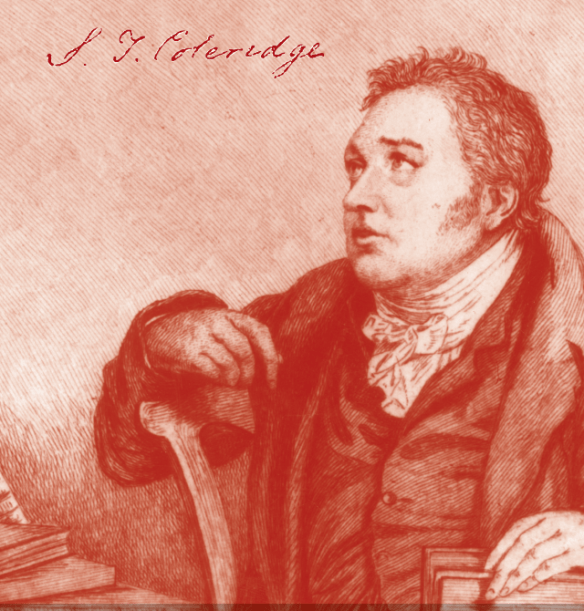
‘In all processes of the understanding the shortest way will be discovered the last and this, perhaps, while it constitutes the great advantage of having a teacher to put us on the shortest road at the first, yet sometimes occasions a difficulty in the comprehension, inasmuch as the longest way is more near to the existing state of the mind, nearer to what if left to myself, on starting the thought, I should have thought next. The shortest way gives me the knowledge best, but the longest makes me more knowing.’
– Samuel Taylor Coleridge, Chapter V, ANIMA POETÆ
Managing the Coleridge Memorial Trust social media platforms and website as well as its memorial statue Crowdfunder campaign [now postponed], I have over at least the last three months been immersed in Samuel Taylor Coleridge’s writing – his poetry of course, but perhaps more so his aphorisms and maxims from ANIMA POETÆ which is a collection of the written intense outcomes of his relentless thinking and contemplation on issues ranging from a comparison of the efficacy of wood vs coal burning to expressions of deep love to philosophical ruminations.
Accepting that we can all sometimes find what we want to find, I have been reading and re-reading the quotation of his that leads this post, never feeling confident that I have pinned down exactly what he means. It is a complex thought and sentence to articulate this. But I do feel I now have its emotive and intellectual gist, and that is about how knowledge acquired over time and experience is more meaningful – and useful/purposeful – to that acquired quickly by instruction, and that [quite obviously] by rote.
That may seem eminently sensible, and I think it is, but Coleridge’s expression is quite convoluted. However, I don’t intend to unravel his expression further through analysis as I am more than happy with his conclusion about knowing over knowledge, or certainly as I see and understand this.
And I have found this certainty because I believe it to be true. I believe it to be true because it underpins my teacher’s objection to the current fashion for a Knowledge Curriculum, that purported by the American educationalist H.D. Hirsch and his UK acolytes Cummings, Gove, Gibb and even lesser less-knowers Young. That this fashionable theory for learning [though I use that term ironically] has informed the current Ofsted Inspection Framework is part of the danger I see in giving primacy to Knowledge over Understanding, the latter which is Coleridge’s knowing.
That’s it.