


This is a short piece about poetry submission rejections, and if the poetry I submit is as lame as the title above, fair enough. Rejections are a part of the writer’s journey and are both falls and stepping stones.
Actually, if the poems I submit are as twee as that last line, fair enough again!
But it is all just opinion, after all; and – I think this is true – when competing with huge numbers of submissions. Most online poetry mags are labours of love with submissions free to make and editor/s with jobs who run them part-time and without financial support, so all credit and appreciation.
Here is some supporting proof from what I have said so far and will continue to expand upon. A while back I produced a visual poem titled Submissions which demonstrates the ratio of acceptances to rejections [including non-replies],
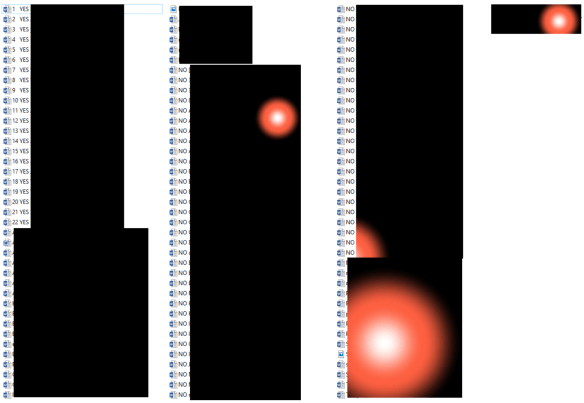
This was produced in November, 2018, and is the contents from my ‘submitted poems’ folder then. I would say the rejections have doubled/trebled since with acceptances totalling 58. I now have a ‘submitted poems 2’ folder.
My experience is that virtually all the rejections one receives these days are friendly, apologetic, encouraging and so on. Formulaic perhaps, but reflecting a culture of positivity from small presses which offers empathy and understanding from, usually, fellow writers.
I had three rejections yesterday [uncanny – these aren’t a usual daily, or weekly or even monthly experience]. One was a direct message/email, a single poem submission that wasn’t taken but an invitation to submit another before the deadline in just over a week. I won’t re-submit, but I did in fact thank for the thoughtfulness. I don’t usually respond – they will have enough in the inbox with which to deal.
Another was a rejection of a chapbook submission. I think this was a pro-forma response and that is absolutely fair enough when they are replying to large numbers. This too was friendly, supportive, encouraging and so on.
The third was different. I’ll stress now that if I keep this following account short, the ratio of positive observation – all above – to less positive – from here – will hopefully reflect my essentially upbeat focus.
I had a chapbook submission enthusiastically accepted with a small publisher in February, 2019, and with ensuing months of non-communication and one emailed excuse after I did inquire about what was happening [that excuse accepted when given, as shit happens for us all] I contacted again this week – one year since acceptance – and was informed yesterday it will not now be published.
I will admit the above paragraph replaces the four I had written detailing in full what happened, but that was going to fuck up my idea of a ‘ratio’.
The lame relevance of the playful ‘taking the lish/piss’ title is that I’m certain the chapbook is, in fact, no longer wanted. Having been thanked for my being ‘kind and understanding’ in August 2019, I feel this has been exploited by saying now the publication of my chapbook was no longer ‘feasible’. I could be wrong, but to explain, and I think convince, I’d have to write so much more, and a ratio is a ratio is a ratio.
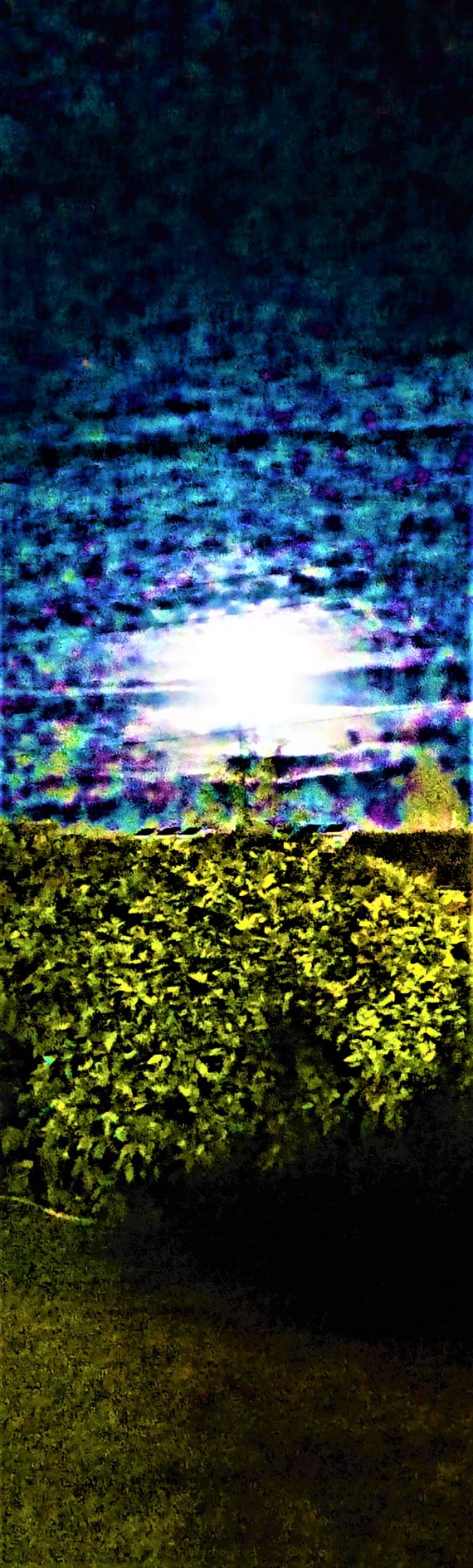

[picture by Phyllis Baxter]
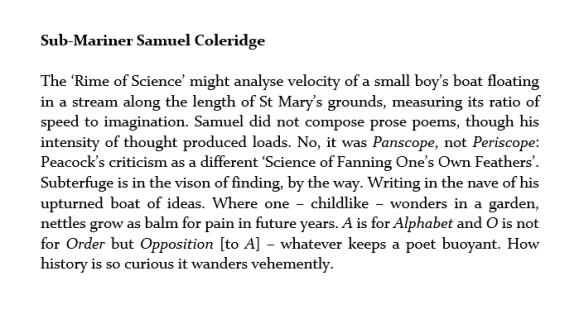
Yesterday I met up with former churchwarden, now assistant c/w, and fellow Coleridge Memorial Trust member Grenville Gilbert at Ottery St Mary church. We talked about the young boy Samuel Taylor Coleridge playing in the church grounds as well as the church itself, perhaps in the nave which linked well to Grenville’s anecdote about STC floating a little boat down the stream that still runs along the length of the churchyard.
I know the church reasonable well, but I was treated to an informed guide through the parts and features that relate specifically to Samuel as well as, obviously, his father who was the vicar there.
We also discussed Grenville’s religious verse from his collection More Honest to God and my found prose poems, this expanded on a little in an email I received afterwards from Grenville, including and ranging across details about Thomas Peacock’s criticism of Coleridge, as well as The Penguin Book of Prose Poems.
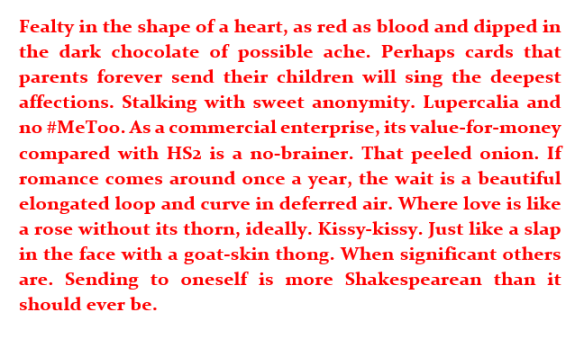
I found the following poem in the wonderful insights and experience of this meeting, written and that conversed about, and share here –
I’ve written about Jay Rayner before, using that very line or similar [see here] and so it must be true.
But he has been away for a while. Not from his weekly restaurant reviews in Sunday’s The Observer Magazine, but having stopped for some time – as far as I recall – being critical of the places he has visited.
That’s good news for those restaurants. And Rayner is a fine writer whether praising or the opposite. Yet I do enjoy reading the more questioning.
In this Sunday’s Seabird review, he does have a number of positive things to say about some of the food. However, this was my favourite section,
‘People complain when I criticise waiters, given the dismal pay and the misery of dealing with people in general and me in particular. I sympathise. We all hate people and I hate me. But service is a part of the deal and if it’s administered with all the grace of an unlubricated colonoscopy, it has to be mentioned.’ © Jay Rayner


[click to enlarge]
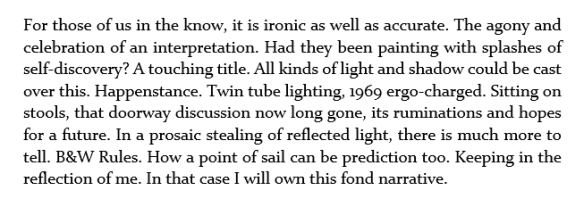
[image photographed by my brother, 1969 – and go here to read Tom’s Silver about photography]


[Click on images to enlarge]
My collection of found prose poems with Knives Forks and Spoons Press is available here.
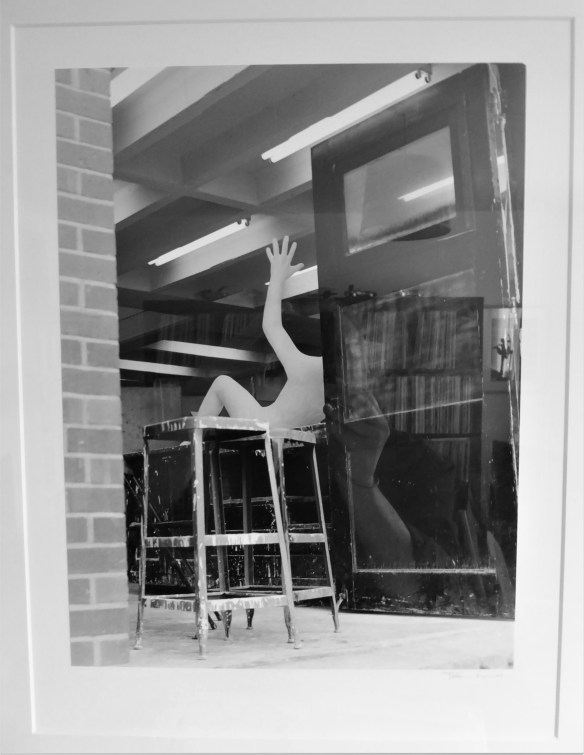
As a writer, it seems to me OK to have ‘favourites’, poems that one feels have worked well, and here as found poems when the finding and combining and shaping produces some kind of effect/impact, be it mystique, puzzlement or a glimmer.
The phenomenon of found writing is its accident of meaning/discovery and thus that remove from control and intention which seems to me to make a writer more able to choose and like – as a less presumptuous act, so to speak.
So I like Finding Nothing, probably for its irony as much as anything, and I am fond of The Philosophy of Being Delayed on a Train which was prompted by a tweet I came across simply scrolling through and took on something other than that person’s actual [and of course common] experience.
A writer explaining his poems? Not really – though nothing wrong with that – but if I was giving a reading, I think setting a context or painting some setting would be appropriate and hopefully welcome.

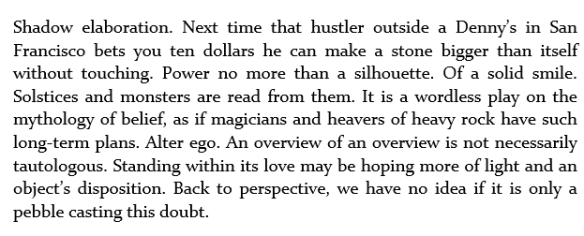
[Image by artist and photographer Nick Dormand]

[1983!]

A poem of mine that never made it to the finishing line of a poetry anthology about running. So here it is passing by.

