Last one – see previous two postings. I’ve had fun.
Last one – see previous two postings. I’ve had fun.

[See previous post]

[*] At the end of Martin Stannard’s upbeat review of my poetry chapbook ‘Professions’ here, he made a suggestion for further writing:
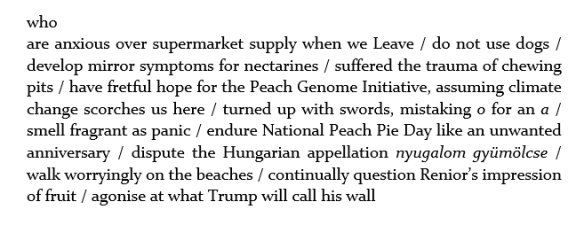
The only other thing I have to say is that there is scope for another set of these things, because all kinds of professions remain to be written about. The surface has barely been scratched. I’m thinking, for example, of tripe dreamers, lantern dressers, violin stringers, nose touchers, chestnut counters, mattress washers, mitten strummers, card stunters, peach worriers and unicorn whiteners among others. Perhaps someone will write a companion volume to Professions one day soon, or maybe Ferguson will do it himself.
I have.

Most pleased to have a found prose poem here today, and with my sincere thanks.

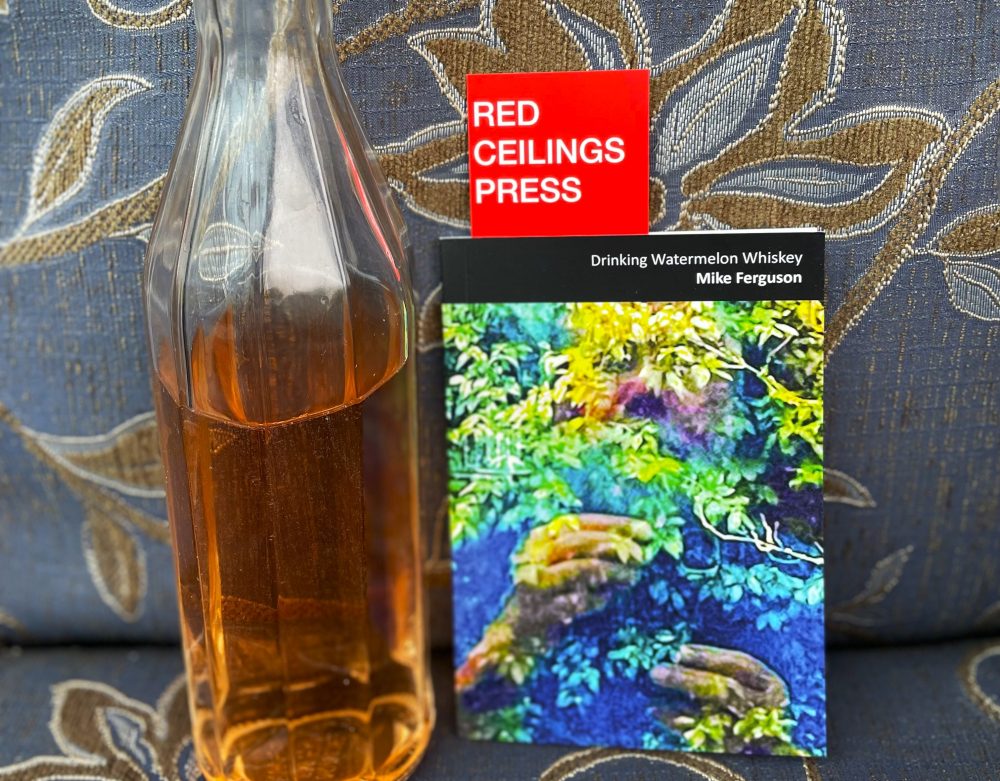
In Ian Seed’s back-cover blurb to this wonderful Red Ceilings chapbook, he states rightly of how the poems ‘do not shrink from expressing despair’ but also how they ‘reach out to us through their beauty’, and this duality is the lyricism of a ‘crazy scene’ [words from the final poem] which defines Baker’s achievement in keeping us hopeful in the pain of what we read in this collection.
This mix of despair and beauty is, for example, encapsulated in two sets of italicised lines – as speech – in the book’s third prose poem, the second line of which is
“There are no rough sleepers, and no-one is lying awake figuring out how to pay their medical bills. The world turns; there is song, a set of scales and keys; words, a vibration in the mouth and ear; blood, a sense that it no longer rules.”
We immediately recognise this modern world – quite unacceptably our own [framed as not existing] – and the lyricism soothes the thought to ironic sharpness.
A line in the fourth poem subverts further through this mixing, I think, by claiming ‘Tonight I’m feeling lyrical:’ and what follows as a quote is actually quite formal and seemingly dated as an expression, and what continues beyond is a portrait of dislocation and yearning as a synthesis of diminished acceptances, for example ‘hoping for Limbo, if not the Elysian Fields’ and where ‘those of limited curiosity are happy’.
At another location in the next poem there is the sweet line ‘that’s where the aspens shed their silver, and birds sing with the voices of children’ but its face is shoved up against another reality, masked in wit, of ‘Don’t come here, where negative interest rates threaten stability, and the Foreign Minister attends meetings in a clown’s outfit’ so the fragmentation in the feel of moving between various expressions reflects our kaleidoscopic world and lives: we see one momentary and welcoming pattern, but on arrival, the view and experience have been altered a fraction yet to something entirely different.
There are many other more painfully bifurcated hopes and actual experience, as in the sixth poem, but to quote here would be to ruin the involvement of reading in its narrative those shifts, though what has preceded [and I think hits hard] is mirrored in the poem’s closing line of ‘there’s a sheen in the air, rain, or charged ions before rain, before a storm.’
Storms can be beautiful but of course they are also destructive. Therefore, in the ninth poem, a seemingly straight meteorological account of the weather is, we sense, brooding with dark clouds. In the tenth poem, a possible tour guide is full of invite as well as menace.
That these are letters from the underworld which do or do not get past the firewall of their creation attests to their ‘crazy scene’ by having emerged but containing paradox and confusion and lyricism. They are ghost writings in one sense, and like ghosts, bear witness through visitations across the world’s miseries other than death – especially current ones of conflict, precarious escape, desperate hope for sanctuary, and whatever elements of survival can be found: this latter sometimes, but not as often as it should be, through what is provided by the kindness of others who recognise a common need.
As we read through all the poems there does seem to be an increasing and collective conflict between the representation of hope and what is allowed [as I have already mentioned] and this is a ‘compelling whole’ as Seed, again rightly, concludes in his blurb. It is an entirety that has been made so by the recognisable if discomforting contexts/references in the prose poems, but most importantly also by Baker’s language mastery of the prose poems.
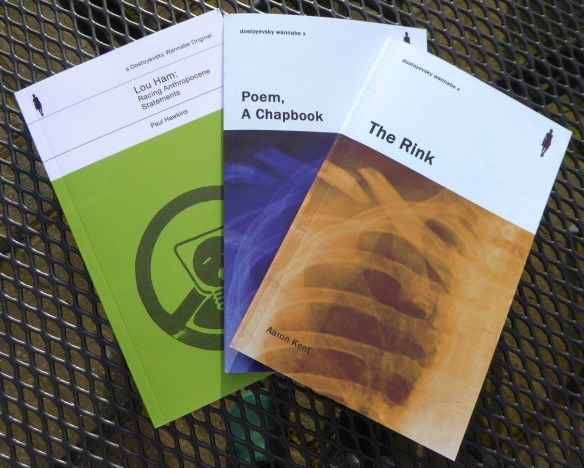
And Three Brieflys
The Rink – Aaron Kent
In a world of uncertainties, it is reassuring to feel reasonably confident that Kent’s own poetry publishing press is named after the closing two words of this chapbook’s opening poem Ice Skating, Garden of Eden, 1998.
That the ‘Eden’ of the poem’s title is ironic and apt within a set of poems about being anxious and finding ways to express aspects of this is also reassuringly certain.
In a blurb-stated anxiety about nuclear war, lines like
‘We are three bombs away from night time pressing
halos into the rearview mirror.’
[I Have Eaten The Moths And Now My Mouth Is Soot]
convey a lyrical paradox in the poetic expression of beauty and destruction which is potent.
In the sonnet Moving My Family Into A Den In The Corner Of The House, Kent is playful with language echoes like
‘It is there we can cower less, coward less, courage
lest…’
and then finds the killer lines [pun intended]
‘…Our daughter’s too fresh to fully
understand the difference between a soul set aside
for the ripening and nuclear devastation.’
These poems address a range of apprehensions in a personal world of trying to find stability in the old traditions of home and family, but disruptions from the other dangerous ones interrupt. New poems placed on old ones and other found reminders of others’ [a magic three of intended puns] different realities make this a fresh and at many times haunting reminder of what does not change,
‘We forget we are working class / We are disposable.’
[Amnesty International Workers]
Poem, A Chapbook – Timmy Reed
Do you want to feel love? Then this chapbook is for you.
But first we hear about ‘dudes’ and an absence of punctuation – ‘This book contains no periods’ – and I like that surprise.
The fact a question mark is in the next poem could be another surprise, but to be fair, Reed didn’t say punctuation, just ‘periods’. Be careful what you extrapolate, I always say.
However, Reed’s playfulness is more engaging than mine. Of the question mark, he writes,
‘That last one was a question mark
It looks like a period on fire
A lump of coal
Releasing a plume of black smoke
Like a flag above it
But it isn’t
It only denotes an interrogative
Something that needs an answer’
This is as intense as it gets, by the way, and I am making a point about an intentional lack of intensity.
There is counting in these poems – if you want – and dudes that come and go. Reading newspapers is the art of setting them on fire first to make this ‘urgent’, and exclamation marks are
‘A period with a knife in it!’
The narrative thread is playful, like having an ice cream [I mean in the enjoying sense], and the manifesto is about writing in ‘the realist mode’ but with a healthy caveat of reserving ‘the right to take liberties’.
With Reed as we read we are poeming, and that is entertainment, especially in approaching the poem’s simple but bold declaration of ‘LOVE’.
Lou Ham: Racing Anthropocene Statement – Paul Hawkins
This world tour of cut-ups appropriated from what is found, actually, or in computer searches,
‘but as you see
from my posteriors
how this is web experienced’
is a narrative as disjointed as it is connected in the sheer amount of information we can all access and understand/not understand.
It deserves being seen as it is on the page, so here it is,

Climate change and globalisation and ferrari worship are all proverbial snapshots in this collection.
There are also the occasional verb appropriations that engage for their surprises within other linguistic surprises,
‘suggest you
cormorant that
lou
this is not even eyewash yet’.
There is a discourse here about conferences and management and advertising and car racing and computing and calculating and purchasing and gymkhanas and lou
to name a few.
I will call this baited poems.
Enjoy the catch.
These three with free p&p for just over a tenner. C’mon. To find with others, visit here.

Well done to all those UK students who take part in today’s school global strike, making a protest about the effects of climate change, especially on their lives and the lives of their children/that further generation. Also well done to any schools and/or those teachers who support them and let it be known it is right and proper to stand up and be counted on issues of such colossal importance, and issues of far more significance than one day of attending lessons.
I hope those students taking part – and those who want to but for whatever reason are prevented from doing so – understand fully they have a right to express an opinion and to make that statement in a public and demonstrable and notable way. It is a right of self-expression and self-protection that they have for a lifetime and should use whenever desired and needed. No establishment has an equal right to diminish, quell or silence that.