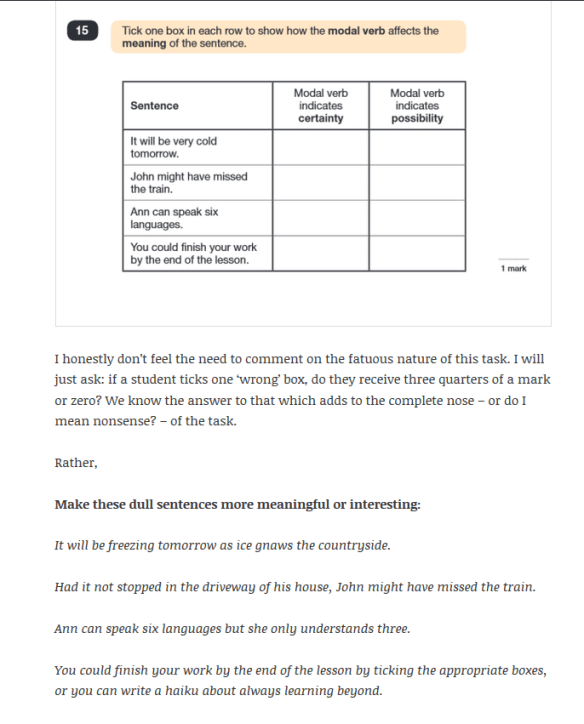
DfE Publishing of Real [ironic] Spelling Test as Sample Test on Site

Just a quick comment on this nonsense [see further details here], but I continue to be bemused by the DfE drafters’ dodging responses to public/media queries, this one of their easier dismissive deflections:

A DfE spokesman said the paper had been removed from the website.

He added: “Fortunately this is a Key Stage 1 test which is provided to schools to support teacher assessment judgments.”

Well that’s OK then! It’s not a monumental cock-up, just an annoying erection of ineptitude.

Richmond Fontaine – You Can’t Go Back If There’s Nothing to Go Back To

Never Better

I saw Richmond Fontaine at The Tunnels in Bristol on Monday as they tour their final album and as a band for the last time. The Richmond Fontaine discography is considerable and it plots over time their punkrock roots, but most importantly the memorable songs written by Willy Vlautin. His musical narratives with this band, and also The Delines, tell stories as evocative as those of his novels, and of course there are reflections of themes and motifs across all. This latest album is very much a part of that continuing literary significance, as well as musically superb: as seen in a live performance of the song A Night in the City above.

In all our worlds, time advances inexorably – it is a simple law of nature – but in Vlautin’s and that inhabited by his many personas, that ‘progress’ forward is not as the cliché would have it, even if ironically, a move to betterment. Invariably, it is about dissolution, or at best, change: but it is never the same. As the album title tells us – and I am sure the line is directly or indirectly stated in many of Vlautin’s songs over the years with Richmond Fontaine and The Delines – you can’t go back. You can physically and therefore literally, but if you do, things will not be the same and they will most likely be worse, in most cases depressingly so.

Documenting such a harsh reality, as Vlautin will do from the caustic to the tenderly empathetic, is the forward momentum of this final album from his long-standing band Richmond Fontaine, and one presumes that having made this decision to end, he and the others will not go back. In many ways, all of the song-narratives are brutal, but there are those that take observation to its plainest honesty, and even the music refuses to offer plaintive sympathies to sooth the story-line. That’s how it is with the third on this album, I Got Off the Bus, and even before we listen we know the narrator has returned somewhere that should have been left in its past:

Our protagonist has returned home where a ‘friend’ said he’d pick him up, but doesn’t show; he makes his own way to Little Mexico, once a small street but now a sprawl that never ends; he calls a girl he used to know, a nurse, who had a place on 7th Street, but her dad says she has moved and is married, living in Stockton with her baby, and the dad says he remembers him, but the narrator knows he is lying; he wakes up from a sleep somewhere to see a policeman standing over me [the chorus]; he goes to the movies but falls asleep there where a nervous 16 year old tells him he has to leave; the narrator – perhaps seeing himself in the boy – reflects you can’t go back if there’s nowhere to go back to; he goes to sit by the river where the sky was full of stars and the water was rust and the night was never ending; then there is a return to the chorus and he tells the policeman I didn’t mean to run out of everything but the policeman replies he doesn’t care as long as the narrator got out of there, and the song draws musically, and simply so, to its close.

This isn’t lyrical, but it is realistic, a tale told in the nothingness of its ordinariness but which touches because of that. The music here is more backdrop to the delivery than a mimetic carrier, and that gives it its own significance amongst the other stories of drifters and losers who reflect on their loss and misery. However – and this grows with the listening again and again – other songs are transferred with a greater musical partnership, this often conveyed through the inherent yearning of pedal steel, as with fourth Whitey and Me.

There are two songs that stand out for me in this memorable whole of such emotive storytelling, and the first is I Can’t Black It Out If I Wake Up and Remember. Rather than paraphrase the narrative – you will know its despairing reflection – it is Vlautin’s wholly empathetic vocal that pains here, the constant inflections upwards mirroring the hurt, it seems, and a beautiful wordless chorus line – also the guitar vibrato that slowly follows. The musical build-up to that cooed chorus – drums and bass so gently worked to offset the relative crescendo, and a brooding synth backdrop like we hear in Springsteen’s similar slow ballads – is unsettling.

The second is the penultimate song on the album, A Night in the City, and the pedal steel here, played by Paul Brainard, conveys the haunted telling again of unhappy living, this time the narrator breaking routine in some useless hope of the different and better: for once I didn’t go home after shift, called my wife and said I’d be late, every day it gets harder to go home after work, so he instead and ironically goes to the home of a workmate where his life is the same or worse, and the rest of the escape from this monotony is a tale of ordinary woe, and here the relentless slow beat of the drum drives to the mean poetry of the chorus the night in the city, oh the city at night [having arrived as listeners in a musical crescendo again], this symmetry offering no more than its platitude and this rhetorical question: is this all there is, is this what life is, a job that means nothing, a woman who sleeps right next to you – and she ain’t yours at all….?

It is hard to know/describe the engagement one has as a listener to this despair without redemption of any kind [though the music, of course, in all its – there is no other word – plaintive glory does affect] and the best answer I have is its utter honesty. For a final album, Richmond Fontaine as a band and Willy Vlautin as a songwriter have never been better, especially in their musically melancholic but memorable evocation of lives that are never better for being lived, compelling us as listeners to engage with this certainty even though we believe it will never happen to us.


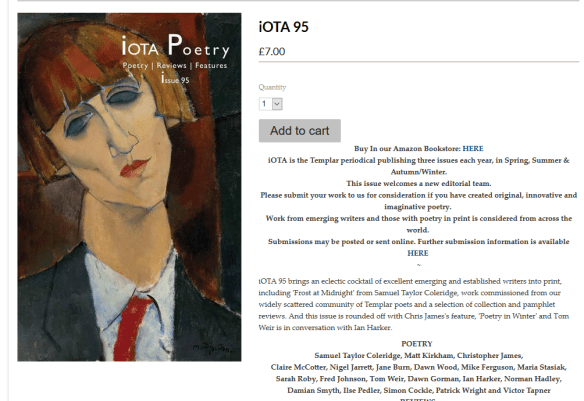
iOTA Poetry – Issue 95

I am delighted to have three poems in the new edition of iOTA Poetry.

Also, I am particularly pleased to be in the company of Samuel Taylor Coleridge whose poem Frost at Midnight is included. That pleasure is, of course, because I am a member of the Coleridge Memorial Trust, so I like the long lineage as a link!

This latest edition can be ordered here.

Screenshot 2016-04-19 09.34.49

Was Sat or Was Sitting on the Grammatical Fence?

I provide the following which can be perused rather than closely scrutinised – unless you have the stomach – and it proves a number of things, the first that pedantry is alive and well beyond myself [was so in 2005/6, but there are current examples], and to acknowledge the source it comes from the englishforums.com site, but there are plenty of others similar to this out there.

It also proves what an utter waste of time it is to set the type of grammar test the government currently proposes for Key Stage 2, or any other level. The point is, the degree of disagreement, and the intensity of the analysis and interpretation applicable over a single grammatical query like this exemplifies the messiness of seeking to engage with it. More pertinently, the idea of setting a test with definitive answers to grammar questions like this is nonsensical.

I’ll let the following thread speak further. And this is just one page: it continues, but I didn’t have the stomach:

The continuous (or progressive) verb forms in English are constructed with the present participle (-ing form), not the past participle (-ed form) of the verb.

In your example, sat is an irregular verb, so its past participle does not end in -ed. Nevertheless, sat is indeed its past participle, so cannot be used in this active progressive sentence.

Of course, if this sentence were considered passive (which it is not, since you have also given us the correct equivalent), then sat would be possible– but such a sentence would no longer be progressive:

The little boy has been sat at the table by his father and is not permitted to leave it until his plate is clean as a whistle.

(I presume that you meant to write at rather than on in your original?)

goldmund:
AnonymousCan anyone tell me why it is not correct English to say “He has been sat on the table all day” as opposed to “He has been sitting at the table all day”
Dear Anonymous,

I have observed that English people may say «was sat» in place of «was sitting». It appears to be a northern English idiom. In my opinion, it is used for humorous effect by southern English persons. It is perhaps no longer amusing.

Kind regards,

Goldmun
Reply

Forbes:
I agree that was sat (when not passive) is a colloquial expression and should be avoided in formal situations. It is interesting to note that in Spanish when talking about sitting and other bodily positions it is necessary to use the past participle – the use of the present participle would suggest that you are actually in the process of sitting. Perhaps this thought is behind the use of the past participle in the colloquial expression.
2nd September 2005Regular Member933

Reply

MrPedantic:
The ‘humour’ in ‘I was sat there’ seems to reside in the thought of ‘being plonked there’, like a small child.

It is annoying when southern folk say it, though. Makes you want to slap a few heads.

MrP
3rd September 2005Veteran Member12,806

Reply

Forbes:
Is it in fact a northern expression? I am sure people in the south (I am from Brighton and you cannnot get any more south than that) use the expression. It may just be though that I have heard it a lot on TV.
3rd September 2005

Reply

MrPedantic:
That’s true. Maybe it just sounds northern.

MrP
4th September 2005

Reply

Anonymous:
I think the “I was sat” may have originated with a very popular TV commedienne who some years ago would fold her arms and push them under her bosom and commence her next joke with “I was sat sitting…” or “I was stood standing..” which immediately had the audience falling about laughing before she told her joke.
29th March 2006

Reply

MrPedantic:
Some tv comedians have certainly milked the phrase. I think Victoria Wood used to say it a lot; and perhaps still does. (Or was that who you were thinking of, Anon?)

MrP
30th March 2006

Reply
Rotter:
The little boy has been sat at the table by his father and is not permitted to leave it until his plate is clean as a whistle.

1] Is it correct to say ‘has been sat at the table’ in any context?

2] What is the meaning of the words ‘his plate is clean as a whistle’ ?

In football, referee blows the whistle.

Given the context, whilstle blowers are like watchdogs.

Politicians or rather government ministers and prime minisers make whistle-stop tours.
30th March 2006Regular Member959

Reply

paco2004:
RotterThe little boy has been sat at the table by his father and is not permitted to leave it until his plate is clean as a whistle.
1] Is it correct to say ‘has been sat at the table’ in any context?
Yes, it is correct. It is a (present perfect) passive construct. The boy didn’t want to sit but his father made him sit.
Rotter2] What is the meaning of the words ‘his plate is clean as a whistle’ ?
In football, referee blows the whistle.
“Clean as a whiste” is an idiom to mean “very clean”. A whistle makes a very sharp and clear sound. So Dickens used a phrase “clean as a whistle” in his novel and it became an idiom.

paco

Reply

Rotter:
Paco says the following is correct.
The little boy has been sat at the table by his father and is not permitted to leave it until his plate is clean as a whistle.

OK, then the following should be correct too.

The little boy has been cried because his father did not permit to play outside when it drizzles.

If the past tense of the word ‘sit’ fits here, the past tense of the word ‘cry’ should fits too.
30th March 2006
Reply

CalifJim:
a very popular TV commedienne who some years ago would fold her arms and push them under her bosom and commence her next joke with “I was sat sitting…” or “I was stood standing..”
Exactly. That was Mollie Sugden playing Mrs. Slocum in Are You Being Served?. It was nearly always the expression of outrage at having to wait.

CJ
30th March 2006Veteran Member67,639

Reply

Rotter:
CalifJim

The following must be an Amrican affair or rather American TV program.

Mollie Sugden playing Mrs. Slocum in Are You Being Served.

I am not aware of it.
30th March 2006

Reply

paco2004:
RotterPaco says the following is correct.
The little boy has been sat at the table by his father and is not permitted to leave it until his plate is clean as a whistle.
OK, then the following should be correct too.
The little boy has been cried because his father did not permit to play outside when it drizzles.
If the past tense of the word ‘sit’ fits here, the past tense of the word ‘cry’ should fits too.
Hi Rotter

You cannot say “The little boy has been cried”. “Sit” can be both intransitive (=”Someone sits”) and transitive (=”Someone sits other person”). But “cry” is only intransitive (=”Someone cries”).

paco
30th March 2006

Reply

CalifJim:
Rotter,
It’s British. Probably at the height of its popularity before you were born! (1970’s)
I only know it through more recent reruns in the States.
CJ
31st March 2006

Reply

Anonymous:
You should only use “he has been sat on the table” if you meant that someone else picked up the person and put them in a sitting position. For all other circumstances, you should use “he has been sitting on the table”.
5th June 2007

Reply

Anonymous:
When I was at school, one of the teachers used to say to the pupils ” I want all of you children sat over here”. Is this correct english? I always thought it should be “….sitting over here”.
13th July 2007
She Was Sat in the Stress

For those of us who have been there, and more so those currently in it, the idea that the stress caused to students and teachers by the exam factory at primary and secondary levels [and beyond, perhaps] is somehow easy to ignore, or an exaggerated assertion, or any other form of casual denial of its impact and effects, is as absurd as it is rude.

Seeing this reality written about doesn’t of itself make it any more true, but doubters should take note. This article today by Zoe Williams in The Guardian articulates the problem carefully and with supporting evidence and I encourage readers here to read.

I simply also want to post one paragraph from the article about a test for 6 years olds that Williams quotes as having seen. This should be absurd, but sadly I believe it must be another truth.

In parental quarters, what you notice most about the new curriculum is how joyless it is, how little of it makes sense on its own terms. I have seen literacy questions for a six-year-old in the past week that I couldn’t answer. (You think I’m exaggerating. Of course you do. So try this: “‘Kajal looked at the time and jumped out of the chair she was sat in. She had just enough time to meet her friend Julia at the cinema across town if she caught the bus. She ran out of the house towards the bus stop, just as the bus began to drive away. ‘Stop!’ she shouted. What do you think happened next? Why?” Never mind that the text itself is drivel, and strips out any gift of interest, wisdom or magic that a paragraph has ever bestowed upon a reader. I don’t have a clue what happened next.)

And I shouldn’t be seeming to put pedantry before astonishment, but surely sat in ought to be sitting on? I am mentioning here my concern for accuracy in the interests of a balance I always try to maintain in my criticisms of educational matters. I visited the TES resources pages again yesterday, looking at what is on offer for teaching Writing [usually at GCSE level] and yet again I have found material, written presumably by teachers, that seems to me quite appalling. I’m not going to mention by resource, but one PowerPoint being offered for free [and that shouldn’t make any difference] is littered with errors in its own writing. Inaccurate spellings [in one ‘narrative’ exemplar, there is quite for quiet – easy error to make, easy error to check and correct before publishing!] and absence of apostrophes are two consistently common problems. One persistent error comes up with an error-indicating red line on one of the PowerPoint slides!

I know, pedantic and pompous. But 1 mark for the apt use of alliteration…..

Michael Rosen’s 13 Arguments

I have been dogged in my response to the sample KS2 English grammar, punctuation and spelling tests [or SPaG as they were previously arranged and therefore abbreviated – and those of us in the know, know they were terrible then, as now, as if a new acronym of GPS helps designers to ‘navigate’ to a brighter territory…], but Michael Rosen has been hounding these with a bark and a bite that has already achieved Crofts Championship Super Supreme status.

Through Twitter, Facebook and his personal blog postings, Rosen has mounted a sustained rationale against this primary school test regime. With Twitter he has satirically posed brisk teasers to expose the nonsense of so much of this, and on Facebook and his MR blog he has provided detailed, informed and instructive grammatical and linguistic analysis to not only counter the aims and purposes of these tests but also their accuracy. Yes, their accuracy!

His latest convincing argument is a 13 part collation and summary of the points and evidence he has marshalled against the English test, and it should and can be read on his blog here.

In a further nutshell, I think the simplest objection [though it requires these detailed background arguments] can be summarised by three points:

1. These tests are too complex and difficult for 11 year olds

2. These tests only exist to provide a simplistic means of measurement as a performance in these, and only these, tests

3. These tests have nothing whatsoever to do with the teaching and learning of how to write

Whilst I have constructed my own arguments against the testing principles as a whole and then particular test questions – challenging these as educational tools – I have also mounted my own satirical dismantling. However, much of my satirical reaction has been in providing alternative approaches to actual test questions. I am considering working more carefully on these to see if they could provide an actual substitute set of questions/tasks that could be used to aid student learning about aspects of Writing [including grammatical and linguistic choices].

I know there are immediate dangers/divergences in this: using original questions, even in subverting them, somehow still provides credence to their existence; my ideas are generally to encourage actual writing rather than discrete ‘answers’ about writing, and my ideas usually encourage group work rather than individual student questioning.

But I am considering…

Below are three ideas already posted on this blog and which I will use as models should I continue to explore this idea:

Screenshot 2016-04-17 15.52.55

Screenshot 2016-04-17 15.49.54

Of further interest, there are two points in Rosen’s list of 13 that are personally poignant, for different reasons:

No. 5 about Michael Gove’s insistence, when he was Education Secretary, that questions about ‘subjunctives’ having to be including in the tests – against informed advice – could seem unbelievable [it is certainly ridiculous] but as I have argued so often on this blog that he is solely responsible for the banning of American authors for study in GCSE English Literature, I found this both appalling and yet reassuring because I don’t think enough people believe he wielded this kind of crazy dictatorial power.

No. 7 because I used to have and teach from a red binder Language in Use when I started teaching English in 1980 in my then secondary school [later a comprehensive] and my recollection is of how purposeful and informed it was about exploring and teaching language usage through a wide range of contextualised and meaningful ideas and tasks.

Finally, it is absolutely clear that the only effective fight against the existence of these tests will be in a boycott of them. Whilst of the utmost importance to have argued convincingly against them – and I think that has already been achieved, surely – we know [take the Gove interventions as evidence; and the current White Paper on national academisation of all schools] that no amount of truth will alter that myopic and arrogant course of this government on education policies.

Nebraska 6 – Omaha and Carl Sandburg, Again

Originally posted February, 2014:

Sunset From Omaha Hotel Window

INTO the blue river hills
The red sun runners go
And the long sand changes
And to-day is a goner
And to-day is not worth haggling over.

Here in Omaha
The gloaming is bitter
As in Chicago
Or Kenosha.

The long sand changes.
To-day is a goner.
Time knocks in another brass nail.
Another yellow plunger shoots the dark.

Constellations
Wheeling over Omaha
As in Chicago
Or Kenosha.

The long sand is gone
and all the talk is stars.
They circle in a dome over Nebraska.

I did find a beautiful picture of a sunset over Omaha but it seemed for too beautiful and comforting for the ennui that Sandburg encapsulates here. It is probably to do with personal emotions of the time, but I imagine also an oppressive summer heat and humidity, not that this is mentioned.

Jane Eyre – on the bicentenary of Charlotte Brontë’s birth

janeeyre

There is an excellent Guardian page here today of various writers’ and readers’ observations on their love of Charlotte Bronte’s Jane Eyre. I certainly can’t compete with the collective wisdom of this – and wouldn’t want to –  but I am happy to join in the celebration.

I came to Jane Eyre late in life [compared to the world of teenage readers], studying Charlotte Bronte in Oxford as one of the major English novelists whose entire works you were expected to know. I was heavily influenced by my dynamic tutor Anne Wordsworth to approach this and her other work, especially Villette, with a Freudian reading, Bronte having been constrained as a writer by the expected propriety of the Victorian novel, yet sexual realities erupting through this as awkward narrative interventions or apt metaphor, the former as the ghost in Villette – though no longer ‘awkward’ if you appreciated its necessity – and the latter as the burning stubble in Jane Eyre.

I simplify, but I believe entirely in that reading. I do also agree with DH Lawrence who intuited the Freudian reading that Bronte emasculated Rochester with his injuries at the end of the novel, the passion he and Jane felt for one another held to the implicit propriety by the physical inability to consummate, or consummate in the way Lawrence would have done so, as well as what he and we should rightly expect of Bronte’s other implicit but real narrative drive before the actual fire.

This reading never detracted from my appreciation of the novel as a powerful story of independent thought and romance, as I imagine many would argue it could.

It is also such an excellent read, especially the opening 10 [or is it 11, I don’t have the book to hand…] chapters, a separate book in many ways plotting Jane’s abuse and rousing the reader’s anger and contempt with such masterly storytelling.

Nebraska 5 – Omaha and Olin

A few years ago I discovered details about my birth father, though searching on the net, the most significant that he had died. In the process of discovery, I learned more from his surviving wife who generously supplied details through kind letters, photos and, obliquely, sending me his wedding ring from their marriage – an unusual artefact – that I had a half-sister with whom I am now in contact but also another brother or sister though I haven’t been able to find out any information about this sibling, two years younger than me.

It is in searching for any information about my unknown brother or sister that I bought limited access to the Omaha World-Herald newspaper online archives, hoping that there would be relevant detail in the ‘Births’ section at the very least. There wasn’t. I did, however, find a selection of references to my birth father, Olin Stanfield, and it was the increasing amount of purely numerical rather than personal details that struck me as an impersonal acquisition of precious material, though, excusing the pun, amounting to little.

Most of those references were quite simply about his existence as a teacher in an Omaha school as the paper made annual statements about employment in these city establishments. I did, however, find the following, and wrote the poem that follows this:

Screenshot 2016-04-15 09.18.50

$9.95 and Other Numbers

For 5 cents short of 10 bucks, all I actually buy are numbers,
30 downloads in 24 hours and yet little of any revelation
in these newspaper archives about my history: the
unknown father; brother or sister too – my sibling still with us,
possibly. 2 years younger than me, there are no mentions in
Births for that May in ’56, nor me, surprisingly, in an
otherwise documented March of ’54. Nearly 60 years ago and
none the wiser. But another sister is announced in 1960 with
our new dad, 6 years further down but in another Omaha road.
I find the pictures of that home, number 1406 on North 40th,
the duplex’s concrete porch still staring out at the passing cars
as the years rolled by. Thousands and thousands, some still in
primer grey. Olin is mentioned 13 different times, only 1 quote
of ‘his boys work hard’ – students with him in 1961, Oct 29.

Nebraska 4 – ‘Read Your Fate’ by Charles Simic

Originally posted February, 2014:

A world’s disappearing.
Little street,
You were too narrow,
Too much in the shade already.

You had only one dog,
One lone child.
You hid your biggest mirror,
Your undressed lovers.

Someone carted them off
In an open truck.
They were still naked, travelling
On their sofa

Over a darkening plain,
Some unknown Kansas or Nebraska
With a storm brewing.
The woman opening a red umbrella

In the truck. The boy
And the dog running after them,
As if after a rooster
With its head chopped off.