Eton College and Rough Boys

No Panama Connection, Yet

Idly searching on a whim to see if there was any connection between Eton College and recent revelations in The Panama Papers [seemed a fruitful punt] I didn’t find anything on this but did come across some of the college’s King’s Scholarship Examination papers and looked at the latest available for 2014.

The following struck me as interesting that a school of such privilege would be offering up the Stephen Spender poem without any hint of irony:

Screenshot 2016-04-06 10.45.00

The comprehension questions on the poem were less surprising: rather obvious because that is essentially what they are, but also the one requisite feature-spotting ask.

Screenshot 2016-04-06 10.45.13

How much more enlightening if examinees had been asked to summarise their own attitudes on ‘children who were rough’ and to imagine where such would come from in ‘our world’ today. Or set an essay task titled ‘We Are All In This Together’.

Omaha – Somewhere In Middle America

Originally posted in April, 2012:

omaha - Copy

[Kinda hard to make out on this map, but Omaha is on the far right of the State, bordering Iowa and on the Missouri River].

I was listening recently to Counting Crows’ fine song Omaha from their great debut album August and Everything After and it reminded me how one day I want to compile and post all the quips ever mentioned in song about Omaha, the place of my birth, and/or Nebraska. Poetry is another place to look, and I will, but I know of two Carl Sandberg poems referencing Omaha, and this is the better of the two, if not as explicitly about Omaha as the other,

Sunset From Omaha Hotel Window

Into the blue river hills

The red sun runners go
And the long sand changes
And to-day is a goner
And to-day is not worth haggling over.

Here in Omaha
The gloaming is bitter
As in Chicago
Or Kenosha.

The long sand changes.
To-day is a goner.
Time knocks in another brass nail.
Another yellow plunger shoots the dark.

Constellations
Wheeling over Omaha
As in Chicago
Or Kenosha.

The long sand is gone
and all the talk is stars.
They circle in a dome over Nebraska.

– Carl Sandberg

Omaha, Nebraska – Literary and Lyrical

I have over recent months been re-posting on this blog writing from another of mine where its focus on poetry, book reviews and similar was not a part of the main purpose which was music reviewing. That left-field source has nearly finished.

Another but more thematic alternative run of posts was about my hometown of Omaha, Nebraska, USA, though I moved away from there around the age of 10, initially to Germany and then a little later to here in England where I eventually stayed. Though leaving at such a young age, it has always surprised me how much the place and period then still seems to have impacted on me, perhaps more as a metaphor for change than memories of that time, though many of the latter as realities are fundamental to who I am today.

So I am going to re-post a selection of these, but ones mainly concerned with literary references to Omaha, most through poetry, but also some song and the like. The entire set of original postings included a wide range from advertising to film references to American football quarterback calls. Really.

This first brief post is from May 2011. It is interesting for me as I subsequently posted another ‘mention’ in 2012 but didn’t start the sustained run of references until 2014:

Omaha mention

One day I’ll compile a list of Omaha mentions in song, film and other. My place of birth. Prompted today by hearing a snippet of Ginsberg on Cerys Matthews’ BBC Radio 6 programme, so here’s an exerpt on the banjo and Nebraska:

…as the western Twang prophesied
thru banjo, when lone cowboy walked the railroad track
past an empty station toward the sun
sinking giant-bulbed orange down the box canyon –
Music strung over his back
and empty handed singing on this planet earth
I’m a lonely Dog, O Mother!
Come, Nebraska, sing & dance with me –
Come lovers of Lincoln and Omaha,
hear my soft voice at last

– Allen Ginsberg, from ‘Wichita Vortex Surta’

The Plosive Pointlessness of Tom Bennett

To show a film or not to show a film – that is a stupid question

If I am looking in national newspapers for corroboration of my views on or just common sense about educational matters I will naturally go to The Guardian/Observer. I wouldn’t, for example, read The Daily Mail’s opinions on such which would be like seeking advice from Donald Trump on how to make the world a more caring place.

Yesterday’s Observer had two articles directly and indirectly about using film in the classroom which are convincing rebuttals to views expressed by the DfE’s so-called educational expert Tom Bennett about his opposition to teachers showing films. The first in the newspaper was a report on actor Michael Sheen’s observation the films I was shown in school inspired me; the other in the paper’s The New Review was an article about The British Film Institute’s Shakespearean film season.

I’ve commented on Tom Bennett before in this blog. I don’t know if his specific statements on film use in the classroom and other general observations on teaching approaches are genuine, in which case he is a purveyor of pontification, or just mischievous, in which case he is a perpetrator of pettiness. It’s probably the plosive both, an alliterative impact I would teach to students with a caution about overuse but also illustration, as here, of aptness. I would never teach as a SPaG tick-box points scorer, though Bennett would likely view this as worthy. In addition – to make it a theme – I’d have group work or whole class discussion on whether someone like this should be paid public money to disseminate his elaborate but silly metaphors as educational guidance:

Outside of a media course, the only place for a full movie is a film club or similar. Otherwise you’re just lighting cigars with fivers made out of children’s opportunities. Every second counts in a school; many children won’t get a second chance to sound out letters, learn about Vikings, run their tongue around algorithms and formulae and rhyme. For too many kids, school is the big window into another dimension, a cannon that can fire them from here to infinity. So why stuff that cannon with confetti?

Those final two sentences make little sense to me, but that’s how ‘gurus’ sometimes talk.

As a Head of English, I wouldn’t have been happy if members of the department showed films aimlessly to their classes, but I would have been disappointed if they didn’t use them as the purposeful and winning classroom tool they can be. As an English teacher with thirty years of classroom experience, I can’t imagine having not shown films throughout that time to entertain, engage and inform my students.

The Observer article on the British Film Institute is particularly relevant to my argument in favour of the use of film in the classroom. The BFI school resource packs linked to films – ‘popular’ as well as those interpreting texts, most obviously Shakespeare, but also classic and contemporary – provided a wealth of aids to learning. Obvious connections to English as a subject would be in their developing skills of appreciative and critical analysis, as well as the more general explorations of meanings in themes, characterisation, storytelling and so on. Oh yes, and that ‘entertainment’ factor.

But it is the impact of film versions of Shakespeare’s plays that provided me with the most dynamic classroom resource to complement that of the texts themselves. If students and staff could attend theatre performances, or we could have visiting theatre groups with workshops, then we would – and did [more on this in another posting to celebrate my school’s Shakespeare Days, organised by a colleague]. To engage whole classes and year groups – and the majority who couldn’t/didn’t attend theatre trips – then the use of film versions was a necessity. I’m sure this is glaringly obvious, but not, apparently, for Tom Bennett.

I could write at great length to exemplify my practice and experience of using film to assist in the teaching of Shakespeare, but I’ll save that too for another posting. I will, however, refer to just two other examples – telling ones, but a mere fraction of the use of film in that thirty years of my teaching. The first was in teaching Waiting for Godot to GCSE mixed ability groups. I will always be proud of exploring such a complex play with students of a broad ability range, that pride generated by the quality of their engagement and understanding and reflection of this through coursework as well as speaking and listening responses. This couldn’t have been achieved without seeing the play in performance, and doing so with film versions: in this case using film for the practicality of viewing. Whilst always seeking to explore the whole, the specific assignment I would set focused on the ‘story’ of the four gospels presented in the play. A wider contextualising would be for students to explore, as much as they could individually, whether they saw the play as negative or positive. For a more positive outlook and interpretation, they had to understand its humour, and to understand its humour, it had to be seen in performance. Again, this should be glaringly obvious, but not, apparently, for Tom Bennett.

The second is a more ‘film-as-film’ example and one that, because of this, seems most likely to fall into Bennett’s absolute category for banning. It was also a television programme. Used again for GCSE mixed ability groups, this showing of film was for the media coursework assignment of the syllabus I then taught. The film I used was from The X-Files television series, and it was the episode called Home. Showing this was in many ways genuinely risky, and I could only use in year 11. It was risky because it contained elements of quite graphic horror – though I would not call this ‘explicit’, a nuance I accept – and this was framed in an overall gothic if modern setting. I showed this specifically to teach the impact of visual narrative: the opening setting and scene [the hooker] works across precisely edited visual shots – though accompanied by sound effects of rain and thunder and screams – to tell the uncertain story, at this point, of the burial of a body, probably that of a baby.

The focus of the media assignment was in ‘thematic’ terms the understanding and articulation of how the visual shots conveyed meaning and drama. It was more than this in fact, but I won’t develop now. The other focus of the assignment was on ‘writing’ as a precise skill, here plotting exactly the shots and describing these with a critical vocabulary, in this case media/filmic terms. And it worked. It worked because the visual narrative of this film is so immediately dramatic and effective and engaging and therefore an excellent prompt and tool for teaching and learning. It engaged the students. It helped them to understand visual narrative – and in small groups, students devised their own visual narratives using a defined number of still photo shots – and through this develop a confident appreciation as well as ability to articulate this.

Showing Home was risky for other reasons too, but that was, for me, its educational value beyond the ‘media’ focus. This was in tackling and being challenged by the programme’s exposition of the theme of incest. Such a problematic portrayal is set in the film in contrast with the idealised world/town of Home, and the exploration of what is ‘normal’ behaviour is further examined through quite a bit of humour. Stuffing this educational cannon with confetti? Obviously not, but the ‘film’ context made it accessible in a way I think was profoundly purposeful for teaching, but I would stress it would take confidence, and I had that, to control this. It wouldn’t be a lesson idea I could recommend to everyone.


Roger McGough – The State of Poetry

Originally posted November, 2011:

My State of Reading

I know I don’t read enough. Apart from my recent rapture in reading Willy Vlautin’s three novels, I tend to dip in and out of poetry and don’t read the prose/novels I should. I need the sun I think. I love reading outside in the sun. I’ll have to move.

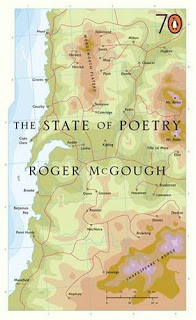
I did start two books today, finishing one, Roger McGough’s lovely Penguin collection The State of Poetry.

stateofpoetry - Copy

I’ve read all of these poems before, but it’s a mainly humorous set that had me laughing out loud on a number of occasions. Here’s just one:

Scintillate

I have outlived
my youthfulness
so a quiet life for me.

Where once
I used to
scintillate

now I sin
till ten
past three.

It was a wonderful time to be growing up and getting into poetry when Penguin Modern Poets 10 – The Mersey Sound came out in 1967 featuring Adrian Henri, Roger McGough and Brian Pattern. Poetry was then hip and irreverent and funny and so much of an inspiration to try and be similarly creative. These guys didn’t make it seem complex or difficult. This and all those psychedelic lyrics made language such a hoot. Buying this book then was a cool thing to do. I will have bought mine probably in ’68 – maybe even ’69 – but still 14 or 15 years old.

pmp - Copy

Not that anyone reading this will need convincing, but McGough is a fine poet. Defying Gravity is such a strong collection. As well as this and others of his, I do prize his ‘novel’ Frinck  A Life In The Day Of and Summer With Monika poems, as well as An Imaginary Menagerie.

The other book, by the way, is John Steinbeck’s Burning Bright. I thought I had read all of his but found this untouched at 30 pence for my 1974 Pan edition. Very mixed feelings about this at the moment. I’ll write about it when finished, if anyone is interested.

NB I did write about it and have re-posted already here.

Gig Set List – Proleptic Kinecy

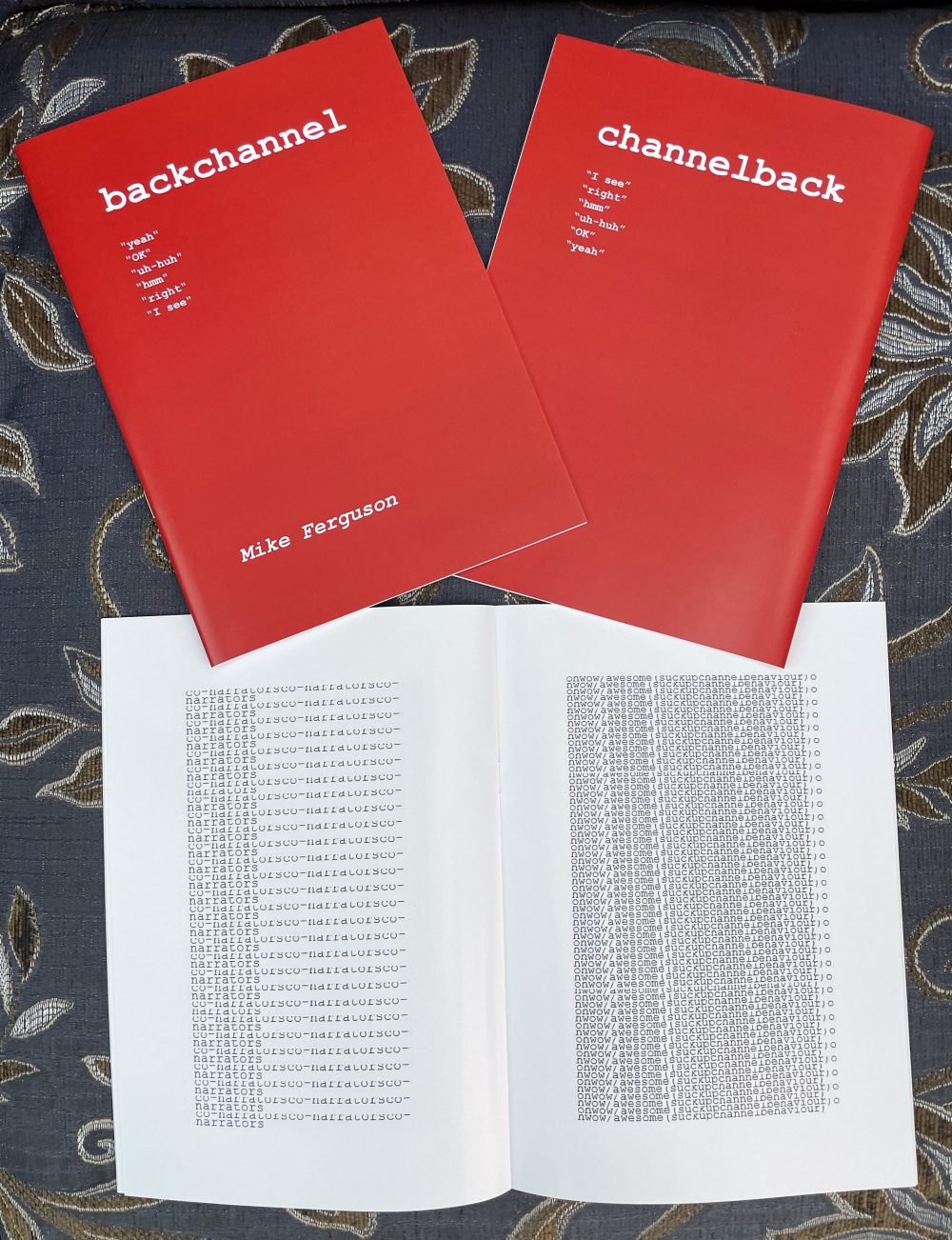
Proleptic is a genuine word and quite profound in what it is defining; kinecy I’m convinced is a real word too – was convinced back in 1969 anyway – and when combined they weren’t as a musical group name even that plausible at the time of odd names but the ‘band’ and I soldiered on both in title and ambition. Alas, this set list which I found the other day is the only vestige of a memory from that one and only gig. The audience did love us though; thoroughly adored our concert. But they would.

concert copy

Examination

Not quite the
anthropomorphosis

from an answer,
the palpable check

stares back,
warns me to be less

disapproving
in how I perceive the

caveat, looking about
for points of display

of the knowing I have been
collecting over years.

But my gaze
holds more,

passing perusal
more assured than

that and the
ornaments of crap.

Penguin Modern Poets 5 – Gregory Corso, Lawrence Ferlinghetti, Allen Ginsberg

Originally posted November, 2011:

5

5 - Copy

Delighted to find and get this today in beautiful condition for a 1963 first edition [along with no. 4 Holbrook, Middleton, Wevill, also 1963 and near pristine], and this picture will be of a later edition because both of mine are priced on the cover at 2’6 – that’s two shillings and sixpence for you young ‘uns.

Here’s a sweet one from Ferlinghetti

Dove sta amore

Dove sta amore
Where lies love
Dove sta amore
Here lies love
The ring dove love
In lyrical delight
Hear love’s hillsong
Love’s true willsong
Love’s low plainsong
Too sweet painsong
In passages of night
Dove sta amore
Here lies love
The ring dove love
Dove sta amore
Here lies love

Deconstructing the SPaG

Appropriation of the Abbreviation

It is good to see that the NUT is to ballot on a primary test boycott: good as it is the right thing to do because these tests are so bad.

I have said before on this blog, the argument that these types of tests, but in particular the Key Stage 2 English grammar, punctuation and spelling papers, are bound to cause young pupils stress is convincing. This is linked to the obvious argument that they will cause this stress because they are far too hard – pitched at a level well beyond the grasp of most students at the target age.

I have also argued that in addition to these convincing points, we need to mount a pedagogical rationale for why these tests are inappropriate, and I intend to do more of that here and now. The comprehension/knowledge level demanded of the discrete secretarial questions that make up a complete paper is ridiculously ill-judged for the intended age range. However, as a ‘test’ of students’ writing competence, and by implication a key element of their required teaching of how to write, they are utterly meaningless.

I have provided arguments for and examples of how I teach writing throughout this blog and would urge anyone interested in seeing how this informs my rejection of the ‘test’ approach to seek these out. I want to focus on specific examples of test questions from the English GPaS Sample Booklet published in July 2015 [as teachers we have appropriated the abbreviation to the more familiar SPaG!]. These are a selection:

Screenshot 2016-03-28 10.07.12

Frankly….I don’t give a damn. And I couldn’t [do you see what I did?] resist.
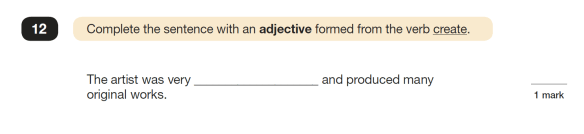
Screenshot 2016-03-28 10.08.04

Feeling my way into a more focused criticism, I want to mention I was struck by the irony of the required word, considering the nature of these ‘writing’ tests. In addition, the use of the adverb is a poor model of good writing.
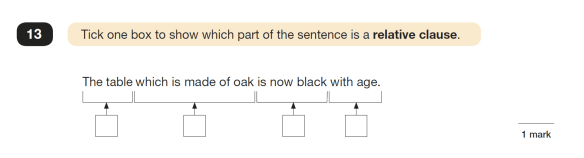
Screenshot 2016-03-28 10.08.24

This is one of the first ‘train-spotting’ questions. This tests ‘knowledge’ that has no actual relevance to learning, especially learning about how to write.
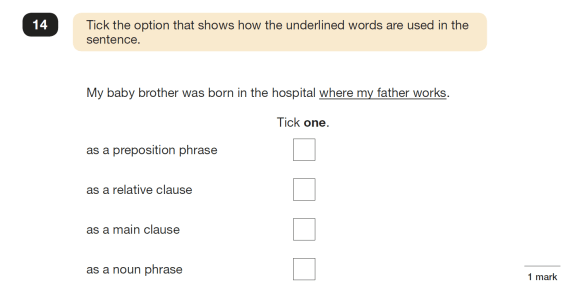
Screenshot 2016-03-28 10.08.38

Why? The underlined section tells us information we need to know for the sentence to make sense. The question about identifying the grammatical construct is far less important to know then that fact. Why not ask why the hospital requires further information when a hospital doesn’t [if one feels the need to ask]? That, by the way, is a rhetorical question [1 mark]. The point is these tests need to be this definitive so that the mark scheme can appear to have a singular right answer. All others are ‘wrong’. Even if they make sense…..
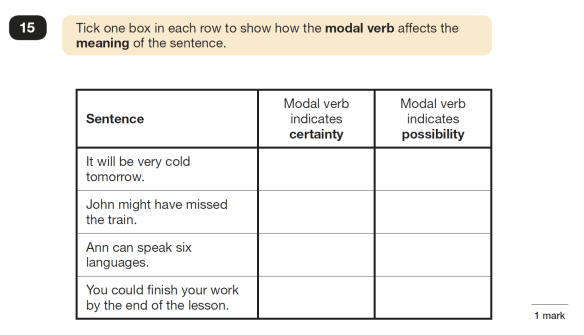
Screenshot 2016-03-28 10.08.47

I have commented on this here. Far better to play with how such sentences can work.
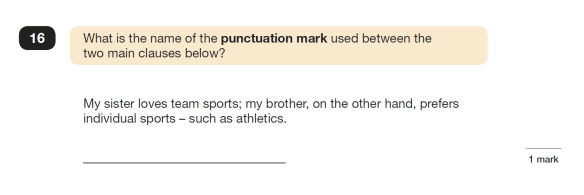
Screenshot 2016-03-28 10.08.59

Train-spotting. By the time students reach GCSE, and having been taught how to write on a diet of this kind of punctuation nose-picking, students sneeze semi-colons all over a page thinking this will earn them marks for ‘sophisticated’ writing. Like a sneeze, the placing of the semi-colons will be quite random.

Screenshot 2016-03-28 10.09.14

Have you noticed each of these questions is worth 1 mark? No differentiation, though they can be significantly varied in their demands. I of course reject the premise of their existence, but if you are going to offer them up as a sample/model, there must be some recognition of the broad range in demands. Clause recognition here.

Screenshot 2016-03-28 10.09.59

Frankly…..

Screenshot 2016-03-28 10.10.42

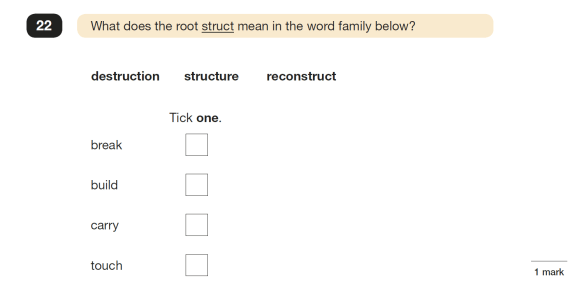
Of all the roots in all the towns in all the world…….

Screenshot 2016-03-28 10.11.41

Why a dash? The simple connective ‘and’ makes a better sentence. Illustrating poor writing to ask a question seems a bad thing to do.

Screenshot 2016-03-28 10.11.52

Why why why why why why why why why? A better question would be to ask about the intentional syllabic rhythm of my question. But not at KS2.

Screenshot 2016-03-28 10.12.38

Train-spotting, and the train is heading for a long boring journey. Going nowhere.

Screenshot 2016-03-28 10.13.04

Obviously, why? And for 11 year olds? To achieve what?

Screenshot 2016-03-28 10.13.16

I could work this out by extrapolation, understanding subordinate and co-ordinate as words, but as grammatical constructs I wouldn’t know these to spot and label.

Screenshot 2016-03-28 10.13.27

How much more purposeful and engaging would this kind of question be if students, probably in groups and making posters [stick that up your Tom Bennett], were tasked to explore and discuss and use and then comment on the variations of writing wanted, needed, desired, had, craved..…?
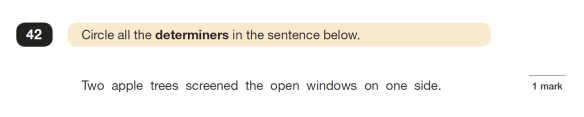
Screenshot 2016-03-28 10.14.01

No. Or, again, as a class task with a purpose, ask how other words [or verbs…] would alter meanings in this sentence, and to what effect? For example, instead of screened, how about sheltered, dwarfed, fragranced [I know, but why not?!], shadowed, stifled, hid…..
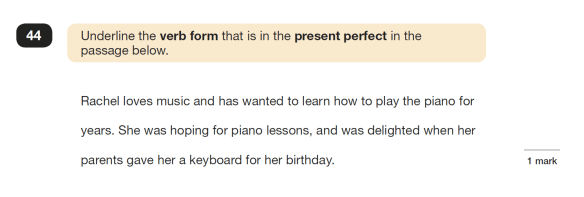
Screenshot 2016-03-28 10.14.16

Actually, Rachel wanted a piano, not a keyboard, so she was pissed off.

Screenshot 2016-03-28 10.14.41

You genuinely despair completely by this point.
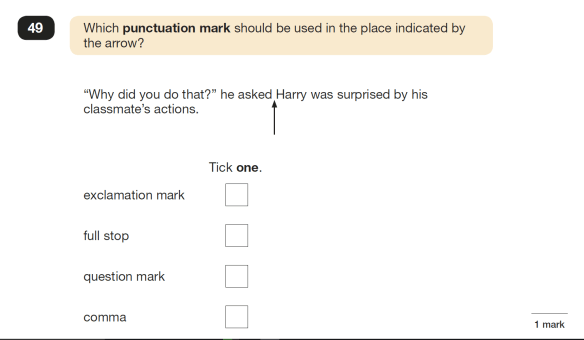
Screenshot 2016-03-28 10.15.13

What and How an exclamation mark shouldn’t go there but here is fine!

Remember, all of the above represent a snapshot of the entirety of the daft questions asked in the test paper. I have been playful in my rejection at times, but satire and irony are elements of sophistication in writing; not the use of semi-colons.

It should be a comma.