
Linked to my recent and/or sustained comments on Nicky Morgan, national testing, and the KS2 sample English tests, I’m delighted to have my poem ‘MSC’ published over at ‘IT’ here, with thanks, as ever, to Nick Victor for the illustration.
Linked to my recent and/or sustained comments on Nicky Morgan, national testing, and the KS2 sample English tests, I’m delighted to have my poem ‘MSC’ published over at ‘IT’ here, with thanks, as ever, to Nick Victor for the illustration.
I heard it expel
which made the slight
at the time
and hit the very moment
before the sound
which startled
that slight brush
like breath on a
chick’s feather
Originally posted March, 2012:
Squibs – Intimate Journals
Even though God did not exist, Religion would be
none the less holy and divine.
God is the sole being who has no need to exist in
order to reign.
That which is created by the Mind is more living
than Matter.
Love is the desire to prostitute oneself. There is,
indeed, no exalted pleasure which cannot be related
to prostitution.
At the play, in the ball-room, each one enjoys
possession of all.
What is Art? Prostitution.
The pleasure of being in crowds is a mysterious
expression of sensual joy in the multiplication of
Number.
All is Number. Number is in all. Number is in the
individual. Ecstasy is a Number.
Inclinations to wastefulness ought, when a man is
mature, to be replaced by a wish to concentrate and
to produce.
Love may spring from a generous sentiment, the
desire for prostitution; but it is soon corrupted by
the desire for ownership.
Love wishes to emerge from itself, to become, like
the conqueror with the conquered, a part of its victim,
yet to preserve, at the same time, the privileges
of the conqueror.
The sensual delights of one who keeps a mistress
are at once those of an angel and a landlord. Charity
and cruelty. Indeed, they are independent of sex, of
beauty and of the animal species.
The green shadows in the moist evenings of summer.
Immense depths of thought in expressions of
common speech; holes dug by generations of ants.
The story of the Hunter, concerning the intimate
relation between cruelty and love.
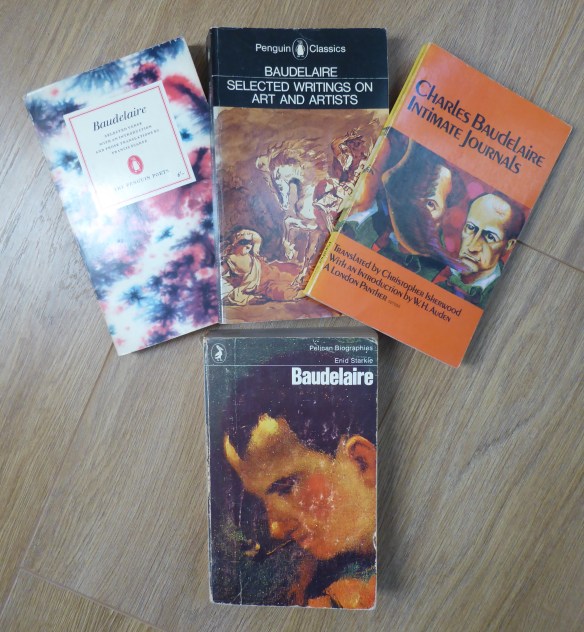
According to the dates in my mini-Baudelaire library, 1972-73 were those of my fascination for his writing and their wild, irreverent philosophies and explorations. All obviously in translation, I devoured Selected Writings on Art and Artists [Penguin Classics], Selected Verse [The Penguin Poets], Twenty Prose Poems [Cape Editions], Intimate Journals [Panther], and the brilliant Enid Starkie Baudelaire autobiography [Pelican] that fuelled the wonder and amazement I mainlined from his writings.
The seepage that plagues my memory means I can recall little of that reverie, with some excuse that it was nearly 40 years ago and I was only 18 and juggling ideas rather than catching and pocketing. But as the extract from Intimate Journals above so clearly demonstrates, Baudelaire’s ideas and their expression were so declaratory and assured that they appealed to the teenage search for alternative beliefs and the willingness to express them wildly but with such conviction.
I still don’t fully grasp his dichotomy of the dandy and the woman, but I still enjoy the celebration of the former’s spirit, especially when searching for that free spirit which seemed achievable at that time and with those incipient readings. The woman represents the opposite of this,
Of airs in Woman.
The charming airs, those in which beauty consists,
are:
The blasé,
The bored,
The empty-headed,
The impudent,
The frigid,
The introspective,
The imperious,
The capricious,
The naughty,
The ailing
In the introduction to the Intimate Journals by WH Auden I highlighted back then this one brief passage/explanation:
‘The truly dandyish act is the acte gratuite, because only an act which is quite unnecessary, unmotivated by any given requiredness, can be an absolutely freely self-chosen individual act’
and you can see how this would appeal to the teenage urge for independence and individuality. Perhaps in retirement and after all these years I could in reality be more free to follow the independent spirit of Baudelaire’s dandy. We shall see.
Just Plain Wrong
I had wondered if I could/should comment on the first year anniversary of this blog: it’s no big deal in the life of my or any other blog, and I wouldn’t intend to do so annually, but it has been a significant year for me in the amount I have posted, and especially in the earliest ones, focusing on Michael Gove and subsequently Nicky Morgan’s refusal to reconsider a decision to ban the study of American novelists for GCSE English Literature [including, to illustrate, my significant correspondence with responses and finally some acknowledgement of wrongdoing from the DfE]. I have also been proud of the amount of teaching materials regarding creative writing I have shared, though it is always difficult to gauge how much this has been used.
But I wasn’t sure about commenting on this inasmuch as my focus has shifted over time to including postings of my own poetry, advertising my writing [someone has to!], and most recently sharing reviews of prose and poetry from a few years ago. Then yesterday [seen by me today], Nicky Morgan tweeted a video of her desperate attempt to articulate a defense of her government’s and Department’s ‘primary assessment regime’ because this has come under critisicm and attack from teaching professionals. That is all the spur I have needed to celebrate my continued fight against all that is inept but also ‘just plain wrong’ [NM’s mantra] about this government’s educational policies and implementations, but especially anything to do with assessment.
I wrote ‘disdain’ in my title: I try, at times, to retain some level of civility. Watching Morgan’s video today here, I was struck immediately by the ennui of its platitudes. She essentially states that primary school students should learn the ‘basics’ [yes, a term requiring considerable scrutiny, but not here nor now] to prepare for secondary education, and that the attainment of this needs to be measured through assessment. What she fails to see is that no teacher or parent would disagree, so her knee-jerk defense against being criticised most recently by, amongst others, Mary Bousted [ALT general secretary], the NAHT, and the change.org petition signed by Michael Rosen with such knowing and convincing professional argument in support, is risible.
Put simply, the solution to students learning the ‘basics’ is through good teaching by good professionals and these same people carrying out regular formative teacher-assessment in order to support their students’ progress and well-being. Morgan’s horrendous mistake is to parrot – as so many before her – the panacea of national testing regimes to fulfill this, which most professionals dismiss as ‘just plain wrong’ for a variety of experienced reasons.
I have always focused on the English side of such assessment, and I have posted here and here my disdain [I am retaining that level of politeness…] for such. This is the critical problem. Whilst others have quite rightly focused on many factors like the lack of time to prepare for implementation and the detrimental impact on young students, I think as a teaching profession we need to continue to analyse and expose the nonsense of so much that purports to be the teaching and assessment of the ‘basics’, and beyond. That Morgan can persist with her happy endorsement of the ‘primary assessment regime’ where, for example, Key Stage 2 English tests ask students to make multiple choice selections on the use of modal verbs as if this is relevant to learning about, or ‘mastering’ a ‘basic’ skill, in Writing [especially, but not exclusively, at this level] makes me livid with her for her woeful lack of understanding.
Because I have analysed to a degree aspects of those sample Key Stage 2 English tests, I won’t repeat such here, but this is precisely what fuels my immediate anger when I listen to Morgan making her bold but bland claims in her video today. I should add that I feel I have been consistent in my dismay with anyone who deals in these kinds of platitudinous assertions, as I articulated in a recent posting about the disappointment of receiving Shadow Education Secretary Lucy Powell’s observations [or not] on this kind of testing and assessment regime.
The last on Steinbeck. Originally posted March, 2012:

Links
I haven’t come across any direct link between John Steinbeck and Raymond Carver – apart from the obvious: American writers in the ‘realist’ tradition; and Carver clearly will have read and assimilated and so on. But I haven’t found any critical commentary that has pursued links, or writing from Carver that references Steinbeck in any detail.
I have been looking for this overt link because as I am reading Steinbeck’s wonderful short story collection The Long Valley I am constantly thinking of Carver, but only at a specific point. Steinbeck’s detailed descriptions, especially of the natural world either as an entity or in its relationship with any particular protagonist, are second to none. He must have had the most observant eye and retentive memory. Carver’s world doesn’t use or rely on this level of description. It is simply different, and where there is the need for detail it is more about people and how they act. Both writers, of course, excel in the use of realistic dialogue. But that’s not the critical point of comparison.
Where I have been making the key juxtaposition is at the endings of Steinbeck’s stories. In so many ways, for example in The Chrysanthemums, The White Quail, The Snake and Breakfast [I haven’t finished the book yet], Steinbeck adds explaining and/or alluding lines at the very end where Carver would have left the story ‘hanging’ more. He would have left the moment of clarity or confusion or, especially in his case, nothingness, to speak for itself.
Take Breakfast for example: a superb snatch of a moment. The final paragraph, spoken by the first person narrator, explains where no explanation is really necessary,
That’s all. I know, of course, some of the reasons why it was pleasant. But there was some element of great beauty there that makes the rush of warmth when I think of it.
The last line of the preceding and penultimate paragraph is And I walked away down the country road. That’s where Carver would have ended it. The story about a shared, random breakfast in the early morning is a quintessential vignette: a moment and mood conveyed with palpable simplicity. As readers, we have sensed the ‘great beauty’ and ‘warmth’ as it happened, and in that respect there is no need to be reminded. The other stories I have mentioned have similar additions. Perhaps it is to do with the time and a reader’s expectation of explication. I don’t know.
This will sound like preference, but it isn’t. Both writers are brilliant; and literary heroes. It’s just something distinct that struck me today as I was reading.
Originally Posted February, 2013:

Uplifting Experience
In Peter Reading’s 1984 collection C, he presents the poetic paradox of being unable to write about Cancer/illness/death and yet ‘(Incongruously I plan 100 100-word units.)’ to do so in this dark and complex work. There are moments of bleak humour, but little that is uplifting in this ‘Terminal verse’, unless the other C of candour will suffice. But poetry does not suffice for Reading,
‘Why? Snot, gore, filth, suppuration of the arse-gut – for these no metric is vindicable.’
In Anthony Wilson’s recent collection Riddance where he deals poetically with his own cancer, the creativity carrying his candour is wonderfully uplifting, as it is also humorous and honest and unflinching amongst many other enduring attributes.
I had the great pleasure of attending Anthony’s launch of this poetic collection on the 17th September 2012 at the Bike Shed Theatre in Exeter. The attendance for this was amazing – tribute to the high regard from so many for Anthony as a person of considerable humility and warmth, for his journey with this cancer, and for his talent as a writer.
I read and wanted to review Riddance almost immediately, wishing to share in its significant appeal, but have found it a more complex work than I originally imagined and thus have lived with it rather than quickly treat as a product. This complexity beneath its otherwise freshness of direct accessibility is one of its many strengths, and in characterising this now, I want to light-touch as a review and tempt anyone reading to discover for themselves the ease with which you will follow Anthony’s vindicable poetic exploration. Where Reading’s objective stance struggled [though this was his ruse], Anthony’s subjectivity succeeds.
The opening poem ‘Tumour’ encapsulates as a title the directness of the telling throughout the book. There is no need for metaphor or other embellishments. I like the unsentimental honesty of lines like
‘I would like to claim
new attention to my children
but the truth is they grew up
whether I watched them or not.’
In ‘How to Pray for the Dying’, the concluding line ‘Try saying ‘Shit happens.’’ reinforces the lack of sentimentality, and in its secular declaration, he avoids the cloying spirituality one would find in others’ writing – which isn’t to say these poems are devoid of spirituality. That is a feature of the unravelling depth and complexity they offer over several readings.
The list poem ‘Lost’ is bookended with the lines ‘Lost my hair’ which asserts the humour found in many poems, but also that sensible grasp of priorities: being bald is more critical a reality than agonising over whether to rail against an uncertain god. This humour is continued in the delightful ‘Homeshopping’.
The poems I am focusing on are largely from the first section ‘The Year of Drinking Water’ and they establish aspects of discovery/realisation/pain/fear/acceptance/recovery, themes which are revisited throughout all five sections of the book. Whilst the fifth is titled ‘Reasons for Life’ these reasons are plotted in poems throughout all the sections, often directly or by extrapolation.
I also like the playfulness of many poems, like ‘Words’ where the distancing of not quite clinical but key diagnostic terms suggests much about isolation and pause and focus as the emotive response to hearing these. This gets an oblique repeat it seems to me in ‘I am Fighting’ with its echoes and repositionings of meaning.
In ‘Heads’, Anthony returns comically but by its very mentioning again the very visible consequence of cancer and treatment in being bald,
‘I’m Kojak without his lollipop,
a paunchy Duncan Goodhew and haggard
Syd Barrett on his bike.’
The physical manifestations of this illness are what he and others so readily see – it is only in this retrospective telling [though much clearly written during] that deeper truths are conveyed.
The close observation in the poems ‘I am Becoming my Grandmother’ and ‘Man in a Fleece’ account for further physical but also behavioural changes – real and imagined – that attend the progress of the cancer and treatment. The humour now is more sardonic, but there is also the poetic imagining at work which perhaps finds a beauty that Reading could not, for example, achieve [or attempt to achieve],
‘I stroke my second skin.
It catches the light in beads
which ripple up then down my arms.’ [MIAF]
In the poem ‘Blood’, a visual and tactile description leads to the telling line ‘….you seem stable as mercury./If only.’
In ‘The End of the Affair’, a poem that recounts the recovery and defeat – though we will be taken through the processes again and again: this being an aspect of the overall complexity I hadn’t noticed at first – we get the first dialogue with an illness that has gone but can never go away as an experience,
‘My days grow fat without you.
There are rumours of gales.
No, I don’t think we can be friends.
I would rather you didn’t write.’
Indeed, in section three ‘Riddance’, we get a poem like ‘The Clothes I Bought During Cancer’ which is all about discarding and change. In ‘Playing Dead’ Anthony recalls what is presumably an early MRI scan. And in ‘Probably Nothing’ we are reminded though a poem of childlike verses the grown-up reality of beating this disease,
‘You won
you beat it, they say.
No I didn’t.
But it did go away.’
These references merely scratch the surface of a book that startles in its apparent simplicity. The account of being diagnosed with non-Hodgkin’s lymphoma [7 years today] through to remission is told with candour and considerable grace, the subjectivity having an innate power no metaphor could hope to deliver. The poetry is in the tones and emotions, the playfulness at times, the precise placings on the page [Anthony Wilson has always been an excellent craftsperson] and the total lack of any self-pity. It is, as I have said, an uplifting experience to read.
Anthony’s website with details of how to purchase Riddance: [link]

[for Rupert]
He is not a prophet or a magician or even a
shyster, so there is no divining of water. It is
already there, a large pool full of liquid words
that he lifeguards. As his young swimmers
dip in toes the ripples suddenly distort so the
translucence becomes opaque – and it startles
as well as scares, these drylanders not quite ready
to accept how meaning will float to the surface
if you relax fully, still so many lengths and lengths
away from walking on this skin to read its
metaphors. Many will not wade, feet on the even
solidly found, surroundings too murky for their
goggle-less eyes; there are no inflatables or other
buoyant words that will help the drowning to rise.
Originally posted May, 2012:
More Travels With Cormac
I’ve just started reading The Crossing, second in Cormac McCarthy’s Border Trilogy. Those following this blog will know I started reading his work with No Country for Old Men, and then All The Pretty Horses. I have written about the wonderful, lengthy compound sentence structures he uses in that latter novel mentioned, and he continues with these in The Crossing.
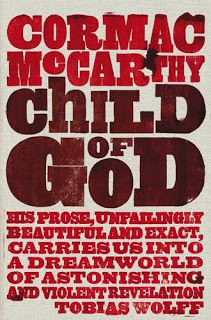
I am writing now briefly about Child of God, his novella that I have just finished. In looking for a copy of a cover to post with this, I read that the book was written in 1974 [I hadn’t looked when I read!]. Shows how stupid I am: I perceived of him as a modern writer, in a recent time sense, not the literary one of which he clearly is ‘modern’. It must have been prompted by a sense of the recent movie of NCFOM, and The Road, which I haven’t yet read. And ATPH was written in 1992. It hadn’t struck me that he had started writing and was published in the sixties. And I have only really taken note of him this year. Astonishing.
Child of God is a brilliantly and at times beautifully written story of the disgusting and despicable Lester Ballard, a man-thing who roams and ruts and routs around the hill country of East Tennessee. I’m not sure that there is a classic tension in what we as readers feel about this nasty protagonist, who is never even an anti-hero, and who never seeks our forgiveness or understanding either consciously or otherwise. I don’t believe McCarthy does. Ballard’s isolation both socially and physically in the story isn’t compromised by any authorial hand-holding. You must read this to experience the degradation for yourselves. The only one of two palliatives I can offer is that there are moments of humour. But they don’t last long.
The other is the writing style. At times, this sickening story is expressed so poetically that this could provide the only chance of being serenaded to some kind of empathy, but it is never about a Macbeth who is given salvation and redemption though a heightened language. There are many styles too, from vivid description to first person vernacular by unidentified speakers. Near the end, the sheriff and his deputy think and express themselves as templates for the Sheriff in No Country for Old Men. Here, fairly randomly, are two poetic narrations: the first about fireworks –
High above their upturned faces it burst, sprays of glycerine flaring across the night, trailing down the sky in loosely falling ribbons of hot spectra soon burnt to naught. Another went up, a long whishing sound, fishtailing aloft. In the bloom of its opening you could see like its shadow the image of the rocket gone before, the puff of black smoke and ashen trails arcing out and down like huge and dark medusa squatting in the sky
and the second, hounds attacking a boar –
Ballard watched this ballet tilt and swirl and churn mud up through the snow and watched the lovely blood there in its holograph of battle, spray burst from a ruptured lung, the dark heart’s blood, pinwheel and pirouette, until shots rang and all was done
There are countless more, some where the poetry is more lyrically in tune with the qualities being described, others even more antithetical in the grotesque juxtapositions of beautiful language and horrific events/situations. In this respect, there is schizophrenia in the reading, and I highly recommend the madness.
Originally posted April, 2012:
Writing
As an American who has spent most of his life in England I have dual nationality by way of experience if not by legal right, not that the latter would make any real difference. As a writer I have and use both voices – often together; often separately – and as a reader I make a varying preferential choice for either of these two voices.
I feel that my best writing comes from my American voice and it is when it is conversational and attains a natural rhythm and sound. My English voice – though this is going to be quite simplistic – is when I impose structures/form on that writing, for example in my sonnets when I use rhyme in quite an obvious way. As I’ve said above, there are times when these are kept quite separate. It’s more complex than this, and I have explained more comprehensively elsewhere – though not in this blog – but this shorthand will do for now.
For those few following this blog you will know that I have been reading the American voice of late: quite a bit of Steinbeck, always Ray Carver, Patrick deWitt [I know he’s Canadian, but…] and most recently Cormac McCarthy. In trying out my next new read I thought I’d have a go at McEwan’s Atonement. I couldn’t get into it: far too English. Brilliantly so, a luxuriant prose in many respects, and so tuned into representation of character, thoughts and feelings, and sense of place, especially inside and interiors and what these too represent. I made about five pages.

Then I found I actually had McCarthy’s All The Pretty Horses and hadn’t read yet [as I’ve said, I’m catching up]. Hooked immediately. I love the simple flow – deceptively so, of course – of the narrative and dialogue. And as I continue to make simplistic claims, another appeal at the moment is his ability to write about the exterior. By this I mean the expanse of land and open spaces McCarthy can write about because of where his stories are set. But it is more than this and below is a particular example of that American voice I want to celebrate. I’m trying to not make this sound like a lesson, but that’s difficult, so you can either listen or chat amongst yourselves. Here’s the passage, the fifth paragraph into the opening chapter:
As he turned to go he heard the train. He stopped and waited for it. He could feel it under his feet. It came boring out of the east like some ribald satellite of the coming sun howling and bellowing in the distance and the long light of the headlamp running through the tangled mesquite brakes creating out of the night the endless faceline down the dead straight right of way and sucking it back again wire and post mile on mile into the darkness after where the boilersmoke disbanded slowly along the faint new horizon and the sound came lagging and he stood still holding his hat in his hands in the passing ground-shudder watching it till it was gone. Then he turned and went back to the house.
It’s that long, wonderful sentence. And it’s because it follows the first three short ones – the most brilliant set-up. I think Raymond Chandler is one of America’s finest modern writers, and apart from his unique talent with similes, he is master of the long compound sentence. He is also master of mixing up his sentence lengths. But McCarthy’s takes this further. It is in the richness of the grammatical make-up of that long gaze, represented by the sentence, and how we as readers try to take in all the detail too, detail heightened by the weightiness of verbs, surprise naming [nouns yes, but it is more than this] and the succession of ‘and’ connectives that should jar but don’t because where they lead is too demanding of our attention.
Hey, I said you could chat – I didn’t say you could do that! If you’re not interested, I apologise, but do me the courtesy. Your homework is to turn to the third page and read the even longer paragraph beginning In the evening he settled his horse and rode…. The example of the meandering compound sentence is even more elaborate here. And it isn’t a style that McCarthy labours to produce. It happens here at the beginning and then tends to disappear. But you keep hoping to hear more.

A reminder that these re-postings – mainly reviews of prose and poetry – are from recent years but a music blog, so placing here in the hope of reaching a new audience. Originally from April, 2012:
Never For A Lazy Sunday
After reading DeWitt’s The Sisters Brothers, I began his first novel Ablutions, having ordered on the strength of his superlative sophomore book. Its dark bartender narrative, however, didn’t engage me and I soon gave up. That much observed ennui and despair without any sense of a comic or even sardonic overview just didn’t have the capacity to maintain my interest. It could be that the brilliance of The Sisters Brothers cast too daunting an expectation.
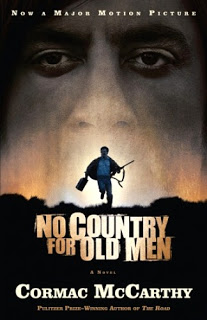
So I turned to my recent charity shop purchace of Cormac McCarthy’s No Country for Old Men, my first McCarthy read [I am behind the times, this book itself published in 2005, though like many I’d seen the Coen brothers’ film]. If Ablutions appears saloon dark and dirty, No Country… is the blackest and bleakest of universal presentations, though pointedly set in 1980s America, Texas to be precise, so it is best to see it as socio-historically and culturally a Western universalising, even a modernised Wild West metaphor.
What it does possess is a dark humour to counter-balance its nihilism. Sheriff Bell has a homespun philosophical wit that allows him to observe wryly on the things that abhor, frighten and disappoint him about the world as it is. Even the evil Chigurh has his comic assessments, either through internal narrative or dialogue when thinking about or relaying directly to the person he is about to kill.
The themes of honour and duty are prevalent ones, and McCarthy presents them with an amazing insight into their complexities. Sheriff Bell has an ‘old-fashioned’ commitment to serve and protect the citizens who fall within his jurisdiction, though he would extend this to anyone in genuine need because that is the way he was brought up. These ‘old-fashioned’ values are for Bell the ones upon which his country/county [an important symbolism as well as linguistic similarity] have been built and which are now under absolute threat by the modern world, or the world of the 80s when the story is set. The ostensible threat comes from narcotics in every aspect of its grip on the country/county/[world]: the effects of the drug itself, the criminals who buy and sell it, the ‘dopes’ who take it, the horrific consequences of this, and ultimately the greed and dispassion which underpins and grows from it. The main consequence of this in the novel is a multitude of killings. McCarthy’s detailed description of these and the guns that facilitate it provide an astonishingly informed and clinical narrative.
The relentless, remorseless Chigurh has his own code of honour which is to carry out his commitment to a job whatever the cost. The cost is usually killing someone or many people and he is unstoppable in this commitment. The only iota of escape offered to occasional imminent victims – if they even have a moment of such opportunity – is the flip of a coin, which in the two cases it is offered doesn’t even work in their favour. Chigurh’s world and control over it is that certain – even chance has no chance of changing the inevitable.
Other key characters are Moss, somewhere in the middle of good-guy Bell and bad-guy Chigurh, a Vietnam vet and welder who stumbles on that very nightmare consequence of this drug-corrupted modern world and in being tempted to benefit from this, essentially launches the story with its multiple escapes and chases, his own existential greed tempered by not having been directly involved in the existence of the money he decides to take as well as wanting mainly to improve his and his wife’s quality of life; his wife Carla Jean whose Christian beliefs are frankly not up to competing with what is going on at this time, and Bell’s wife Loretta who loves her husband unconditionally and provides him with stoical support as well as a colossal wisdom: the closing scenes of these two reflecting on and talking about what their life and the world in general has become provide the book’s most perceptive philosophy
There is so much more that I have left out – like Bell’s wartime secret – but that’s for you to read, and also the fact that for all of its simple narrative, driven by hypnotically realistic and/or surreal dialogue, it is packed with depths and complex tangents. I don’t know if the following Times recommendation on the back cover blurb is taken out of context, but it is so woefully bereft of touching on this book’s impact and significance that it is genuinely hilarious:
A Western thriller with a racy plot and punchy dialogue. Perfect for a lazy Sunday.


