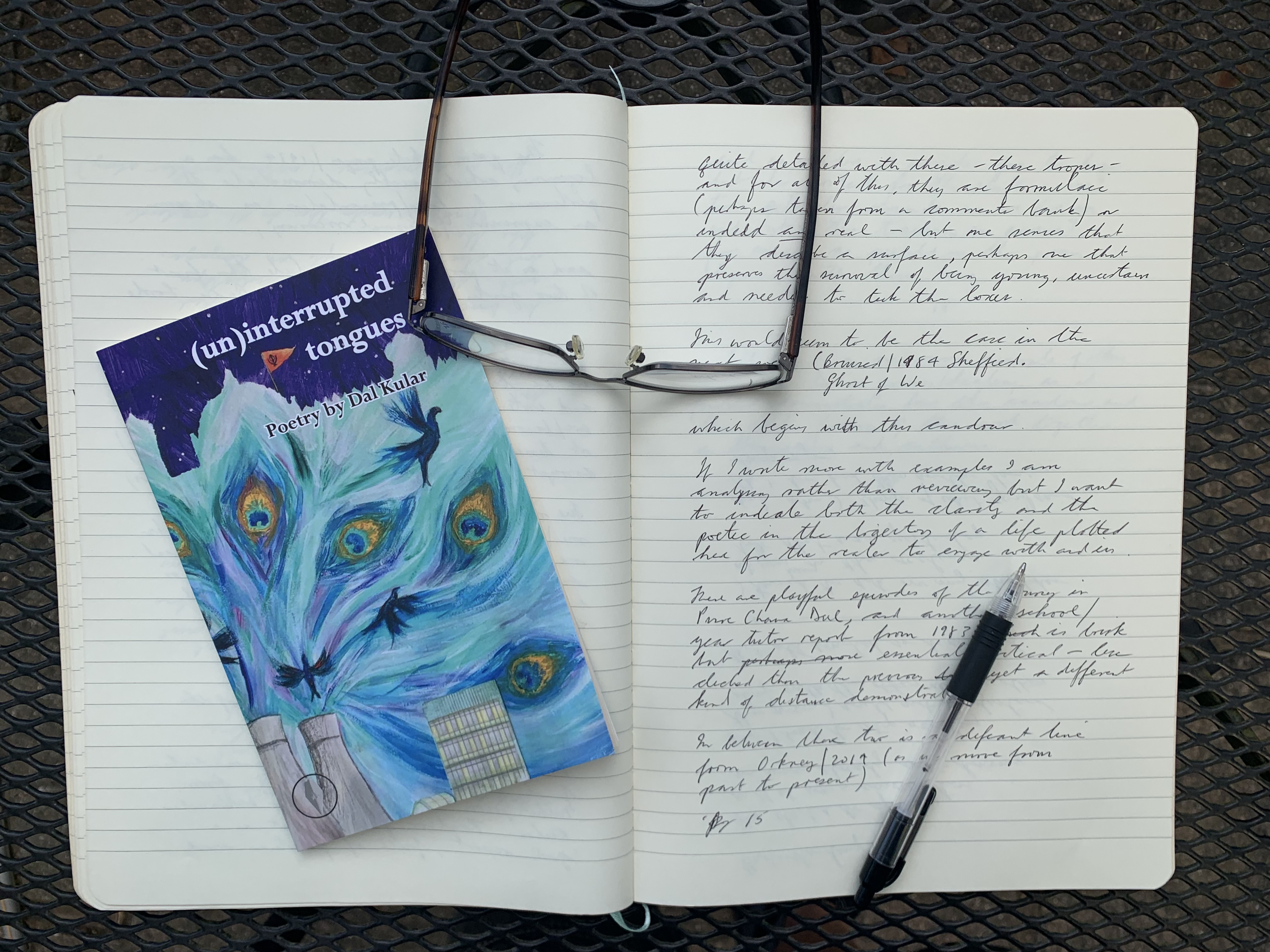
 The journey a reader takes in getting to know Dal Kular gains impetus when reading through this collection’s self-revelations, its ruses (presentational/tonal), the personal artefacts as representation of historical and cultural points, and through this, a palpable sense of her own journey that is aided by this therapeutic writing process.
After an opening poem time(less) li(n)e – itself playfully provocative – the first untitled poem begins,
‘this works in a
MEsS.
My m-
ess.’
and we will increasingly discover the meaning/meaningfulness of such a recurring typography that presents the surface examples of being seen/judged as a person. In a collection exploring identity, this presents a familiar – if ultimately superficial – aspect of that external framing which nevertheless impacts on the internal thoughts and feelings of the individual.
The poem white pages | 1974 has a beginning which quickly demonstrates the pertinence of form/presentation in shaping an expression of personal meaning,
‘i was creative before i
was brown| i created myself
female before i was born| that
was my first act of creation| my soul
in shades of everything| when
i was six i wrote about snow-
white-men in royal blue
ink across off-’
[on the printed page this is a box/square: important as that presentation],
and as the poem progresses to include the first of two quotes by Audre Lorde in the whole collection,
“…the decision to define ourselves,
name ourselves,
and speak for ourselves,
instead of being
defined and spoken for by
others”
[right justified on the printed page]
we are being introduced to the external and internal forces that act on who we are/become, the poetry itself interrupted at times by lines that halt/pause/prevent/corrupt expression – or so it seems.
The next two poems Haunting | ancestor speaks me | Punjabi 185? and uprise | ancestor speaks me | Sheffield 2019 explore historical and cultural shifts/impacts on Kular’s life as a child and growing up into adulthood. The second poem ends with
‘see fire in my eyes
scars on my tongue
i am alive|
made of places
wilded by
others
others-wised by
wild|’
and the hurt as well as learning of the self is beautifully defiant.
As a teacher I was interested in the presenting of a school report from 1978 and Nether Green Middle School for Dalbinder Kular. Actual or faux, it is a ‘good’ report, full of positives and quite detailed with these – these tropes – and for all of this, they are formulaic (perhaps taken from comment banks) or indeed are real – but one senses they describe a surface, possibly one that was achieved and helped to preserve the survival of being young, uncertain and needing to tick the boxes; to fit in.
This would seem to be the case in the next poem (Bruised | 1984 Sheffield. Ghost of We which begins with this candour,
‘The Ghost of I looks down into the school yard – all the white
kids are walking west. Defying physics. One Brown Girl walks
East. Trailing her scream behind her tangled into broken
peacock feathers. When the school yard is empty she sucks up
the space and spreads her feathers and lets the scream escape
into smog.’
It is emerging how there is both clarity and the poetic in the trajectory of a life plotted here for the reader to engage with and in.
There are playful episodes of the journey in Pure Chana Dal, and another school/tutor report from 1983 is brisk but essentially critical – less cliched than the previous yet a different kind of distance is demonstrated.
In between these two are defiant lines from Orkney | 2019 (as we move from past to present),
‘Race is the least interesting lie of me. It
visibilises me and invisibilises me in equal
measure. I prefers being invisible on her own
terms. Like the way the North Sea sculpts
the space between the old man and
mainland, splitting sunsets in two.’
and as readers it provides joy to hear but also context for the shifts across time. It also reminds us of the complex personality/identity bifurcations Kular experienced as we dip in and out of the recorded trauma – as for example in the poem beginning with these lines,
‘I had a dream once, a horrific
interruption that still shocks me.
I lived in a tiny terraced
house in Nottingham, on
ancient battle-land, bloodied
bodies strata-fied beneath her,
genetic rememberings of a long
ago capital. A hooded shadow
burst into her bedroom with
hurricane intensity, in the
darkest darkness, an atrocious
force ripping the covers from her
bed and sucking every part of her
soul from me. It woke I. Or was
I already awake?’
I’ll finish on one more example of this trauma in the poet’s journey/healing as it further demonstrates how the candour and the poetic framing of this (specifically here: the nomenclature/playing/re-presenting) work together as documentary and catharsis,
‘depressioning
suicidaling
disassociationing
anxieting
scatterationing
regretfulling
fear-fulling
racializing
the dead-end day jobbing
‘The Professional Careering’
stresssssing
presssssurising
shagginging
the manyfathomed depthness of knowing the path that I didn’t
following
un-believing-in-myselfnessing
confidencelessnessing
unremitting escape pathings – here!’
To get more information and buy, go here.



 gravyfromthegazebo