
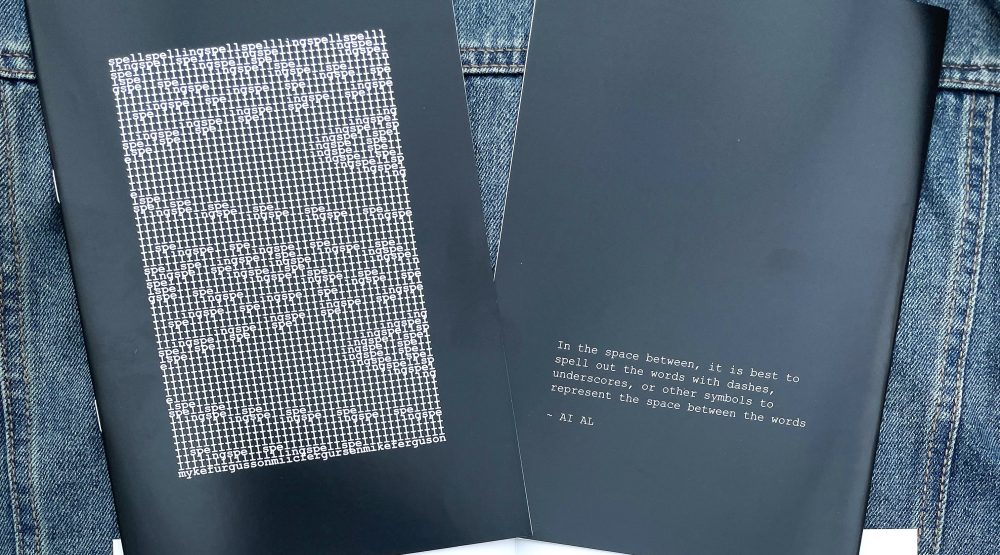
My current writing and posting of a couple of found poems so far come from John Millington Synge’s book The Aran Islands, published in 1907.
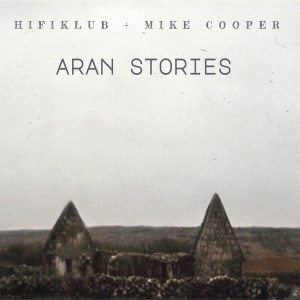
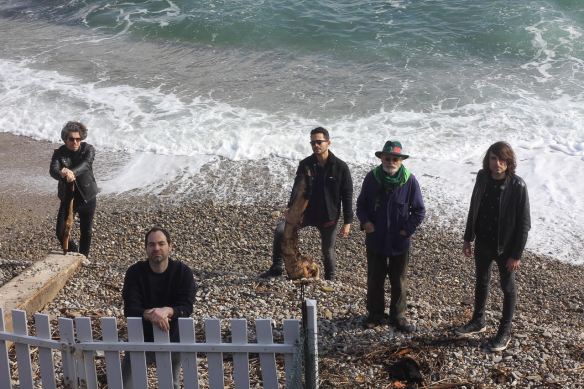
This itself was a complete find after listening to the new album Aran Stories by Hifiklub and Mike Cooper, a pairing of the French instrumental band – who I have not heard before – and the English guitarist Mike Cooper who, like many, I knew from his The Machine Gun Co. with Mike Copper days [1972], but also and more pertinently from his more recent Radio Paradise: Mike Cooper in Beirut [around 2012] where his playing of electric lap steel with electronic manipulations is more akin to the guitar work in this latest release. An expansive example of such on Aran Stories – not just from Cooper of course – are the layers of screeching and wah-wah sounds on first track Naked Bridges at its start, with a killer bass line, which is then accompanied by Cooper singing cut-up texts from The Aran Islands. It has an echo of Jim Morrison and The Doors in their more jammed performances, Morrison in incantation mode.
The band and Cooper’s album is more closely a musical reading of Robert J. Flaherty’s silent film Man of Aran, which I have never seen, so it is the Synge text that I could find and read and start to manipulate.
A calmer [at the beginning], ambient-esque album take on the Synge text with Cooper’s cut-up renditions is third track Geography. Fourth Gaelic Falling is a psychedelic, spacey backdrop to a delivery of text I more readily recognise from my reading so far. It is an excellent interpretive album.
Perhaps it is important to stress that Cooper’s excised text consists of more phrases and thus reflects the original’s description compared with my searches for quite separate/independent meanings.


…though a different one

That is, a different poster, not original, but a copy. My writing day profile with original [in two ways] poster is here, and you can read many other accounts of personal processes on this dedicated-to-writing-accounts site hosted by Rob McLennan.
That black and white poster is back hanging in the hall with others.

Playing around with text from W H Mallock’s The Human Document, the original source of Tom Phillips’ A Humument
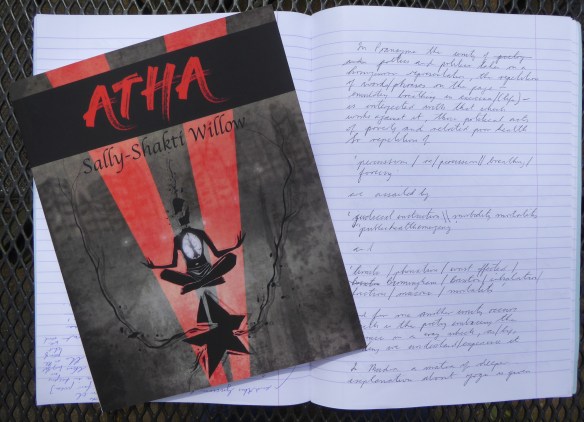
I have not in reading, and am not in writing about that reading, ignoring the poetics of this collection, that which explicitly makes up Part 1 of Atha but also necessarily/fundamentally informs all.
It is because I feel more comfortable writing about the poetry itself [with apologies for that glaringly paradoxical split] and it is the ‘comfort’ that is perhaps my most intuitive reaction to the poetics: the words that spread in fluid movements across the page are most yoga-like in my limited appreciation of yoga and complete physical/meditation inexperience of it. I think that is it by way of explanation/excuse – though as ‘reader’ reflected on in the Poetics I need not feel so contrite.
The control/comfort/oneness implied and achieved by the words and their instructions are, however, disrupted by the intrusions of the world outside – though, excusing paradox again, the poetics/poetry is all about being at one with all and everything – yet intrude it does because the world we live in is increasingly alienating and segregating. It is a destructive force to be reckoned with.
So at the beginning of Part 2 we have instruction [with another apology [!] for not representing here the exact fluidity of movement of the words on the page, as WordPress reformats what I type, even if I transfer out to Notepad, for example, and back again]*,
‘breathing is movement is / fundamental / of living things’
but throughout the opening there are physical realities that can restrict yoga’s and therefore ‘life’ processes, like
‘not advised / for people suffering’ // ‘high blood press’
and there are also other restrictions to this from the outer as opposed to inner world which are expressed ironically, like
‘freedom of / movement’ // ‘freedom of travel’ // ‘free movement’
and this results in the alienation/segregation and worse that these poems want to overcome,
‘You return & you are not /
one of
them
they
treat
you
with
indifference’
so while these poems are all about union and not excluding, there are forces [more than our own bodies] that can and will work against us. This is represented in spite of – though I don’t really mean that caveat – what the Poetics tells us: ‘IT DOES NOT SEEK TO CONSTRUCT FANTASY WORLDS’ and ‘UTOPIAN POETICS DOES NOT EXCLUDE’.
And there I am contradicting what I said at the beginning about not writing about the Poetics…and will continue to write so: one gets drawn into it naturally
Part 2 enacts this fundamental force against and recovery from alienation where at the close of its opening section Asana [though again unable to represent the fluidity of the writing], it states,
‘release / dormant energy / become light / creative / biorhythms of body / in positions that / cultivate’
In Pranayma the unity of poetics and politics takes on an homogeneous representation, the repetition of words/phrases on the page – emulating breathing in exercise/(life) – is interjected with that which works against it, those political acts of creating poverty and related poor health. So, repetitions of,
‘percussions / re/percussions’ // ‘breathing / forcing ‘
are assailed by
‘judicial instruction\\morbidity mortality “publichealthemergency”’
and
‘limits / phonation / worst affected / Birmingham / Brixton / inhalation / friction / mucous / mortality’
and for me another unity occurs which is the poetry embracing the polemic in a way which as/by reading we understand/experience it.
In Mudra a mantra of deeper explanation about yoga is given and this too is aligned to/contrasted with the outside/(affected inside) assault,
‘naked power / grab / by ministers’
In Part 3: Three Rituals for Theresa Hak Kyung Cha, a ‘ghostword’ is in many ways all the words that continue to explore the indirect world of these poems [and so by that determinate of being unified it also means all that preceded], a ‘nomenclature’ for tension/unity where ‘unconcluded exile’ is perhaps the existing hope.
This is a long piece and deserves reading rather than review, but what is interesting is how the poet enters more obviously the movement of the poem, the ‘I wonder / who…’ we now read about. It isn’t authorial so much as is.
There are visual representations to enjoy in the whole, by the way: the block writing of B&ha, the visual/found poems of Asana and infinite imperative [and others], and the faint text of Cha’s Hands, 1979 – this faint/bold typeface an increasing part of Part 4: Movement and Meditation [so often mesmeric] that closes the whole.
There are Notes at the end of the whole text to explain/offer citations and I haven’t read these [yet], my offering instead here a review/impression of a first reading. I have enjoyed/been affected by the symmetry/merging of the poetic and polemic in this work, noticing how my increased assemblage of words quite instinctively begins to emulate what I read and feel. It is very much a feeling/discovery rather than analysis and I want to leave it at that as the most organic reflection/celebration.
You can read more about and purchase Atha at Knives Forks and Spoons Press here.
*screengrab of the text from KFSP page to give [distant!] sense of appearance on the page:


Really?
my daughter, who turns twenty tomorrow,
has become truly independent.
she doesn’t need her father to help her
deal with the bureaucracies of schools,
hmo’s, insurance, the dmv.
she is quite capable of handling
landlords, bosses, and auto repair shops.
also boyfriends and roommates.
and her mother.
frankly it’s been a big relief.
the teenage years were often stressful.
sometimes, though, i feel a little useless.
but when she drove down from northern California
to visit us for a couple of days,
she came through the door with the
biggest, warmest hug in the world for me.
and when we all went out for lunch,
she said, affecting a little girl’s voice,
“i’m going to sit next to my daddy,”
and she did, and slid over close to me
so i could put my arm around her shoulder
until the food arrived.
i’ve been keeping busy since she’s been gone,
mainly with my teaching and writing,
a little travel connected with both,
but i realized now how long it had been
since i had felt deep emotion.
when she left i said, simply,
“i love you,”
and she replied, quietly,
“i love you too.”
you know it isn’t always easy for
a twenty-year-old to say that;
it isn’t always easy for a father.
literature and opera are full of
characters who die for love:
i stay alive for her.
‘No Longer A Teenager’ by Gerald Locklin from The Life Force Poems. © Water Row Books, 2002.
I’ve been a long-time fan of Gerald Locklin and his poetry, and this poem is a perfect example of his conversational writing that superficially has a casual chat with us as readers when it at the same time conveys deep truths about, in this case, a father/daughter [and more broadly parent/child] relationship.
It is largely the American colloquial style that prompts me to make this comparison, but he and his writing remind me of Charles Bukowski, but a much kinder and gentler version. That shouldn’t encourage too much analysis, so let me just say it as an off-the-cuff aside.
In my 1999 poetry teaching text Poems in your Pocket I included two Locklin poems, one that was a sweet whimsy of a piece – and there for that purpose – and the other ‘my son wants to ride the chairlift’ which is one of the most frightening stories I have ever read, telling as it does, and in that disarmingly casual Locklin way, about the fear and terror of his son falling from a chairlift, being so small when riding in it – ‘casual’ because it is anecdotal and the dread is really all in his imagination of likely events within the otherwise domestic situation, he also with his wife and youngest child, his daughter. She is one year old at the time/in the poem and I assume the daughter of ‘No Longer a Teenager’.
My other Locklin posts are here.

Here today. With my usual, genuine thanks, but also to Nick Victor for the illustration.
 gravyfromthegazebo