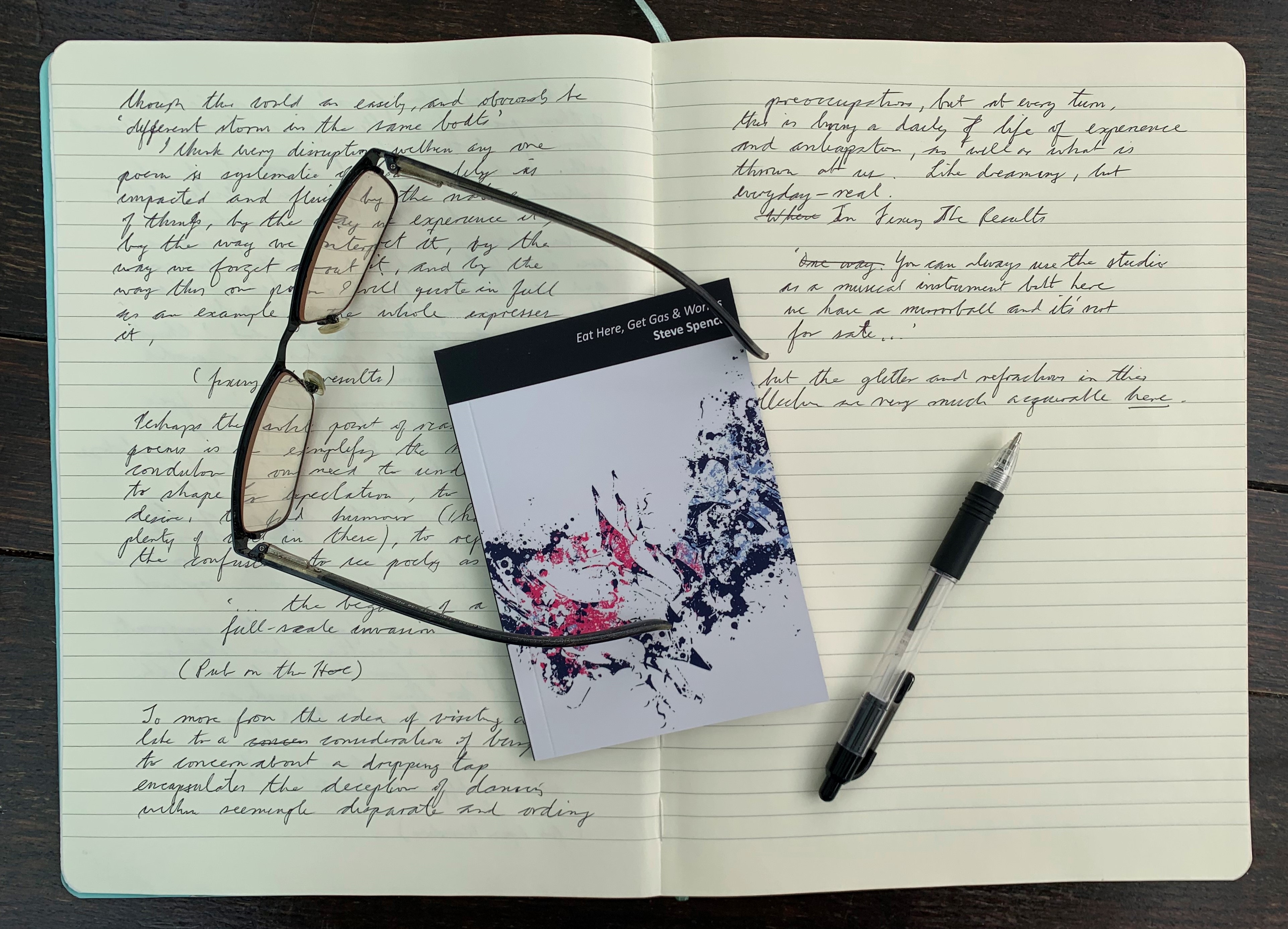
I have been looking forward to a collection of these poems from Steve Spence, having followed and enjoyed them online (both in their appearances and within each narrative) in International Times, Stride Magazine and other. I don’t mean I have been looking for, expecting or wanting ‘answers’ – their collages of surprise are wonderfully paradoxical in evasion and anchoring. The ‘he said/she said’ is the one recurring hook in the constantly evolving dialogue, and I think we take this as any and all speakers in a world of disrupted communication.
There are so many ‘themes’: free-market economy, invention of lithography, colouring books, King Kong, bird songs, graphology, log cabins, salmon, self-censorship, surveillance, and bright orange fiddler crabs – to scratch the surface of the poetic preoccupations. In the explorations, nothing is resolved and everything is considered as we move quickly from one captured thought to another.
I take great comfort in the uniformity of each poem’s structure: five stanzas, the first four of four lines each and the fifth with two lines. Perhaps this is as much certainty over which we have control, and this much is therefore familiar and finite. Each poem is
‘…the same storm even if
we’re in different boats’
(An Open Window)
though this could as easily and obviously be ‘different storm in the same boats’.
I think every disruption within any one poem is symptomatic of how reality is impacted and fluid by the nature of things, by the way we experience it, by the way we interpret it, by the way we forget about it (often immediately), and by the way this one and only poem I will quote in full is an example of the whole,
‘One way or another we are
all under surveillance all of
the time. “My concern is that
this is about territory,” he said.
You can always use the studio
as a musical instrument but here
we have a mirrorball and it’s not
for sale*. “Everything in our path
has been obliterated,” she said.
Yet all areas of recording are
happening simultaneously and
we are looking at an increase in
volcanic activity. What about the
headless body? “This is how it
should feel all of the time,” he
said. When magma rises through
the crust it puts pressure
on the surrounding rocks.
(Fixing the Results)
The whole point of reading these poems is to enjoy and maybe to exemplify the human condition – our need to understand, to shape to expectation, to shape to desire, to find humour (there is plenty of this in these), to replicate the confusion, to see poetry as
‘…the beginning of a
full-scale invasion’
(Pub on the Hoe)
To move from the idea of visiting a lake to a consideration of burglars to concern about a dripping tap encapsulates the deception of dancing within seemingly disparate and ordinary fixations, but at every turn, this is living a daily life of experience and anticipation, as well as what is thrown at us, randomly. Like dreaming, but everyday-real.
*And the glitter and shifting refractions in this delightful collection are very much acquirable here.




 gravyfromthegazebo