
 The AI Literary Review is a focused forum for writers/artists who engage with AI as a prompt and/or process for their own creative productions. That is probably a reductionist summary when the wonderful range produced across six issues now reflects a lively and evolving interaction.
I’ve made two contributions – with my thanks to Dan for taking and posting – and my most recent in the current edition can be read here: https://ailiteraryreview.co.uk/issue06
Anyone who accessed the link above may be interested in an elaboration on my work to follow, otherwise, I suspect you aren’t…
The editor Dan Powers rightly keeps contributor narratives in the Review to a minimum and showcases instead the creative outcomes.
I can do what I like here, and will! Here is some further detail to my Issue 6 contribution:
When using the earliest ChatGPT available, trying to get this AI to write poetry was a chore because the responses were always so literal, anchored to rhyming, and usually banal/twee in content. Although once getting a wonderful but fortuitous, aberrant pair of visual poems as a response (included in AI Literary Review, Issue 2), I quickly gave up on it.
Until recently: mid-August, ‘25. Asking ChatGPT to ‘in no more than 8 words, write your best poem’, it produced ‘Stars whisper secrets; silence blooms louder than words’. Not impressed, I set a series of challenges for it to work on this, including my critique of the line being clichéd, my prompt to present that line as concrete poetry, then ChatGPT’s offer to make this a ‘graphical version’, with a subsequent proposal of ‘visual artwork’, and it came up with these:


As you can see, these are versions on the same simplistic theme. I have a copy of the narrative occuring within these repetitive outcomes, which includes ChatGPT’s sycophantic responses acknowledging my ‘corrections/suggestions’ (which I won’t labour through here) and I eventually asked it to try ‘something brutal’ and we arrived at the following:
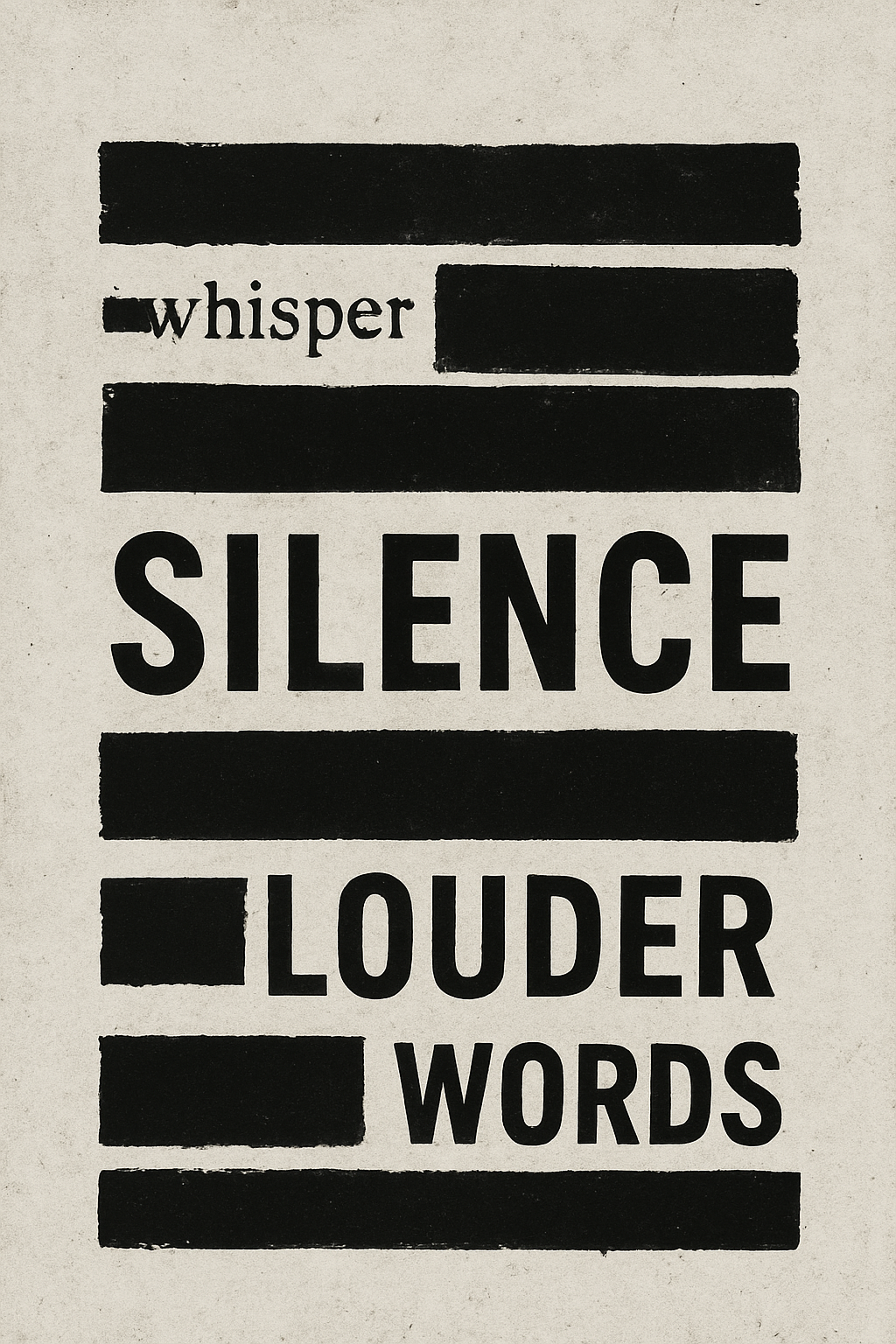
The intentions of ChatGPT this time around seemed far more informed and adventurous, but the actual results were no more than a trivial adaptation of some erasure and varying text size approaches, so I have given up on these poetic quests with AI once more.
There was an outcome, however, and that is my creative, human TextArt response to this included in Issue 6 (with link for that above) and the following second piece – not published – as it is a generative TextArt poem:

 gravyfromthegazebo