Maya Angelou – Caged Bird Songs

Originally posted May, 2015:

mayou - Copy

Still Rising

This is definitely an interesting album, and a tribute that as such justifies itself, and Angelou was keen on its production just before her passing so all is good. The hip-hop to funk to other beats attached to her poetry and readings highlight and complement and perhaps most of all present to a further audience.

It is an extra: I am always content enough to listen to Maya Angelou read aloud, her own rhythms and sassy intonations, that deep resonance of voice, all quite sufficient to engage me as listener. I got to see her reading once many years ago and that was genuinely special, and of course she would occasionally break into soulful song so I would be content enough again to have a recording of this.

maya 1 - Copy

Some of these poems lend themselves to the adornments more than others. The plosive sounds of Pow Pow as well as its natural rhythms are perfectly transformed by the additional grooves supplied by Shawn Rivera and Roccstarr; Harlem Hopscotch seems to have the spoken word slowed to an unnatural pace to accommodate the beats/percussion; On Aging is auto-tuned, and there is fuzz, and I am not sure; Ain’t That Bad is similarly vocally enhanced, but I think the inherent sass gets whiplashed effectively through the slight echoing, and the repetitions and quick rhymes work particularly well here: ain’t that bad ain’t that black ain’t that bad ain’t that black and ain’t that fine.

One More Round retains the spoken pace and rendition with a jazzier underpinning that is a happy medium. Naturally, one looks forward to the ‘classics’ Life Doesn’t Frighten Me and Still I Rise, the former suitably haunted [some literal sound effects!], the latter roused by a gospel repeating of lines, and overall the most overtly musical: wonderful.

You can hear much of it here.

maya 2 - Copy

George Osborne, Tomorrow’s Budget Announcement and the Acacacacademy of Anthropopopometry

…..crowned by the Acacacacademy of Anthropopopometry of Essy-in-Possy of Testew and Cunard it is established beyond all doubt all other doubt than that which clings to the labors of men that as a result of the labors unfinished of Testew and Cunnard it is established as hereinafter but not so fast for reasons unknown that as a result of the public works of Puncher and Wattmann it is established beyond all doubt that in view of the labors of Fartov and Belcher left unfinished for reasons unknown of Testew and Cunard left unfinished….

Like Lucky’s long random rambling speech about the Acacacacademy of Anthropopopometry in Waiting for Godot, the announcement by George Osborne in his budget speech tomorrow – already announced – that all state schools will have to become academies is a meaningless hot wind produced by the vapid vapour [smokescreen] that is the Fartov and Belcher of this Tory government.

It is, however, an announcement which as a news item is intended to bury the other news in tomorrow’s budget that Osborne will likely make further cuts to welfare payments for the disabled and other vulnerable people in our society in order to provide money to assist with the tax cuts he wants to make for the wealthiest in society. And this is one of the reasons it has been announced today, established as hereinafter….

It is full of insidious intent and therefore malicious meaning, but it is meaningless as an ideological dictate because the clarion call that this provides our state schools with independence is yet another mirage. That ‘independence’ is always stressed by this government to be ‘from local authority control’ – as if this is by its existence a bad thing – when this too is a complete deflection from the other story which is that such independence is always shackled by what the government legislates state schools do have to follow on a national basis.

It is such a simple argument that I will not delineate further because you either see this clearly or you are wafting the smokescreen into your own eyes for the masochistic myopia it pleasures you. There are arguments for and against the benefits of being an academy, but claiming simplistically that such a status provides the broad brushstroke of independence from [as it is claimed by Cameron] ‘the bureaucrats’ is a lie.

I’ll close this brief outburst on today’s announcement about tomorrow’s announcement – my blog catharsis – by a nostalgic reference to the local authority education control with which I grew up as an English teacher in Devon throughout the 1980s and into the mid-90s. And referring specifically to the English Advisory Service of that time, it was for me the richest, most dynamic, insightful and influential support to me as a teacher and professional and did so much to make me the teacher I was and professional I continue to strive to be. The practical and intellectual support was invigorating, from day one. The most significant impact came from English subject training courses run by the local advisory team across those years, so a team that changed but maintained its exceptional qualities, and the sense of a shared professional journey for teachers in Devon was personally exhilarating as well as fundamentally impacting on those students I, and others, were teaching at that time.

I won’t attempt to outline the many varied courses and foci of these over that 15 or so years [things did change….], but a few that mattered hugely and relate directly to posts I have made recently on this blog about the teaching of writing were those that focused on teachers as writers.

I don’t believe such courses and the intense focus they sustained exist anymore. They don’t exist because there is no local authority infrastructure – anywhere – to finance and implement this, and to sustain it over a period of time that develops expertise. And they don’t exist as well because in-service training ceased to be about subject/professional development and rather the delivery of government dictates on the curriculum, for example the Literacy Strategy I referenced in a recent posting. And these will be the dictates that all state schools as academies will have to follow in the future and certainly have no independence whatsoever to ignore. It isn’t Catch-22. It is what is there when the smokescreen dissipates. Or when you just open your eyes.

I know it is too late. But I had to say something. The dismantling of local authorities began many years ago and they cannot be resurrected I suspect. I also acknowledge that many were never as good as the Devon one – certainly the Education section – that I was so privileged to experience and benefit from. However, there was in Devon at least the model that could and should have been worked on, and developed nationwide, but even Labour under Blair began their decline and demise.

But Labour wouldn’t take from the disabled to give to the silly rich. I don’t think even Lucky would be that grotesque. If this doesn’t in fact happen tomorrow [the jester likes pulling tricks out of the hat] it will soon enough.

Esophagus Writ by Daniel Y Harris and Rupert M Loydell – Knives Forks and Spoons

Originally posted August, 2014:

DSCN1503

Viral Meaning

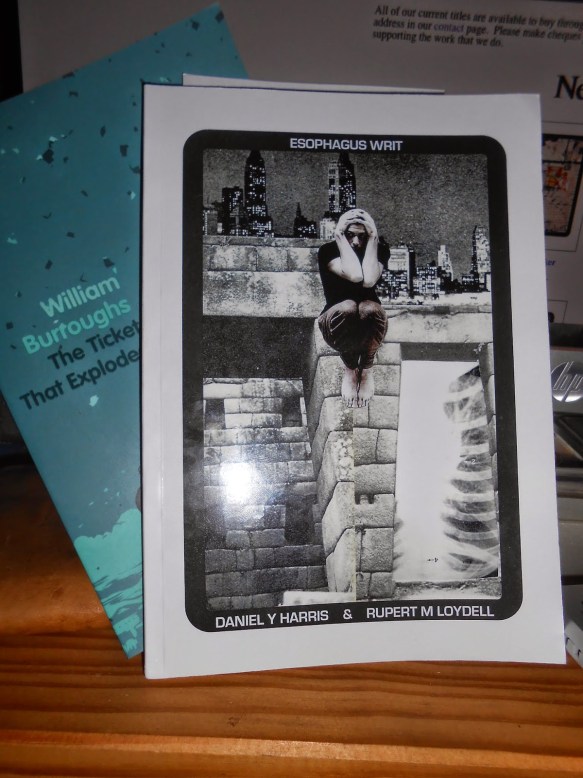
I didn’t see it cited in the notes from the Introduction by the little-known but clearly scholarly Dr Theodolite Cardew, but I am sure that the anthropoetjests Messrs Harris and Loydell will have referenced directly or indirectly the influential works of Fartov and Belcher in their own scholarly ruminations on the meanings of in their new poetry collection Esophagus Writ.

In the way cosmic coincidence will commune with those of us who listen, it was uncanny that I am currently reading Burroughs’ The Ticket That Exploded because this work is cited in the notes of that Introduction – the quote ‘the word is now a virus’ – and to expand on this reference, our dynamic duo explore the ‘other half’ which includes the meanings of, and do so with the compelling organism of their refracting poetic words.

I say ‘refracting’ because the poems in this anthology are placed side by side: one on the left [generally tempting with an organic accessibility] and then the one on the immediate right a bifurcated refraction of its leftie [generally teasing with an organic complexity] – never a copy or mirror re-working. Thus the organism of these shared words and ideas becomes a mutual virus that infects both and then spreads across the whole as a parasitic creator of new meaning.

The dichotomy of these refracted new meanings can be exemplified in titles like The Museum of Oblivion/The Museum of Oblation; The Ghost of an Impoverished Past/The Gimp of a Tumescent Now; Enter Babe Rainbow/Enter Billy-Bob Bovary, the latter in which ‘I suddenly felt much better’ and ‘I felt better in my thong’ wrestle with the plurality implicit in the meanings of.

A closer analysis of any more of these refractions – an inspection surprisingly missing from the otherwise erudite and learned exploration of Dr Cardew – reveals how the prism of this poetic intercourse shifts and splits meanings of two startling [and intentional] obfuscations. From the domesticity of

‘My beautiful time bomb,
will you dance before we explode?
How is the weather inside today?’

[The Mystery of the Mind]

to the psychoanalysis of

‘Hell is glial. Heaven, a dendrite. Between
podes, the myelin of a normative stint
in living with charm and poised saunter.’

[The Mystery of the Brain]

where the damaged layers of both our expression and understanding are wrapped up in each focus, one on love and one on over-analysis so that neither explains though one may seem more palpable.

I won’t comment further on the poems for these are for the reader to mainline and in doing so find their veins of personal meanings because ‘Everything should become clear to the most idiotic among us’ [Advice to the Reader]. I have just injected a tiny droplet of the virus.

I will nearly close on an admittedly pedantic point: I take issue with the esteemed Dr Cardew’s citing of the Blinky Snoodle work ‘Stupid Groups of Animals’ in The Journal of Behavioural Science vol. 12, #2, 1993 as a paper in any way informing the theoretical basis of these poets’ work as this fraudulent fancy was roundly discredited in the subsequent volume of that venerated journal by the renown American anthropology expert Wyde I Ceen.

I will, however, fully conclude by stating that this work is above and beyond any academic reference points a demonstrative hoot. If the virus is Poetry, the vaccine is reading the meanings of this challenging quality.

Buy the book here.

Locklin for the Ladies

Originally posted in October, 2011:
maybe the women are right about us


after an evening of glowering at my daughter
for such heinous offences
as having spilled milk
(i nearly cried over it)
eating her brother’s baby food,
and tipping over her chair
with herself in it

i hold her on my lap
while i read her
an illustrated hansel and gretel.
viewing the last page, she says,
“is their father a girl?”
and i say, “no, of course not;
their father is a man.”

and she says, “he must be a girl.”
and i say, “why can’t he be a man?”

and she says, “because he’s smiling.”

Gerald Locklin

Brian Doyle – Mink River

mink

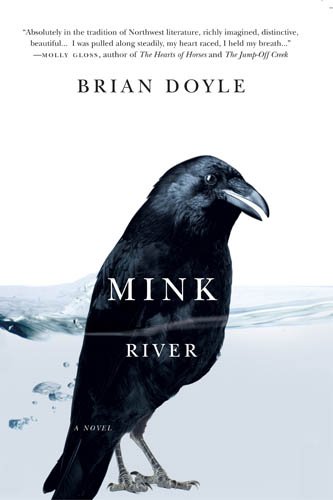
My sister sent me Brian Doyle’s Mink River as a birthday present, and I look forward to reading it fully. I started today, but didn’t get very far.

I began that read but was stopped immediately in my tracks. Heightened as I am by my recent anger at a teaching/modelling of writing as a bloated, overwrought linguistic process, I saw in the first few pages of this novel that gift of a ‘simple’ writing style. When I articulate next what I see in and mean by this, it will be evident how stylised it actually is, indeed complex in its artifice. But the use of long, rolling compound sentences, and a generally straightforward vocabulary are a part of its inherent simplicity. This is an ‘American’ style of writing, to simplify, and hardly original, but as with Hemingway and Chandler and Carver and McCarthy – in significantly different ways – the connective and becomes the most used word and you can’t easily teach the purposeful effectiveness of this but you can recommend reading it to experience that effectiveness.

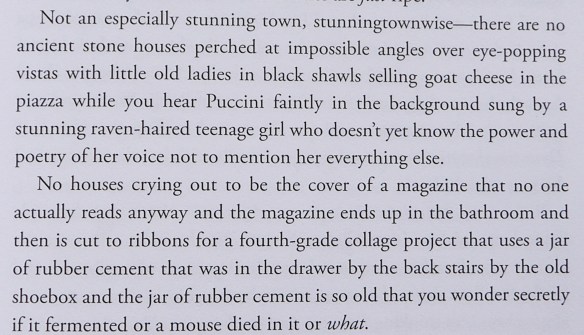
Doyle has a style that breaks conventions – long broken, really; revels in the straightforwardness of language use, though employs a complex vocabulary, and indulges clever repetition for the impact this has when crafted rather than simply happening from poor judgement. These two paragraphs from the opening page illustrate aspects of what I am describing:

P1000498

Naturally, there is huge cleverness in the detail that is being connected in just these two paragraphs which generates so much of the reader’s engagement. I had meant to include above a subsequent paragraph that flows similarly in all respects, but then closes on the line I will type in now, one that also illustrates what I mean by Doyle’s use of a complex vocabulary:

 ….. – the kind of juxtaposition of things that painters like to paint for inchoate inarticulate unconscious reasons they can’t explain.

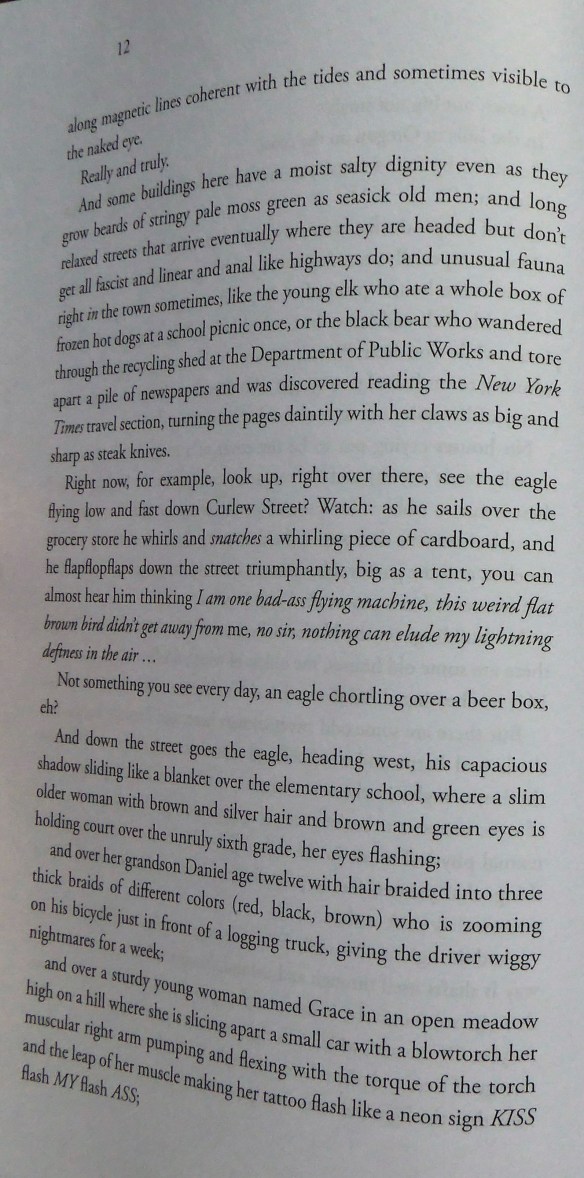
The next illustration is of two whole pages and demonstrates how Doyle’s breaking of convention and therefore invention propel his narrative with such energy. It engages because of the relentless pace, but also the fluency of its sentence structures – this very much an aural impact – and also its paradoxical mix of straightforwardness and then its more playful moments, like the repetitions in the third paragraph on the second page:

P1000501

P1000500

That’s all I wanted to say and display at this moment. It should be clear that I am proposing how Doyle’s writing would be an excellent model to share with students [at GCSE/Key Stage 4] to introduce them to the meaningful possibilities of good writing, writing that has an integrity in both its honest simplicities but also highly contrived playing with this. And as I was writing this post – honestly – I had an email alert of a ‘popular in your network’ set of twitter posts, the first of which is this, from Michael Rosen: The simplest and best way to help children write is through investigating good writing – then mix imitation, adaptation, invention to write.


Jayne Cortez and the Firespitters – There It Is

Originally posted in February, 2012:

jaynecortez - Copy

Nuff Said

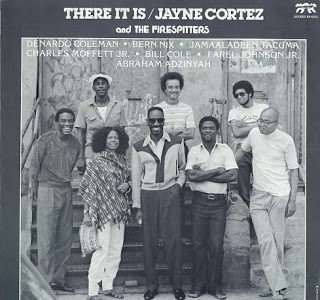
Been listening to this all morning: poetry and jazz and invective – it’s powerful stuff. Second track U.S. – Nigeria Relations is a mesmerising example of Cortez’s performance poetry with the repeated line They want the oil but they don’t want the people hammering home its stinging message. This method is used again for sixth track If The Drum Is A Woman: potent repetitions across a greater variety of lines, percussion accompanying. The marriage of jazz [the Firespitters] and poetry [Cortez] gets a rousing work-out on fifth track Opening Act.

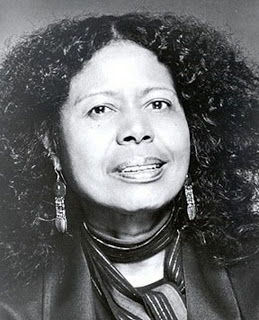
I’m learning all the time: researching around this album I discover today that Jayne Cortez was married in 1954, at age 18, to Ornette Coleman. Nuff said.

And here are the lyrics to the rousing and more rockblues oriented opening track There It Is,

There It Is

My friend
they don’t care
if you’re an individualist
a leftist a rightist
a shithead or a snake

They will try to exploit you
absorb you confine you
disconnect you isolate you
or kill you

And you will disappear into your own rage
into your own insanity
into your own poverty
into a word a phrase a slogan a cartoon
and then ashes

The ruling class will tell you that
there is no ruling class
as they organize their liberal supporters into
white supremist lynch mobs
organize their children into
ku klux klan gangs
organize their police into killer cops
organize their propaganda into
a devise to ossify us with angel dust
pre-occupy us with western symbols in
african hair styles
inoculate us with hate
institutionalize us with ignorance
hypnotize us with a monotonous sound designed
to make us evade reality and stomp our lives away
And we are programmed to self destruct
to fragment
to get buried under covert intelligence operations of
unintelligent committees impulsed toward death
And there it is

The enemies polishing their penises between
oil wells at the pentagon
the bulldozers leaping into demolition dances
the old folks dying of starvation
the informers wearing out shoes looking for crumbs
the lifeblood of the earth almost dead in
the greedy mouth of imperialism
And my friend
they don’t care
if you’re an individualist
a leftist a rightist
a shithead or a snake

They will spray you with
a virus of legionnaire’s disease
fill your nostrils with
the swine flu of their arrogance
stuff your body into a tampon of
toxic shock syndrome
try to pump all the resources of the world
into their own veins
and fly off into the wild blue yonder to
pollute another planet

And if we don’t fight
if we don’t resist
if we don’t organize and unify and
get the power to control our own lives
Then we will wear
the exaggerated look of captivity
the stylized look of submission
the bizarre look of suicide
the dehumanized look of fear
and the decomposed look of repression
forever and ever and ever
And there it is

Nuff said, you know

JayneCortez2 - Copy

Woeful Wow Words

Study Hemingway, particularly his early work and learn how to write short sentences and how to eschew all those beastly adjectives. Surely it is better to say ‘She was a tall girl with a bosom’ than ‘She was a tall girl with a shapely, prominent bosom’, or some such rubbish. The first one says it all.

  • Extract from letter Roald Dahl wrote to 17 year old student aspiring to be a writer.

I found the Dahl quote, written in 1980 but apparently discovered and made public only last year, when I was searching for an article about the primary school student who recently wrote to children’s author Joanna Nadin chastising her for beginning a sentence with a conjunction in her book The Stepmonster. I shall return to this in a moment.

I have not been aware of ‘Wow’ words until recently, first when I saw some flaunted with the piece of exemplar descriptive writing I have criticised here a few days ago, and then subsequently as I have researched these. My ignorance isn’t surprising. They would appear to be largely a primary school initiative – I only ever taught at secondary level – and I presume they were born out of the Literary Strategy, that mad structural teaching monolith of the then Labour government and also professionals that did so much to damage teaching and learning, and those kowtowed to follow its dictates.

I do know something about that kowtowing. Even at secondary level I was as Head of English put under consistent pressure to make Key Stage 3 schemes of work reflect elements of the Strategy, and all Advisory Service meetings/conferences that occurred in the latter and dreadful part of my tenure – at least the last 10 years – were consumed with this and directed by zealots who bought into its drivel. But so did I at times: I confess I even framed by Strategy terms a collection of three creative writing resources I produced  to make them marketable. I always asserted the primacy of its creative purpose, but it would be deceptive to say I didn’t employ its terminology. It is frightening what fear and loathing can make one do.

Not requiring any support for my negative views regarding this, I do, however, have one memorable and salient incident to corroborate: it was when one of those advisers who had lead many LS gospel meetings admitted years after implementation it had all been terribly wrong. Words to that effect. I cannot remember exactly. I think I was there. It is a blur. A blur of fury that still fuels the disdain.

In the Times Education Supplement report here on the Nadin incident, it quotes the author’s refreshing and cogent dismissal of the use of wow words by primary school students, calling them ‘ugly’ which is succinct and most apt [I nearly put the adverb ‘superbly’ before succinct, but didn’t: do read on, especially Stephen King]. Her reported advice on what makes good writing is one I wholeheartedly support, and have done so consistently in the postings on this blog about writing. Reading this last night, I searched out other authors’ advice on writing, and of course there are countless sites where these are collected, and as famous quotes, oft repeated. I have made a small selection of those that deal mostly with the use of words [three are on punctuation; one more general] and these follow for your interest.

Substitute ‘damn’ every time you’re inclined to write ‘very;’ your editor will delete it and the writing will be just as it should be.

Mark Twain

Here is a lesson in creative writing. First rule: Do not use semicolons. They are transvestite hermaphrodites representing absolutely nothing. All they do is show you’ve been to college.

Kurt Vonnegut

If you want to be a writer, you must do two things above all others: read a lot and write a lot.

Stephen king

Cut out all these exclamation points. An exclamation point is like laughing at your own joke.

F. Scott Fitzgerald

Keep your exclamation points under control. You are allowed no more than two or three per 100,000 words of prose.

Elmore Leonard

 If it sounds like writing … rewrite it.

Elmore Leonard

I believe the road to hell is paved with adverbs, and I will shout it from the rooftops.

Stephen King

Avoid adverbs, especially after “he said” and “she said.” “While to write adverbs is human, to write ‘he said’ or ‘she said’ is divine.

Stephen King

Two of the ‘wow’ words attached to the exemplar descriptive writing I have been referencing were Arcadian and obfuscation. The first is a silly recommendation. The second is more problematic: obfuscation describes, ironically, the result of an overuse of wow words, but it is an excellent word when used in more discursive [rather than descriptive] writing. And that is the crux. Wow words do not exist in a vacuum and context is everything.

My point here is that vocabulary is obviously an important tool for any writer. And as English teachers we should be exploring and expanding this for all students, in creative and precise contexts, but also in others’ writing, and thus by reading this: advice so many of the above authors make as well when talking about what makes a good writer.

My reading and then writing has been heavily influenced by American authors: firstly Earnest Hemingway when I was a teenager, and much later Raymond Carver – both demonstrating the power of simplicity. Raymond Chandler is also an excellent model, and I came to him through teaching The Big Sleep at A level.

Cormac McCarthy is the other. He is one of the greatest writers of our time, and perhaps the greatest when it comes to his use of language; his phenomenal vocabulary and how he uses this with such a unique felicity.

My final comment is that though I have stressed the importance of reading in helping us all to become good writers, I will close on my fundamental, over-riding ethos as a teacher of writing: it is treating students as writers and helping them to write as writers. It is not as exam fodder. It is not as wow-worshippers. It is not as word strategists.

A final observation: had I been aware of wow words in February 2015, I might have been inclined to name this new site after the title of this posting – http://www.www.wordpress [don’t try – it isn’t a link!]

[There is also this good related article from The Guardian in June, 2015, here].

e.e. cummings – it may not always be so;and i say

Originally posted in February, 2012:

it may not always be so; and i say
that if your lips,which i have loved,should touch
another’s,and your dear strong fingers clutch
his heart,as mine in time not far away;
if on another’s face your sweet hair lay
in such silence as i know,or such
great writhing words as,uttering overmuch,
stand helplessly before the spirit at bay;

if this should be,i say if this should be—
you of my heart,send me a little word;
that i may go unto him,and take his hands,
saying,Accept all happiness from me.
Then shall i turn my face,and hear one bird
sing terribly afar in the lost lands

As one of my ‘teenage’ poems, I’m sure this will be more familiar than those I have posted previously. It is interesting to me how there is a pattern emerging in the love poems I seem to be selecting with their final honest lines.

There were a number of favourite cummings poems I could have chosen, but the one that would have run this choice the closest is my father moved through dooms of love.

Yevgeny Yevtushenko – Waiting

Originally posted February, 2012:

My love will come
will fling open her arms and fold me in them,
will understand my fears, observe my changes.
In from the pouring dark, from the pitch night
without stopping to bang the taxi door
she’ll run upstairs through the decaying porch
burning with love and love’s happiness,
she’ll run dripping upstairs, she won’t knock,
will take my head in her hands,
and when she drops her overcoat on a chair,
it will slide to the floor in a blue heap.

[from Selected Poems, Penguin Modern European Poets, 1962]

Of course I’ve got the bug now, right up there, and I’m revisiting the old reading grounds. It’s wonderful.

With Yevtushenko, it was a choice between this poem and Lies with the following opening that had an obvious appeal for a teenager’s sense of being wronged by anyone and everyone older,

Lying to the young is wrong.
Proving to them that lies are true is wrong.
Telling them that God’s in his heaven
and all’s well with the world is wrong….

But I went for Waiting because I was as romantic as radical in my poetic moods in the 70s and I love the simple rushing narrative of this immediate poem.

Incendiary Teaching of Writing

I Am Incensed

Today I came across an English teaching resource advertised and available for purchasing, targeted at teaching for a current GCSE English Language Paper 1 Section B [Writing] component, and a segment used to illustrate the resource as well as appeal to potential buyers is abysmal.

I will not name where exactly this is advertised, nor offer any more description of the full contents. I’m not entirely sure why I am being so circumspect other than the sorely tested sense of professional courtesy I still feel: assuming it is written by a fellow teacher and that its intentions are well-meant. However, I am genuinely angered that any other teacher might be enticed to buy this, and worse, use it as a model for encouraging, in this specific example, students’ similar descriptive writing.

This model for such writing is awful. It is typical of the over-written, intense word-level nonsense that has been foisted on students over many years in the misguided notion that its very wordiness will score marks for students in an examination. It is a classic write-by-numbers model, a misconceived template where a language focus is made at the expense of actual communication. As I am in danger of over-explaining in my annoyance, here is the given paradigm:

The sky was a dark ocean that had been ripped apart by the streaming sunlight. Heavy clouds hung silently like retreating enemies. Slowly, a blue canvas emerged, bathing the cottage in a natural glow; it was a truly beautiful sight. The clouds groaned as they dissolved into the midwinter air. Summer had gone. Autumn threatened with cool swishing winds and darkening skies. For now however, the clouds allowed one last glimpse of the departing summer.

[and no apology for the pedantry, but if modelling for students, it must be accurate: thus the last sentence should read For now, however, the clouds…..]

I want to unpick every detail that doesn’t work simply in terms of common sense, let alone expose the mess of the linguistic jumble, but I’ll avoid that superfluous venting: any intelligent reader will see and hear the descriptive conflicts. What is immediately obvious is how this has been constructed: the first impulse is to use as many nouns, verbs and adjectives as possible, assuming these will be tick-boxed and rewarded in a mark scheme; the next impulse is to employ as much personification and alliteration as possible for exactly the same reason.

It is not about evoking the last moments of summer.

As an examiner of a GCSE English Language creative writing paper, I have seen students emulate this kind of formulaic ‘exam’ writing, and do so to the detriment of meaningfulness and to themselves because they have not been treated as writers but rather as mechanisms in the acquiring of requisite exam grade passes. It would be churlish I suppose to ignore the insipid pressures that will be put on many teachers to make this kind of shift from teaching to training.

I must also stress than Awarding Bodies need to do more to clarify skills descriptors in mark schemes. This existing GCSE hierarchical strand for language use in Writing is of course a shorthand, but guidance needs to be provided to demonstrate good practice at achieving these descriptors [within the examining context], as well as warnings about teaching a mechanistic approach to them – the caveat embedded in examiner training and their eventual practice too:

  • Simple vocabulary
  • Simple vocabulary; simple linguistic devices
  • Begins to vary vocabulary with some use of linguistic devices
  • Conscious use of vocabulary with some use of linguistic devices
  • Vocabulary clearly chosen for effect and appropriate use of linguistic devices
  • Increasingly sophisticated vocabulary and phrasing, chosen for effect with a range of successful linguistic devices
  • Extensive vocabulary with conscious crafting of linguistic devices
  • Extensive and ambitious vocabulary with sustained crafting of linguistic devices

Problem areas in this shorthand are the repeated reference to linguistic devices, the term conscious use and extensive. I like crafting and I think terms like sophisticated – again, with exemplification – are useful when accompanied by other similar terms in that assessment ladder.

I dislike conscious use [though I understand it] because it makes writing sound like the ‘construction’ model for sale I am criticising. Indeed, we should know the most effective writing is that which doesn’t foreground its selecting of language – it is more fluent than this, that fluency coming from students writing as writers. I dislike linguistic devices because it makes a requisite of these: a brilliant piece of descriptive writing can exist entirely without figurative expressions. That doesn’t mean it has to, but it can. The mark scheme – being what it is – cannot articulate this!

As co-author of the Cambridge University Press Writing Workshops, self- advertised on this blog here, I have put my experience of and attitude to the teaching of writing in this book. I don’t mention now to advertise yet again, but do so because anyone is as free to see and then criticise my thoughts about and examples of this as I am of the turgid model that so incensed me today.