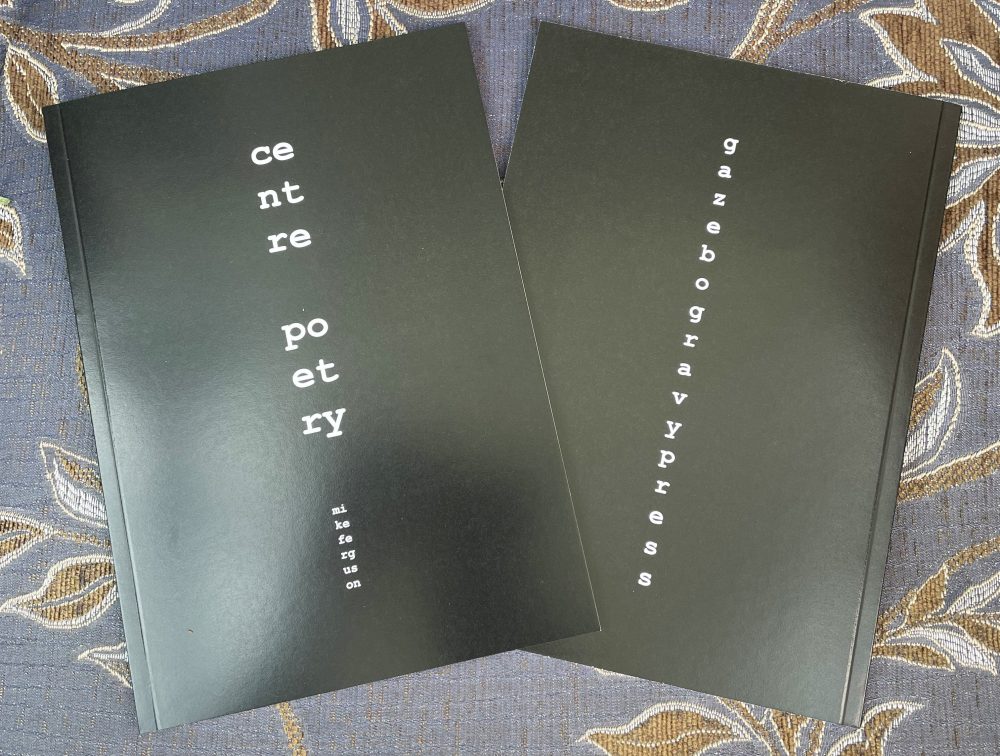
Delighted to see this. Not that easy to get messages, let alone the book, out to teachers to see and use:


Full information can be seen here.
Originally posted June, 2012:
I wrote the following some years ago about the thieving of my dad’s Chrysler, self-published in a pamphlet called Years where various songs and the year of their recording prompted poetic remembrances. It’s a poem I used to enjoy reading aloud:
the sister said
we took the car
just for a ride
and my boyfriend could drive
but it wasn’t stealing, only borrowing
[with dad in Greenland
he’d hardly know]
and my brother would pay for the gas
with money from his paper round
so we headed out of town
with the Chrysler gliding up and down the long road
like it was floating on air
and in the black of night
speed wasn’t really noticeable
then my boyfriend said something
which reminded me of
why Lenny Bruce was on trial
and my little brother was listening
so we should’ve been thinking
about getting home
her boyfriend said
whata cocksucker of a car
and we’d be on trial
if caught
so who’s Lenny Bruce anyway
a real jerk
not tough like me
i got a razor blade and
carved her whole name down my arm
MXXXXXX in big letters
with the cigarette burns
we’ll dump the car
and wipe it clean
like on TV
i said
this is neat
i’m with the boyfriend who
looks like James Dean
combs his hair back
and rolls up his t-shirt sleeves
i was in a car with him once
being chased and going around
a corner on two wheels
i got a razor blade too
and carved my girlfriend’s name
but forgot the D
so have CINY on my arm
he reminds me of the pictures
on my sister’s bedroom walls
Sal Mineo, Ricky Nelson,
Elvis Presley
i heard Roy Orbison’s
Oh Pretty Woman on the radio there
what a song
as cool as being in this car
when we got home
i turned her bedroom light on
to tell them the car was missed
as they drove by
i was scared
the guys on that wall a lot
tougher than me
The reference to the missing D is a true story: trying to be a tough guy like the boys hanging around and chasing after my sister – though not going for the deliberate cigarette burns – I did carve my girlfriend’s name in my forearm in front of her, but got it wrong. Had that misspelt scar for quite a few years, this future English teacher….
Originally posted February, 2014
A world’s disappearing.
Little street,
You were too narrow,
Too much in the shade already.
You had only one dog,
One lone child.
You hid your biggest mirror,
Your undressed lovers.
Someone carted them off
In an open truck.
They were still naked, travelling
On their sofa
Over a darkening plain,
Some unknown Kansas or Nebraska
With a storm brewing.
The woman opening a red umbrella
In the truck. The boy
And the dog running after them,
As if after a rooster
With its head chopped off.
As mentioned previously, there will be a series of re-postings on Omaha and Nebraska, literary and lyrical, the place of my birth. This was originally posted January, 2014:
Omaha
Red barns and red heifers spot the green
grass circles around Omaha—the farmers
haul tanks of cream and wagon loads of cheese.
Shale hogbacks across the river at Council
Bluffs—and shanties hang by an eyelash to
the hill slants back around Omaha.
A span of steel ties up the kin of Iowa and
Nebraska across the yellow, big-hoofed Missouri River.
Omaha, the roughneck, feeds armies,
Eats and swears from a dirty face.
Omaha works to get the world a breakfast.
by Carl Sandburg
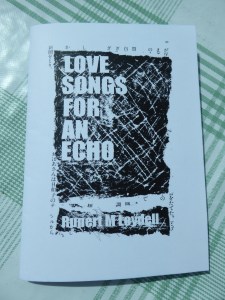
Prolific poet and painter Rupert M Loydell’s latest collection is about many things but I think these poems are mostly about journeys, and not simply because this chapbook begins and ends on a train.
The writing is not surprisingly concerned with the literal journeys we take, but more so those in our thinking: about the past, about the present, about change, about what is good or bad or neutral about change, about seeing some or all of this as a sequence of postcards prompted by music, or similar prompted by someone else’s music.
And that is what the poet and painter spends his or her life doing, all the time – journeying, observing, thinking and recording: the latter literally, or holding as a thought for further along the travelling.
Loydell is very often experimental with his writing, and his affinity for found inspiration and crafting into collages of varied or precise patterns [some of that precision here as in parts of the sequence Nine Postcards and in New Grids or Patterns from the other sequence Fifteen Minutes Nowhere] is a trademark, but in this collection I think we find him at his most lyrical, and many times beautifully so.
It is, however, a calm and carefully observed lyricism, as in the opening detail of the first prose-poem One of These Days. That calm is also the prevailing mood of these poems and in the varying shapings, even though their considerations are at times expansive. There are no histrionics in the contemplations; no drama. I think Rupert would see it as not freaking out, and it suits him and this gently intelligent, thoughtful and compelling collection.
I frankly enjoy raving, but in an empathetic mood, review this now with a reserve that I trust does not disguise my considerable liking.
You can buy for £3.60 here [scroll down to find].
I mentioned that Loydell is also a painter and that gives me the very good excuse to advertise the following to which Rupert has donated an art work. I will certainly be taking a wonderful existential punt for an extremely important cause:

Read more here.
Karaoke Krazy
As reported in today’s Guardian, news of secondary schools seeking to hit demanding GCSE performance targets by switching to ‘alternative’ courses and qualifications has caused outrage among many politicians, especially those in Government and responsible for promoting the national academisation policy of its recent White Paper. Education Minister Nick Glib appeared on ITV News this evening and read from the Guardian article what he called ‘one of the newspaper’s more disturbing revelations’:
The DfE said it was looking closely at GCSE-equivalent qualifications such as the European Computer Driving Licence (ECDL), which can be taught in as little as three days but is equivalent in the DfE’s league tables to a two-year GCSE such as history.
Glib went on to explain that one of the qualifications coming under close scrutiny was for a new subject called Political Karaoke which offers students the opportunity to compose and perform a well-known ‘popular’ song melody with an original re-written lyric for examination. These new lyrics must be based on the phenomenon of political parties – especially the Conservatives – standing by its members regardless of how stupid or criminal they have behaved in either or both of their private and public lives.
A spokesperson from the qualification’s Awarding Body, Spincity College London, did not wish to appear live on the ITV programme but did provide a written statement which offered the following:
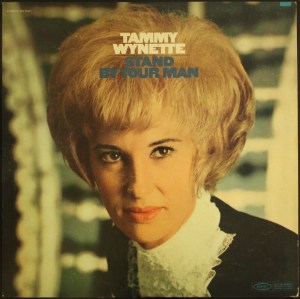
Students are tasked with choosing a contemporary political figure who they determine has demonstrated poor ethical or legal judgements and/or acts whilst in a position of authority. They then compose a song lyric to a familiar tune about that person’s total lack of integrity when denying any responsibility for their misdemeanours. As a template and guide, a re-written version of Tammy Wynette’s ‘Stand By Your Man’ is provided for students to use.
We have been able to acquire a copy of the exemplar lyrics presented in the syllabus for this subject:
Stand By the PM Man
Sometimes it’s hard to be a minion
Giving all your trust to the PM man
You’ll have bad times, and he’ll have very good times
Doin’ things offshore you don’t understand
But if you voted for him, you’ll have to trust him
Even though he’s a bugger to understand
And if you support him, oh be blind about him
‘Cause after all he’s the PM man.
Stand by the PM man, give him Daddy’s accounts to cling to
And something porkish to come to
When nights are cold and lonely.
Stand by the PM man, and show the world you trust him
Keep giving all the trust you fucking can.
Stand by the PM man.
Stand by the PM man, and show the world you trust him
Keep giving all the blind faith you can.
Stand by the PM man.
Read the Guardian article here.
Certainties
I was sitting outside reading and initially just delighted that he had written I step to one side to let them pass, but it is so slippery…. rather than the prevalent silliness of slippey [even the BBC….]. When I later went indoors, there was a plain envelope on the floor beneath the letterbox. Inside was a pamphlet-like ‘Dictionary’ – as it said on the cover – but when I opened the slim volume there were mainly blank pages and only one definition which was this: elusive in meaning because changing according to one’s point of view. This confused but did not displease. I was, however, later disappointed that there was a handwritten note, on the final of the few otherwise blank pages, because it was addressed generally rather than personally To whom it may elude. That said, the smiley-face emoticon after this made me lol.
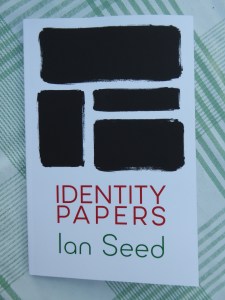
The universal literary question asks whether the story being told is about appearance or reality and in Ian Seed’s collection of prose poems Identity Papers it is of course both. But they don’t ‘elude’ for me or cause any anxiety about fixture because certainties would seem to be the ultimate illusion in our lives. I enjoy the uncertain journeys. These can slip and slide across the varying landscapes too.
Three poem narratives will serve as an immediate example of the shifting terrain under which these poems are precarious: Honoured Guest is unusual but relatively bland [as it should be, by the way]; New Neighbours disturbs in its mention of child abuse, and Documentary is quite beautiful in its story of a man recovering from mental health issues who we read walks on a sea of crushed forest, formed from dead trees over millions of years who then seems in danger, but at the end of the momentary observation shows a smile that radiates confidence.
The book’s cover suggests something has been redacted, but transferring this as a metaphor to the poems’ quick if tenuous reads would be overstating. There are no black obliterations that require being found out – that would suggest there had been those prior certainties; and anyway, the darknesses of many of these narratives, like New Neighbours, have not been covered up. Nor has that in Late which seems like it could be linked to a ‘real’ life story of a mother who has lost a child in a hit-and-run, but Seed’s imaginary involvement in another near tragedy for her, and the tender absurdity of his offer to make amends, take us as readers beyond a literal response to her story to its shadier if still compassionate reflection.
There is much to smile about in the unravelling of unevents as well. The title poem is lightly teasing in a tale of a return to a former place and life, the closing enlightenment more comic than the tragedy it could have been, or would if a Hollywood film.
Like Seed’s Threadbare Fables reviewed here – and included in this volume – these poems toy with our expectations, arousing them. It’s hard to review that without spoiling the ride. Better to drive yourself up the dark alley or to the cliff’s edge. I’ll simply close by presenting one full poem as a taster, not as sinister or surreal or surprising as many, and not because of that word, but because I was a teacher, and I am as certain as I can be that it isn’t about me:
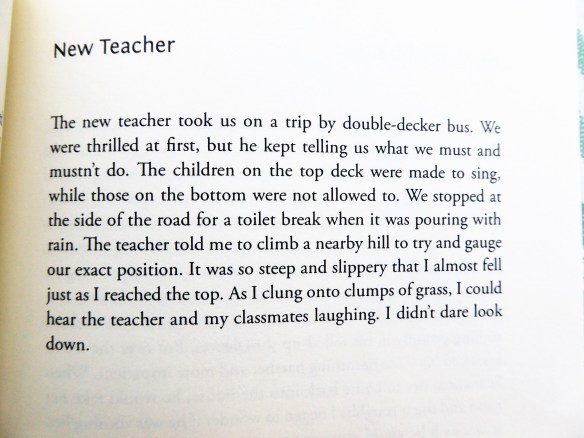
Read more and purchase here.
Eton Tests
Another Eton College King’s Scholarship English examination paper from 2012 makes interesting reading. Compared with yesterday’s 2014 example I posted, this actually offers reading material and questions that could/should engage, though the difference in the reading demands and potential responses seem at quite disproportionate odds for an exam that is apparently meant to set the same standard. Wouldn’t get away with that for national GCSEs…..
I am bound to be amused by the following latter part of the extract given from Fitzgerald’s The Great Gatsby as it would seem to potentially reflect the actual experience of likely candidates for the scholarship! And lest anyone suggest that as a scholarship this is targeted at the less privileged or a broad social background: I suppose it could be, but when the College’s own literature explaining the purpose makes a reference like In most papers of the examination there is a wide range of questions, so that any clever boy has ample opportunity to prove his worth, the language is so steeped in a public school paradigm of that ‘clever boy’ it seems unlikely:
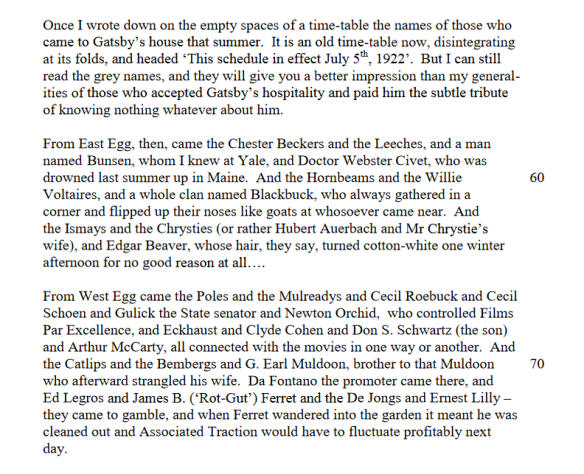
If I was undertaking a response to question 4 [b] I would, as an Eton aspirant, most likely chose the relatively modern Gatsby because the more contemporary and useful godfather figure Cameron isn’t available. I would call my essay Gatsby and His Panama Hat, writing obliquely but dreadfully keenly about the lavish lifestyle I could lead when such a ‘father’ figure guides and teaches me how to make the most of my offshore funds:

No Panama Connection, Yet
Idly searching on a whim to see if there was any connection between Eton College and recent revelations in The Panama Papers [seemed a fruitful punt] I didn’t find anything on this but did come across some of the college’s King’s Scholarship Examination papers and looked at the latest available for 2014.
The following struck me as interesting that a school of such privilege would be offering up the Stephen Spender poem without any hint of irony:

The comprehension questions on the poem were less surprising: rather obvious because that is essentially what they are, but also the one requisite feature-spotting ask.

How much more enlightening if examinees had been asked to summarise their own attitudes on ‘children who were rough’ and to imagine where such would come from in ‘our world’ today. Or set an essay task titled ‘We Are All In This Together’.
Originally posted in April, 2012:
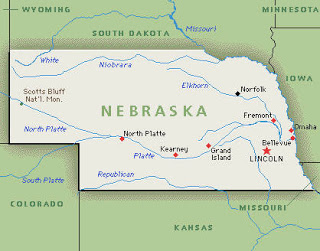
[Kinda hard to make out on this map, but Omaha is on the far right of the State, bordering Iowa and on the Missouri River].
I was listening recently to Counting Crows’ fine song Omaha from their great debut album August and Everything After and it reminded me how one day I want to compile and post all the quips ever mentioned in song about Omaha, the place of my birth, and/or Nebraska. Poetry is another place to look, and I will, but I know of two Carl Sandberg poems referencing Omaha, and this is the better of the two, if not as explicitly about Omaha as the other,
Sunset From Omaha Hotel Window
Into the blue river hills
The red sun runners go
And the long sand changes
And to-day is a goner
And to-day is not worth haggling over.
Here in Omaha
The gloaming is bitter
As in Chicago
Or Kenosha.
The long sand changes.
To-day is a goner.
Time knocks in another brass nail.
Another yellow plunger shoots the dark.
Constellations
Wheeling over Omaha
As in Chicago
Or Kenosha.
The long sand is gone
and all the talk is stars.
They circle in a dome over Nebraska.
– Carl Sandberg
 gravyfromthegazebo