Be Alive – at Dime Show Review

Always pleased to have/get my poetry out there. It is an interesting process: you have to be quite committed about it all – self-serving in one respect; confident there is value in the sharing as well. I couldn’t subscribe to any notion that a writer doesn’t want his/her work in the public domain and read, and hopefully liked.

I have made an intense decision of late to submit quite a bit of work. Initially this was my two found poem sequences, because these need to be accepted and published in the magazines [online primarily] if there is ever going to be any hope of finding a publisher for either as a complete text. I have subsequently, by engaging in that process, been submitting other writing.

On the one hand, it seems ‘easy’ – what I mean is, there is an abundance of outlets. A frightening amount. Gauging suitability of placing work with any one of these – obviously a two-way process, but I am only at one end – is itself hard work, and only fair. The other ‘daunting’ element of becoming immersed in this process is coming across an equal abundance of ‘competing’ poets/poems out there! As a writer I should be, and am, delighted to see this. But this is the other hand: having to compete for places and interest.

Having provided that honest context, here is my latest:

dimeshow

be alive

Read it here.

The Easier Ride to Nowhere

For anyone who read my posting yesterday on a Schools Week report, it will seem like I am out to give them a ‘hard ride’.

Well, I’m not because by and large they report what is happening in education so it isn’t that paper’s ‘fault’ if this is bad and/or wrong. They do have a responsibility to comment knowingly, however, and I acknowledge that commentaries often follow news reports.

Today’s headline has got me animated: Government makes SATs an easier ride after ‘fiasco’ last year.

Now, I could not find an attribution for the apparent quote ‘fiasco’, though I agree with the judgement, from whoever, and nor could I find a direct reference to the other non-quoted assertion ‘easier ride’ – though I immediately guessed this could not be the case. And of course such an idea is completely irrelevant.

The DfE and has-beens like Nicky Morgan are quoted as regurgitating the nonsense about rigour and standards being maintained – these requisite mainline assertions for the philistine addicts – so nothing new or enlightening here. The only substantive factor that links to the ‘easier ride’ metaphor is that the test questions will be better stepped: in other words, questions will be organised so that ‘easier’ ones are at the beginning of tests to prevent students being discouraged at the off of their experience.

So, ‘easier start’? As there is no reference whatsoever that has any relevance to my subject English – for example, that the questions will make some informed/cognitive/linguistic sense in terms of relating to the teaching and learning of actual Writing – the fact the students might find it ‘easier’ to begin their meaningless journey is ultimately neither here nor there. Apart from them not being emotionally devastated, which I confess is quite important. Not at the start, anyway.

For anyone really interested, I have spent considerable time exposing the nonsense of last year’s KS2 English SATs elsewhere on this blog, as have others out there, and nothing has changed about that – especially as it would appear nothing has changed about this continuing type of ill-informed, pedantic and often ludicrous questioning – apart from the nonsense it will be stepped!

I do and don’t despair. The English teacher in me prompts the former; the weary realist informs the latter.

Continuing KS2 question type:

In the sentence above, write an explanation for each way in which a semi-colon [shown] or a connective [rewrite and add an appropriate one] would serve the rhetorical balance of its assertion.

‘Harder’ is not Harder – and the Twat

Schools Week has run an exclusive today stating how the paper has received figures signalling a significant drop in A-level entries in schools/colleges for next year. They claim the hardest hit is English as a subject and that the reason for this is the standards now expected of students – the implication, clearly, that these are higher/harder than previously.

One other detail in support of this is that students are receiving very low marks in their mock exams and this is adversely affecting their confidence in considering further study.

Well, it could be this. But I am not entirely convinced. The English GCSE is not harder in terms of the standards being set/required [taking out, for English Language, the significant increased weighting given to SPaG]. Not standards in terms of, for example, kinds of writing that will be required. Not standards in terms of, for further example, reading comprehension skills.

What has changed in one important aspect – dramatically so – is the nature of the required study. In English Literature, if you can no longer read and study an engaging and accessible text like Of Mice and Men, this will have a detrimental impact on enjoyment, meaningfulness and thus learning potential. If your choice of a 19th century text is the dense and at times linguistically turgid Dr Jekyll and Mr Hyde [great story, but…] this will have an adverse effect on learning. If the examination for this is closed-book and entirely terminal [no coursework/tasks produced in class] this will have a catastrophic impact on the ability to demonstrate skills and understanding.

In English Language, I think the actual examination tasks are straightforward and mirrors of their previous, but it is again the 100% terminal examination that makes the most depressing impact [in both senses of the word] as well as, already mentioned, SPaG weighting in Writing.

And there is considerably more detail I could provide about texts and timings and other content, and that 100% terminal exam shift – including the removal of Speaking and Listening assessment from overall marks – that paint a broader picture, but what I have already mentioned and this other are not collectively about setting ‘higher’ standards, and I don’t like the word ‘harder’ either, though these two GCSEs will be harder, yes.

More important, they will be boring. They will be tedious. They will be so focused on examination outcomes – and the conditions in which these will now be wholly realised – that all of this is what will make levels of ‘achievement’ harder to attain.

Teachers teaching these new GCSEs will be more weary [though as committed and hard-working and innovative and inspirational as they can be at any given opportunity] yet they will be preoccupied with covering the amount of content and the kind/type of content. This is not about teaching and setting ‘higher’ standards [and I am avoiding using that word ‘harder’ because it has a duplicitous meaning – oh the punning again – in this context]. I don’t want the politicians and other philistines stating these new GCSEs are ‘harder’ to imply ‘higher’ standards – more demanding academically – when really what it mainly amounts to is a hard slog of practicalities over and above teaching and learning.

So I am also a little disappointed that Schools Week hasn’t made this clear and tended to deal in the superficialities of this set of figures and the presumed reasons for their impact.

I did get through all of that without mentioning Michael Gove, but he is by and large the monster architect twat responsible for all of this.

Dead Poet’s Society – poems of Okla Elliott

ink - Copy

This isn’t a club I wanted to join by initial design as it is out of ignorance first and then choice that I have become a member. And I am not entirely sure my appropriation of the title seems immediately acceptable, but I have taken it to obviously reflect that similar celebration of poets and poetry, though the writers now have only recently passed.

These writers are Tom Raworth and Roy Fisher and Okla Elliot, three poets I did not previously know about or their work. I mentioned recently and briefly on this blog my new reading of Fisher, having acquired his books The Dow Low Drop: New and Selected Poems and The Furnace. I have yet to fully read Raworth’s two bought texts, Tottering State and the Penguin Modern Poets 19 in which he appears.

Today I have been reading the third poet’s work, Okla Elliott’s excellent debut collection The Cartographer’s Ink. Where Raworth and Fisher had long and one hopes happy lives, passing this year at respectively 79 and 87 years old, Elliott passed at only 39 and would have had much more to write about and share.

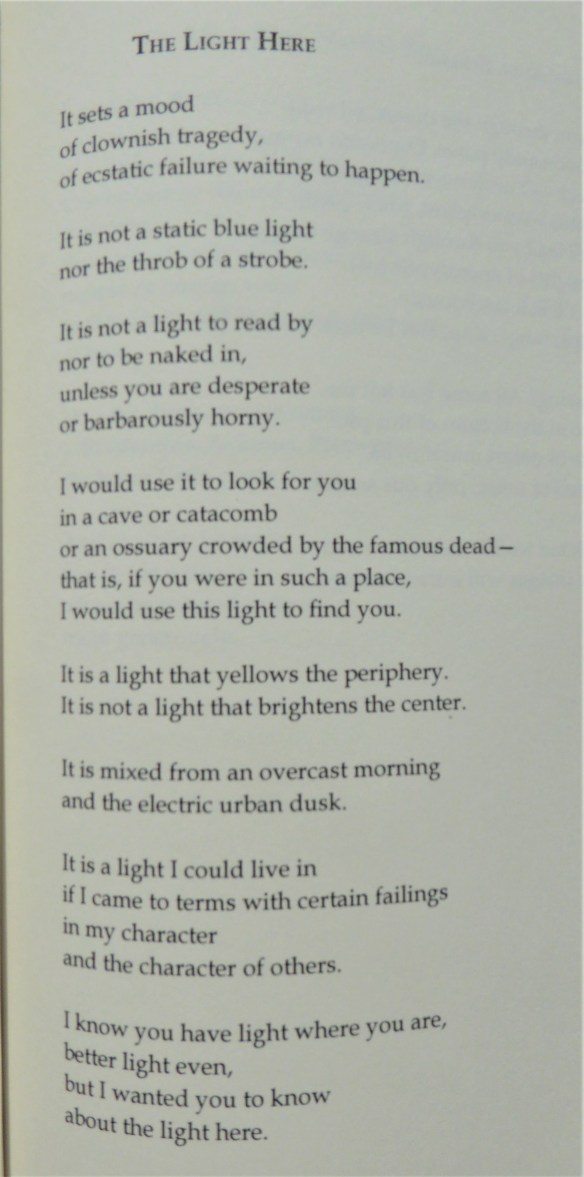
So that is what I am doing now, briefly. I want to share a few of his poems from the book I have rather than analyse them. What struck me immediately when reading this were his wonderful eclectic imagination and writing styles, poems that have a freshness in seeing and thinking about the world, then conveying this in a distinctively personal approach. This opening poem The Light Here struck me for its explosion of ideas about such an ‘ordinary’ source, which it clearly starts as, rather than immediately taking and playing with it for the obvious metaphors therein – though these do transpire:
P1010070

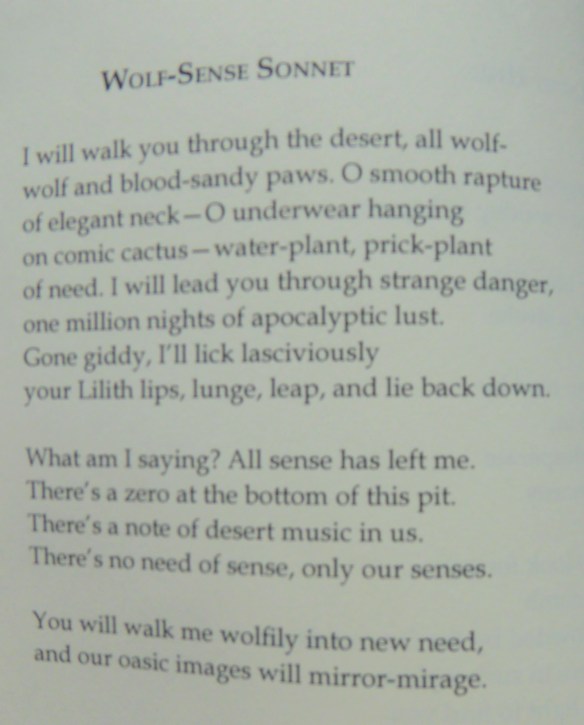
The next poem, literally, Wolf-Sense Sonnet, is instantly different. It is clearly a sonnet, but playfully irreverent in using the form, not a sonnet about love, but lust [I know that is hardly unconventional] yet erotic/dirty, and as rough with the punning and alliteration as it is with the sexual suggestiveness. Playfully so, again:
P1010071

In Lonely in Seoul, I like the simplicity of these seemingly meaningless observations, for that very reason, and because they are picked up next in part 3 of the poem, as in part 4 are other similar casual references from earlier. It is storytelling without drama, as loneliness so often is:

P1010072

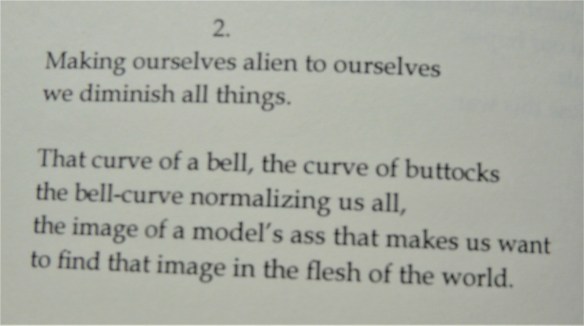
My last snapshots to share are from the poem Alien War, Human War, and I select not because they prove Elliott tackles more ‘serious’ subjects too, but because he does and with a knowingness that resonates in today’s world and it’s conflicts, this poem itself not surprisingly written on the tenth anniversary of the Iraq invasion, Elliott making his feelings obvious before the poem adds layers of insight to this:
P1010073

P1010074

I have much more to read from this debut still, and I look forward to exploring more of his other work in the future.

My apologies if the texts here are a little blurry – I took as photos because I didn’t want to have to type them up. I think they are readable, you can always get his book to get a crisper take.
Ants and the Poetry Stones

kk3

The ants would appear to be no lovers of verse,
though if having a penchant, perhaps silly for
a rhyme like worse because they love the crack,
excusing the pun as I mean the cracks between
granite stones that really came all the way from
China to carry Samuel Taylor Coleridge’s words.

Walking today along the entire run of Kubla Khan
I see the skateboard grazes, mud traces of cycle
tyre treads, and footprints using Ancestral voices
and other phrases as stepping stones from path to
grass at the Land of Canaan where this poem lay.

Ottery’s Poetry Stones – the longest laid alfresco
poem in the land, though measureless to a man
from ‘The Guinness Book of Records’ because
unique: an obtuse decree – cannot deter the ants
whose triangles of mounded dirt rise between the
gaps that allow this curve of Samuel’s words to
make their igneous way along the tarmac track.

It was a while back that someone observed how
within these carved meandering lines a connective
or preposition was incorrectly placed, though
meaning is clearly not compromised as passers-by
follow unencumbered by error when girdled round,
reading for pleasure at their own casual pace.

Imagine Coleridge’s preference for the irreverence
of free-spirited scuffs: accidents instead of pedants.

Grammar Vigilante

I applaud Bristol’s grammar vigilante as reported in today’s national news, both for his commitment to correction in the commercial streets of his home town, but also for a news item that brought a smile rather than a darker emotion.

The best accolade I can share with him is to post my own picture taken recently in an elevator [lift] in Las Vegas where I could not help but record my apostrophe’s nerd pleasure in the correct use of the plural possession:

P1000938

Educational absurdity of the moment: Ofsted is considering tracking pupils’ and parents’ social media pages to help decide which schools need an intervention.

Found In’It

near
realtime data
from afar
from the stars
maybe

not
falsetime data
from ajar
a door opened
and gossip
inside

but data science
and perception

a novel idea
in it

‘s innovation
engaging with
perception

a timeline
for watching
dogs

for off
the stead
off
the head

off the face
book and
novel idea

near
realtime data
or near
enough

ruff
ruff
the watch
dog
gruff