humbughumbughumbughumbughumbug

boris ignite

scrooge has acquired
a gun

shoots from the hip
of his mouth

once perhaps a ball and socket
now replaced

cocked and loaded
a cock loaded

a scatter-gun and outcome
of deadly words that stick

not rhetoric or pomp’s barristerial
but guttural

because of the verbal ditch
scrooge scavenges within

and where dreams
are humbug too

Teachit English and CC

I’ve written before about my ‘dilemma’ regarding Teachit English, the online provider of resources for English teachers/teaching. As a contributor, I am obviously delighted to have shared work through them, especially creative writing ideas. There is payment too, though this – as is always the case in educational publishing – is a modest amount.

On the other hand, there is my continuing dismay at Teachit English needing/feeling it is right to pander to ‘populist’ educational needs/ideas, although as soon as I write this out I know it isn’t all that serious an issue: it is more my dismay that what is popular seems to me to be pragmatic and secretarial as far as English teaching resources/ideas go.

Here are two images I picked up from visiting Teachit English yesterday, responding to a regular email share. The first is my happening on the following account of my number of resources – at 6, not prolific by any means – but I was a little astonished to see that these have been downloaded over 11,500 times. I find that genuinely uplifting: the idea that colleagues wanted to use these with their students. Whether these worked – well, I don’t know! But as my priority is always the sharing of professional ideas in support of other teachers, that is a positive, hugely positive weight to my further overall liking for Teachit English.

teachit1

The other image is of that ‘pandering’ to the populist agenda. Previously, where Teachit English’s most popular resources were those largely to do with functional skills [admitting that at KS4 especially, these are heavily assessed in GCSE examination], the ones to do with Cultural Capital are quite different: the resources themselves – literary studies/support – are fine as such in their intention, and quite traditional and familiar in that respect, so to ‘sell’ them as delivering the new educational buzzword of ‘Cultural Capital’ seems a sham. I do get it: CC is in the new Ofsted Framework, and this might make it seem necessary to attend to. But it is also touted by the Hirschian school of Tory educational policy thinking, and is therefore suspect because of this. CC is creeping into other educational selling/publication materials [see my view of Educake here] so Teachit English is simply following a trend, but I personally dislike it.

teachit2

Here’s The Truth – National Poetry Day, 3rd October, 2019

Here’s the truth
of writing a poem
about Truth –

It isn’t a stroll
in the park, but
a good walk outside.

It’s not a slam
dunk, but
that dribble of hope.

It isn’t a piece
of cake, but
kneading dough.

It’s not a
doddle, but
a doodle will do.

It isn’t plain
sailing, but
row row row.

It’s not easy
as pie, but
working out the recipe.

It isn’t a push-
over, but
pulling all in.

It’s not a bowl
of duck soup, but
a soupçon of homemade.

It isn’t falling
off a log, but
hanging on.

It’s not a cake
walk, but
dancing in the mix.

It isn’t a
picnic, but
your alfresco lunchbox.

It’s not a
milk run, but
pulling the cart.

It isn’t child’s
play, but
playing with words.

It’s not
kid stuff, but
poetry for youth –

that’s the experience
of writing a poem
about truth.

[A final edit of a poem for students writing their Truth poems on National Poetry Day]

Incredulity Paradox ©

I want to lay claim to this term.

Incredulity Paradox – definition: at a news conference with Donald Trump yesterday a Pakistani journalist claimed that the President could get the Noble Prize if he mediated a Kashmir peace deal between India and Pakistan. Trump responded that he should receive it anyway “for a lot of things, if they gave it out fairly”.

An obvious response is ‘Did he really fucking say that?’ An obvious response is ‘Of course he really fucking said that!’

This is the Incredulity Paradox.

This symptom/scenario has existed for centuries, exemplified through Greek tragedy and Shakespeare’s plays – to name two popular portrayers of the human condition – but the 21st century, and our current decade, have seen its crystallisation to a fundamental fact of daily life, especially through our political world and its institutions/representatives.

Had I the inclination and cleverness, I’d cite in detail many recent, incredulous/not incredulous examples, but we all know it exists. There are those who do not know it exists.

David Mitchell’s Flush

toilet

[Illustration above from yesterday’s The Sunday Observer]

I have written previously about my Monday morning breakfast pleasure of reading Stewart Lee’s satirical sketches from the day before in the new review, see here.

Today’s [yesterday’s] was written by David Mitchell, as is the norm when Lee, having a regular short break, hasn’t penned one. Like a number of repeated attempts to flush away that clog in the base of a toilet bowl, Mitchell’s lengthy metaphor regarding the theft of the golden loo from Blenheim Palace took forever to arrive at some sort of satisfactory conclusion.

That this was regarding the turd which is David Cameron and recent media confessions in support of hawking his autobiographical stench of a memoir, just about saved the satirical day.

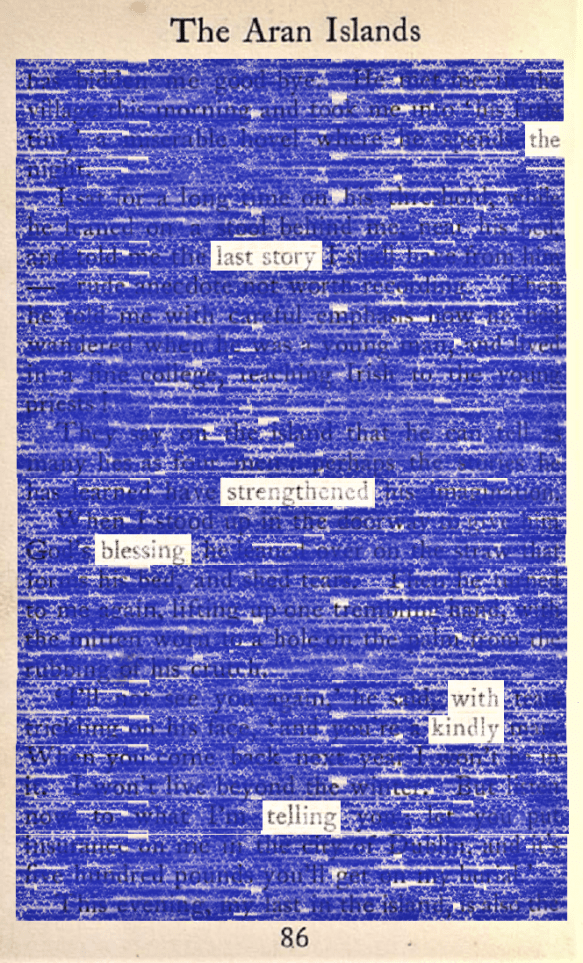
Nebraska 29: ‘The Millionaire’s Dream’ by Isabel Richey [the long read, literally]

abc

Isabel Richey [1858-1910] wasn’t born in Nebraska but lived there. She is cited as perhaps ‘the first woman in Nebraska to publish books of poetry’.

Her poetry collection A Harp of the West reflects their time, though they are earnest enough. This poem seems a distant take on A Christmas Carol, but it is a standard Christian morality tale.

My following found/erasure poem reflects a banker disinclined to alter,

1a23a4a5a

2008 has an enduring impact, not that things were all that different long before, as Richey shows in her original.

Nebraska 28: ‘Subtitle’ by Weldon Kees

We present for you this evening
A movie of death: observe
These scenes chipped celluloid
Reveals unsponsored and tax-free

We request these things only:
All gum must be placed beneath the seats
Or swallowed quickly, all popcorn sacks
Must be left in the foyer. The doors
Will remain closed throughout
The performance Kindly consult
Yours programs: observe that
There are no exits. This is
A necessary precaution

Look for no dialogue, or for the
Sound of any human voice: we have seen fit
To synchronize this play with
Squealings of pigs, slow sound of guns,
The sharp dead click
Of empty chocolatebar machines
We say again: there are
No exits here, no guards to bribe,
No washroom windows.

No finis to the film unless
The ending is your own
Turn off the lights, remind
The operator of his union card:
Sit forward, let the screen reveal
Your heritage, the logic of your destiny

1935/36

[‘Nebraska __’: a slow, long series on this blog featuring poets/writers from Nebraska, associated with Nebraska, who mention Nebraska or similar, the State of my birth]