
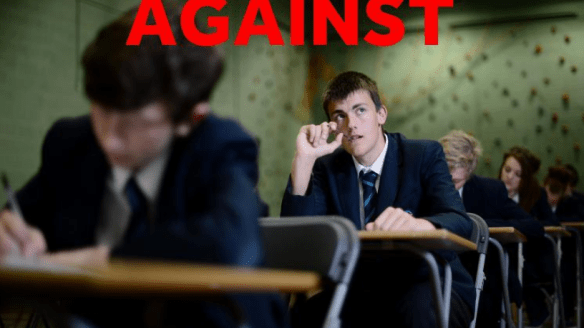
FIGHT!

for

against

The TES is acting like most other school students would act: they’ve seen a fight, are running after it, and are letting as many people as possible know about it.

In my day – I mean as a teacher – you knew there was a fight taking place in school because so many students were all running together, and running in one direction. This will today still be the instant physical manifestation, but presumably the message gets passed on via phone messaging rather than gleeful cheering, apart from schools where mobile phones are banned. Then it’s still relying on just that movement and the screams of delight.

In my Twitter feed today were two TES posts of a pair of their articles – more so reminders of these – which were follow-ups to its reporting on Wednesday of Schools Minister Nick Gibb’s comments about addressing student mental health issues through setting them more regular examinations, addressed by me here.

Sadly, this is now a debate becoming a bit of a game, or a fight to watch as a game. Gibb’s comments understandably aroused considerable backlash against, and thus it has become a news story with extra wheels. Those wheels are now being further oiled by the TES and its For and Against responses to Gibb’s initial comments. This might seem fair due process on controversial observations by a politician, and to a degree this is true, but it does seem that the advertising is essentially like those students running gleefully towards and shouting about the fight, encouraging anyone and everyone to come and watch.

I wouldn’t even mind that, understanding the reality of a newspaper stirring interest, and certainly don’t mind the argument agreeing with Gibb – though I disagree with it, an important if not surprising distinction – but it now seems to further highlight the initial problems inherent in Gibb’s response and the reporting of it.

My arguments against, which I continue to vehemently adhere to, are that someone like Schools Minister Nick Gibb shouldn’t have been addressing the issue of student mental health awareness with a rather simplistic suggestion about increasing the amount of exams students take over their time in primary and secondary education. This silliness was exacerbated for me, but also made extra serious, because I know the type of meaningless examinations Gibb supports and was therefore promoting. And the significant point is the arguments For and Against have largely dealt only in that misleading territory, though I believe, as I am bound to, that the one against is more expansive. Both, interestingly, tread around in the meaningless mire of ‘in my day’…, the Against, I will honestly admit, the muckier culprit.

By all means, have an intelligent argument about the purpose, design and regularity of examining at particular stages in schools. In doing so – a final critical point even I forgot to mention in my initial anger – we need to acknowledge that regular examining is already a common enough feature in schools and Nick Gibb was already barking up the wrong tree, for more reasons than that worse one.

Seeming contradictory for me to offer, but in the interests of fair play, you can read the two articles here: For [agreeing with Gibb] , and Against [disagreeing with Gibb] .

Gibb’s Frontal Lobotomy Testing and Examining

MR1

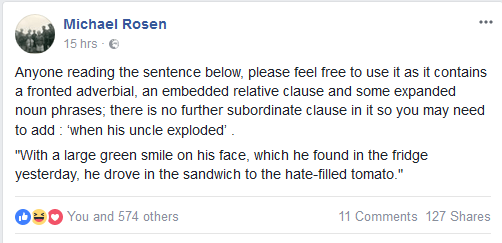
I trust Michael Rosen won’t mind my re-using the included two Facebook postings of his from today – which are public and I clearly credit to him here and now – but they further illustrate one of the salient features of the kind of testing Schools Minister Nick Gibb promotes that I was criticising in my posting about such here.

What should be clear in what I was arguing is how this kind of testing/examination is totally meaningless. It is pointless in terms of teaching and learning, and it is brutal [thus my preparedness to use ‘that’ term in my title] in the way it corrupts students’ and teachers’ approaches to the teaching of and learning about how to Write. Such testing/examination – however often – should not be allowed in schools. Teachers should fight this. Parents should fight this. Writers – who will clearly be the former too – should fight this.

That this kind of testing/examination definitely causes students anxiety and stress is self-evident in the risible but challenging demands it makes. Perhaps there are those who can train themselves or be trained to work to these puzzles, but that is a very few and is still a pointless activity. But to suggest, as Gibb did in responding to how we deal with student mental illness [stress and anxiety], that we set more of these kinds of tests as a conditioning and therefore presumed prevention is ridiculous.

The second of Rosen’s postings taps into what I have been arguing for a long time on this blog. Essentially, we should all ignore in terms of applying – as is – the kinds of test an idiot like Gibb promotes. However, it can be educational, and fun, and a learning curve of experimental exhilaration, to subvert such test questions and play around with their prescriptions and absurd conventions. I have illustrated this here and also elsewhere on this blog, and this sentence from Rosen is a perfect example too,

mr2

A final observation. I have also consistently argued on this blog that we should resist to a degree constantly challenging tests/examinations like Key Stage 2 English GPS solely on the grounds that they cause students stress and anxiety. They obviously do, but it has always seemed to me more focused and convincing to challenge them on their educational deficiencies.

This blurred somewhat the truly disturbing implications of what Nick Gibb proposed. It could allow a deflecting focus on the nature of examining in its broadest sense – good and bad – where in fact it was Gibb’s complete lack of understanding about and empathy for young people’s mental health issues that was so brutally laid bare in his widely reported and criticised observations.

‘White Noise’ by Rupert Loydell – zimZalla

This Book Is Not on the Internet

P1020148

I am a genuine fan of internet poetry. By this I mean firstly, as a reader, to have so many online magazines and journals where good poetry can be easily accessed and read. It will seem a little contradictory because of what I am going to say soon, but one can also skim through or pass on with writing that doesn’t engage, and no commitment to keep has been made [though this is a little problematic so I will leave for now but pick up later]. That access is colossal – sometimes too much, too easy – but it is there, often brilliantly presented, often with sharing opportunities, and it is a richly diverse source. Secondly, online poetry magazines and journals are rich and varied resources for getting writing published/posted. Again, there is an ease in attempting this [not necessarily achieving this] – perhaps too much, too much access sometimes – but nonetheless the outlets are also colossal, growing all the time, with online information on what and how to access. Twitter is in this case, it seems to me, quite positive for promoting, facilitating, marketing and celebrating poetry – it is all in the Following.

The editors of these sites take on significant tasks/commitments in promoting and receiving and reading and, if you are lucky, publishing. That goes for all editors and publishers, hard copy and digital – before, now and after. But the online poetry phenomena is staggering in its scope.

I say this because there is still nothing quite as special as receiving an actual real book, the artifact of the writing. This goes for any collection of poetry that one wants and values, and the physical reading process [sorry that sounds clinical] is special and, to deal with that ‘problematic’ thread above, probably facilitates the ability but also occasional need to re-read and persevere and trace back having read on and to come back days weeks months years later which isn’t something you do with online material. Indeed, I have of late been finding and looking at poetry books and the writing inside from years ago – enjoying immensely – and you wouldn’t do this with online material.

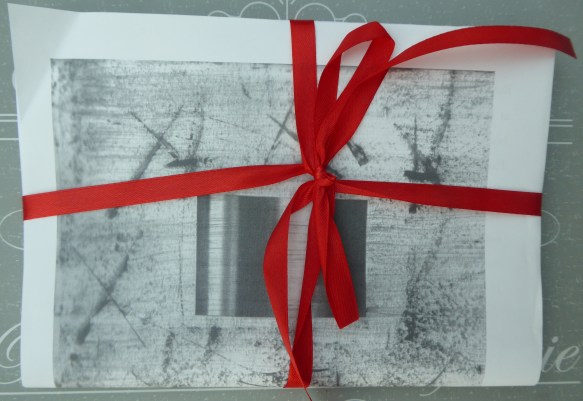
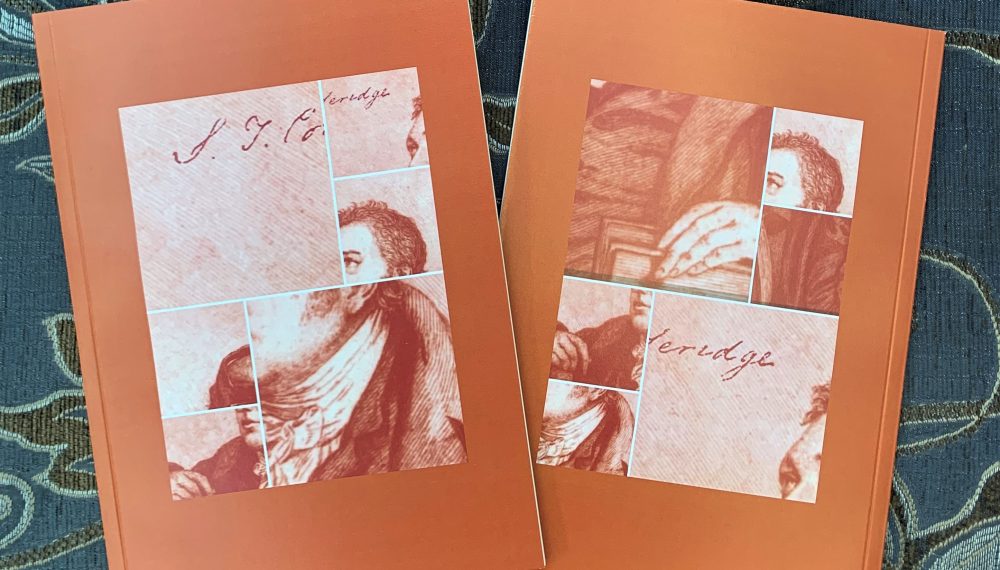
Which leads me to Rupert Loydell’s latest physical collection of poems White Noise, published by zimZalla, described as ‘a bundle of hand-stamped pamphlets with visual wraparound’ and when I received my red-ribboned copy yesterday it was a genuine, palpable pleasure – to unwrap, to see, the physically handle, and to read.

Even removing the red ribbon is a process one has to think about. To untie? To cut? I slipped mine off and have kept as is. Or as what it has become no longer wrapped around. The three chapbooks once released are superbly simple: neatly white and uncluttered and highlighting through that simplicity the poems inside. The wraparound is a bonus, with information printed on the inside.

I am not going to review the contents. Naturally, I would recommend this book to anyone new to the work of Rupert Loydell. It is certainly worth reading, and these poems are both accessible and challenging – easy to read but demanding in whatever thinking response is prompted. My other reason for not reviewing is that being realistic, most people wanting and obtaining this set know the work of Loydell, know the focus [the questioning/the observing/the processing/the visualising/the eluding] and, especially in this case, the taut poetry that journeys along this.

For anyone not that familiar, I have written a fair amount about Loydell’s work in various postings that are chronicled here.

White Noise listens to the modern world and responds in either laughter or lamenting. There are many other L-words too – yes, even Love gets mentioned – so you need to get a set so that you can listen and hear as well. Go here.

P1020149

North 40th Street, Omaha

omaha2

It can be hard but also isn’t
to remember once living here,

six or seven years old and sitting
alone on the walled porch watching

strangers and the occasional
cool cars passing by, unable to recall

what dreaming of then was beyond
new polished chrome and bright colours

to replace the grey primer of what might
have just been for damage and age. Or inside

at those bigger times, believing in presents
unwrapped on the living room floor

as shiny and bright as a customised
Christmas and that sheen of a better life –

then with mom’s homemade smorgasbord
afterwards where I do hold on, perhaps that

omaha3

red wagon the one gift to take another
time up to the main road and corner

of Hamilton Street, panhandling my used
toys from its flat bed all worn dull by then,

small change for the bakery’s doughnuts
now a music store, windows filled with

pumpkin heads instead. And in the back yard
seen fenced off like a demarcation at the side,

omaha4

my escaped pet garter snake flattened
by someone’s random car as yet another

act of indifference, no more or less
thoughtless than my peeing into the rainwater

collected in a bowl for washing her hair
on that woman’s own front porch, or so

omaha5

I was told she had, but enough for this
believing if there was payback to be done

way back then in Omaha, in a duplex still here
and someone else’s beginnings as their home.

How Do We Cut the Risk of Nick Gibb’s Glib Solutions?

health - Copy

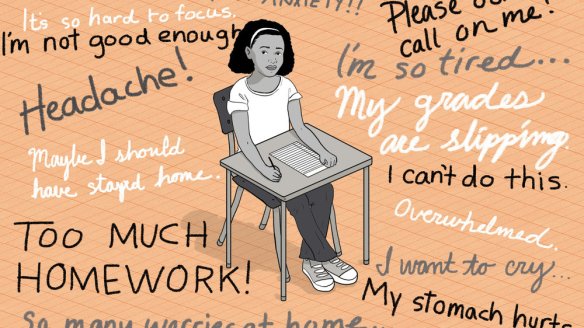
I accept I only have the information as reported here to go on, but knowing how stupid Nick Gibb is both through what he has said previously and the curriculum realities over which he presides, I am not surprised at the truly obnoxious – and upsetting – observations he has made regarding student mental health issues.

The call to increasing the regularity of taking exams as one method for reducing student stress and anxiety is too banal to take seriously, but we have to, unfortunately.

What is extraordinary is this following reported comment:  “Exam pressure has always been part of being at school. Nothing we’ve done has made it worse.” There are so many things wrong with this and it is difficult to know where to start in unpicking its blatant nonsense. Here are a few points:

Nick Gibb makes that all too familiar error of comparing his own school experiences with those of the whole nation’s students. Many politicians latch on to this ridiculous personal anchor. They did for the 30 years I was a teacher and have done ever since. We can presume Gibb had a proclivity to learning and some relative privilege in this with schools he attended and parental/social environment as support.

He is quoted as saying he thrived on the ‘rigour’ of his best educational experiences, one reported example being his obtuse but celebratory comparison of Music being taught precisely like Chemistry in one of the schools he attended. It worked for him – allegedly – so it must work for everyone else. That he clearly extrapolates such ‘rigour’ as a means of preventing students from being anxious and suffering mental health problems is frighteningly lacking in empathy as well as being, quite simply, dumb.

It isn’t just the timings and number of examinations that cause students anxiety, and his idea of starting formal examination in year 7 as a conditioning against this is ludicrously myopic. And that is being polite. I have argued often on this blog that it is the type of examining that matters, not the amount– to broaden the notion – of assessments that can/need to be made. A simple example is the utter meaninglessness of Key Stage 2 English GPS which demands a demanding kind of learning [it isn’t learning, is it?] and pressure to be ‘correct’ where there are no finite answers – other than those required by the prescriptions of a mark scheme only a zealot like Gibb would see as a positive ‘rigour’ rather than, in this example, totally anathema to the realities of understanding how Writing [and thinking] works.

The pressures for students at GCSE in particular, in schools that over many years have themselves become the furnaces of industrial target-setting and, to expand the metaphor, the cauldrons of intense pressure to be melded to these, has been a ‘modern’ phenomena that Gibb cannot compare to his school days nor dismiss as surmountable by students taking more exams.

And the other 21st century pressures affecting students which I surely don’t need to delineate here add yet further incendiary realities to that.

I don’t want to get caught up in my own diatribe so will leave the analysis at that. What I mean is I am genuinely horrified [thought not surprised – an essential paradox with people like Gibb] that he has been so dismissive of student mental health issues and latched onto examining as a method of addressing.

My feelings on this must be shared by countless others with any humane, knowing thoughts. But I had to say something.

NB [8.2.18]: Even yesterday’s Daily Telegraph couldn’t bring itself to endorse Gibb’s ridiculous ideas and instead presented some of the critical backlash.

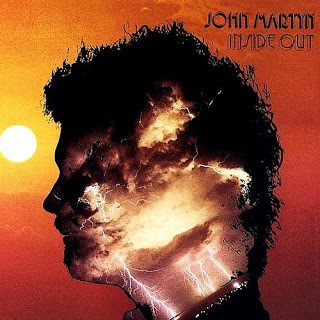
Top Fifty 12: John Martyn – Inside Out, 1973

[Originally posted March 2013]

29

Sublime Inside Out and Anywhere Else

This is a cheat as I have already posted in September, 2011 what follows from the next paragraph [frightening flight of time], but as I recently acknowledged regarding the first three Jimi Hendrix albums – and even perhaps the first three Quintessence albums considering my most recent posts – there are artists whose work must appear in my Top Fifty, and John’s seven studio albums from numbers 5-11 have to be there: omission and inclusion of others at their expense is simply pratting around with variety rather than honest application of feeling as well as actual playing time.

John’s fifth solo album [seventh studio], released in 1973, this sublime collection marks the beginnings of his musical trajectory towards jazzier writing/performance and the use of his voice as a distinctive instrument to match his peerless guitar playing. The songs are bolstered by Danny Thompson’s supreme double bass playing as well as by luminaries like Steve Winwood on keyboards and Chris Wood on saxophone.

First track Fine Lines is a beautiful melodic song in John’s inimitable folk-acoustic style, but the slur in the voice that will become so prevalent across this whole album and all future work has its incipient roots here. Third Ain’t No Saint signals the much more experimental writing too: a jazz-chant about Love [as John writes comically and always somewhat self-effacingly, as if his seriousness shouldn’t be taken that seriously: love…love…love…love…tra la la…triddly dee dee], the voice oozes this word over dancing acoustic riffs with tabla and other energetic percussion provided by Remi Kabaka.

Inverted title and fourth track Outside In makes psychedelic use of the signature Echoplex that John perfected, especially when playing live. This song is gloriously expansive in its guitar range and with Thompson’s bass dancing in and out of the groove. The saxophone puts in layers of slow romantic jazz with John’s punchy bursts of more chanted love, it is love, guitar now echoing and looping its waterfalls of sweet chord sequences, until the voice growls and shouts out in ecstasy. John has spoken of the inspiration behind such a sound:

I don’t think I would have done some of the stuff on Inside Out if I hadn’t heard ‘Karma’ [‘Karma’ by Pharoah Sanders, released in 1969]. The only reason I bought the Echoplex was to try and imitate Sanders’ sustain on my guitar…I pursued the fuzz box and its various accompanying things just to try and get the sustain that you can get from a sax. I just really wanted infinite sustain at the press of a button. And I almost achieved it. And it sounded so sweet to me. And I knew that people would like to hear it because nothing like it was around. If it makes me feel good, I kind of have this touching faith that it’s going to stay with somebody else.

Sixth track Look In is a fuzzed-up rock gem, and the Martyn growl continues to mature, though the song finishes on his delicate best. Beverley is a beautiful instrumental for then wife, with Thompson’s bowed bass perhaps full of lament under the acoustic core and then gorgeous straining electric lead. Eighth Make No Mistake is classic Martyn songcraft but with the voice again working through more range and variation, and this too ends on a love-chant

A love
Love again
A love supreme, divine
Anyway that you want it to be
Love – Its love, its love
Love! Love! Love!
A love supreme, a love supreme

Make no mistake,
Make no mistake, its love
Make no mistake, its love…

30

Penultimate track Ways To Cry is starkly emotive in its honest, complex message If I ever took another woman I was in my need for you/If I ever took another woman I was bleeding for you, and last track So Much In Love With You signs off on a pure-jazz, voice-hazed declaration that not only indelibly brands his love-statement into our aural consciousness, but fully establishes the direction of so much of his future sublime music.

‘Swamp Kiss’ by Colin Herd – The Red Ceilings Press

P1020102

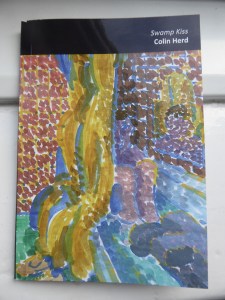
If poetry is metaphor, which of course it often is, then I need to select an apt one to characterise/tag this collection of Colin Herd’s, so I’m going for Pinball Poetry which I trust is suggestively sprightly enough to counter any hint of trivialising.

Because I am not. For me, these poems are – here it comes – shot from their first line to propel their way here, there and everywhere, bouncing from one idea and language encapsulation to the next, often as complete tangents and often as links that are nonetheless surprising: the former exemplified in the scatterings of Poem on a bath mat / Poem on a shower curtain with its richly relentless line after line after line of

‘Hello Yes As Soon As Possible
obsessed with pumpkins and polka dots
all the sweat in and around and over’,

the latter exemplified in a – relatively – extrapolated take on

‘jouissance or puissance?’

from I doubt you want me which also contains two little but likeable jokes on the names Bill and Will.

Yet it could be in the way they are read. Poems like Book Lungs and Here I wriggle with a sunken butt are clear narratives – well, clearish in their linear momentums. My favourite sister’s uncle tells a delightful story.

What is a description anyway in a world that at all levels defies describing? What is truth? It would seem it is all a ‘chewed shape’ and Herd continues to see it appearing and disappearing and reappearing ‘more chewed than you remember’ and so the poetic grasp is a ping from one to the next, sprightly and chewable over and over and over for the reader.

Another bright nifty collection from The Red Ceilings Press, you can purchase here.

Trump Poetry

genius

I am very pleased to have another ‘Trump’ poem published here, and again at the feisty forum of the International Times.

I found yesterday in a reconnaissance through my PC files that I have a body of poetry written in response to The Donald, and I have collected these under the ironic title The Inspiration of Trump. As with Genius, most are found in his own distorted words, themselves a reflection of his – being ironic again – thinking.

I wrote here about the P.E.N. Anthology of Poetry from 1973 and that night I watched the amazing, unsettling programme Nixon on Nixon, In His Own Words on TV – recounted largely about that same year but also into 1974, the words of Nixon himself on the Watergate affair truly frightening in reflecting the same denial and arrogance of Trump today [it is more expansive and complex than this…]. Nixon of course had more guile and inherent intelligence compared with Trump, but it is both astonishing and deeply disturbing that the abuse of power would seem to be as commonplace today as it was then.

What I did wonder was how much poetry was written explicitly about Nixon and Watergate at that time compared with the amount about Trump today. Interestingly, there was only one direct political poem in the ’73 P.E.N. anthology, and that was Michael Hamburger’s poem Newspaper Story.

I did find today this reference to The Poetry of Richard Milhous Nixon, a volume compiled by Jack S. Margolis and published in 1974. These too are found poems taken from the Watergate tapes, so, and not surprising, the methodology is the same. The book is no longer easily available, but three original copies are for sale on Amazon marketplace starting at £166 [or $65 from .com]. Here’s a poem from the book,

IN THE END

In the end
We are going
To be bled
To death.
And in the end,
It is all going
To come out anyway.
Then you get the worst
Of both worlds.

nixon - Copy