So Many Things

[for Trevor]

I am as much as anything
that something which gave me

so many connected
with what could fire

a sunlight characteristic
if quieter this time:

the shortening days
and some savage asides,

but today brings
yet more books

and just as the real summer
we look ahead for better.

I try to find somewhere
of honest appraisal

in the emergence of these days,
so little to utter

without a bit of warmth
yet I am glad

to have this intellectual
independence more reminiscent

of somewhere there was no doubt
and I believe in fully.

It must have been
in the genes

this dappled characteristic
as we will now call it.


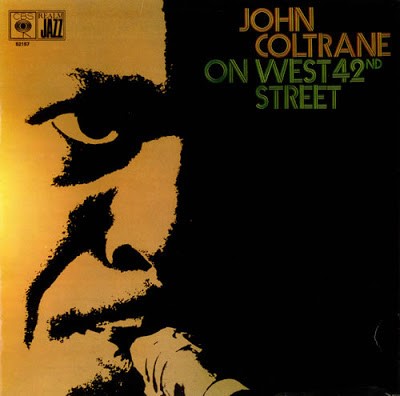
Top Fifty 14: John Coltrane – On West 42nd Street, 1957

[Originally posted January 2013]

35

Darting and Running

Yesterday I was listening to Pharoah Sanders’ John Coltrane tribute album Crescent With Love and it got me thinking about the first time I heard Coltrane. It was on an LP I got when I was about 15/16 years old, John Coltrane On West 42nd Street, and it was well played at the time so is a little rough if put on the turntable today. I’ve never been able to find a cd copy, and in that ever turning learning curve I now know this is because it isn’t strictly speaking a John Coltrane album – it is a vinyl only collection put out under his name to cash in on his then emerging popularity.

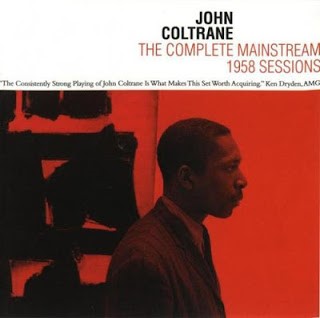
Taken from 1957 recordings with the Wilbur Harden [fluegelhorn] quintet, including on the tracks on the album Tommy Flanagan [piano], Doug Watkins [bass] and Lois Hayes [drums], the record includes the following songs in this order: Side One – Wells Fargo, West 42nd Street, E.F.P.H. [sic]; Side Two – Snuffy, Rhodomagnetics. I am writing this as these and other tracks [19 in all] can be found on cd on the Coltrane Mainstream 1958 Sessions where, for any nerd interest, there is an extra ‘F’ on its third track E.F.F.P.H. [compared with album liner notes, though on the album itself there are both ‘Fs’], and the Side Two tracks on the vinyl are inverted as well as becoming respectively in that inversion tracks four and nine [and you’d have to be intense to want to follow that].

36

All five tracks are quite conventional and there isn’t an outstanding melody/song, compared with, for example and unfairly, My Favorite Things. Each player gets a solo set and this too is quite formulaic. But I do recall simply loving each Coltrane solo as I still do, inevitably mixing that nostalgic sense of first discovery with the continued appreciation of today. I’m not incisive enough to really discern differences  in absolute quality of playing – though it’s hard to make a bass solo soar like Harden’s flugelhorn – but Coltrane’s tenor sax solos do always seem that little bit more adventurous than the others; more on the edge of breaking from the formula and routine. Yet that could be the wishful thinking/hearing of my original joy and the occasional nostalgic revisiting – though listening as I write to final track Snuffy, Coltrane’s solo following Hayes’ piano really does dart out of the starting gate and run much more wildly and entertainingly.

It makes my Top Fifty for all the obvious and right reasons as I hope I have outlined here. As well as my first introduction to Coltrane, it consolidated an incipient interest in jazz, and a fairly traditional form of jazz as well. Whilst I moved on to the more adventurous and avant-garde, I think I had my fix of that already from the prog rock representation of the time.


Literally my List Poem at Burning House Press

lizst

So delighted to have my List Poem up now at Burning House Press here.

Big thanks to current guest editor Florence for such warm enthusiasm about this and care for presentation, with creative work by Alexandre Cesa [I have kept the image small here so you check out the site – please – to see the larger version].

In addition to that genuine appreciation, I am also pleased because I have always championed list poems: to read from others, to write over the years, and to use in my teaching of creative writing – especially for regular National Poetry Day ideas/resources. I’ve had the pleasure over those years to read so many wonderful list poems from students.

This one is my dedication to its art.

Valentine’s Day Poem

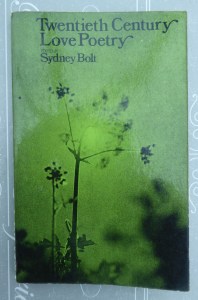
It should be easy enough to find a love poem to post on Valentine’s Day, and of course it is, but I recalled I had an anthology of love poems from years ago – remembering its green cover, and thinking I enjoyed reading it back then – and so it seemed interesting to seek out and find a poem from that nostalgic source.

P1020159

And I did find it, but what a miserable collection! I’d forgotten how narrow its selection was too: its three main poets T.S. Elliot, D.H. Lawrence and Robert Graves, and then fifteen individual poets ‘Since 1945’. Well, we all know how miserable Lawrence can be, and is, and the fifteen are little better in avoiding the ‘darkness’ and ‘pain’ of love! I note I had got the book in 1973, so aged 19, and perhaps that teenage angst about the misery of love – albeit late – had been the attraction.

It’s not that I felt I needed to post a red roses romantic version of love on Valentine’s Day,  but I did think something reasonably upbeat would be sensible. So I got expansive and turned to poet John Hegley, searching for the light and fluffy, and thought his collection Love Cuts would be a probable good resource. ‘Cuts’? You guessed it – back to the metaphors of pain, apart from an opening poem about his first love being a ‘puppet dog’.

But I persevered, and here is another Hegley poem, just so I have fulfilled some part of my ambition for today’s posting:

P1020161


Top Fifty 13: Quintessence – Quintessence, 1970

[Originally posted April 2013]

31

This Quintessence of Bliss

The second eponymous Quintessence album, released on Island in 1970, is sublime, and opening track Jesus, Buddha, Moses, Gauranga is a brilliant showcase for the stunning vocal of Australian born Shiva Shankar Jones. The song is a broader offering than those on debut album In Blissful Company, with its backing vocal chorus and the foregrounding of flute by Raja Ram. Second Sea of Immortality exemplifies Quintessence’s marriage of a spiritual sound with rock elements, the former by some instrumentation, but largely through lyrical content – celestial wine filling you with divinity/shores of time and space dissolve – and titles, and the latter with the wonderful wah-wah excess of Allan Mostert’s guitar solo that screams into its rampancy after a subtler sweet start: absolute bliss. Third High on Mt Kailbash introduces the spiritual and Indian elements of chanting, supported musically by hypnotic sitar and various percussion – Shiva’s voice itself mesmerising both in the mysticism of its ‘foreign’ language, echoing and inherently resonating tone. The song segues into a live snippet from Burning Bush which is Mostert again psychedelicising with wah-wah and volume: more bliss.

Side 1 of the vinyl ends on Shiva’s Chant, a communal performance that I and countless other teenagers joined whilst listening back in the aural day and which I still repeat when listening now, though as ever, unaware of the actual meanings. Prisms, the start of Side 2 on the vinyl, is a beautiful echoplexed [certainly echoed] flute solo by Raja Ram who has continued throughout his musical career post-Quintessence to experiment with electronic music. This too segues into another track, seventh Twilight Zones, back to a rockier mood though the flute is still spiralling around in a jazzier slant and Shiva’s vocal is gloriously soothing in the mix. A quick Hari Krishna chant Maha Mantra is the eighth track, and ninth is Only Love, exquisitely harmonised at the start with Ram’s flute providing a by-now signature sound, and Shiva’s vocal grows to an anthemic climax with bass and guitar joining the rise until this too segues into another track, tenth St Pancras [live] that features six minutes of Mostert in a superb guitar solo a la wah-wah and feedback: quintessence of bliss. The album ends on another hypnotic chant/drone Infinitum [Conception Barham].

32

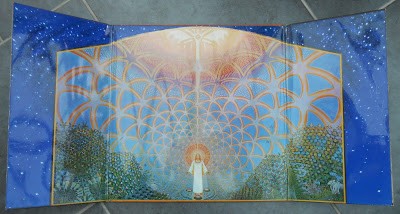
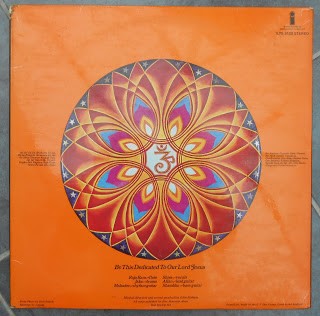
As you will see from the images, the album cover is a wonderful gatefold sleeve that opens in the front centre to provide a colourful inner spread. And for those who are interested, the process of writing a review is always – or at least invariably – an extended one: whilst writing this for example, I have obviously been listening to the album, though as I literally write these lines I have moved onto third album Dive Deep, but more importantly, during the writing I will research, which might be something as simple as checking spellings and certainly trying to get information accurate, and today undertaking that research I have come across and then purchased two further ‘Quintessence’ albums: Rebirth: Live at Glastonbury – a recording of the 2010 performance of the reformed band for a one-off Glastonbury gig [40th Anniversary] to celebrate the fact that Quintessence played the first two Glastonbury Fayres – and Shiva’a Quintessence Only Love Can Save Us, a revamped revisit of Quintessence classics. And to conclude, I am wondering if Dive Deep will also make the Top Fifty……

33

34


Poetry Products

In writing recently about Rupert Loydell’s latest poetry collection White Noise, published by zimZalla, I focused on the palpable pleasure of the book as product, this in itself such a significant part of the whole.

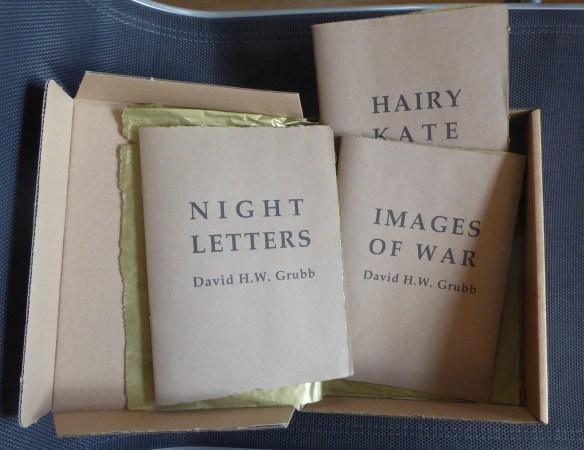
I had thought of mentioning then, but do so now, other books/presses that delight, and I will in a moment feature one in particular, David H.W. Grubb’s Box collection, published by Like This Press in 2012.

Mentioning LTP allows me to reference it again as well as my review of Ian Seed’s Italian Lessons and the significance of its production by this wonderful press here. I have also written about the chapbook collections of The Red Ceilings Press here which have their distinctive qualities in, obviously, the poetry selected but importantly the size of production that shapes this. Another that springs to mind as a publisher of books I frequent is Knives Forks and Spoons Press with its signature covers and the alternative [for want of better word] work it tends to celebrate by publishing, some references here. I must also highlight the work of Michael Cain as I have done here: his productions special, and of those I have, genuine treasures.

P1020152

P1020153

The David H.W. Grubb collection is wonderful, the production in a large cardboard box an unusual ruse, and the three chapbooks inside again palpably pleasing, their ‘rough’ torn covers of thin card and the delicate torn insert page [a shiny gold] adding both the tactile and the aesthetical – if you like, as I do.
P1020154

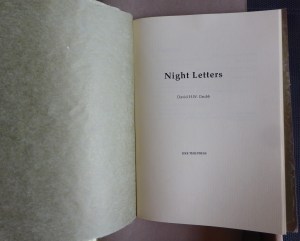
Re-reading the poems this morning I was reminded of their excellence. The first collection, in the order of my box, is Night Letters. The first poem opens with such suggestiveness,

It is said that we each make a place for the dead
in our heads so that we might sometimes visit them
with songs and barley and corners of gardens

This is a lovely poem, elegiac and fantasist, tapping into known, shared experience and that only imaginable [but then made as known] in the poetry of Grubb’s visualising, as with this also,

and I see my father stopping to note the sadness of snowdrops
and mother hiding her burnt currant buns in the pampas-grass
and Sam Frost speaking to rain as he lays another section of the hedge

In the second poem from this collection, Always the Blue Clown, that sense of loss, again widely ‘known’, is poignantly crystallised by the way Grubb describes,

and what the man was saying to his daughter
in that stained glass moment when he released her,
and now, and now he has returned to the same field
and the silence rattles and every person he has ever
respected or adored is present and waiting for him
to pull the earth over him like a blanket of stars

and who hasn’t also been there and wished they could have described it so in order to understand the feelings more?

The second collection Images of War reflects on experiences Grubb gained, as I have read in a brief Shearsman Press bio., ‘working in places of extreme poverty and civil conflict’ and ‘conflict zones such as Bosnia, Rwanda and Kosovo, where he worked delivering humanitarian aid’. An early poem Rumours of War finds and conveys the paradox of haunting beauty in describing the horror of dying,

He may have heard the screams and weeping,
he may have seen the men falling backwards
as if they had been slapped by an ocean;
he may have heard the all day rain, not falling
from the sky so much as inside the heads of
soldiers as they lay in their long drowning.

This next poem, which I present in its entirety, adds another deep layer of knowing in its presentation of the then and now, the former poetically heightened by its language and metaphor; the latter made bathetically dark by its literalness,

P1020156

The third chapbook is – I will use the expression again – a beautifully haunting sequence Hairy Kate.

I’m not sure Grubb’s collection is still available, but you can see what is and enquire further here.