Over a period of a few years, though a while ago, I wrote and compiled a sequence of my Top Fifty albums of all time, posted elsewhere, and as these reflect my thoughts and feelings beyond the music itself I am re-posting here to share, but also as a means of my revisiting the memories and expression of this at the time. They are then inevitably dated, but that in itself can resonate, as with this first one written soon after the death of Havens, and the words echoing what is the impact of so many more since that time. This Top Fifty was never written as a rank order and is posted now in no particular order:
[Originally posted April 2013]

Deserved Ripples
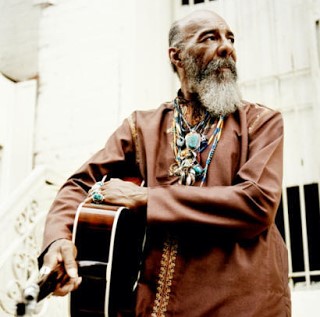
I was saddened to hear of the death of Richie Havens, who passed, aged 72, on the 22nd April. This is a sentiment and line becoming all too frequent of late, but not surprising as musicians with whom I grew up as a teenager – so themselves already or just being established musically as young adults – are of an age where this will be more common.
Having been away in the Lakes last week I have only just found out. So the sadness is deepened a little by the fact that Haven’s death did not register more widely. If at home I would have ‘heard’ as I touch base daily with music sites for reviews and information, but even though I was able to go to a local cafe to use their WiFi for quickly checking emails, and I got a daily newspaper and watched the TV news, his death hadn’t registered enough to be reported. Lesser ‘popular’ stars would, I’m sure, have created larger if less distinguished ripples.
Quite by coincidence, I had during the week been thinking about my musical Top Fifty [see – even when away from home and not writing on the blog I am somewhat consumed by the insular world it provides for me] and wondering if Richie Havens should have a place there. He is without doubt a favourite artist of mine. It is his distinctive vocal – at times quite a growl, but at others a soft and resonating folk vocal – and of course the guitar playing, open-tuned with a famously, aggressively strummed style. This style was brought to my attention and so many others with his opening performance at Woodstock – obviously through the film version – and his mesmerising and commanding stage presence with, as we now know, impromptu jamming as he was asked by the organisers to extend his performance as other acts were held up in traffic [if you are from another planet and haven’t seen/heard, check out the stunning Freedom].

It isn’t his death that sways me to include Alarm Clock in my Top Fifty, but it does provide me the opportunity to honour him by its inclusion. This is one of the first few albums with which I grew up musically and in many other respects, so it was played a considerable amount. It is beautiful – the song I am listening to as I write is the self-penned [with Roth and Margoleff] End of the Season, with its unusual, for this album, orchestral accompaniment, acknowledged on the album as a string arrangement by Bill Shepherd, but surely it is a Moog Synthesiser dominating the background. It is a lovely song with Havens’ deep vocal and the heightened drama of that arrangement.
The title track is quite a bluesy number, Havens’ signature rhythm driving the beat and Paul Williams providing some funky lead guitar. It has a jamming/live element that appealed particularly then, reminiscent of the Woodstock performance [the cd version runs at 7.17 to accentuate this feel, compared with the vinyl at 5.17].
Havens was a great interpreter of others’ songs, especially the Beatles, and Alarm Clock opens with a beautiful cover of the beautiful George Harrison number Here Comes The Sun. Third track Younger Men Grow Older is another Havens/Roth song and its apparent gentle lyricism about age and wisdom and hopes for the future encapsulates perfectly the ideals of the Woodstock generation, that initial sweet focus tempered ruefully by reflections on the destruction of war and assault on the environment. Fourth track Girls Don’t Run Away, written by Havens, is gorgeous, if plaintive, and lyrically also reflects well on preoccupations of this generation, here the ‘generation gap’ and a mother who does not understand/appreciate her daughter, and an urge that the daughter should stand up for herself and seek independence. Such musical folk excellence was heightened by a storytelling which so deeply tapped into the contemporary listeners’ thoughts and feelings.