I had the great pleasure yesterday of having a private visit to the Exeter Cathedral Library. I was in a small party of six – four from The Friends of Coleridge, with myself and another from the Coleridge Memorial Trust – there to present JCC Mays’ scholarly book Coleridge’s Father to the Library.
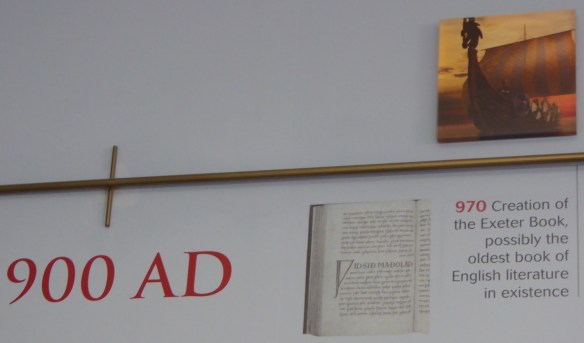
We were welcomed by Canon Librarian Ann Barwood who gave an informative and detailed introduction to the work and collection of the Library before we moved to a side room for the presentation of Mays’ book. It was fascinating to hear of the library’s copy of The Exeter Book, the Codex Exoniensis, a tenth century anthology of Anglo-Saxon poetry,
as well as the Exon Domesday, Liber Exoniensis, from 1086,
Ann Barwood had laid out books/manuscripts for us to see, and we were able to view The Exeter Book, inside its glass frame, and to marvel at the precise handwritten script as well as quality of this ancient text,
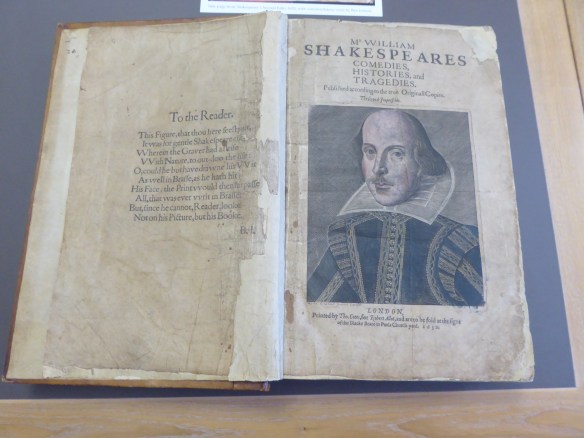
What I hadn’t expected was there would also be the library’s copy of Shakespeare’s second folio to view, and indeed to look through some of its pages, very carefully,
This may sound overly precious, but being able to see this 1632 text up close and physically turn and read a few pages as well as take photos, including Ben Johnson’s commendatory verse, was a genuine treat. An immediate surprise is that the edition begins with Shakespeare’s final play The Tempest,
Jim Morrison will be one of the most obvious selections for musician and lyricist as poet. His The Celebration of the Lizard King is the best known and most dramatic of his poems performed to music [maybe competing with The End]. And of course Morrison wrote poetry for the printed page, though these distinctions are meant to be challenged somewhat by my postings on literary lyrics – that term ‘literary’ itself requiring its own scrutiny.
This lyric/poem is printed on the inside cover of the gatefold edition of The Doors’ album Waiting for the Sun. Sadly, in my teenage years I used to hang these covers on my bedroom walls, using tape [how dumb], so when I took them down the album covers were torn by this stupid sticking and I cannot therefore show my copy – I could, but I don’t really need to display my error beyond recalling it. Here is an indistinct picture I found on the net, not to read the poem but to see its presentation,
I attended a secondary modern school and my main English teacher then was a bit of a tyrant and boorish braggart with other annoying traits, especially being strident politically where he was consistently antagonistic to my incipient and admittedly naïve late 60s’ revolutionary thinking. I cannot remember the actual circumstances, but I did bring my Waiting for the Sun album cover to one of our lessons, pre-ripped, and this teacher at my request did play it to the whole class and then attempted some description of the meaning of The Celebration of the Lizard King, an analysis I do not recall at all, but it seemed honest and helpful at the time. I will always be grateful for that, though still surprised, and maybe he was a more complex character than I appreciated then, though his belittling of youthful thoughts and ideas will always be a shameful attitude.
Here is this powerful and enigmatic poem,
The Celebration Of The Lizard
Lions in the street and roaming Dogs in heat, rabid, foaming A beast caged in the heart of a city The body of his mother Rotting in the summer ground He fled the town
He went down South and crossed the border Left the chaos and disorder Back there over his shoulder
One morning he awoke in a green hotel With a strange creature groaning beside him Sweat oozed from its shiny skin
Is everybody in? The ceremony is about to begin
Wake up! You can’t remember where it was Had this dream stopped? The snake was pale gold Glazed and shrunken We were afraid to touch it The sheets were hot dead prisons
Now, run to the mirror in the bathroom Look! I can’t live thru each slow century of her moving I let my cheek slide down The cool smooth tile Feel the good cold stinging blood The smooth hissing snakes of rain . . .
Once I had, a little game I liked to crawl back into my brain I think you know the game I mean I mean the game called ‘go insane’ Now you should try this little game Just close your eyes forget your name Forget the world forget the people And we’ll erect a different steeple This little game is fun to do Just close your eyes no way to lose And I’m right there I’m going too Release control we’re breaking thru Way back deep into the brain Back where there’s never any pain And the rain falls gently on the town And in the labyrinth of streams Beneath, the quiet unearthly presence of Nervous hill dwellers in the gentle hills around Reptiles abounding Fossils, caves, cool air heights
Each house repeats a mold Windows rolled Beast car locked in against morning All now sleeping Rugs silent, mirrors vacant Dust blind under the beds of lawful couples Wound in sheets And daughters, smug With semen eyes in their nipples
Wait There’s been a slaughter here
(Don’t stop to speak or look around Your gloves and fan are on the ground We’re getting out of town We’re going on the run And you’re the one I want to come
Not to touch the earth Not to see the sun Nothing left to do, but Run, run, run Let’s run House upon the hill Moon is lying still Shadows of the trees Witnessing the wild breeze C’mon baby run with me Let’s run Run with me Run with me Run with me Let’s run
The mansion is warm, at the top of the hill Rich are the rooms and the comforts there Red are the arms of luxuriant chairs And you won’t know a thing till you get inside Dead president’s corpse in the driver’s car The engine runs on glue and tar C’mon along, we’re not going very far To the East to meet the Czar
Some outlaws lived by the side of the lake The minister’s daughter’s in love with the snake Who lives in a well by the side of the road Wake up, girl! We’re almost home Sun, sun, sun Burn, burn, burn Soon, soon, soon Moon, moon, moon I will get you Soon!, Soon!, Soon!
Let the carnival bells ring Let the serpent sing Let everything
We came down The rivers and highways We came down from Forests and falls
We came down from Carson and Springfield We came down from Phoenix enthralled And I can tell you The names of the Kingdom I can tell you The things that you know Listening for a fistful of silence Climbing valleys into the shade
I am the Lizard King I can do anything I can make the earth stop in its tracks I made the blue cars go away
For seven years I dwelt In the loose palace of exile Playing strange games With the girls of the island Now I have come again To the land of the fair, and the strong, and the wise Brothers and sisters of the pale forest O Children of Night Who among you will run with the hunt? Now Night arrives with her purple legion Retire now to your tents and to your dreams Tomorrow we enter the town of my birth I want to be ready’
Quite by coincidence, I came across this wonderful William Burroughs sampling of the poem and set the The Doors’ music,
The lyric to follow here is a one-off: whilst Brown is a songwriting lyricist, the storytelling of Ina Bell Sale is a writer’s comic tour de force of mock-evangelical preaching and is grotesque as well as hilarious – it bears reading, but it is hearing Brown perform this that delivers the ultimate impact. When singing live [there are YouTube clips you can access] he does adapt the role of preacher setting up the actual delivery.
It is a dynamic brisk account of a person, her death and subsequent yard sale: absurd as much as it is believable. I have used this in the classroom, with post 16 student writers, to generate feelings/ideas for similar narratives, monologues that can tell Ina Bell’s own story, or imaginings of alternative viewpoints. I wrote one as exemplar about visiting the sale, I think, or something about describing items in the sale.
Here is Ina Bell Sale,
InaBell is dead, Savior, and we pray that Thou wouldst give us the strength To lift her and carry her to her grave. InaBell is dead, and, Jesus, we’ll Never again hear her gravel-on-the-window voice, her tail-in-the-door Voice. We’ll never again see her goiter shake like an old apple in a Windstorm. InaBell is dead and gone home to Thee, oh Precious Lord. Welcome her with open arms and spread ’em wide. She’s dead, oh Precious Lamb, we’re sure of it this time. She went over in her kitchen With a thud, scattering her Chicken Surprise for her ill-tempered, little, Pop-eyed, slobbering dog, who ate most of it. InaBell is dead and gone and Left us here to carry on and carry her big, fat, annoying ass out to the Grave and bury her deep so she won’t get up even in dreams to HOLLER HER INSANE SHIT AT US! THANK YOU, JESUS! THANK YOU, LORD, FOR TAKING INABELL!. I bet she was hard to lift, even for Thee.
InaBell is dead. She killed her husband, poor old Pete. She screamed and Hollered him to death with her helium woodpecker voice, pulled at him and Yelled at him and hit him and screamed at him until he had fits and slapped His own face and talked in tongues (talks in tongues) at the dinner Table. OH, SWEET JESUS CHRIST! INABELL IS FINALLY DEAD! HALLELUJAH! HALLELUJAH AND AMEN!
There’s a big sale on Tuesday. Big sale on Tuesday, who will buy her angry Purse, forty pounds of frozen pot pies? Who will buy her stiff hairnets For failed perms, her fly-speckled glasses? Who will buy her girdle that Didn’t? Who will buy her hippo bra, and her nylons that woulda fit Pylons? Hey!
Who’llgivemeanickelwho’llgivemeadimewho’llgivemeanickelwho’llgivemeadime, Who’ll give me sumpin’ for this SHIT?! Who’ll buy the little plastic Church that used to light up, the busted pink hairdryer, and half a carton Of menthol cigarettes? Who will buy her cracked bowling ball and enough Knickknacks to sink the Titanic?! Who will buy her sidewalk made out of Storm doors and cardboard and a blown Pontiac full of sparrows and Saplings? Oh, who will buy? Who will buy? Step right up! Who will Buy? Who will buy? Who will buy?
Put a big ol’ stone on top of her that says, “InaBell finally shutup and Kicked the bucket!” Big sale on Tuesday.
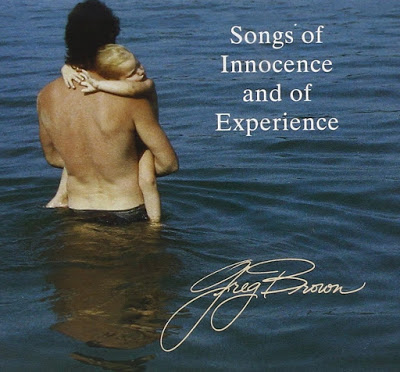
Brown doesn’t need the support of his clearly being a keen reader/writer to validate the crafting of his Ina Bell story, but he is nonetheless keenly interested in poetry/narrative and its place in songwriting. One obvious example is his album Songs of Innocence and Experience where he sets some of Blake’s poems to music.
This is a cute, genuine album from 1986, one that could have been quite pretentious and/or disastrous, but Greg Brown places the poetry of William Blake within simple, delicate folk melodies, or, as with The Echoing Green, jaunty blues which really does add a sweet lightness – especially the harmonica, fiddle and bottle-diddle-lee-do [an approximate translation] vocalisation.
The Tyger gets a swamp-blues presentation, the harmonica and fiddle again dancing provocatively as musical backdrop. It’s not so much threatening as – cool. The warm baritone [now rather grizzled] of Brown’s singing adds warmth to Infant Sorrow; and Ah! Sun-Flower makes an interesting comparison with the version by The Fugs: the latter played to my class in secondary school by a dynamic supply teacher which ignited a teenage interest in poetry, as well as that iconoclastic band/ensemble, and if I was still teaching today I’m sure I’d be in a different classroom armed with both versions. The Little Vagabond has a pretty country folk melody with harmony vocal and is another example of these Blake poems re-presented with Brown’s careful creativity.
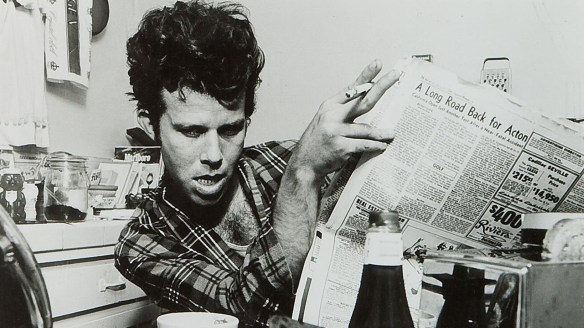
Another definite literary lyricist is Tom Waits, his storytelling in the beatnik, Burroughs and Bukowski trajectory. It is both raw and beautiful, and I’ve been reading and discovering this morning, like the great narrative Red Shoes by the Drugstore, and as it is only November but the TV already swelled with Christmas ads, here’s a little festive fare from this story,
now the rain washes memories from the sidewalks and the hounds splash down the nickel full of soldiers and santa claus is drunk in the ski room and it’s christmas eve in a sad cafe when the moon gets this way there’s a little blue jay by the newsstand wearing red shoes
But the one I know best and have always liked is Frank’s Wild Years, always enjoying the wild imaginings of its violence and humour,
Frank’s Wild Years (For Frankie Z.)
Well Frank settled down in the Valley and hung his wild years on a nail that he drove through his wife’s forehead he sold used office furniture out there on San Fernando Road and assumed a $30,000 loan at 15 1/4 % and put down payment on a little two bedroom place his wife was a spent piece of used jet trash made good bloody marys kept her mouth shut most of the time had a little Chihuahua named Carlos that had some kind of skin disease and was totally blind. They had a thoroughly modern kitchen self-cleaning oven (the whole bit) Frank drove a little sedan they were so happy
One night Frank was on his way home from work, stopped at the liquor store, picked up a couple Mickey’s Big Mouths drank ’em in the car on his way to the Shell station, he got a gallon of gas in a can, drove home, doused everything in the house, torched it, parked across the street, laughing, watching it burn, all Halloween orange and chimney red then Frank put on a top forty station got on the Hollywood Freeway headed north Never could stand that dog
Continuing with my look at lyrics as poetry, Pete Brown is interesting as being someone who makes a clear distinction between the two. He is also personally interesting for a few reasons I will explain.
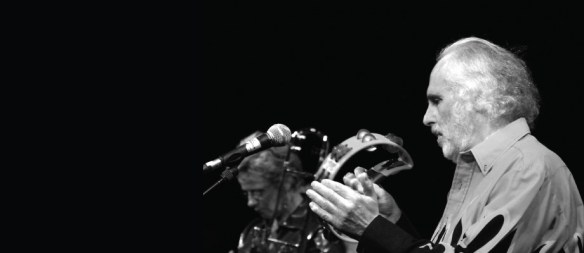
Best known for his writing of lyrics for Cream, especially his close work with Jack Bruce, one of my favourites is for his own band, the Pete Brown and Piblokto song High Flying Electric Bird. I cannot separate the beauty of this song from the beauty of its lyrics, and thus I may over-hear and overstate the poetry. But that doesn’t matter.
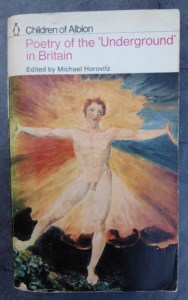
Before printing that lyric, and a link to the song, I’ll mention his poetry and one more lyric. I recently acquired a second hand edition of the excellent Penguin poetry anthology Children of Albion – Poetry of the ‘Underground’ in Britain edited by Michael Horovitz, having lost my original copy. Published in 1969, Brown is one of the writers represented, and here is one of his 15 poems included,
Few
Alone and halfdrunk hopeful I staggered into the bogs at Green Park station and found 30 written on the wall
Appalled I lurched out into the windy blaring Piccadilly night thinking surely, Surely there must be more of us than that….
This is typical of the playful selection made of his work here, as well as more generally typical of the irreverent, unconventional poetry of this ‘underground’ time.
Fascinating then to compare this with one of his lyrics, this one for the Cream [Jack Bruce] song White Room. Much is written on the origins of the lyric, and Brown tells us that Bruce had rejected his first offering and how the version we now have was hastily composed,
In the white room with black curtains near the station. Black-roof country, no gold pavements, tired starlings. Silver horses run down moonbeams in your dark eyes. Dawn-light smiles on you leaving, my contentment.
I’ll wait in this place where the sun never shines; Wait in this place where the shadows run from themselves.
You said no strings could secure you at the station. Platform ticket, restless diesels, goodbye windows. I walked into such a sad time at the station. As I walked out, felt my own need just beginning. I’ll wait in the queue when the trains come back;
Lie with you where the shadows run from themselves. At the party she was kindness in the hard crowd. Consolation for the old wound now forgotten. Yellow tigers crouched in jungles in her dark eyes. She’s just dressing, goodbye windows, tired starlings.
I’ll sleep in this place with the lonely crowd; Lie in the dark where the shadows run from themselves.
Compared with his poetry, certainly that anthologised by Horovitz, this is actually far more conventional, or perhaps ostensibly poetic.
In an interview I found online at The Argotisthere, when asked if Brown considered his lyrics as poetry, he replied:
I don’t usually think of my lyrics as poetry, but having said that some have more “poetic” content than others. You have to bear in mind that I came from poetry initially. The earlier lyrics thus had more residue from that. As I progressed, I found that working in more day-to-day language suited me better, except in certain instances when I wrote for other people who wanted the other thing. Having said that, I also had a huge influence from films and the more surrealist of painters, which led to a certain flavour of imagery which some thought “poetic”, whereas I mainly didn’t think of it as that.
I don’t think this helps all that much! I’m not going to attempt a fuller analysis of Brown’s lyrics, especially chronologically in order to trace what he claims, but it doesn’t matter all that much anyway as it is down to how we as listeners/readers respond.
I respond to the writing in High Flying Electric Bird as being poetic, and that sounds, I know, like a linguistic compromise in not calling it ‘poetry’. But again, I don’t intend to analyse further.
Having posted this lyric on another blog some years ago, I had a reader response which supplied an alternative version, or more precisely an alternative hearing. This is a difficult song in which to hear the lyrics clearly, and many of these variations are printed online. The one I have here seems to match perfectly when one listens to the song being sung, so I’m happy with this,
High flying bird, I don’t hear the last for me High flying bird, I don’t know the rest of it Into the dark where electric wings spark you into life
Sketches of night are first to fade away Stretches of light grow wings to greet the day Into the waves where submarine slaves kiss you into life
Flying over the mountains of rust Blowing over the weddings of dust Into the dark where electric wings spark you into life
High flying bird, I don’t hear the rest for me High flying bird, the sky’s where I need to be Into the grin where electric eyes spin you into life
Sounds of the day smash themselves into dreams Somewhere I lay are tears running down my beams Into the sun where the silver wings run themselves into ground
Flying over the mounts of gold light Blowing over the bottles of night Into the grin where electric eyes spin you into life
Flying over the mounts of gold light Blowing over the bottles of night Into the grin where electric eyes spin you into life
High flying bird I don’t hear the last for me High flying bird I don’t know the rest of it Into the dark where electric wings spark you into life
Sketches of night are first to fade away Stretches of light grow wings to greet the day Into the waves where submarine slaves kiss you into life
Flying over the mountains of rust Blowing over the weddings of dust Into the dark where electric wings spark you into life
I think its poetry is obvious and I think it is obvious that Brown was writing poetically. The rhyming is a feature of it as a song lyric, I think, but it doesn’t have the sound of twee and/or forced rhyme.
Here is the song and I’d recommend just listening and enjoying first, if you don’t already know, and then listen again whilst following the lyrics.
This link (https://gargoylemagazine.com/redux-2/) is an engaging read, written by Brown in 1979 as a correction of details to The Gargoyle Magazine. It tells us quite a bit about Pete Brown in the early days of his writing as a poet and then his move to writing lyrics, and is an excellent brief account.
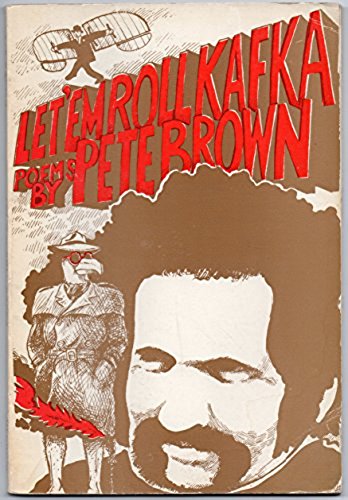
I have one of Pete Brown’s latest cds with Phil Ryan, Road of Cobras [2010] which is excellent, and I ordered yesterday, and am excited about receiving, a second-hand copy of his 1969 book of poems Let ‘em Roll Kafka,
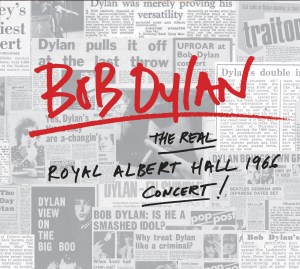
This morning I am listening to Bob Dylan – The Real Royal Albert Hall 1966 Concert, and I am sure I will have heard this before, though apparently a ‘Royal Albert Hall’ version has previously circulated that was actually recorded in Manchester. There is also, by the way, a 36 disc set of 1966 live Dylan recordings available.
I am not that discerning about when and where a ’66 recording was made, certainly not interested in listening to a single year’s 36 concert performances, and am not and never have been a Dylan aficionado: I know the ‘hits’ and have always liked though never followed that closely.
Having recently posted on Dylan’s award of the Nobel Prize in Literature, including some examples of his lyric writing, I have, however, been thinking much about the notion of lyrics as literary work, and my thoughts have been continued by the death of Leonard Cohen, considering his poetry and lyrics, the latter informed by The Observer this Sunday which printed a copy of Cohen’s Democracy, a song and lyric I didn’t know.
I have never been an assiduous listener to lyrics, apart from those that in my teenage years would have been glaringly pointed in ‘protest’ terms, or surreal and outlandish in psychedelic terms. Or, more consistently, in sing-along terms: I won’t recount key examples of these, though I was only yesterday singing along to Arlo Guthrie’s Ukulele Lady,
If you like the ukulele lady the ukulele lady likes you
as a prime illustration of my shallower aural and re-presenting tendencies.
What did strike me today listening to Dylan was the powerful, evocative if elusive storytelling in his song Visions of Johana. Reading around this a bit this morning, I was not surprised to learn that it is a lyric cited as one of his best, not that this more public approbation matters at all. However, I think it is a writing that also bears reading, and that says it all about the significance of such writing:
Ain’t it just like the night to play tricks when you’re tryin’ to be so quiet ? We sit here stranded, though we’re all doing our best to deny it And Louise holds a handful of rain, tempting you to defy it Lights flicker from the opposite loft In this room the heat pipes just cough The country music station plays soft But there’s nothing really nothing to turn off Just Louise and her lover so entwined And these visions of Johanna that conquer my mind.
In the empty lot where the ladies play blindman’s bluff with the key chain And the all-night girls they whisper of escapades out on the D-train We can hear the night watchman click his flashlight Ask himself if it’s him or them that’s really insane Louise she’s all right she’s just near She’s delicate and seems like the mirror But she just makes it all too concise and too clear That Johanna’s not here The ghost of electricity howls in the bones of her face Where these visions of Johanna have now taken my place.
Now, little boy lost, he takes himself so seriously He brags of his misery, he likes to live dangerously And when bringing her name up He speaks of a farewell kiss to me He’s sure got a lotta gall to be so useless and all Muttering small talk at the wall while I’m in the hall Oh, how can I explain ? It’s so hard to get on And these visions of Johanna they kept me up past the dawn.
Inside the museums, Infinity goes up on trial Voices echo this is what salvation must be like after a while But Mona Lisa musta had the highway blues You can tell by the way she smiles See the primitive wallflower frieze When the jelly-faced women all sneeze Hear the one with the mustache say, “Jeeze I can’t find my knees.” Oh, jewels and binoculars hang from the head of the mule But these visions of Johanna, they make it all seem so cruel.
The peddler now speaks to the countess who’s pretending to care for him Saying, “Name me someone that’s not a parasite and I’ll go out and say a prayer for him.” But like Louise always says “Ya can’t look at much, can ya man.”
As she, herself prepares for him And Madonna, she still has not showed We see this empty cage now corrode Where her cape of the stage once had flowed The fiddler, he now steps to the road He writes everything’s been returned which was owed On the back of the fish truck that loads While my conscience explodes The harmonicas play the skeleton keys and the rain And these visions of Johanna are now all that remain.
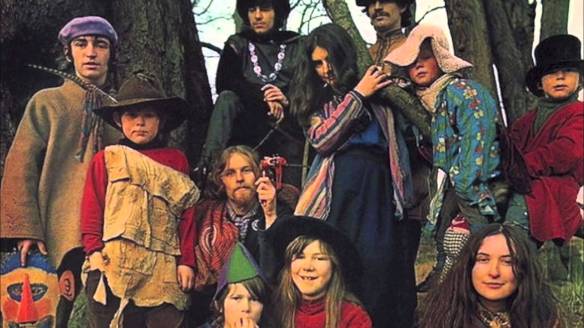
In the spirit of my previous posting, here is a celebration of a song lyric from the past. This was written collectively by Jerome Clark, Linda Williams and Robin Williams, the latter who I have seen once, playing with John Renbourn, and though it isn’t a song or band that was that influential to me at the time or since, listening today in the car it made me smile throughout and this seemed such a delightful experience to share and celebrate its playfulness:
I’ve been wearing faces in the strangest places Just to make a dream come true The dawn is sweet but it’s incomplete and l’m waiting for you The breeze is blowing and my hair is growing Forgotten everything my mother knew The day is young and spring is sprung and I’m waiting for you Must you bring that horse in here Miss Jones (although your snowshoes do look terrific) Yes, they all come from out of the sky, you know
I’m waiting for the dove that never came home I’m waiting for the painter when his colours were gone I’m waiting for the soldiers at the war I’m waiting for a royal decision I’m waiting for the sun to snore I’m waiting for a rumble from Jericho Waiting for the world to begin
I’m a bareback rider, I’m an outsider and I love to dance the boogaloo I’m a turnip head, I’m a lately wed and I’m waiting for you
More tea vicar? (Hold that tiger) Yes, the hydrangeas do look divine this time of the year
I’m waiting for the angels to put on their smiles I’m waiting for the judges to come to trial I’m waiting for the aeroplane I’m waiting for the graves to open I’m waiting to be sold in chains I’m waiting for a signal from the trapdoor queen Waiting for the world to begin
I’m a snake charmer, I’m a guava farmer I’m a goose to me don’t ever say boo Let the universe roll, I’m a simple soul and I’m waiting for you
Oh it sounds so sweet when you play it me like that.. (that tiger really doesn’t want to be held)
I’m waiting for the signs to point a different way I’m waiting for God to take a holiday I’m waiting for night in the mine I’m waiting for the hills to grow steeper I’m waiting for the man they call Shine I’m waiting for Willie the Weeper to wake Waiting for the world to begin
I’m off to market with an old straw basket singing dodeodeodo Green cloth to wear in the spring, in the April breezes how it will blow
I’m going to introduce to you now The personalities who compose The Jim Spiggatt Occult Quart
Over there on my left We have Miss Cynthia de Monfort-Jones On her silvery toned mandoline
And just a little further over the left We have that famed Oriental bass player Miss Fenola Bumgarner (first time in captivity folks!)
On the pounding batterie and coterie We have that well known bricklayer’s labourer from Pilton Mr Jack McMarker
And perhaps we just have time To devastate your synaesthesia With one more searing chorus From Black Jack Davy on the steam organ
It is becoming, this year, a sad retrospective: listening to the music of artists who have passed, those with whom one grew up, being influenced by their music – an influence that lasts forever as playing the albums at the time generates the memories of those significant teenage experiences, then feeling it again when older in that phenomenon of aural recall – and for so many of the singer-songwriters at that first moment in the late 60s and early 70s, also reading and absorbing the poetry of their lyrics.
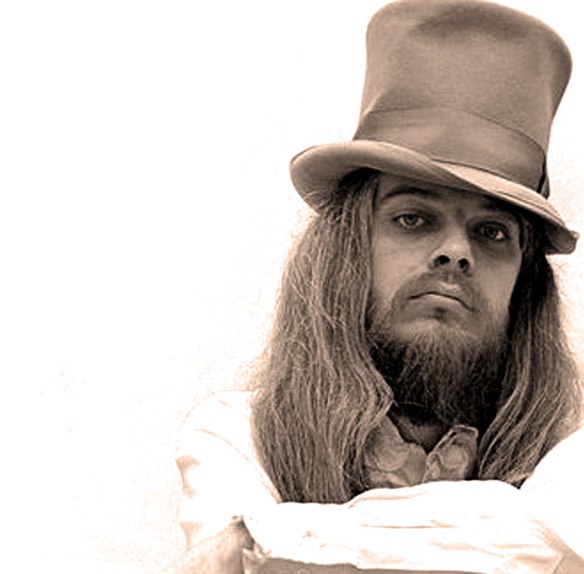
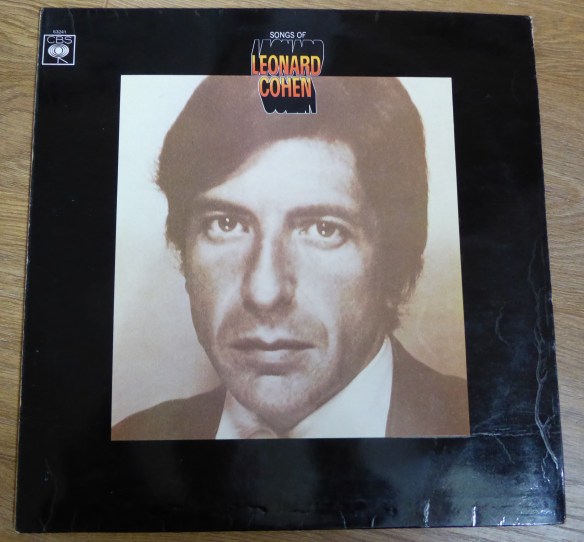
Leonard Cohen’s passing yesterday makes him my current revisiting, and I listened to two compilations which contained old and newer songs, but it is today’s playing of his vinyl album The Songs of Leonard Cohen that has meant more because this, from 1966, is the music that most contains and transmits those memories.
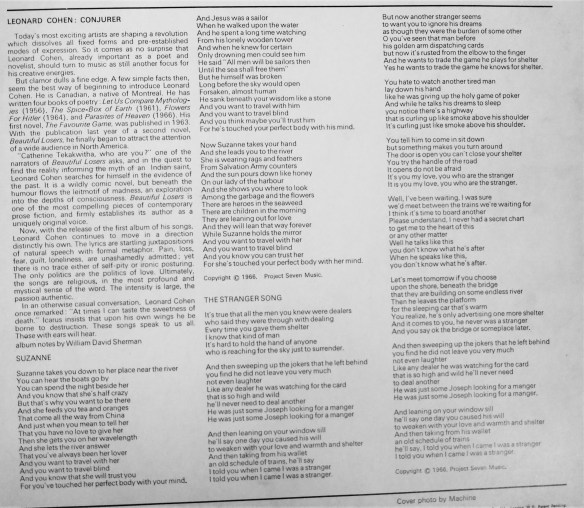
And the album covers themselves printed the lyrics, on the back with the liner notes or on the inside sleeves, this an important part of the physical acquisition [I know lyrics are printed on cd cover inserts. I know]. It is fascinating to read on this album’s liner notes by David Sherman a quote attributed to Cohen: At times I can taste the sweetness of death. We know there is much reference to violence in Cohen’s poetry, and darkness in his lyrics, not least on his most recent [very recent] release You Want It Darker,
They’re lining up the prisoners And the guards are taking aim I struggled with some demons They were middle class and tame I didn’t know I had permission to murder and to maim You want it darker
but how wonderful to know that his quote presented in 1966 still had 50 years to mean whatever it meant.
It would be hopelessly naïve to think there will be less listening like this as 2016 is only an obvious timeframe, and certainly hasn’t been the beginning: so many of the artists who had the influences I am writing about were already adults as I was becoming a teenage listener and reader – Cohen himself in his 30s when he turned to music – and thus this ironic coming of age will continue. I don’t want to engage in some macabre prediction of selecting and listening to the future if relatively imminent losses, but I must start more celebrating now rather than recovering the past when it has passed.
As contrived as that last sentence sounds, I’m sure, I know this is linked to the other loss of friends too, and thus these realities cannot be separated. To anchor what I mean by this, I will close on the following poem by William Stafford:
Friends
How far friends are! They forget you, most days. They have to, I know; but still, it’s lonely just being far and a friend. I put my hand out – this chair, this table – so near: touch, that’s how to live. Call up a friend? All right, but the phone itself is what loves you, warm on your ear, on your hand. Or, you lift a pen to write – it’s not that far person but this familiar pen that comforts. Near things: Friend, here’s my hand.