With a billhook and a pruning saw
I took down the tree, an ash not
fully grown, obviously, but enough
to be sweaty work on a frosty day.
The hook is over forty years old in
my possession, and I am sixty two
trying to be the young man I was back
then, but the racing heart and rests in
the patio chair put that ambition to
shame. I have a chain saw but it is still
boxed after many years, too afraid to try
and swing the same as I did when
wooding on the farm. This morning was
not as reckless as the last time I tackled
the tree, falling down the ladder and
holding on to rip muscles in my arm,
soothed with pain-killers for some
time afterwards until another ache
refrained. Today was well prepared
with rope and props and calculations
for the cut, stopping to survey instead
of running ahead, and in the end it fell
exactly where I had planned and not
reduced the rhododendron to mush
or swiped me across the back, dead.
I’ll have to keep an eye on the stump
as ash grows back quickly, long young
shoots I might allow to try and then
sever to weave in another rustic fence.
It is a cycle, and I survive, so far, like
not tumbling from the high hedges too,
all this existential gardening with a look
to being more careful with a swung hook,
but a trimmer cord is cut to its death
by circuit breakers that save and protect
me, still life in this older feller yet.
Author Archives: omahaglenn
outside
I wrote the following poem 46 years ago in September, 1970. I have never presented it before, but do so now having re-visited yesterday and tidied up a little [no more, really, then correcting some errors]. It is personally interesting for a number of reasons: it is a poem I recited/composed into a cassette tape recorder and later transcribed; it is during a brief period of living in Oakland, Iowa, as I was waiting to return to the UK to study, not realising then I would stay in England for the rest of my life; I remember precisely the time as it is just a few days after Jimi Hendrix died; my experience of dislocation and anxiety is the result of previously living, very briefly, in a small town in Michigan where I encountered such direct redneck hatred for me – because I had the beginnings of long hair [!] – that I decided to definitely leave the USA; it reminds me in a palpable way, though the poem does not address that Michigan experience, of the same redneck stupidity and hatred I have experienced more recently and which was and is so evident in this post-Trump election period, and finally because it captures a simple style of writing I have tried ever since to acquire and maintain, though this long paragraph would suggest otherwise,


Teasing Pricks

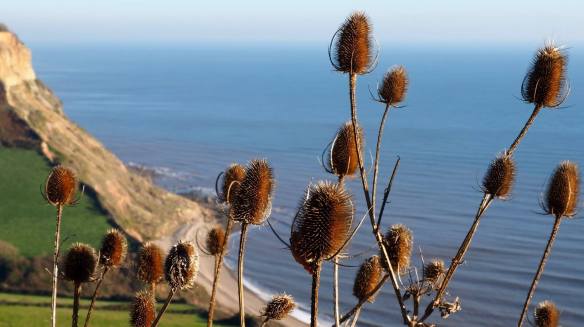
Teasels tease the foreground, yet ravenous for water
you’d think they would be down below with roots in
the blue sea on a clear November day. But there’s the
icy cold, then the salt – and a partiality for the treat of
insects makes them land-bound carnivores. So what
are they good for, apart from invading the USA where
walls are still not built? The seeds feed birds in the
winter, and for years the prickly pods were used to raise
nap on wool – a cultivated comb to clean and align,
not shape a hairstyle in the weave of a golden throw.
This year too many pricks have been thrust forwards,
their sharp barbs poisonous and self-serving rather
than giving. There’s no joshing with such mad dipsacus,
snaring as they do all for themselves and nothing for us.
[Photo by artist and photographer Nick Dormand]
Pete Brown – Let ‘em Roll Kafka

I wrote briefly about Pete Brown as lyricist and poet here, and mentioned that I had ordered his 1969 poetry book Let ‘em Roll Kafka. I received this yesterday and have enjoyed reading this collection of its time, poetry made popular by its simplicities, its nonsense, its irreverence, its protest, its experimenting, and its lyricism.
I’m going to share two here, both sadly about death, the first Sad is the Man [poignant, perhaps, the day after it was announced an inmate commits suicide every three days in our prisons now], and the second Goodbye/The Mad May Dawn. The first seems to me reminiscent of the song lyricist in Brown, obviously the rhyming and the rhythms and the immediate transfer of emotion, and the second demonstrates some of the playing with form in ‘modern’ poetry at the time, though this is hardly original or radical. Is there an echo of Samuel Beckett in this?


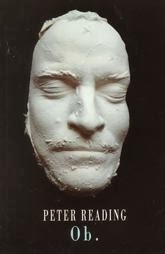
Peter Reading Lighter

No other poet is going to sensibly compare with the distinctive writing of Peter Reading, who passed five years ago this month, but seeing the American poet David Baker recently and hearing as well as going on to read some of his current poetry I was struck by a similarity in the love of mixing up and amalgamating differing written resources within his own. Reading’s work was most often complex and acerbic, and Baker’s certainly contains elements of the first characteristic, but Reading could be lighter on his poetic feet, and humour was always a fundamental part of his poetry, even when tearing the world to shreds.
The following poems are from the appropriately titled Ob. published in 1999 – a title typically and darkly humorous by a writer who documented general and specific decline in our world with his characteristic candour – sometimes caustic, sometimes comic – and the challenging complexity of love for esoteric language and metrical forms.
I am presenting the following poems because they are accessible, funny and biting. They are about writing and about others writing, and I suspect refer to a writing tour in America and reading to and working with aspiring poets. They are indignant as well as rude: a potent mix.
[With apologies that I still cannot format text in WordPress, even transferring it first to Notepad]
Workshop
You say you love words?
Hmmm, let me see: ‘Sweet zephyr…’;
keep up the good work.
Flyer
…poetry reading…rare opportunity…
one of the leading…whose reputation is…
recent collections: Foibles, Frog’s Breath…
gained international…lyric beauty…
At the Reading
The sham-coy simper,
the complacency,
the frisson titters,
the sycophancy.
In the SCR
The puerile academic quips,
the smugly learned repartee
withstanding little scrutiny.
Catullan
Possibly I may find some time to peruse your
puerile outpourings
(I don’t remember your name);
more likely, though, I shall not.
[Untitled]
Unfortunately
an A in Histrionics
doesn’t count for much.

Waiting at the International Times
My poem Waiting is up at the International Times, and it is always a pleasure to have work out there, and especially at this venue. A special bonus is also the illustration that is done for a printed poem at IT, today’s by Nick Victor for mine,

You can read the poem here.
Arlo Guthrie’s Thanksgiving Tale
This wonderful satirical story from Arlo Guthrie isn’t being presented as an example of a literary lyric. It is a musical narrative mocking the world of the day, and doing so on Thanksgiving Day, both in the storytelling and for this posting.
So, Happy Thanksgiving to all reading.
It is apt for today as a holiday reminiscence as well as, sadly, the reality of how a song nearly 50 years old still ridicules behaviour and attitudes prominent in the world now, especially post-Trump.
Perhaps the saddest aspect would be how that hope for change sung in protest songs of the day would appear to have been a waste of idealised time. Well, we did have Obama for eight years, and that wouldn’t have seemed conceivable then,
If you want to end war and stuff you got to sing loud.
I’ve been singing this song now for twenty five minutes. I could sing it
for another twenty five minutes. I’m not proud… or tired.
Arlo continues to perform this crowd favourite live, sometimes contemporising the lyrics, and such versions can also be found on YouTube and elsewhere, for example a 2005 Farm Aid performances.
The following original recording is about 19 minutes long and that is a proper sit-down experience. I actually have the lyrics printed and was going to post along with the video – but that seems superfluous. You can always find this yourself easily enough online if you want to read as you listen:
David Baker – American Poet and the Lyricism of Politics

Reading at the English Department, University of Exeter, 22nd November, 2016
I went to see the American poet David Baker reading in the English Department at the University of Exeter yesterday. On a dark and wet early evening, Baker was as uplifting in reading aloud so expressively – and physically with a bird-like movement of his arm and hand – as he was poignant in being compelled to express his despair at the election of Trump in America. Poetry and politics are inherently linked, but Baker did question with honest personal angst how poetry could possibly account for the artistic and intellectual [and much more] disruptions reflected by that election result.
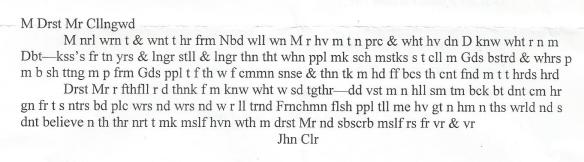
Reassuring then to be warmly soothed by the lyrical depth of much that he read, as well as the scholarly and experimental intensity of his current writing, reading as he did from a poem in progress that weaves elements of John Clare’s life into its narrative. This included what I’ll call poetic redactions to represent the limits and/or obfuscations of language, these imitating the coded vowel-less words John Clare used when writing letters from High Beach, the asylum where he was kept. The following example is taken from a hand-out [how wonderful!] Baker distributed before reading this poem – I like that engagement with the audience: teacherly in such a communal way,
David Baker lives in Ohio, teaches widely as a Professor of English and Creative Writing, is the poetry editor of The Kenyon Review, and is most often referred to as a Midwestern poet who writes predominantly about the poetry of place. Last night’s reading included poems from his latest book Scavenger Loop which seemed to always involve birds, and thus my mentioning of his physical movement in reading – these were comforting to hear in their lyricism and the rhythmic way Baker reads and often recites.
The expressions of frustration and dismay about current political and social events in America were spontaneous and heartfelt. Baker claimed not to be a political poet, and I presume he really meant by regular inclination, but in the circumstances he did read a poem from his Treatise on Touch: Selected Poems which he said was twenty years old and about one of the ‘Bush boys’. This next poem is one I want to share as it does reflect, despite what he says, his powerful ‘political’ take on and portrayal of aspects of American life and society. It is titled Patriotics,

[From Like Thunder: Poets Respond to Violence in America, edited by Virgil Suárez and Ryan G. Van Cleave, published by the University of Iowa Press. Copyright © 2002 by Virgil Suárez and Ryan G. Van Cleave. All rights reserved]
His book Scavenger Loop has been out for a year in America and was released yesterday as a paperback here in the UK, a significant event in the life and popularity of a poetry book and its author. From what I read in some detail from lengthy extracts online, this is a complex work, incorporating many external resources experimentally and playfully into his own lyrical narratives.

I did not know about David Baker and his work before yesterday, but I am so glad I do now. I look forward to receiving and reading my copy of Scavenger Loop [how amazing that David was simply reading and sharing yesterday, and not promoting/selling his book] and will review this at a later date.
The UK Elastomer to the USA
Knock knock
Who’s there?
The Elastomer
The Elastomer who?
Nigel Farage, the UK Elastomer to the USA
Isn’t ‘elastomer’ a synthetic, rubbery substance?
That’s what I said.
It’s the best I could do at short notice. I mean having just watched the 10 o’clock news. Of course I’ve been aware all day of Trump’s tweet about Nigel Farage as UK ambassador to the USA, but I have had other things to do rather than respond immediately, like go to a poetry reading given by a great American poet who couldn’t resist expressing his despair at Trump’s election. Watching the news this evening I too despaired at the government’s and the media’s complete inability to treat Trump’s tweeted suggestion with the comic derision it deserved.
Everyone has responded with such seriousness. Even the buffoon Boris couldn’t really make a joke out of it in the House. I guess he saves the ‘best’ of these to alienate European Heads of State. An ex-ambassador was wheeled out by both the BBC and ITV to explain the realities of the protocol for the UK deciding who its ambassador to the USA is going to be. Protocol? How utterly absurd. As if Trump would know what this word means, let alone follow it.
It was Trump’s joke too. And whilst he probably actually likes and rates Farage – one volatile Machiavellian maverick to another – we know that Farage is also a joke. Dangerous yes, but still a joke. And Farage has today milked it for all its creamy worth. And which Simpson character does he most resemble? I couldn’t quite work it out this evening watching his sweaty, elastomer face on the ITV 10 o’clock news.
Anyways, that’s enough of this for now. I’ve got the following to work on for more Knock Knock deflections:
capacitor
challenger
diameter
examiner
excalibur
great grandmother
knight bachelor
lord chancellor
parameter
rectangular
sea lavender
slide fastener
snap fastener
spectacular
spike lavender
stage manager
triangular
vernacular
vice chancellor
A Poodle Pontificates for Trump
I caught a little of ITV’s The Agenda last night, just as Piers Morgan was delivering his suave and self-aggrandising assessment of Donald Trump and his election as America’s next president.
It was suave in the way Morgan is always articulate and almost charismatic, attributes that have propelled him into the public arena as an apparently trusted spokesperson on international affairs and the qualities of talented dogs.
I tend to switch off when Morgan is pontificating because I don’t have confidence in the truth of what he is saying. But I am still listening, knowing it is important to be aware of what the ‘influential’ are expressing and perhaps propagandising deceptively. As a long-time friend of Trump it was hardly surprising Morgan defended him, albeit with a clever-clogs caveat he is divisive, he is challenging, he’s not everyone’s cup of tea. But I don’t think he’s the next Hitler, as if the latter extreme in the phrase excuses, by not being the case, those appalling realities – unacknowledged – which do make him dangerously ‘divisive’ and ‘challenging’. And then there is the very English trivialising in the ‘tea’ reference: it is little more than a smart-alec rhetoric.
The most absurd defense Morgan made of Trump is that the public and media had ‘demonised’ him. As if Trump’s wild-river raft of tweets, inflammatory assertions and promises at his rallies, and the incoherent ramblings in his three election debates with Clinton were not clear evidence of the man’s nasty and perilous thinking. It would appear Morgan does not consider there to be a connection between thoughts and actions. That is worryingly stupid.
The self-aggrandising was in Morgan’s sickly coy response to being questioned about Trump having phoned him and perhaps offering a job. He smirked and almost giggled with the sense of self-importance this apparent president-elect bonhomie conferred on him, and he joked about remaining shtum on the possibility of being offered employment as if such public reticence demonstrated anything other than shallowness and a greed for more attention and perhaps lucrative incentives for his continued support.
Trump has now tweeted his desire for Nigel Farage to be appointed the UK ambassador to the USA and thus this position – in Trump’s fantasy world – isn’t available for his other English mate Piers. Perhaps with Morgan’s expertise on performing dogs he still has another shoehorn into Trump’s inner and even outer circle: a poodle’s role for the pontificator.