Messages for Facebook Friends

I send this message to my Facebook friends
hoping our like-ship never ends,
the agreeing comments and sharing too,
this approbation which comes through you.

I send this message to my Facebook friends
keen to join in one of the popular trends:
it’s National Poetry Day so I’m writing in verse,
my own ideas and not a newspaper search.

I send this message to my Facebook friends –
not the causes my posting usually defends,
and rather than a sonnet this set of quatrains
with digs at social media its satirical refrains.

I send this message to my Facebook friends
like a surviving library with books it still lends
after cuts – sorry, I fell in an onomatopoeic trap
of sharing heartfelt ideas others consider crap.

I send this message to my Facebook friends
without pictures of mac ‘n’ cheese or burnt ends,
no towering burgers, or platters of ribs and steak,
but a selfie of me in a hot-tub at a seaside break.

I send this message to my Facebook friends,
a public act of trust for the privacy it transcends:
insights or just asides perhaps best left unsaid
if adrift in cyberspace unliked as if an undead.

I send this message to my Facebook friends
with an apology to make some amends
for a preceding stanza so stark and serious
when it isn’t de rigour to post the imperious.

I send this message to my Facebook friends
hoping its mix of wry truths recommends
poetic warm readings with an incline to care,
tasty memoranda a metaphor to tear and share.


Sharing this here, a NPD poem I posted on Facebook: in a previous posting I urged people to ‘message’ poems to one another, this being about as apt a facility out there to fully utilise the theme of messages for this day. I’ll never know how many did.
Message in a Deposit Return Bottle

pb-copy

Please don’t leave me

beached with other lonely ones
like a tombstone rising on a tide line
as a useless see-through windbreak
sucking a billion grains of sand

Please return me to

a machine marrying me to others
the reception of the receptacles
other transparencies
new possibilities for my future

Please don’t leave me

intruding in a sand dune
hidden like a trap
waiting to be drowned
emptied and forgotten

Please return me to

a new grip for drinking
those who’ll see me again and again
tidal waves of conveyer belts
plastic reinvention

Please don’t leave me

scattered by the random wind
with four centuries of dying
swelling whales like Jonah’s cries
digestible as poison

Please return me to

a better environment
seashore hands and filled anew
a broken link in the food chain
fresh thinking


One day to go until National Poetry Day and its theme of Messages, and here is another poem I have been working on using the ‘message in a bottle’ idea, linked to the current Surfers Against Sewage campaign for a national move to deposit return bottles, read here.

On the day it is also reported that discarded take-away coffee cups could each take 30 years to break down, these are no-brainer environmental issues and necessary suggestions for beginning to seriously deal with it.

This is another list poem idea that could be used in the classroom tomorrow, students perhaps engaged and enthused by the issue and expressing their thoughts and feelings in poetic messages.

The Partial Catharsis of a Mole Saga

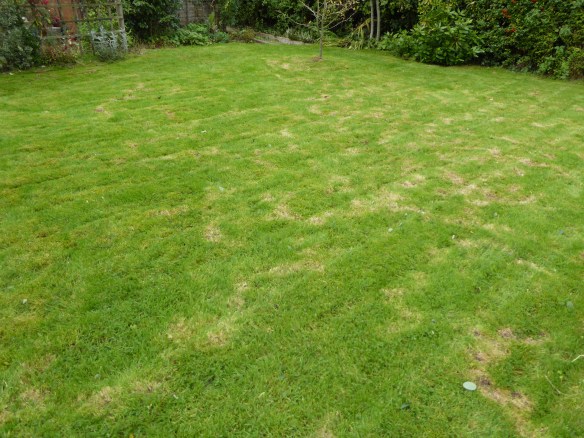
This picture is of the lawn-damage my current cleverclogs mole is making – not going underground to erupt in mounds of dirt, which is the norm and thus making it easy to place traps to catch and kill, but rather skimming just beneath the grass and causing these random lines of damage without my being able to track or find any spot with a depth where a trap can be set:

p1000720

The little bastard. I have written about my decades’ old battle with moles and posted about this here and here as well as this haiku about the last mole I caught and killed here. And I have no compunction about getting rid of these creatures because of the extraordinary damage a single one can cause, an aspect I have explored in my ruminating but cathartic poems because I do not normally or easily kill animals.

I think the poems are cathartic…

Mole Au Fait

This new mole is a submarine, a few slight mounds
breaking through the grass-arched tunnels like failed
periscopes, no holes in these with a depth to set my
traps which have caught and finished the others. A wise,
wily skimmer.  I could walk for hours along its winding
protrusions and still not lay the lawn back to its flatter
unevenness from that damage of years ago – and those
poems about give and take, growing older, life and death.
There’s no philosophy in this, but a seeming evolution of
tactic just as I had learned a new skill for slaying, and it’s
the taunting that angers me now the most: ribbed routes
plotting its underground joyrides that I never catch live in
the calculated journeys of insult. I wish I’d made my
gibbet years ago for a killer’s visible if mummified wins.

NB I don’t know if it is a well-known term: the ‘gibbet’ in my poem alludes to a keeper’s gibbet. On the large Suffolk farm where I worked many years ago, the gamekeeper was responsible obviously for raising and managing game-birds for their annual slaughter [I do think this is quite different to a mole invading my garden] but he also had to control the vermin on the farm. To demonstrate he was doing his job, the gamekeeper followed the tradition of hanging dead vermin from a tree where employers/owners could see evidence of his work being done.

Messaging National Poetry Day, 6th October, 2016

npd

[with acknowledgement to nationalpoetryday.co.uk]

I am continuing to plug National Poetry Day and my teaching [or for anyone] resources of creative writing ideas on the theme of messages for the day. I always support this annual event though this year I have put more effort in than ever, and the genuine hope is that as many as possible will be engaged in and encouraged to take part, writing their own poems and/or sharing others’ poems.

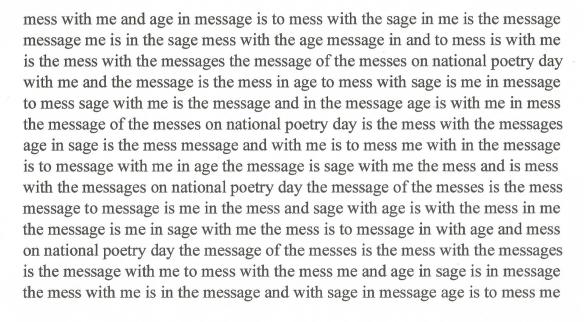
My following poem Messing with the Messages on National Poetry Day is a concrete poem that explores and plays around with the theme, and that is, I think, the essence of the day, to have some fun with writing creatively:

mess-messages


Lie Detester Test

That’s fine.

That’s correct.

Yes, OK.

Yep, correct.

Oh my goodness. That’s despicable. That’s nasty.

OK.

No, that’s disgusting! You lying bastard. How could you?

That makes me sick. I want to physically puke.

Probably honest.

That’s an easy one.

You sick fuck! Where does this darkness come from?

Horrible. Horrible. Horrible.

I didn’t think that was possible!

I am appalled. Utterly appalled.

Well, you wouldn’t get that wrong, would you?

Another easy one.

Too easy.

Wow! You are the most contemptable person I have ever tested.

Wicked. Wickedness personified.

The devil incarnate. This is outrageous.

Scandalous!

I am lost for words.

On BBC News yesterday, one of the football agents caught on the newspaper film sting about football shenanigans was interviewed. He claimed the accusations he made on camera were all lies and to prove he was not lying about this now he would willingly take a ‘lie detester test’. He said this twice.

Andrew Neil’s Negative Narrative

I wrote the following when away from home for a few days, never able to fully escape…

I watched Jeremy Corbyn’s Labour Party Conference speech live on TV on Wednesday, and as an incidental but crucial observation I thought it very good, obviously for me wanting to hear socialist principles articulated with conviction, clarity, warmth and genuine belief. This is what I saw and heard, as did most of the conference delegates it would seem, though not according to BBC bloated political commentator Andrew Neil. Almost immediately after Corbyn had finished, Neil as anchor of the BBC programme showing this went to the ‘outside’ reporter in the foyer of the conference centre who conducted a live, impromptu, in-your-face interview/straw pole of delegates exiting the venue. His question to all was quite simple: what was their view of/response to Corbyn’s speech? He managed to get between 6-8 or more people to respond immediately, and almost all were without hesitation positive, some just expressing that simple response, and others expanding on the policies they were pleased to have heard, a number commenting favourably on Corbyn’s delivery and persuasiveness.

Of this admittedly small straw pole – but I repeat, live and immediate and therefore an honest set of responses – there was one dissenting voice. Only one. This was, however, immediately countered by another person who argued quite forcibly against the dissenter. It is worth mentioning also that the crux of the singular negative observation was that the person hadn’t heard how Corbyn intended to deliver his policies/suggestions, so it wasn’t even opposed to the principles of them – not perhaps surprising, I admit, as the person dissenting was still a Labour Party member.

Straightforward then, yes? Not according to Andrew Neil. His immediate summation of that live, impromptu questioning of exiting delegates’ responses – which were all positive, bar one – was that here we TV viewers all were instantly after Corbyn’s speech and witness to the ‘fact’ there was already in-fighting and argument. Apart from being patently untrue (!) this was the most despicable piece of broadcast journalism to generate a negative narrative that simply did not exist on the evidence we had just seen. All of us watching. Saw and heard. Witnessed as a viewing nation. Andrew Neil simply lied.

Two things: (platitude alert for the first) there may well have been more than one dissenting voice from those who watched Corbyn’s speech in the conference hall, but this wasn’t presented in the BBC interviews given live; (prat alert for this second) earlier in the day, Neil had conducted an interview with two guests about Main Stream Media (MSM), obviously including the BBC, and whether this had reported contrarily on Jeremy Corbyn and the conflicts of late within the Labour Party. Fumbling with saying the initials MSM and pathetically even the term Main Stream  Media (how ridiculous), Neil in interviewing the two clearly conveyed his personal view that the BBC did not indulge in such negative reporting.

Pants an inferno.

Reading ‘Rabbit, Run’ by John Updike

rabbit-run-copy

Having gone from the often aggressive pulp noir of four Jim Thompson novellas/novels to a measured pathos in the campus fiction of John Williams’ Stoner, I am now reading the elaborate, burgeoning prose of John Updike’s Rabbit, Run.

It is my first encounter with his work, and he has the most fastidious, intense descriptive style. I am still relatively early in the story, and yet again I am enjoying this literary learning curve in coming to this famous author’s writing so late in my reading days.

You notice immediately that his describing is compulsively extravagant – though the originality keeps it from being overwrought – and in the beginning that decorative description is attached to the most commonplace things, like a reminiscence that Rabbit has of climbing telephone poles as a boy. There is sumptuous detail about all kinds of ordinariness, but as the novel progresses this grows into insights about people [characterisation] and their thoughts and feelings. But it is also much more than this: it is philosophy and psychology conveyed through layer upon layer of outer and inner observational detail.

I am at the part of the story where Rabbit is getting to know the minister/preacher Eccles, and the verbal exchanges about faith [Rabbit’s and, of course, Updike’s own] are woven into the fabric of the whole narrative, like a description of the golf course where they are having a first game together,

Down in the pagan grooves and green alleys of the course Eccles is transformed.

It is of course much more than this, but that one use of the word pagan demonstrates the crisscrossing of external and internal details. It is genuinely exciting – sometimes exhausting – to read, and one has to be willing to take on wave after wave of narrative tangents. So I’ll close this brief diary-like account of my reading and explaining about it with a longer extract from the text, this one where Rabbit is now doing some gardening work for an elderly woman Mrs Smith that Eccles has arranged for him. The move from knowing description of flowers into the world of nature and onto ‘types’ of women wearing flowers in their hair or hats is a snippet of a continuous narrative roller-coaster ride:

rabbittext

The Arrogance of Selective Education on the Backside of a Bus

Theresa May’s proposals to allow for the proliferation of grammar schools in state education are based on many things: much just political blindsiding and deflecting from more critical issues, domestic and international, but also the sheer arrogance of attempting to impose her personal feelings as well as the inherent arrogance upon which selective education itself is based.

Her arguments about the promotion of academic achievement through grammar school education are widely reported today as unfounded by the Education Policy Institute [formerly CentreForum] who have stated We find no evidence to suggest that overall educational standards in England would be improved by creating additional grammar schools. The full report can be found and read here.

Having stated this, I have actually been prompted to express my consistent disdain for May and her proposals not because of this further contrary report on these, but by the  advertisement I saw today on the rear of a local bus: The academic choice in Taunton, the claim made by Queen’s College in that town. It sums up the endemic arrogance of selective education and those offering it, here emanating from the backside of a bus rather than its usual source.