Literary Humour

Originally posted August, 2011:

After Frost
-by Robert Creeley

He comes here
by whatever way he can,
not too late,
not too soon.

He sits, waiting.
He doesn’t know
why he should
have such a patience.

He sits at a table
on a chair.
He is comfortable
sitting there.

No one else
in this room,
no others, no expectations,
no sounds.

Had he walked
another way,
would he be here,
like they say.

This poem can be found in the ‘Black Mountain Poets’ section from the excellent and massive Poetry Foundation site. I like this because I enjoy Frost and enjoyed teaching him to my students – not an experience universally shared, sadly – and because I enjoyed teasing them with alternative and/or lack of meanings for The Road Not Taken, which probably explains why my enthusiasm for Frost wasn’t universally shared, or not. Of course, Creeley was one of the greats too, indulging in light witticism here.

Educational Excellence Everywhere, But Not Inside Nicky Morgan’s Head

There is so much that is platitudinous in the government’s latest white paper on education – the DfE document Educational Excellence Everywhere – not least in the childishly obvious pilfering from Labour’s Education Education Education with its own title’s alliterative three Es.

This document was lauded by Nicky Morgan on last night’s BBC Question Time in which she appeared embarrassingly out of her depth, and it is this demonstrative personal struggle that fuels the essence of this critique. Morgan does have an inherent appearance of the shocked animal caught in car headlights, and I have avoided in other postings about her the easy mockery of this look by using readily available images, but last night her continual wide-eyed stares of confusion suggested a much more serious lack of political nous and insight. Especially when it comes to educational matters.

Before addressing the white paper, one of the more pointed questions that Morgan could not answer was by Chair David Dimbleby on the compulsory academisation of all state schools announced in Wednesday’s budget and outlined in the white paper. He asked why successful local authority schools who do not want to become academies should be compelled to do so. Morgan, having just voiced the well-sounding but suspect mantra that she wanted schools to be run by teachers and not the government, was completely unable to see the irony Dimbleby was presenting and could only repeat her already wilting refrain. The mind boggles. As did Morgan’s continual look.

To explore the immediate above a little further, you can read an excellent articulation of one Headteacher’s rejection of being compelled to become an academy here. Geoff Barton writes convincingly about the nonsense of subjecting his highly successful local authority school to such a compulsory ideological and fundamental change.

The white paper begins naturally enough with an introduction by Morgan as Secretary of State for Education – well, clearly not written by her – in which ‘she’ makes understandable if cheap party-political points about having to right the wrongs of the previous government [we inherited an education system….] and then summarising the apparent successes of that rectification, in general terms. Very general.

In challenging the empty rhetoric of much of the sales pitch in the early parts of the document, I am bound to pick out the most contentious points. One of the first in Chapter 1, 1.4, is the statement Exam grade inflation was rife. Selective ‘evidence’ of this is provided in Chapter 6.16 with reference to Mathematics and Chemistry, and no counter – which does exist – to the tangential [and no more than this] reference to international comparisons, so this does not constitute ‘rife’ to my thinking nor does it equate to any national focus on such over recent years. And I pick on this, very early in the document, as it is a massive claim, this being the ultimate assessment gauge of 11-16 compulsory state school education. This is one of a number of such tenuous claims used to underpin the move to compulsory academisation.

That national academisation of all state schools is introduced and explained obliquely if rousingly in 1.15, somewhat in the mode of the Independence Day film appropriation of Shakespeare’s Henry V Agincourt speech to his troops:

We believe that the fastest and most sustainable way for schools to improve is for government to trust this country’s most effective education leaders, giving them freedom and power, and holding them to account for unapologetically high standards for every child, measured rigorously and fairly. This system will respond to performance, extending the reach of the most successful leaders and acting promptly to reduce the influence of those who aren’t delivering for our children. But it will also do more to set up these leaders for success, ensuring they have the necessary tools to seize the opportunities provided by greater autonomy and ensuring that for as long as it is required, support is available for them to draw on when they choose. This model underpins every one of the reforms set out in this white paper.

Henry was of course using his rhetoric to rouse against the odds, and this paper too emboldens the weakest points of the argument with the sound of certainties, like by greater autonomy which we know is a smokescreen [see here the limits of that autonomy for primary schools – much rightly so – where national testing looms large as a battalion]. It is yet again difficult to anchor to a reality that assertion for government to trust this country’s most effective education leaders and one wonders who exactly these are. Does this mean Headteachers? Does this mean all good classroom teachers [and I use the word ‘good’ quite differently to an Ofsted appellation]? The point is, from the 90s onwards, the Tories, then Labour, the coalition and now the Tories once more have consistently not left the job of education to educators – at classroom level and at subject development level and certainly at assessment levels – and thus the claim now is bound to be classical empty rhetoric. And this is what galls about so much of this document’s preamble – the bloated rhetorical sweep of its statements.

I am only on the first chapter of eight so am worried about too much focus on these errant observations in the document, but this early mission statement needs further unpicking. As the ideological fluff continues to be wafted – as well-meaning as it could be, but can’t be on the evidence – in 1.17 we have:

We believe that outcomes matter more than methods, and that there is rarely one, standardised solution that will work in every classroom for government to impose.

The compulsory National Curriculum Tests at Key Stages 1 and 2 would seem to immediately refute this claim with, for example, the recent debacle on imposed guidance about how exclamation marks should be taught and assessed at Key Stage 2 for English exemplifying this, as I have already explored here.

1.18 through to 1.30 contains more of this rhetorical slight-of-hand, its platitude peaks sustained at an alarming height as the repetitive gist is that the government want the best education for all students. It really is this simplistically correct in aspiration and yet laboriously ideological, and erroneous, about academy autonomy to achieve this.

At 1.32 we read yet another inanity dressed as initiative in the sub-heading Great teachers – everywhere they’re needed. This really is too detailed to unpick, not that anyone would challenge the premise of needing good teachers to deliver good education. However, against the recent widespread and apolitical concerns expressed about falling teacher recruitment and rising pupil numbers, the document here claims that all is in order in this respect: no evidence provided to support the claim.

At 1.36 d Accrediting new teachers, we read yet another deeply dubious statement about the current ‘Qualified Teacher Status’ being replaced with a stronger more challenging accreditation based on teacher’s effectiveness in the classroom, as judged by great schools and yet apart from the perhaps contentious adjective ‘great’ [what does that really mean/imply?], this would appear to be exactly the status quo: a teacher’s induction [formerly probationary] year is currently monitored and ultimately judged by subject leaders, senior leadership members and the Headteacher. Indeed, my experience – going back some time, I accept – of having a local authority to support such a long-standing qualifying process with regional probationary teacher meetings and courses would seem precisely the kind of professional model we want to promote.

Backtracking to 1.36 Recruitment, as was picked up on last night’s Question Time by Labour’s Emily Thornberry, the following apparent initiative is risible as a serious attempt to deal with a nationally chronic problem of teacher recruitment where schools cannot attract teachers to fill key posts:

To reduce the costs of recruitment for schools in a more challenging labour market, we will create simple web tools that enable schools to advertise vacancies for free and a new national teacher vacancy website so that aspiring and current teachers can find posts

Schools are quite able to advertise. The teachers they require are not available.

The next section Great leaders running our schools and at the heart of our system is in some respects less problematic, but in others, is more so! Like the claim to need good teachers, this similar requisite of leaders is no less a given [though we could explore the differences between good and great, and the nuance, or not, of attaching the adjective to one and not the other]. In a 30 year teaching career, I have worked with many great leaders and many who were neither of those two terms, and not even good. The point here is that in my experience, leaders led by example – a rather old-fashioned notion – and they should first and foremost be good teachers, able to do the fundamental job. If they cannot, no amount of leadership/management training and qualifications will allow them to ‘lead’. And the notion that multi-academy trusts – MATs [these really should have been deigned ‘multi-academy divisions’….] – will deliver great leadership is yet another absurd leap to defining legislating for that compulsory status made in this document.

I am able to make the claim immediate above – which can of course be challenged – because I have read ahead and therefore the entire white paper. It is without question a massive, comprehensive document, and the headings I have alluded to briefly here from chapter 1 get, along with all the others introduced, detailed outlining, as does Initial Teacher Training to acknowledge because it would appear to be absent from what I have summarised so far. But that detail, that comprehensive delineation, continues in the same platitudinous swathe of sweeping statements, assertions and apparent solutions, a monolith of rhetorical artistry which is ‘correct’ enough in ambition – to provide good education for students – and yet ideologically suspect in its intention to legislate for and achieve. In my opinion.

I have a fundamental objection to that ideological slant which is obvious from my critique so far. To return, however, to where this brief summary began: it is in seeing the current Secretary of State for Education, Nicky Morgan, struggling so embarrassingly and yet assiduously with this cause that undermines it so much for me. Where her predecessor Gove was a strident zealot and clearly in control of his own myopic agenda, Morgan is the mere mouthpiece for a colossal ideological structure she doesn’t seem capable of understanding. With her ‘management’ of this colossal managerial construct so inept, it is impossible to support.

And, of course, it is wrong.
Taxidermy

The taxidermist did not get her limb exactly right,
and it wasn’t because there were no other parts to
provide a scale or further sense of relevance, but
rather because he had not caressed the long smooth
length a thousand times or ever felt secure in the once
perfect placement with its other attachments. I’d given
him photographs – obviously – and also the love letters
she had written to me in those early years when her
words were as if we touched when being read, yet this
wasn’t a feeling he could get second-hand, which I am
glad to say even with the finished piece suffering so in
consequence. I paid him all the same, knowing how any
one of us can fail despite our skills and intentions, though
why he didn’t paint her nails blue will always dismay.

Academy ‘Independence’

As announced yesterday, today’s announcement in the budget that all state schools will become academies has been predicated on the notion that this status will give them their ‘independence’ from local authority control and  from teaching the national curriculum.

As I said in yesterday’s posting on this subject, there is a debate about the pros and cons of academy status, but there can be no debate about the facts. One of the most significant facts mentioned today is that the majority of schools affected by this decision will be primary schools, most of which are still within local authority support, guidance and control.

Here is another fact: this is the DfE guidance from which academy primary schools will NOT have independence, and quite rightly in a number of cases:

the statutory guidance that applies to academies and free schools:

  • Assessment and reporting arrangements (Key Stages 1 and 2)
  • Early Years Foundation Stage (EYFS)
  • Safeguarding
  • Exclusions
  • Alternative provision
  • Admissions (the School Admissions Code)
  • Sex and relationships education (SRE)
  • Special educational needs (SEN) / health needs

Maya Angelou – Caged Bird Songs

Originally posted May, 2015:

mayou - Copy

Still Rising

This is definitely an interesting album, and a tribute that as such justifies itself, and Angelou was keen on its production just before her passing so all is good. The hip-hop to funk to other beats attached to her poetry and readings highlight and complement and perhaps most of all present to a further audience.

It is an extra: I am always content enough to listen to Maya Angelou read aloud, her own rhythms and sassy intonations, that deep resonance of voice, all quite sufficient to engage me as listener. I got to see her reading once many years ago and that was genuinely special, and of course she would occasionally break into soulful song so I would be content enough again to have a recording of this.

maya 1 - Copy

Some of these poems lend themselves to the adornments more than others. The plosive sounds of Pow Pow as well as its natural rhythms are perfectly transformed by the additional grooves supplied by Shawn Rivera and Roccstarr; Harlem Hopscotch seems to have the spoken word slowed to an unnatural pace to accommodate the beats/percussion; On Aging is auto-tuned, and there is fuzz, and I am not sure; Ain’t That Bad is similarly vocally enhanced, but I think the inherent sass gets whiplashed effectively through the slight echoing, and the repetitions and quick rhymes work particularly well here: ain’t that bad ain’t that black ain’t that bad ain’t that black and ain’t that fine.

One More Round retains the spoken pace and rendition with a jazzier underpinning that is a happy medium. Naturally, one looks forward to the ‘classics’ Life Doesn’t Frighten Me and Still I Rise, the former suitably haunted [some literal sound effects!], the latter roused by a gospel repeating of lines, and overall the most overtly musical: wonderful.

You can hear much of it here.

maya 2 - Copy

George Osborne, Tomorrow’s Budget Announcement and the Acacacacademy of Anthropopopometry

…..crowned by the Acacacacademy of Anthropopopometry of Essy-in-Possy of Testew and Cunard it is established beyond all doubt all other doubt than that which clings to the labors of men that as a result of the labors unfinished of Testew and Cunnard it is established as hereinafter but not so fast for reasons unknown that as a result of the public works of Puncher and Wattmann it is established beyond all doubt that in view of the labors of Fartov and Belcher left unfinished for reasons unknown of Testew and Cunard left unfinished….

Like Lucky’s long random rambling speech about the Acacacacademy of Anthropopopometry in Waiting for Godot, the announcement by George Osborne in his budget speech tomorrow – already announced – that all state schools will have to become academies is a meaningless hot wind produced by the vapid vapour [smokescreen] that is the Fartov and Belcher of this Tory government.

It is, however, an announcement which as a news item is intended to bury the other news in tomorrow’s budget that Osborne will likely make further cuts to welfare payments for the disabled and other vulnerable people in our society in order to provide money to assist with the tax cuts he wants to make for the wealthiest in society. And this is one of the reasons it has been announced today, established as hereinafter….

It is full of insidious intent and therefore malicious meaning, but it is meaningless as an ideological dictate because the clarion call that this provides our state schools with independence is yet another mirage. That ‘independence’ is always stressed by this government to be ‘from local authority control’ – as if this is by its existence a bad thing – when this too is a complete deflection from the other story which is that such independence is always shackled by what the government legislates state schools do have to follow on a national basis.

It is such a simple argument that I will not delineate further because you either see this clearly or you are wafting the smokescreen into your own eyes for the masochistic myopia it pleasures you. There are arguments for and against the benefits of being an academy, but claiming simplistically that such a status provides the broad brushstroke of independence from [as it is claimed by Cameron] ‘the bureaucrats’ is a lie.

I’ll close this brief outburst on today’s announcement about tomorrow’s announcement – my blog catharsis – by a nostalgic reference to the local authority education control with which I grew up as an English teacher in Devon throughout the 1980s and into the mid-90s. And referring specifically to the English Advisory Service of that time, it was for me the richest, most dynamic, insightful and influential support to me as a teacher and professional and did so much to make me the teacher I was and professional I continue to strive to be. The practical and intellectual support was invigorating, from day one. The most significant impact came from English subject training courses run by the local advisory team across those years, so a team that changed but maintained its exceptional qualities, and the sense of a shared professional journey for teachers in Devon was personally exhilarating as well as fundamentally impacting on those students I, and others, were teaching at that time.

I won’t attempt to outline the many varied courses and foci of these over that 15 or so years [things did change….], but a few that mattered hugely and relate directly to posts I have made recently on this blog about the teaching of writing were those that focused on teachers as writers.

I don’t believe such courses and the intense focus they sustained exist anymore. They don’t exist because there is no local authority infrastructure – anywhere – to finance and implement this, and to sustain it over a period of time that develops expertise. And they don’t exist as well because in-service training ceased to be about subject/professional development and rather the delivery of government dictates on the curriculum, for example the Literacy Strategy I referenced in a recent posting. And these will be the dictates that all state schools as academies will have to follow in the future and certainly have no independence whatsoever to ignore. It isn’t Catch-22. It is what is there when the smokescreen dissipates. Or when you just open your eyes.

I know it is too late. But I had to say something. The dismantling of local authorities began many years ago and they cannot be resurrected I suspect. I also acknowledge that many were never as good as the Devon one – certainly the Education section – that I was so privileged to experience and benefit from. However, there was in Devon at least the model that could and should have been worked on, and developed nationwide, but even Labour under Blair began their decline and demise.

But Labour wouldn’t take from the disabled to give to the silly rich. I don’t think even Lucky would be that grotesque. If this doesn’t in fact happen tomorrow [the jester likes pulling tricks out of the hat] it will soon enough.

Esophagus Writ by Daniel Y Harris and Rupert M Loydell – Knives Forks and Spoons

Originally posted August, 2014:

DSCN1503

Viral Meaning

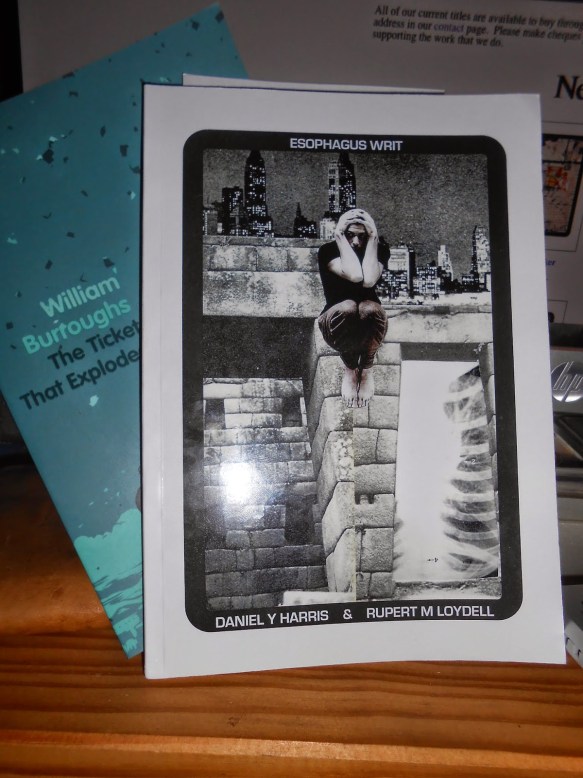
I didn’t see it cited in the notes from the Introduction by the little-known but clearly scholarly Dr Theodolite Cardew, but I am sure that the anthropoetjests Messrs Harris and Loydell will have referenced directly or indirectly the influential works of Fartov and Belcher in their own scholarly ruminations on the meanings of in their new poetry collection Esophagus Writ.

In the way cosmic coincidence will commune with those of us who listen, it was uncanny that I am currently reading Burroughs’ The Ticket That Exploded because this work is cited in the notes of that Introduction – the quote ‘the word is now a virus’ – and to expand on this reference, our dynamic duo explore the ‘other half’ which includes the meanings of, and do so with the compelling organism of their refracting poetic words.

I say ‘refracting’ because the poems in this anthology are placed side by side: one on the left [generally tempting with an organic accessibility] and then the one on the immediate right a bifurcated refraction of its leftie [generally teasing with an organic complexity] – never a copy or mirror re-working. Thus the organism of these shared words and ideas becomes a mutual virus that infects both and then spreads across the whole as a parasitic creator of new meaning.

The dichotomy of these refracted new meanings can be exemplified in titles like The Museum of Oblivion/The Museum of Oblation; The Ghost of an Impoverished Past/The Gimp of a Tumescent Now; Enter Babe Rainbow/Enter Billy-Bob Bovary, the latter in which ‘I suddenly felt much better’ and ‘I felt better in my thong’ wrestle with the plurality implicit in the meanings of.

A closer analysis of any more of these refractions – an inspection surprisingly missing from the otherwise erudite and learned exploration of Dr Cardew – reveals how the prism of this poetic intercourse shifts and splits meanings of two startling [and intentional] obfuscations. From the domesticity of

‘My beautiful time bomb,
will you dance before we explode?
How is the weather inside today?’

[The Mystery of the Mind]

to the psychoanalysis of

‘Hell is glial. Heaven, a dendrite. Between
podes, the myelin of a normative stint
in living with charm and poised saunter.’

[The Mystery of the Brain]

where the damaged layers of both our expression and understanding are wrapped up in each focus, one on love and one on over-analysis so that neither explains though one may seem more palpable.

I won’t comment further on the poems for these are for the reader to mainline and in doing so find their veins of personal meanings because ‘Everything should become clear to the most idiotic among us’ [Advice to the Reader]. I have just injected a tiny droplet of the virus.

I will nearly close on an admittedly pedantic point: I take issue with the esteemed Dr Cardew’s citing of the Blinky Snoodle work ‘Stupid Groups of Animals’ in The Journal of Behavioural Science vol. 12, #2, 1993 as a paper in any way informing the theoretical basis of these poets’ work as this fraudulent fancy was roundly discredited in the subsequent volume of that venerated journal by the renown American anthropology expert Wyde I Ceen.

I will, however, fully conclude by stating that this work is above and beyond any academic reference points a demonstrative hoot. If the virus is Poetry, the vaccine is reading the meanings of this challenging quality.

Buy the book here.

Locklin for the Ladies

Originally posted in October, 2011:
maybe the women are right about us


after an evening of glowering at my daughter
for such heinous offences
as having spilled milk
(i nearly cried over it)
eating her brother’s baby food,
and tipping over her chair
with herself in it

i hold her on my lap
while i read her
an illustrated hansel and gretel.
viewing the last page, she says,
“is their father a girl?”
and i say, “no, of course not;
their father is a man.”

and she says, “he must be a girl.”
and i say, “why can’t he be a man?”

and she says, “because he’s smiling.”

– Gerald Locklin

Brian Doyle – Mink River

mink

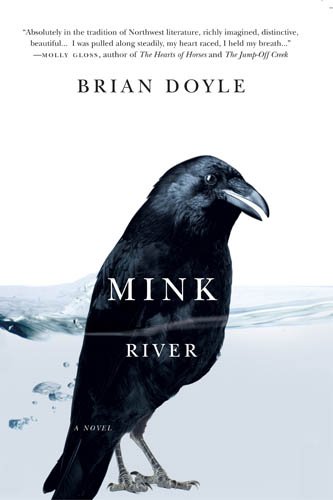
My sister sent me Brian Doyle’s Mink River as a birthday present, and I look forward to reading it fully. I started today, but didn’t get very far.

I began that read but was stopped immediately in my tracks. Heightened as I am by my recent anger at a teaching/modelling of writing as a bloated, overwrought linguistic process, I saw in the first few pages of this novel that gift of a ‘simple’ writing style. When I articulate next what I see in and mean by this, it will be evident how stylised it actually is, indeed complex in its artifice. But the use of long, rolling compound sentences, and a generally straightforward vocabulary are a part of its inherent simplicity. This is an ‘American’ style of writing, to simplify, and hardly original, but as with Hemingway and Chandler and Carver and McCarthy – in significantly different ways – the connective and becomes the most used word and you can’t easily teach the purposeful effectiveness of this but you can recommend reading it to experience that effectiveness.

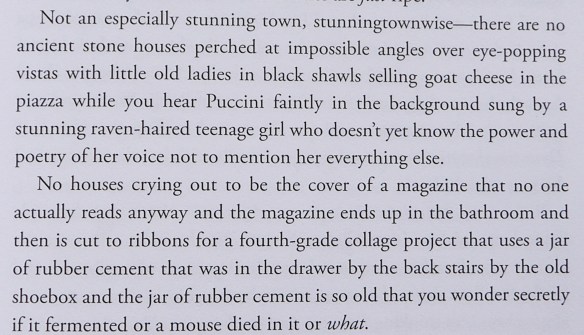
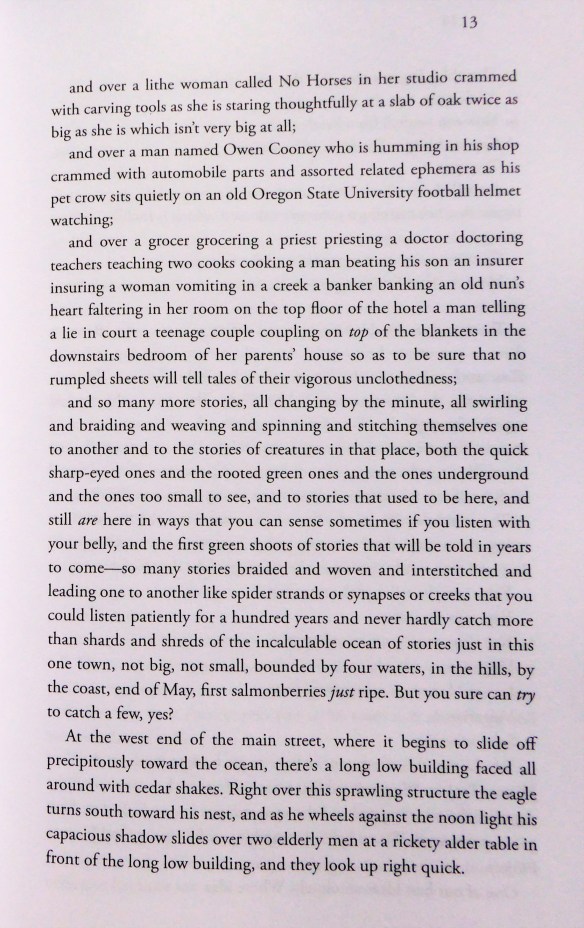
Doyle has a style that breaks conventions – long broken, really; revels in the straightforwardness of language use, though employs a complex vocabulary, and indulges clever repetition for the impact this has when crafted rather than simply happening from poor judgement. These two paragraphs from the opening page illustrate aspects of what I am describing:

P1000498

Naturally, there is huge cleverness in the detail that is being connected in just these two paragraphs which generates so much of the reader’s engagement. I had meant to include above a subsequent paragraph that flows similarly in all respects, but then closes on the line I will type in now, one that also illustrates what I mean by Doyle’s use of a complex vocabulary:

 ….. – the kind of juxtaposition of things that painters like to paint for inchoate inarticulate unconscious reasons they can’t explain.

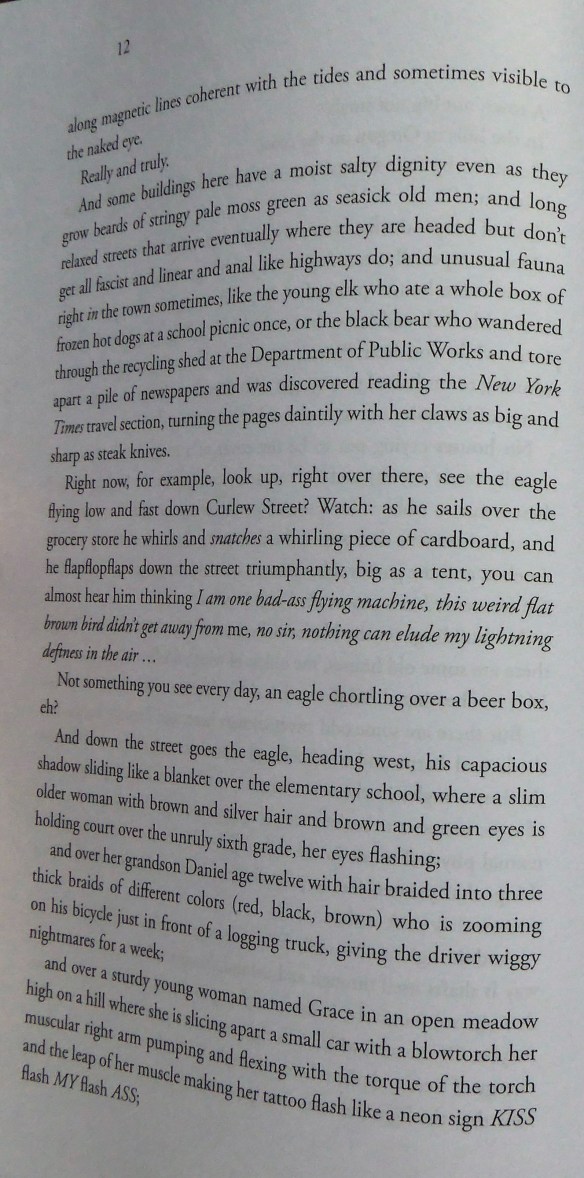
The next illustration is of two whole pages and demonstrates how Doyle’s breaking of convention and therefore invention propel his narrative with such energy. It engages because of the relentless pace, but also the fluency of its sentence structures – this very much an aural impact – and also its paradoxical mix of straightforwardness and then its more playful moments, like the repetitions in the third paragraph on the second page:

P1000501

P1000500

That’s all I wanted to say and display at this moment. It should be clear that I am proposing how Doyle’s writing would be an excellent model to share with students [at GCSE/Key Stage 4] to introduce them to the meaningful possibilities of good writing, writing that has an integrity in both its honest simplicities but also highly contrived playing with this. And as I was writing this post – honestly – I had an email alert of a ‘popular in your network’ set of twitter posts, the first of which is this, from Michael Rosen: The simplest and best way to help children write is through investigating good writing – then mix imitation, adaptation, invention to write.


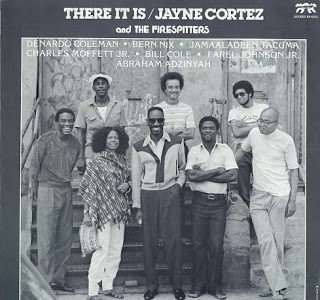
Jayne Cortez and the Firespitters – There It Is

Originally posted in February, 2012:

jaynecortez - Copy

Nuff Said

Been listening to this all morning: poetry and jazz and invective – it’s powerful stuff. Second track U.S. – Nigeria Relations is a mesmerising example of Cortez’s performance poetry with the repeated line They want the oil but they don’t want the people hammering home its stinging message. This method is used again for sixth track If The Drum Is A Woman: potent repetitions across a greater variety of lines, percussion accompanying. The marriage of jazz [the Firespitters] and poetry [Cortez] gets a rousing work-out on fifth track Opening Act.

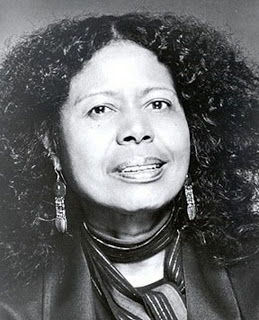
I’m learning all the time: researching around this album I discover today that Jayne Cortez was married in 1954, at age 18, to Ornette Coleman. Nuff said.

And here are the lyrics to the rousing and more rockblues oriented opening track There It Is,

There It Is

My friend
they don’t care
if you’re an individualist
a leftist a rightist
a shithead or a snake

They will try to exploit you
absorb you confine you
disconnect you isolate you
or kill you

And you will disappear into your own rage
into your own insanity
into your own poverty
into a word a phrase a slogan a cartoon
and then ashes

The ruling class will tell you that
there is no ruling class
as they organize their liberal supporters into
white supremist lynch mobs
organize their children into
ku klux klan gangs
organize their police into killer cops
organize their propaganda into
a devise to ossify us with angel dust
pre-occupy us with western symbols in
african hair styles
inoculate us with hate
institutionalize us with ignorance
hypnotize us with a monotonous sound designed
to make us evade reality and stomp our lives away
And we are programmed to self destruct
to fragment
to get buried under covert intelligence operations of
unintelligent committees impulsed toward death
And there it is

The enemies polishing their penises between
oil wells at the pentagon
the bulldozers leaping into demolition dances
the old folks dying of starvation
the informers wearing out shoes looking for crumbs
the lifeblood of the earth almost dead in
the greedy mouth of imperialism
And my friend
they don’t care
if you’re an individualist
a leftist a rightist
a shithead or a snake

They will spray you with
a virus of legionnaire’s disease
fill your nostrils with
the swine flu of their arrogance
stuff your body into a tampon of
toxic shock syndrome
try to pump all the resources of the world
into their own veins
and fly off into the wild blue yonder to
pollute another planet

And if we don’t fight
if we don’t resist
if we don’t organize and unify and
get the power to control our own lives
Then we will wear
the exaggerated look of captivity
the stylized look of submission
the bizarre look of suicide
the dehumanized look of fear
and the decomposed look of repression
forever and ever and ever
And there it is

Nuff said, you know

JayneCortez2 - Copy