Poetry/Creative Writing Ideas – Adverb Poems

This can be an active exercise where pairs work together to compile their poems. It is another idea that encourages exploring and discovering the accident of meaning.

Adverb Poems

The aim of this unit of work is to get you exploring other types of writing created by the ‘accident of meaning’. You will be relying on an element of chance in structuring your own writing.

Your poem will be called Commands With (Optional) Adverbs which is based on an idea by the inventive poet Adrian Mitchell. Here is an example:

15 COMMANDS WITH (OPTIONAL) ADVERBS

Tackle that (drearily) running footballer

Spin out a (sleepily) woven thread

Hold on to your (sarcastically) fleeing bird

Strip this (beautifully) rotten chair leg

Eat the (mischievously) oozing sausage

Collapse that (sloppily) folding chair

Bandage his (caustically) running sore

Slide on the lake’s (hotly) frozen ice

Shout at the (splendidly) stupid dogs

Spice up the (outrageously) dull punch

Grip those (indignantly) turning wheels

Cultivate every (hurtfully) growing turnip

Spin on a (pointedly) unusual spot

Invigorate the (spasmodically) sleeping child

Flatten the (superficially) uneven soil

Writing the Poem

First stage: This is best done in pairs. Part of the fun of this exercise is the ‘accident’ and ‘surprise’ of creating lines that have unusual, often poetic meanings.

One person will be responsible for writing a set of commands, between 15 and 20. The second person will be responsible for matching these with a set of adverbs. You should keep these a secret from one another. A command is an instruction to do something. An adverb is a word that usually modifies a verb and sometimes an adjective or another adverb. Here are some examples of commands and adverbs:

Commands                                       Adverbs
Tackle that running footballer          Drearily
Spin out a woven thread                     Sleepily

The command should begin with a verb and then either have another verb or an adjective to describe its subject:

Verb                   Adjective                 Subject
Collapse   that    folding                         chair

Verb                    Verb                         Subject
Grip          those   turning                       wheels

Most adverbs end in ly and it will be easiest and most interesting for your completed commands to look for these.

Final stage: When each person has completed their individual task, cut out the commands and the adverbs. Turn these face down on to the table. Then, by alternating between each pile, turn over a command and then an adverb. Each time this is done, write out your new command containing its ‘optional’ adverb. There should be some unusual and lively ideas produced by this random process!

Extension: You can alter this process by putting your adverb at the beginning of each command so that it qualifies the opening verb. Or you can produce two adverbs for each command:

Mischievously eat the oozing sausage
Hurtfully eat the indignantly oozing sausage

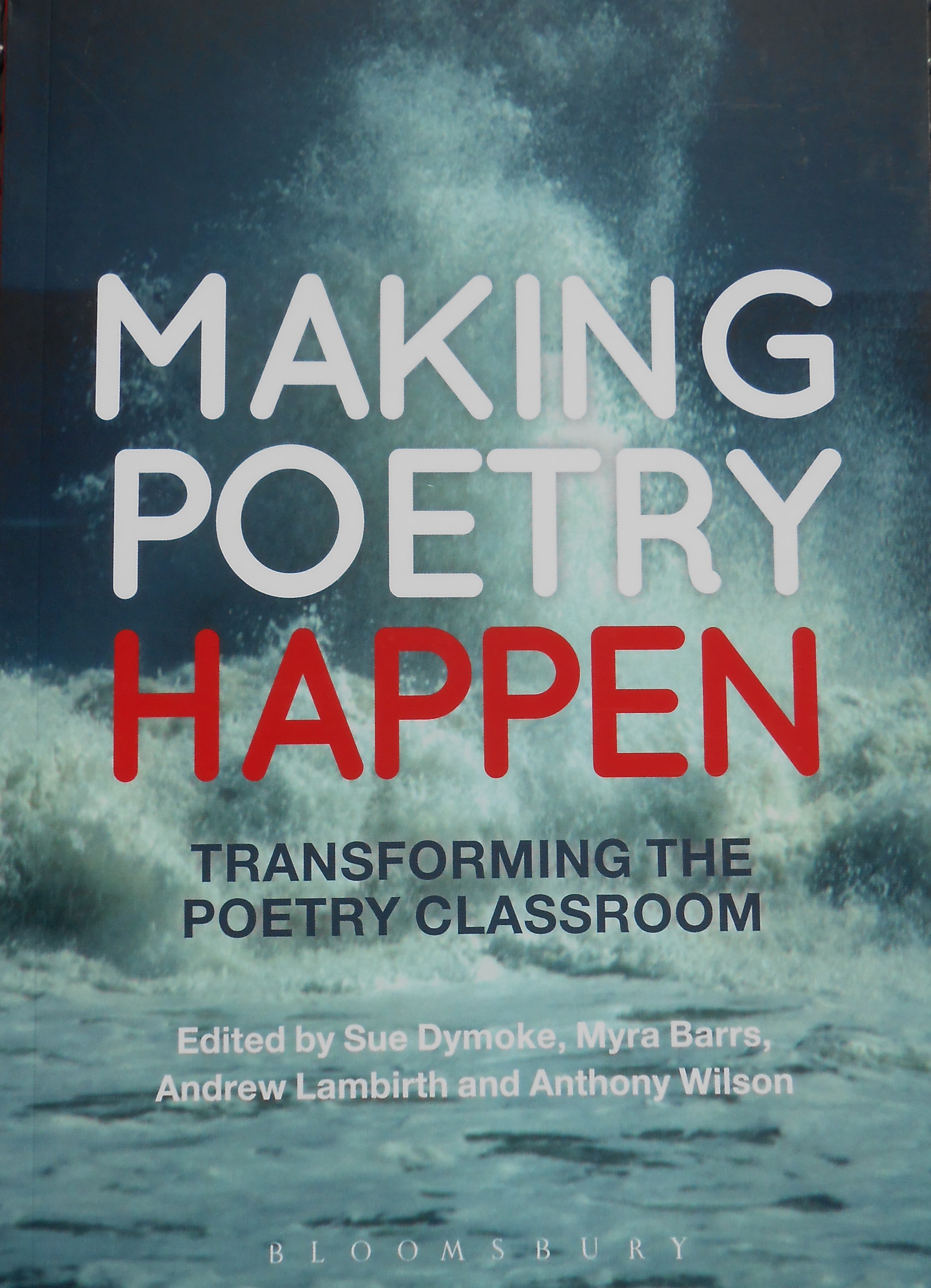
English Teachers and Poetry: ‘Making Poetry Happen’ book review

DSCN1952 (2)

The pre-colon title of this article/review ought to be a mantra that encapsulates the symbiosis of Poetry and English Teachers [I mean more than just inverting that title!], as if an existing reality where a mention of both is as obvious as sky and blue, peace and love, hamburger and cheese. The mantra would be easier to sustain if simplified to Teach Poetry, but that could sound like a conditioning imperative, though if this works…..

It has always seemed the case to me that most English teachers are uncomfortable with teaching the writing of poetry, and are even more hesitant about writing it themselves. In the excellent Bloomsbury book Making Poetry Happen, there is reference to evidence to support this view, not that I think it can be seriously challenged. Teachers have, of course, had to ‘teach’ wheelbarrow loads of poetry at GCSE for years, but this isn’t anywhere near the art, and desire, of making the writing [and reading] of poetry an integral part of the English curriculum at all levels.

I like the way in his chapter The Challenges and Opportunities for Engaging with Poetry Nicholas McGuinn outlines the historical prompts – from HMI, DES, MES and right back to Matthew Arnold writing in 1852 – that either rue the lack of effective teaching of poetry or celebrate its importance. This is an essential cultural statement for its enduring importance to the English curriculum and how this was recognised by the Establishment, though even here that was more about its study than its writing. Indeed, one could argue Michael Gove as Education Secretary continued a similar recognition and promotion of its significance, were it not for the fact he is an idiot and wanted to legislate for the compulsory and discrete teaching of the Romantic poets at GCSE as an ideological rather than educational purpose [and he surely misunderstood the elements of subversion, creative and political and more, in much of their work].

But I do digress. Gove has this effect. Making Poetry Happen is a fundamental resource for all English teachers for the way if collates both thinking about and exemplifying the practice of getting students to write poetry. I will admit now I haven’t read it from cover to cover and I can’t imagine many teachers could or would do this for all kinds of obvious reasons, but it is a wonderful book from which to cherry-pick and it should be in every English department as a reference text. Cliff Yates writing in his chapter Inspiring Young People to Write Poems matches theory to practice with evidence from students’ writing that should of itself be convincing enough. My favourite, however, [of what I have read so far] is Mandy Coe’s chapter Teaching Poetry Based on Actual Writing Practices: Beyond Words where I recommend her many engaging and convincing ideas for prompting poetic writing, for example Connective Leaps.

I will mention one more chapter, Emma Benyon’s Engaging Invisible Pupils Through Creative Writing as this too is convincing, and supported by evidence from a Write Team project, in how it demonstrates the liberating impact of ‘free’ writing to name one common approach for those students who find it difficult to engage in lessons, but also how this impact goes far beyond just reluctant or reticent learners. It certainly chimes with my many experiences of working with students who were not conventionally ‘competent’ or engaged writers who could/would flourish in lessons and a focus that was creative for its own sake and not about tracking or progress or even the stumbling blocks of accuracy [and similar notions of right and wrong/conventions]. This significance of the Write Team project is in getting writers into schools and the influence and effect their sessions with students had on teachers themselves: and that is the whole point – this book cannot of itself address that fundamental problem of so many English teachers being uncomfortable [or just inexperienced] with teaching poetry/creative writing, but it does go some way to providing guidance and the encouragement not just of these ideas but also of experience.

What is needed ideally is writers in schools and teachers going on courses to be writers/or to write themselves. Cliff Yates makes that point in his chapter already mentioned: ‘a free Arvon Foundation course as part of teacher training!’ He is right, and I would go further as such courses should be regular throughout a teacher’s career, but for years we have been consumed by targets and tests and other sharps. I have been quite nostalgic in my writing on this blog but not for the rose tint of the reminiscences: my early teaching experiences in Devon were to attend LEA English courses designed explicitly to encourage and support teachers as writers, and I did attend one Arvon Foundation course for teachers, and these consistently inspired and motivated me in the classroom. Whilst always wanting to write anyway [and I do wonder how many English teachers do write for pleasure, and/or have the simple practice of writing regularly….] these courses were such dynamic fuel for that ambition both as a teacher and writer.

The editors of this book – Sue Dymoke, Myra Barrs, Andrew Lambirth and Anthony Wilson – have form in actively promoting teachers as writers and helping teachers to be writers. I have read a little of Sue Dymoke’s work and know she cares about poetry in education, and I have had the pleasure of working with Anthony Wilson when he would visit my school as a writer and work so positively and creatively with my students. They and the contributing writers can be proud of the collective theoretical background and practical underpinning that this book provides.

It does seem to me, as a final point, that the next few years may be the first time in a long time when English teachers can begin, however tentatively, and with whatever inspirational strengths those who have been around for a while still have [!], to seriously consider increasing the role of creative writing in the English classroom. With that despicable testing and target culture changing – though not completely gone, and many SLTs will hang on to the simplicities and power it provides them for dear life – English teachers can take back more control.

This will inevitably be at Key Stage 3 – the GCSE curriculum is too prescribed and full, and has Gove’s paw-prints all over it. As a concluding piece of nostalgia, I always used to have my GCSE English students write poetry for their Original Writing coursework, though sadly that option no longer survives. I was at that time able to argue honestly [Crafting Poetry: Original Writing for GCSE, dMEC] how writing creatively and in particular metaphorically/adventurously – I used existing poems as models for student to emulate – could without question help most students to meet the language/linguistic assessment objectives well above their ‘normal’ levels of attainment: with reservations about using those latter terms.

One has to hope that placing creative writing at the heart of English KS3 could still have that impact, as Making Poetry Happen does argue, though not so simplistically or directly in terms of ‘attainment’. It seems highly unlikely, but I occasionally wonder that if I was still teaching would I encourage students to write poems for their GCSE English Writing terminal examination. One of the current AQA specimen papers for Paper 1 has a Writing task where students write a description based on a picture of a train on a coastal route being lashed by waves. Would my students be experienced and brave and cajoled enough to respond, perhaps using one of my list poem models:

The train surfing inside its curve of wave
The train cresting its way home
The train drying its tears inside
The train as grey as the bridge of stone
The train is just a train and it is on train tracks and it is carrying people…..damn that idiot Michael Gove……

Students of Consciousness

Another chapter that didn’t make the final edit for my novel Writing With Hammers as it seemed too experimental even for a moderately experimental novel, but I do like it and thus am posting here:

the students who listen and learn the students who come to school from their dark and dangerous homes the students who never put their hands up to answer questions the students who always want to answer questions the students who almost always answer questions wrong the students who have died the students who you meet years later but cannot remember their names the students who never return the students who are creeps the students who use school as a place to lounge the students who use school as a place of refuse the students who are brighter than their teachers the students who dance inside their heads the students who will never know how to dance the students without parents of their own the students who spend all of their free time finding places to smoke and hide the students who can scowl like olympic champions the students who argue all of the time the students who argue inside their own heads the students who are expelled the students who excel the students playing parts in plays the students who are athletes the students who can only manage to crawl through the day the students who get in the way the students who always smile the students who seem to always cry the students who have no friends the students who cannot face school the students who go bald before their time the students who have families the students who forget to attend their exams the students who will never know how to spell the students who write unforgettable words the students leaning back on their chairs the students making films for the future the students who laugh for no reason the students who laugh when you punish them the students who think they are useless the students who think they are god’s gift the students who get lost on school trips the students who find themselves on school trips the students who gossip all of the time the students who draw stunning pictures the students who can be abstract the students who will never be abstract the students who become teachers the students who enter the staffroom in awe the students who are always swearing with their eyes the students who always swear out loud the students who will never grow up the students who mimic me the students who ignore me the students who made love on my desk the students who never bring me an apple the students who give me the first christmas card of the year the students who bother to say thank you the students whose parents never say thank you the students who arrive late for lessons the students who will always arrive late for life the students who control the playground the students who always play football the students who love the school canteen the students who meet the person they’ll marry at school the students who act big because they are small the students who are always absent the students who are always on holiday abroad the students who buy me presents the students who wave from passing cars the students who pull faces from bus windows the students who moon the students on the edge of adulthood the students hiding inside a packed room the students who always need the toilet the students on permanent detention the students who mutilate themselves the students who fall in and out of love the students who never know what they will return to at the end of the day the students who make discoveries the students who never learn to regret the students who live inside their shell the students who were born in hell the students plugged into music the students on drugs the students who worship the students playing games before they have to grow up the students who are interchangeable the students like ghosts in the corridors

my students

Poetry/Creative Writing Ideas – Lending the Lawnmower

Continuing the posting of ideas to encourage creative writing, for the fun of it!

As before, this is a cut and paste resource as I have not yet been able to offer as a download. I will also mention again that these are written to the student/writer:

Lending the Lawnmower

The aim of this unit of work is to promote some fun in the writing of a poem based on Adrian Mitchell’s Ten Ways to Avoid Lending Your Wheelbarrow to Anybody.

Instead of using a wheelbarrow, you will be avoiding the lending of an object of your choice and you will be doing so in a variety of attitudes. The following example uses a lawnmower as its object of rejection:

Six Ways to Avoid Lending Your Lawnmower to Anybody

1. Humorous

May I borrow your lawnmower?
Have you heard the one about the lawnmower and the
artificial turf?

2. Sarcastic

May I borrow your lawnmower?
If I can borrow £50.

3. Overbearing

May I borrow your lawnmower?
It really does require considerable skill
and I’m not sure you have this.

4. Sadistic

May I borrow your lawnmower?
The blades are razor sharp.

5. Diplomatic

May I borrow your lawnmower?
I think my grass might be just a tad longer than yours,
so how about my using it first?

6. Psychological

May I borrow your lawnmower?
So what makes you think it’s mine to give?

Writing the Poem

First: Adrian Mitchell’s poem uses a wheelbarrow as its object not to be lent and the example you have seen uses a lawnmower. You need to decide what your object is going to be.

You can keep it realistic and select an object that someone would commonly want to borrow. This could be any garden equipment, tools, household appliances like a vacuum cleaner, sugar or milk for coffee and so on. You could think about things that are borrowed at school like pens, rubbers or someone else’s homework!

You could make your object more abstract like friendship, love, peace of mind and so on. This could make your poem very unusual.

Second: You now need to decide on the attitudes with which you will reject the request to borrow your chosen object. Mitchell’s original poem used the following: patriotic, snobbish, overweening, pious, melodramatic, pathetic, defensive, sinister, philosophical.

Decide on how many attitudes you want to write about. You might decide to write about a number of objects and so limit the number of attitudes per poem. Whatever you choose to do, try to be as creative as you can with your interpretation of these.

You can use attitudes from Mitchell’s poem or the example you have seen. The following are a few more ideas to help you:

suspicious        antagonistic      obsequious          ambivalent        tired
dismissive        eager                   arrogant              pretentious       noisy
pedantic           soporific             temperamental  tacit                     reluctant
moronic            caustic                lovey-dovey        inspirational     cautious
pompous          teacherly            indecisive            manic                  forgetful

Use a dictionary to work out unfamiliar words and/or to find some more of your own.

Final: Once you are clear about what the attitudes you have chosen mean, write your poem. Each opening line will be a request to borrow your chosen object. You then turn this down with just the right amount of attitude!

Election and Education

In Thursday’s Guardian – April 2nd – there was an article headlined Teachers don’t like the Tories – so why isn’t Labour benefiting? [here]. I didn’t have to think very hard about that certainty on the day, and I have been considering this assertion from the NUT’s General Secretary Christine Blower on and off since. For those of my generation, beginning teaching in 1980 and working until 2010, there are key experiences that inform a view on this question; I am less sure about a more recent teaching generation’s viewpoint, not least the de-politicised nature of the profession overall, apart from apparent dislikes, as it seems to me.

A potted history of my early experiences is all that is needed to underpin personal, main feelings on this question. The first 17 years of my teaching were done under a Tory government: Maggie Thatcher 1980-1990; John Major 1990-1997. The Education Secretaries who served across that time were Mark Carlisle 79-81, Keith Joseph 81-86, Kenneth Baker 86-89, John MacGregor 89-90, Kenneth Clarke 90-92, John Patten 92-94 and Gillian Shephard 94-97. The most infamous amongst this generally shabby lot were Joseph, Baker and Patten.

It is ironic, however, that within this political framework and the distasteful ideologies and strictures imposed by it, this was also the most professionally rewarding time in my teaching career of 30 years. This was always due in the first instance to the wonderful people with whom I worked, especially the English teams in my school across the whole time, but in that 17 year period it was without doubt underpinned by the inspirational,  cogent thinking and ideas shared by my county’s triumvirate of outstanding English advisers Pat Brain, Nick Jones and Martin Phillips . Whilst on the one hand the national political thought was essentially narrow and idealistically skewed, on the other, the Devon LEA English Advisory service was independent and imaginative: a separateness peculiar to the time.

Also historically, the Tories introduced the worst aspects of what has survived to plague the education system to this day – testing and targets. The testing regime was the initial damnation of all that had up to that point been good about teaching English. The Tory’s Education Reform Act of 1988 led to the establishment of The National Curriculum and more crucially SATs, Standard Assessment Tests, affecting me in particular at Key Stage 3, ages 11-14. Trying to keep this as summary, what galled most was the fundamental distrust of teacher assessment, but for English in particular it was the discrete and finite nature of the testing that proved utterly anathema to the realities of how students demonstrated their knowledge, understanding and skills in this subject. When putting this argument to the test – in other words, students subjected to the often simplistic question/answer nature of English SATs at KS3, but most importantly the restrictive and patently erroneous mark schemes for all responses to which examiners were shackled [though these charlatans should themselves have been shackled to something else…] – it signalled the death knell for a creative and expressive approach to teaching and learning in English, as well as a broad method for assessing its rich and varied elements of response.

There is much more I could say on this historically – about both the discussion paper Bullock Revisited of 1982, and the Cox Report of 1989 responding to the demands for a national curriculum in English [respectively brilliant and surprisingly apt]; about the positive role of Examination Boards [JMB/NEAB and 100% coursework assessment], and the creativity of the publishing market for English teaching resources – but I will save this for another time. These are also ironic realities as the genuinely purposeful nature of this collection also occurred within the philistinism of a Tory regime.

Which brings me from this potted and to a degree planted-out historical context to Labour. By 1997, the impact of the diminishing effects of a testing and target culture outweighed the professionally inspired attempts to circumvent it. Therefore, teachers like myself craved a change and we all felt that Tony Blair’s New Labour would achieve this. Did it happen?

I think it was on the very first day of their actual operation in government that Labour confirmed the reappointment of Chris Woodhead as the Head of Ofsted, another Tory construct of destruction in so many ways. Woodhead himself was a withering traditionalist who did little to support teachers and everything to undermine them. That too is another lengthy story, but imagine the shock of his re-appointment for people like me: a dedicated English teacher looking for hope in significant change, and someone whose political ideology of fairness and liberalisation looked to Labour to bring this to bear on educational thought and curriculum development. No, it didn’t happen, and far from it.

During Labour’s long tenure in government – one promising enlightenment under the campaigning banner of Education, Education, Education – they did not change that testing and target culture [indeed they consolidated and strengthened it] and there was little if any insightful or ideological alternatives introduced within the existing curriculum. Whilst it is true that significant sums of money were put into education, and thus a genuine measure of realisation to that campaigning pledge, there simply wasn’t the change to impact on the teaching and learning in English that I had craved. It was devastating.

Getting all of that out of my system – but important in explaining my opening premise about feelings of my generation as a teacher – it is presumably easy to see how Labour wouldn’t for many teachers ‘benefit’ from a current dislike of Tories. Having behaved towards education like Tories in so many ways from 1997 to 2010, what would inspire anyone to imagine there could be a difference in a Labour government from 2015? Certainly little has been said by Labour to significantly challenge the last five years of a return to a largely Tory educational ideology [stated as scant reference to the claimed ‘liberalising’ impact of a coalition], one quite frighteningly shaped by the singular fundamentalism of former Tory Education Secretary Michael Gove.

What has the Shadow Secretary of State for Education Tristram Hunt contributed to encourage me and current members of the teaching profession to favour Labour? In another Guardian article on the 30th March [here], Tristram Hunt answers questions put to him and this one is most apposite to what I am exploring here: What is a left-wing approach to education? Hunt’s answer is:

‘I see it as a heated dialectic between Gramscian rigour and Ellen Wilkinson’s evangelism for innovation, creativity and freedom. In Gramsci’s Prison Notebooks there is this remarkable paean for the traditional rigour of the classics as being crucial for Italian working-class consciousness. On the other hand, Wilkinson, Clement Attlee’s first education secretary, argued: “Schools must have freedom to experiment, and we need variety for the sake of freshness. We want laughter in the classroom, self-confidence growing every day, eager interest instead of bored uniformity.” A modern, left-wing response to the 21st-century digital economy needs a dose of both. But where these two philosophies meet is equally important – that education is precious beyond instrumental labour market outcomes. That is something we must fight for when the right attempts to commodify it.’

I need to place my reservations on hold for a moment to acknowledge the intellectual aspect of what he is saying. As an Historian, Hunt is much better read than I will ever be in many respects, but certainly educational history, and that is a welcome alternative to the tenuous grasp of educational theory yet brazen legislative application from someone like Gove. He would appear to have embraced his role entirely from a personally myopic educational experience and then obtuse extrapolation of this into dictates. However – and accepting the single commentary I am quoting – Hunt’s response also reflects a typically cerebral rather than practical, experienced ability to reflect on what a ‘left-wing’ government would do, in curriculum terms, to return us to a more fair and progressive system. He, and Labour in opposition, have said little else about concrete alternatives they would apply, if in government, to counter the current situation. Where, for example, was the Labour outrage at the undemocratic and appalling legislative move to effectively ban American authors from being studied for GCSE English Literature from 2015, something that has altered the uncontentious status quo in this subject under both governments over countless years?

What else has Tristram Hunt, as the education voice of Labour, offered so that as a political party and alternative to the Tories it can benefit? Two salient but silly soundbites spring to mind to further serve my point: firstly, Hunt’s absurd recommendation of an ‘Hippocratic oath’ for teachers to declare [a piece of peripheral nonsense that allowed the Tories to take the moral – and sane – high-ground and argue that teachers didn’t need to declare such an oath], and secondly, his ‘Master Teachers’ proposal which had all the echoing of a kind of teacher-as-professional-prefect project. Whilst the idea of rewarding and retaining teachers in the classroom is not without merit, it is in the context of announcing such ideas as sudden initiatives [not in fact new or exclusive to Labour] rather than focusing on sustained attacks on Tory policy that has caused Labour to appear so depressingly weak or even distant.

If the current election campaigning is teaching us anything about how thoughtful people are influenced, it is for politicians to stop posturing and to present articulate, convincing and meaningful alternatives in striving to make a case for their declarations of intent. I know it was easy for her to do so in the – let’s be real – unlikelihood of forming or even being instrumental in the next government, but Natalie Bennett as leader of the Green Party did speak in the recent TV debate about two key elements that I think teachers today [and of the past] would see as a position to benefit them in the future: first, a return to local authority control of schools, thus removing aspects of needless competition as well as the incoherence of disparate systems; and second, a call to a broader approach to what we teach so that it is more than what can be measured by testing and targets [and whilst this t&t has changed somewhat of late, its essence is still in place and still toxic]. This would obviously need much more detail and examination – for example, how to dismantle the Academy/free school ideologies and practices, and then fund, structure and support all LEAs so they are as effective as Devon in the 80s/90s – so when you place it against the answer Hunt provided about what makes a ‘left-wing’ approach to education, it is saying something very similar but in quite active if ambitious ways.

Imagine Labour, and Hunt, being a little more proactive and at the very least speaking like this about real alternatives to the Tories. Actions do speak louder than words, but without even that latter, where are the benefits in voting for them to be envisioned?

[An additional note of hope is that perhaps we will be entering a phase where tracking achievement/progress in English will be more reliant once more on teacher judgements; and the book I have promoted in this blog Writing Workshops has, as I have argued, returned to an ethos and approaches that did work in that ‘better’ past. This of course has been achieved without Labour….! A final point which probably hasn’t been strongly apparent in the article above, or in that preceding comment, is I would still much rather see a Labour Party in government compared with the Tories, for many critically important reasons, not least of overriding values about equality and fairness].

Half-Term Break with SPaG

Having decided to move to a weekly posting, I have also decided to give any larger posting a miss for this weekend as teachers will be enjoying the start of their well-deserved half-term breaks. Seems stupid to attempt to intrude on this!

Instead, here is some light relief with a tinge of attitude. I was recently asked if I would be interested in developing multiple choice questions for SPaG practice as a potential online learning tool. A genuine request for a genuine project and something that will happen, but it wasn’t for me.

The last time I was ever involved with MCQs would be between 1980-83, I think, with a then CSE English examination, and I have questioned their value ever since. One very personal experience validates that view over and above my more general and considered objection: in order to attain my Teaching Certificate I had to pass an ‘O-Level Maths Equivalent’ test. Now in any genuine sense I can assure you this would have been an impossibility. However, the exam questions were multiple choice, and I guess I guessed well, but I do also remember clearly one of the questions was based on a quadratic equation and of the four possible answers only one contained the x and y that was in the maths question being asked!

The idea then of devising MSQs for SPaG, where the weighting in the new GCSE English Language Orders for this latter is going to be punitive, was bound for many reasons to be anathema to my particular interest in supporting students as writers. Thus the following:

SPaG MCQs

a. is this the way, you will ask? the question [or]
b. is this, the way, you will, ask the, question? [or]
c. Is this the way you will ask the question?

is this the way you will ask the question
this is the question the way you will ask
ask is this the way you question the will
is the way you will ask the question you
question is this the way you will the ask
will you ask is the question the you way
the question you ask is the way you will
is this the question the way you will ask

d. the question
you will ask
is this the way?

Poetry/Creative Writing Ideas – Beheaded Poems

Moving to a weekly, Sunday posting I thought I would in addition to English subject and general education reflections, share a few creative writing ideas/worksheets I wrote and produced some years ago. These were available to purchase back then, but it is a considerable time since and I trust no-one who did buy would mind my sharing these like this now. I have in fact been re-shaping and revising a number of these, accompanied by a significant selection of new poems written for a younger audience, and hope to put together an anthology with creative writing ideas targeted for a Key Stage 3 audience. We shall see.

An important element of these was obviously encouraging students to experiment and explore, but equally the intention was to provide exercises that prompted students to select and use language for precise purposes, thus developing language and writing skills, but always within this creative context.

I am not able to present as downloadable resources/worksheets, so I hope anyone who would like to use could cut and paste [and maybe then revamp for presentation if desired] for their own use. Do let me know. The work is addressed to students.

Beheaded Poems

The aim of this unit of work is get you to write beheaded poems. These are poems that use beheadings, words that can have their first letter removed to leave another new word – for example, when the word pear is beheaded (p/ear) it becomes ear. Here is an example using this word:

Eating a Pear

Hold a pear
to your ear
and hear the tone
of just one
sound: the slow
rhythm of a low
and steady beat
you’re able to eat.

You do not have to make your lines end with beheadings. You can try writing with the beheaded words anywhere in a following line, for example:

In the Night

Somewhere in the black of night
there is a lack of anything good.
Here is the absence of a bright idea
to show what is right or wrong,
and in the swish of its darkened air
you’ll hear a wish for something better.

Can you work out the beheadings in each pair of lines?

Both of these poems are examples of ‘stream of consciousness’ writing – this is writing which is done spontaneously and without planning. By using beheadings these can act as prompts for subsequent lines because you know what the word is that has to be used in that line.

Writing the Poem

First stage: If you are going to attempt ‘stream of consciousness’ writing you will simply need to select your first beheading and see where this takes you!

However, if you feel you need more back-up and support, you can begin by building up a collection of words that can be beheaded before you begin writing your poem (and you can, in fact, use these to support ‘stream of consciousness’ writing as an acceptable cheat).

Second stage: You need to decide where you want to place your beheadings. These can be at the ends of lines, as in the first example you have seen, or consecutively in pairs of lines, as in the second example.

You can, of course, be more relaxed than this and have the beheadings occurring anywhere in the poem, as long as they are still consecutive.

Final stage: It is useful to have some idea about what you want to write, even with a ‘stream of consciousness’ approach. The poem about the pear is about eating it, so this is a fairly obvious idea! The poem about night explores negative ideas associated with this, for example the lack of anything good and the absence of a bright idea.

Be prepared to edit your poem carefully. If a beheading has taken you away from what you really want to write, get rid of it and start again! Sometimes you have to be prepared to sacrifice a good sounding phrase if it doesn’t actually fit with the overall tone and meaning of your poem.

Writing Ideas – Teaching the Empathy of a Long Sentence

It is hard to teach students when and how to use a long sentence, not least to punctuate it carefully [yes, ‘correctly’, but hearing the shifts and turns in the rhythm is in many ways the best way to achieve both, so by ‘carefully’ I am suggesting an intuitive, if informed by practice, approach rather than the mechanics of a learned accuracy]. Good writing benefits from good sentence variety – written to again emulate shifts and turns and changing emotions and so on in the meaning and dramatic/visual/aural purpose – but we also know as teachers that ‘sentence variety’ is a big one in assessment criteria, especially at GCSE.

The worst way to teach this is in order to hit that assessment criteria. Easy to say; sometimes hard to avoid. Hard if you feel bludgeoned by expectation in target-setting and have an inkling that hitting that assessment criteria – no matter how mechanical – is one step closer to a student ‘improving’ their potential to get the best grade possible in their Writing.

I saw plenty of this manufactured writing when I examined a GCSE Writing component for two years [as well as plenty of superb writing, let’s be clear!]. This assembly-line writing also included the deathly three-adjectives-in-a-sentence proliferation – as if this is the ‘magic three’ rather than a naive example of over-writing – and that other composition coffin-carrier, the endemic use of metaphor and simile: at least one in every other sentence.

I might exaggerate a little. But not that much.

The best way to teach the use of a long sentence isn’t something I can explain definitively. Why? Because good writing is hard to do and hard to teach. I’m sure we all know that one of the most effective guides to exemplify overall good writing, but also in this case the use of sentence variety and in particular the long sentence, is reading good writing. The other is practice. So how do we find engaging ways to practice?

A little pitch: in the book I have co-authored Writing Workshops [see here], one of the units looks at the writing of Charles Dickens from Dombey and Son. With the caveat that one isn’t suggesting we try and write like Dickens did in the mid-1800s, by reading and discussing how he brilliantly mimics the relentless movement of a train, we are ‘hearing’ how he uses long flowing sentences to achieve this, and by some natural osmosis, the collaborative talk of students and reading aloud, and more explicit teaching/doing, we begin to appreciate how his use of punctuation allows this to happen.

I tried to match but also ‘counter’ Dickens’ excellence at such writing through the use of complex sentences with a contemporary example from Cormac McCarthy who also writes glorious long sentences but does so in the [sweeping statement alert] American tradition of using compound sentences, the connective ‘and’ being the magical vehicle for this other journey. But McCarthy doesn’t allow his writing to be used for such a purpose!

So – finally – here’s an idea, but it is primarily a creative writing idea: this wonderful poem by Billy Collins is written as one long sentence. The poem describes the fall of the Elk River, and does so through the mimesis of sentence flow and, of course, the structure of the poem itself. Whilst the latter would seem impossible to work as prose, that is actually just a visual cheat because although the enjambment of the poetic form allows the ‘sentences’ to fall from one line to the next and thus describe the river’s journey to the sea, it is both the punctuation and conjunctions that in fact create the shifts and turns and visual purpose and effect of the whole piece.

Read the poem first

Elk River Falls

is where the Elk River falls
from a rocky and considerable height,
turning pale with trepidation at the lip
(it seemed from where I stood below)
before it is unbuckled from itself
and plummets, shredded, through the air
into the shadows of a frigid pool,
so calm around the edges, a place
for water to recover from the shock
of falling apart and coming back together
before it picks up its song again,
goes sliding around the massive rocks
and past some islands overgrown with weeds
then flattens out and slips around a bend
and continues on its winding course,
according to this camper’s guide,
then joins the Clearwater at its northern fork,
which must in time find the sea
where this and every other stream
mistakes the monster for itself,
sings its name one final time
then feels the sudden sting of salt.

What a great poem! If I was reading/teaching this, I would obviously read aloud again.

Now here is the proof in the sentence pudding:

is where the Elk River falls from a rocky and considerable height, turning pale with trepidation at the lip (it seemed from where I stood below) before it is unbuckled from itself and plummets, shredded, through the air into the shadows of a frigid pool, so calm around the edges, a place for water to recover from the shock of falling apart and coming back together before it picks up its song again, goes sliding around the massive rocks and past some islands overgrown with weeds then flattens out and slips around a bend and continues on its winding course, according to this camper’s guide, then joins the Clearwater at its northern fork, which must in time find the sea where this and every other stream mistakes the monster for itself, sings its name one final time then feels the sudden sting of salt.

In one important and definitive sense this destroys the purpose and effect of it being a poem. However, in another, I think it also illustrates how it is entirely the rhythms of this one long sentence – punctuated perfectly, conjunctions providing connection and impetus – that generate the actual visual emulation.

Enough of this. Speaking of long sentences, this exposition is pretty damn long! So how to use this poem in the classroom?

I won’t produce a worksheet here [but maybe I should have a go later…] and will simply suggest the poem could be used initially as a model for prompting a copycat creative writing response.

Students can take a similar theme, or expand and/or change

• the fall [journey] of a river
• a waterfall
• the ocean’s waves [what they ‘encounter’ on the way: boats, islands, debris, beach…]
• a storm [researching the meteorology of this]
• movement/motion of a train [thinking of the Writing Workshop unit on this]
• any other mode of transport
• a bird in flight [crossing various terrain]
• a plane [!]
• anything similar….

For any of the above, I would encourage the hard work of researching and/or making notes about the content that will form the detail of the long sentence, or as a differentiated option, a number of long sentences. Collecting and collating the information will obviously help in then shaping this into the sentence flow.

I have always believed in and put into practice the principle of copycatting to encourage creative writing. Students benefit greatly from a model to literally copy or adapt and use as a varying guide.

Revisit Collins’ poem and work though how the enjambment – in the first instance – tends to create most of the rhythmic shifts in what is actually being described as the river’s falling shifts. The punctuation used can then be mapped against this, though at times it isn’t a punctuation mark but a conjunction/connective like ‘and’, ‘which’, ‘where’, ‘before’… so there is no single pattern to how Collins keeps his long sentence flowing [and I apologise for ‘mapped’ because that has connotations of some more prescriptive type of teaching and learning but I’ll leave it in for the hopeful irony.].

And did you notice that final parenthesis? Collins only uses one in his poem, and I find I use this quite a lot in my own writing, especially across long sentences [though I often prefer the use of the dash to brackets].

Couldn’t resist.

Once students have written their copycat poems, you could move on to them re-presenting this as a prose piece, preserving the punctuation and so on – or, using the prose ‘conversion’ to highlight the further need for careful punctuation. Word-processing and formatting will obviously make this whole process easier.

I quite like the creative writing idea and have some reservation about appropriating it for another purpose, but the overall intention is to enjoy reading good writing and improve our own writing skills: if a poem to read and copycat aids that intention, then all is well in the world of teaching Writing, certainly far better than the illness of hammering on the dead-heads of assessment objectives.

MF 20.3.15

Teacher Training

Teacher training for those who can
Teacher training leaning into the rails
Teacher training as one of the four
Teacher training with bells on
Teacher training without rhyme
Teacher training to the tune of Ray
Teacher training in four part harmony
Teacher training unplanned
Teacher training whose art arcs science
Teacher training with the umbrella
Teacher training forever
Teacher training waiting for coffee
Teacher training with springs to leap woodcocks
Teacher training like foreplay
Teacher training for outer space
Teacher training spelt conceptually
Teacher training as a mirror
Teacher training before the heartbeat
Teacher training that knows its magic three
Teacher training in its paisley shirt
Teacher training playing the bongos
Teacher training riding the wave
Teacher training inside your head