
Originally written in 2016, posted again now in ignoble honour of Iain Duncan Smith’s knighthood and therefore continued representation of the many and not the few.
Originally written in 2016, posted again now in ignoble honour of Iain Duncan Smith’s knighthood and therefore continued representation of the many and not the few.
Rosalie Cunningham – Rosalie Cunningham

Music Circus Ringmistress
Rosalie Cunningham’s eponymous album is a delightful showcase of her distinctive and fulsome talent as multi-instrumentalist, vocalist and songwriter. The psychedelia of her significant time as leader of superb band Purson is still wonderfully evident, but there is a coherence of the music circus to this fine set of tracks, and by this I mean a theatre of gypsy folk to psyche pop elements merging in the big tent circle of this performance.
In many music reviews I often cite precursor touchstones and then either hasten to confirm the intended compliment or apologise for what are probably familiar [perhaps ad nauseam] references to musical echoes. Unabashed now, I simply reflect on hearing forebears like Clear Light and early Doors, then Affinity as well as one cosmic waft of Hawkwind opening a track, and also a favourite influence mentioned by Cunningham herself in the album’s inner sleeve, the Beatles, and by implication, George Martin.
All these inspirations coalesce in Cunningham’s assured interpretive flair, a musical focus she has honed with instinct and determination throughout her musical career and celebrated in this solo album.
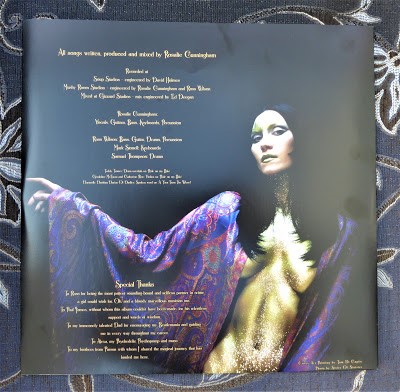
Rather than work chronologically through individual songs, I will highlight the collective pulses of this record from happily engaged notes I made on a first listen, starting always with the voice, Cunningham’s fulsome and resonant vocal and the occasional great swathes of warbling perfection and the harmonies quite beautifully expanded and overlapped. There are 60s/70s fuzz buzzes and space-rock backdrops. There is a portentous, punchy start. There are continuous examples of solo excellence in clever guitar leads, a pounding bass, and layered organ swirls.
Instrumentation and genre merge playfully and evocatively, from lounge piano to wah-wah to marching beats to orchestral keyboards/mellotron to the operatic, and on closing tour-de-force A Yarn from the Wheel, spoken narrative and rousing screams.


Black Oak Arkansas – Underdog Heroes

Keeping the Faith*
This is a paradox of an album – not good/bad; I think it is damn good – but in the polished/raw qualities it relays: the polish of its production, and the rawness that is inherent in the bass-growl of Jim ‘Dandy’ Mangrum’s signature vocal, here foregrounded throughout and often echoed-up for sustaining effect. ‘To The Rescue’ indeed. There is often a talking pace to the delivery, as in the dirtiest walk of The Wrong Side of Midnight, like Beefheart on a tab of sass. Great vocal support from Sammy B. Seauphine.
Rickie Lee Reynolds and his excellent guitar playing also provides a significant anchor to this album’s success, for example superbly on opener Don’t Let it Show, as is the shredded lightning of a contribution from Shawn Lane [who passed in 2003] on Do Unto Others.
Another ‘narrative’ offering is third track Channeling Spirits paying talking homage to other musicians, and this is a sweetly resonant song intoning a lineage from a range of artists. Reynolds’ guitar work on this is a glorious overlay of lead.
Next Ruby’s Heartbreaker is written about former band member Ruby Starr, a hugely powerful vocalist in her own right, and this is a dynamite tribute, using wonderful catches from the chorus of Grand Funk Railroad’s Heartbreaker as well as Reynolds in Funkadelic’s Eddie Hazel mode.
If you want it real dirty – so that’s hot ‘n’ nasty – check out The Devil’s Daughter with Seauphine featured on vocal. With lines such as like a blow job from hell, but boy I’ll bite off your balls it is the lyrical poetry of ‘don’t take this too seriously – just fucking enjoy’.
And I am. Nostalgic and nostalgia notwithstanding.

*Their second album, 1972’s Keep the Faith, is one of my life-long favourites.

Dead Feathers – All is Lost
Generic Accolade
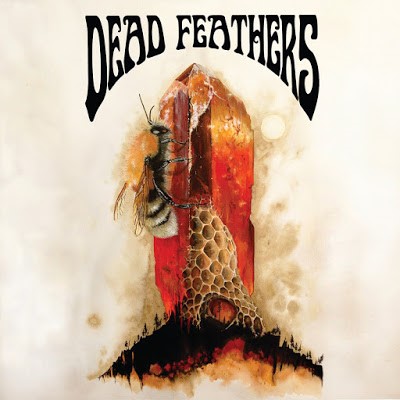
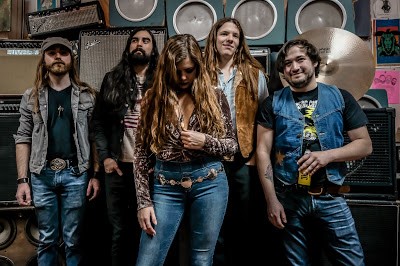
When I say ‘generic’ I do not do so disparagingly: I have, for example, written about the ‘pleasingly generic’ songwriting of Baby Rose because her music is R&B and thus its generic R&B sound is tin-written; therefore, in stressing how the psychedelic rock of Dead Feathers is heavily generic I am endorsing it, the adjectival qualifier, as with my other example, the obvious signpost, albeit here also a pun.
So the wah-wah and pounding bass and thundering drums and riffs from this fine band on this fine album come as expected and wholly welcome: there are many such bands these days presenting this generic retro-rock, psychedelic-wise in this case, and that too is all good to these ears. And before writing this review I have read a few others – essentially looking for images to appropriate, as they have – and these too cite the generic qualities, though tending to do so with precise references to precursor sounds, as I often do, and a regular I have noted is Black Sabbath – a consistent forerunner to mention when writing about any of this kind of music – and also, in at least one, Fairport Convention, which is odd to me on the one hand, but not on the other because when first listening to opening track At the Edge [and I don’t think it is the word ‘Edge’ that has prompted this touchstone citation] I immediately thought of the vocal of Sandy Denny. In the band’s centrepiece of Marissa Allen, Dead Feathers have a singer of beautiful clarity as well as the rock-power to compare with any of the best you can think of and might want to mention, another review actually naming Grace Slick which I wouldn’t argue against.

I know – just felt like writing a little more than cutting to the chase of how this album’s exceptional quality is the vocal of Marissa Allen. That the rest of Dead Feather’s Chicago rockers play a powerfully generic support and platform for this potent voice is, however, firmly celebrated by the other function of that long preamble in making it clear what I mean by ‘generic’.
Adam Page – The Colours Of Grief

The Beauty of Grief
Grief is sombre, but there is beauty in that solemnity on this album, as with opener Red where the saxophone and cello accompany one another in a plaintive melodic line, and where piano and cello break to soothing tones before the sax returns in a slowly paced meditation.
We might expect next Grey to delve more into lamenting, and in a way it does, but the beautiful sense of peace and calm continues and transcends, perhaps as only music can in such emotive terrain. Adelaide based multi-instrumentalist Page soothes again with a saxophone that glides eloquently through playing and melody, deeper notes caverned for their occasional resonances.

Third track Black begins with a piano roll [played loop] where the saxophone and cello are layered together as mood, brooding, and there is more intended tension in this, piano rises signalling.
Page plays piano on fourth track Purple, arriving at quite a beautiful run; fifth Orange highlights the cello in a strongly emotive contribution, especially at its end, Page’s saxophone suspires sweetly, and guitar and piano work together wonderfully – this is a gorgeous track, and closer Green is a group improvisation, the fine ensemble consisting of Adam Page – Tenor Saxophone and Piano; Rachel Johnston – Cello; James Brown – Guitar; Brenton Foster – Piano, and Ross McHenry – Bass.


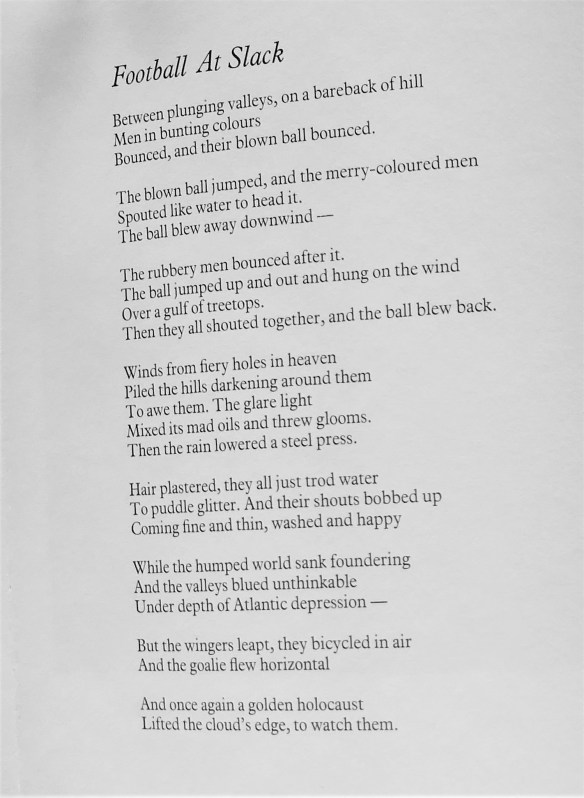
Having written about acquiring a copy of Ted Hughes’ single poem pamphlet ‘Football’ a few posts ago, I was reminded of this from the wonderful Remains of Elmet.
[Not necessarily a ‘top’ ten, but not necessarily not. There is no such thing anyway when there is so much. But these choices/recommendations have words, so that’s something to go on. Posted between now and the end of the month, so that will be two on the 31st, and those two are actually my top two]
Mahatmosphere – Beautiful Dirt

Dirt Beautiful – That’s Called Inversion
In this year’s GCSE English Literature examination, one of the unseen poems was The Richest Poor Man in the Valley, and students engaged wonderfully with its anti-materialism stance and ideological message about finding contentment in the simple things of life. They also grappled well – because they have been taught to – with the oxymoron of the title, a reference to subject terminology that will score marks. Of course, those who extrapolated [and many, many did] will have moved on explicitly or intuitively to express understanding of the inherent juxtaposition and contrast of material wealth with soulful wealth. It can be quite heart-warming, especially at a time of Tory continuance where the only inherent message of note is the celebration of the self and selfishness. Where Harry in the poem is ‘fat with sun’, these newly elected, some more than others, are fat with duplicity, denial and dreadfulness. And as many students would tell you, that is alliteration.
Not an idle observation, but one exploited to make a political point. Of apt substance, the poem’s oxymoronic title links to Mahatmosphere’s album title Beautiful Dirt, though this is perhaps more paradox. But that is for students working at higher levels to argue – and again, many, many can and do.
The album opens with Watching the Skies (Over Syria) and begins with looping electronic landscapes that merge into open plains of scorching guitar, punchy bass riding the loops, and percussive rhythms that keep the fusion focused and dynamic. I’m no expert on distinguishing all instruments from the ‘FX, Vocoder & Soundscape’ but it is an amalgam that pulses strongly.
The following title track Beautiful Dirt is very much the performance of its paradox: a layer of ambient sound in the stratosphere is constantly punctuated by bursts of sound/noise, much the excellent percussion from Marco Anderson. Al Swainger bowls in and out with bass throws, and Mark Lawrence cuts tears with jagged guitar slices. Yes, there is beauty from the scuffs into the earth of this soundscape. Much like next Stealth Blade that has a similar mix, the guitar here more in waves of sound, and the drums a distant, echoed interruption, the bass in bubbles of bursting through. Always the ambient layer like an embroidered cloth draped above.
Fourth No Me He De Regressar is more overall an ambient ascension of the soundscaping, and this is quite sweet. Here as elsewhere, I hear Terry Riley, not in looping, but in the prettiness of melody. We find things as they come to us, and hearing is one of these wonderful accidents. The eventual long guitar lines are also beautifully resonant in their organic additions. Fifth Mahatmafunk Intercession is bass-funk deep, and a return to the fusion elements of the album. Final Heavy is. With expression.
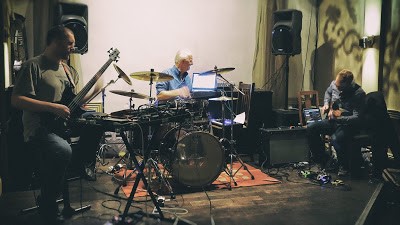

Pleased to be at Stride today, and previous two, with new found prose poems. Thank you Rupert.

