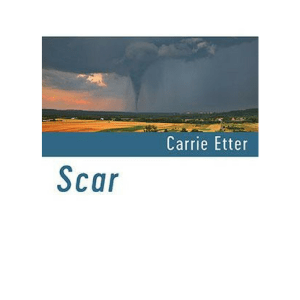
Scar by Carrie Etter – Review

scarA

It is timely that the natural phenomena of today’s complete solar eclipse of the sun in America takes an ‘ideal-view’ trajectory across the states of Nebraska and Illinois, for reasons that will be clear and relevant in a moment.

The linear path across the states wherein you would have the best view is both south of Omaha, the place of my birth, and Normal, the place of Carrie Etter’s: these two landmarks – for the sake of this review – on a reasonably close horizontal plane, interestingly.

The link? I had originally made a seemingly superficial decision to buy and read Etter’s poetry chapbook Scar because she is a fellow Midwest American ex-pat living in England, and the sample of work I saw from the book had that freedom of form – not experimental as such – which I so often enjoy in reading poetry. That her theme was exploring the effects of climate change on her hometown roots was of interest, partly for a shared environmental concern, but also because of my anticipating that writer’s nostalgic referencing of and concern for her origins with which I share a regular and profound personal preoccupation for my own.

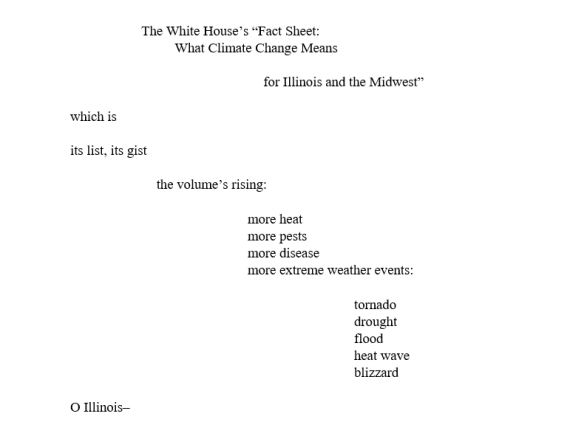
In all respects, my instinct for seeking out Scar has proved a sound one, whatever the reasons. Further made relevant by President Trump’s arrogant and dumb decision to withdraw America from the Paris Climate Accord, the opening has on its second page a now ironic reference to
scar1

and one can see immediately how that use of line space [‘freedom of form’] is used purposefully to draw the reader’s attention to and across the gradations of revelation and predicted impacts – ending on the page as it does with the simple but heartfelt lament for her home state [and of course everywhere else].

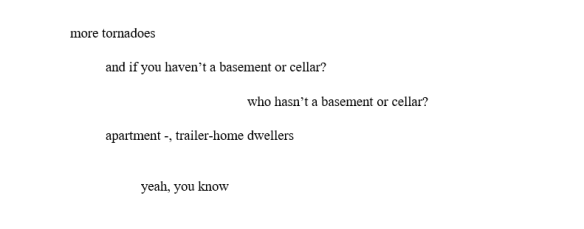
Further references strike a familiar, nostalgic chord:
scar2

and the apparently casual sprawl of language and lines belies the serious reality where comfortable notions of safety from ‘more tornadoes’ are naïve as well as dismissive, for example, of those without and, again ironically, especially those ‘trailer-home dwellers’, Trump’s notional support base – excusing the stereotype but acknowledging a complex socio-economic factor.

I suppose the ‘superficial’ connection does get its fuel when such references do remind of the extreme weather and tornadoes of my childhood: living in Norfolk I remember once in 1965 when summer hail stripped virtually the entire town’s trees of their leaves producing an immediate winter landscape; on another occasion when cowering in my basement during a tornado warning [the town siren blares] a tree was blown down in the garden and crushed my boyhood swing-set.

And yes, there is a normality to these weather conditions, Norfolk and also Omaha in a geographical cyclonic zone, and any google search will reveal other continued, contemporary storm disasters – e.g. the Norfolk hail storm of 2014 – but the warning point highlighted in Etter’s poem is there will over coming years be much more of this.

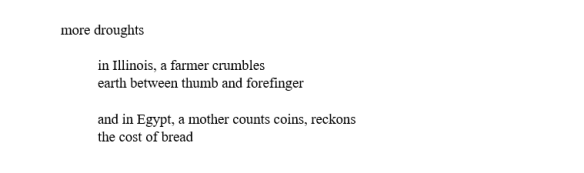
The point is also how the warning recognises the relativity, but addresses America’s dangerous complacence, one again exemplified in Trump’s stupidity,
scar3

It is a global climate problem [that platitude directed at the Donalds of the world].

One of the most powerful poems is a remembrance from Etter as a young girl of nine or ten in the midst of a blizzard, her father on the CB radio trying to find the whereabouts of someone – maybe a family member – and the palpable fear recalled is also a foretelling of further worse fears in a future of climate change unchecked.

There is an emotive crescendo as the poems and their recalled/imagined stories continue, and it is genuinely sensitive, that seemingly simple arrangement of lines with their paces and pauses and projections avoiding the melodrama of a more blatant poetic diatribe but instead more disturbing in the building outlining of the whole.

Like the puissance of a memorable short story, this poem is a one-sitting read and all the more impactful for that. You will return because it is also crafted to endear as well as inform, and that is its literary significance.

In conclusion, another incidental, surprise connection for me was reading the chapbook’s ‘i.m.’ to Peter Reading, my favourite contemporary British poet, and another writer deeply concerned with the environment and its impact on us culturally as much as in the reality of its physicality.  But even stripping away all of this personal linkage, this is a book I do recommend highly for its crafting and its meanings.
 

Rediscovering Weed

I knew that would get some attention…

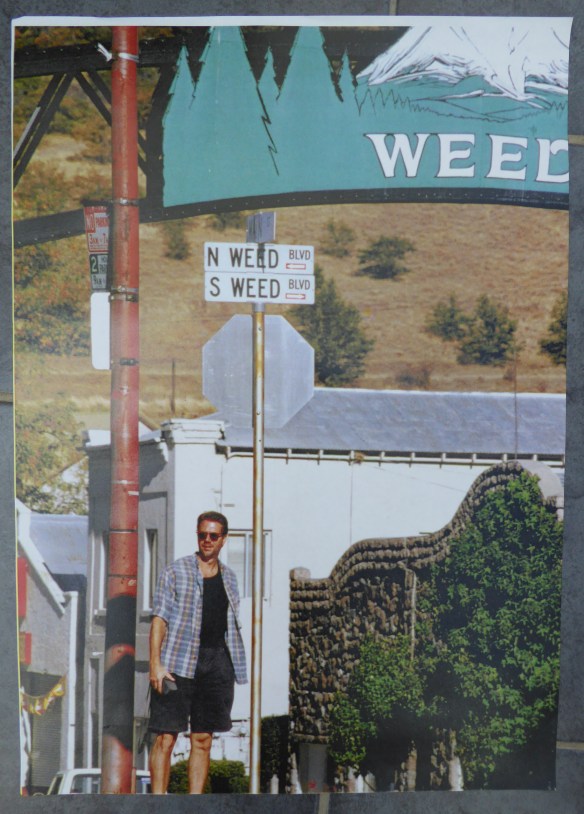
…but I mean Weed near Mount Shasta, California, where George and Lennie had to flee and where I with two good friends and teaching colleagues made a pilgrimage many years ago before the mention of Michael Gove engendered instant indigestion – because he banned this text and others from American authors from GCSE study in the UK – and we were planning an exchange trip of our students in Devon to Ashland in Oregon. Those heady days of educational independence, creativity and professional all-round joy.

Found this and other large colour-photocopied pictures from the trip whilst cleaning today underneath the stairs:

P1010416

Out of extra interest: my school was lent one of the first colour photocopiers to experiment with for a few days, and so we did! That’ll date it too…

Precarious Real – review by Jackie Moore

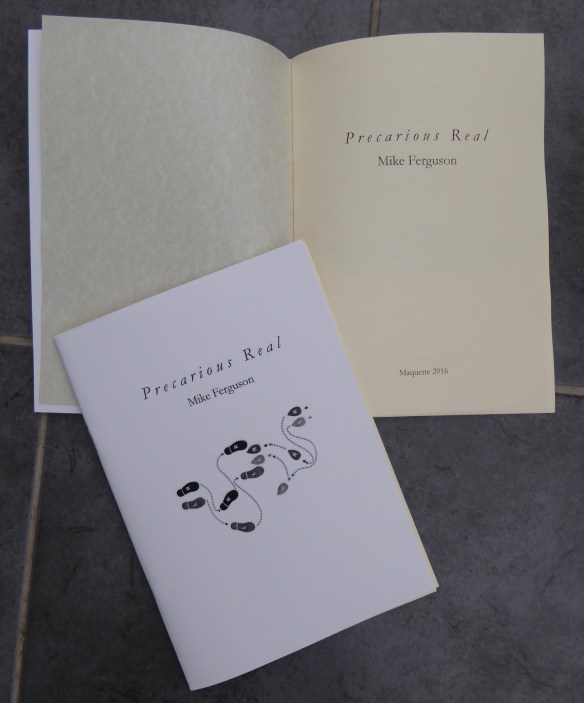
p1000394

I was asked to publish the following review by my good friend Jackie Moore some time ago, but deferred, not looking for something better [I don’t think that’s possible, and I am so grateful for the honest comments] but perhaps hoping for an ‘objective’ commentary from someone who didn’t know me or my work, arriving entirely new. Alas, since its publication in 2016 there have been no other reviews, so I am going to share, as requested, with again my great thanks:

I have enjoyed reading these poems; it matters not whether I had seen them before. Ferguson’s writing always strikes me afresh with its understatement, irony and sudden reversals. He always draws the reader in with that non-intrusive conversational voice: almost a trap, sometimes.

I always appreciate the poems where he indirectly admits to the limitations of his life. The delicacy of the ‘loss’ poems is irresistible and moving. Two-Step is beautiful – so delicate, lyrical and gentle, which points up the extent of what has been lost from the past. The idea of dance with its coordinated harmonies also underlines this. So sad: this shouldn’t be a ‘two step’, should it? A sense of things stripped down, companionship lost, and closeness in the rhythm of life.

On the same theme, but in total contrast, is the superficially humorous meditation on the last shred on the roll in Toilet Paper. Although the poem is grounded in the trivial and the mundane, the link between the paper of the toilet roll – padded like his cell of life at times – and the paper of the map says it all. The choice of trivia as subject matter speaks volumes. Ferguson is forced to look down in contrast to the man with the map and his boundless horizons, unfettered thoughts flying free and high. Very much in harmony with Ghost Voice, the so-sad Reading at Port Launay, and the sense of the woman with only vicarious experience in relationships of Primal Instinct: the sense of being excluded from love and from life.

The two poems about snow are more direct about the cruelties of life and the pain delivered in a medical verdict. The last poem is terrifying, with a most urgent sense of life running out. At the same time, there is a sense of confidence running out, a dreadful breakdown of sense experience, of interpreting and directing one’s life. Too many years of pain and stress have undermined the existential joy of being alive. But then, is it worth it? The horrors of the natural law revealed in Wild Dog suggest the problems we face in a hostile universe. How can one be strong? Are we merely controlled creatures subjected to cruel laws not of our making and not in our understanding?

These are the poems I prefer because of their noumenal qualities, of movement outwards, very delicate and gentle, but perhaps Root Canal and Poo Pipe are too overt for me?

In Fishing, I don’t understand the link between ‘triumph’, ‘fears’, ‘optimism’ and ‘hope’. It seems to be about a dog-eat-dog philosophy, but I have doubts about that reading. Finally, Precarious Real: of course I loved the joke about the two philosophies, and again the sense of tentativeness, though it is rapidly explained by the cow shit. Perhaps this is too bathetic for me as I don’t have a scatological sense of humour, an imprint from my convent education!

There is fun to be had in the cover illustration. It suggests dance. Being a Virgo, I was immensely troubled by the illogicality of the sequence – it doesn’t do what it looks as though it should do, or is doing. In this way I think it’s a really good example of the ‘precariously real’. It looks as though the footprints meet; but they don’t. Looks like the standard use of footprints indicating coitus, but it’s wrong. It would be right if the LHS prints halt before a mirror – seeing things ‘through a glass darkly’, as Ruskin said. All-in-all it’s about the illusionary and the Real.


I’m not sure, but the chapbook should still be available here.

Summer of Love

Looking out the window above where I am writing there is a sheet of grey sky on this August day in 2017. Thank goodness then for memories of other summers.

Having just moved to Ipswich, Suffolk from the USA in 1967, I was an all-American boy more in tune with the Beach Boys and a 13 year old’s inherited Nebraskan patriotism than the hippie movement of San Francisco.

I have written elsewhere about this, but my record collection then was essentially two greatest hits albums by The Four Tops and Wilson Pickett. It wasn’t until later in the year after alt-left thugs [as Trump today would no doubt ascribe them] at my secondary school had turned my head from supporting the Vietnam war and God that I purchased Jimi Hendrix’s Are You Experienced and life changed for me forever, even if English summers have from then to this day continued to be variable.

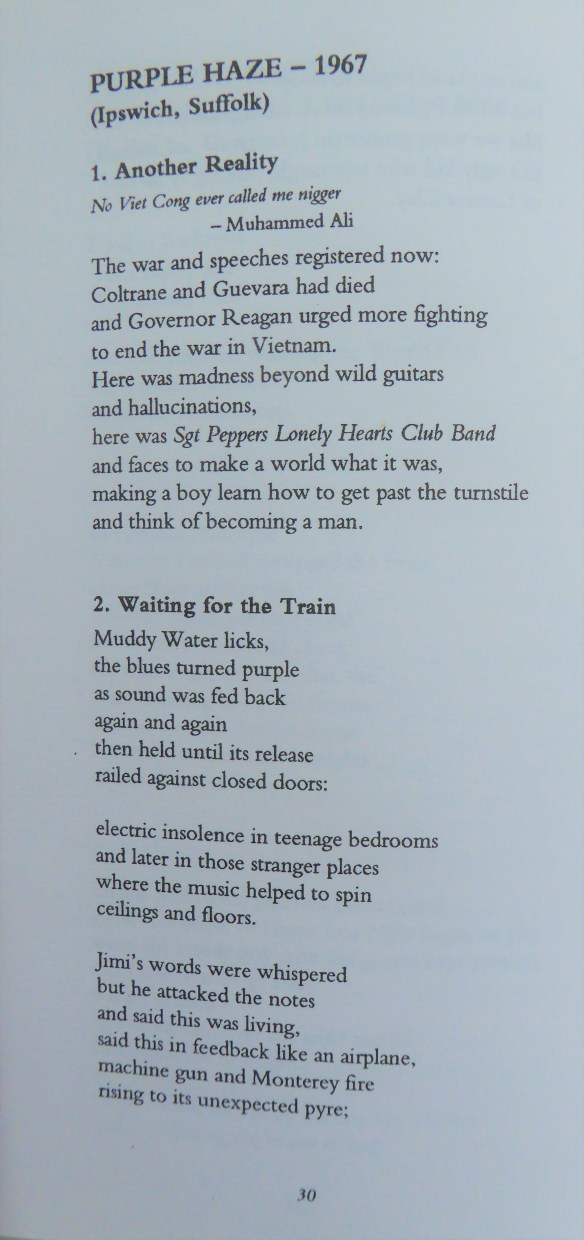
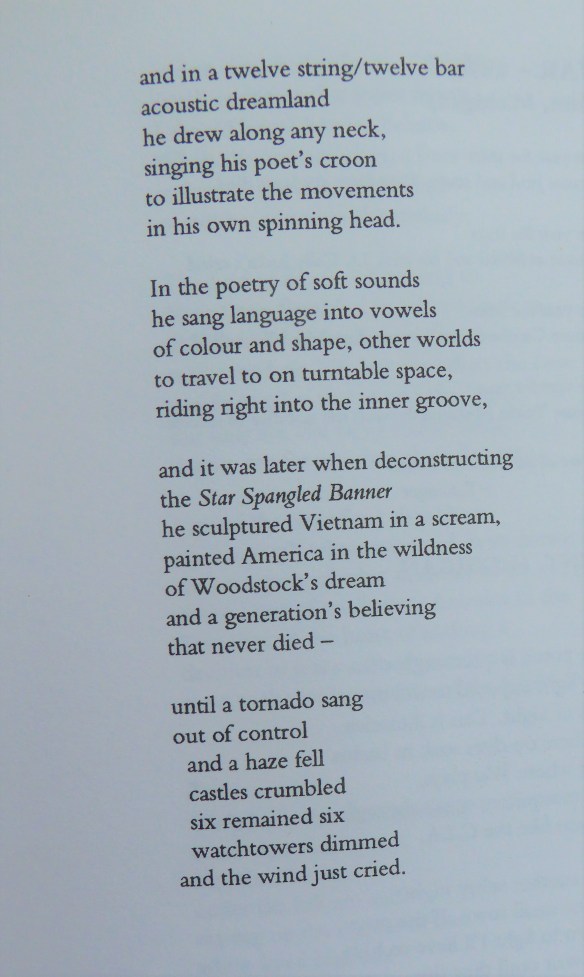
I am prompted to this brief reminiscence having posted my poem about Kentucky and the KKK two days ago. Taken from its initial collection Years, I thought it timely to also share another poem Purple Haze from it that celebrates the year 1967 as we now – well, some of us – celebrate the 50th anniversary of that seminal if ultimately doomed, in terms of realising all its aspirations, Summer of Love.

P1010412

P1010413

Elvis and the Hound Dog that Never Caught a Rabbit

Forty years ago today I was in my kitchen in Ibstone having lunch when I heard that Elvis had died.

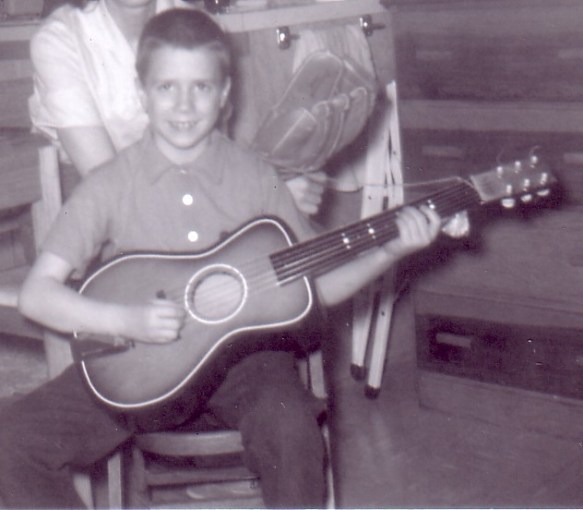
I grew up in the States with his music everywhere and liked in as much as it was so popular at the time, and there are obviously many songs of his I do still enjoy today. Return to Sender is my favourite – not the rock’n’roll of his genuine prime – and when I was a small boy I used to pretend-play my guitar, sing You Ain’t Nothing But a Hound Dog, and shake all over for my family, probably mainly my mother who will have seen my potential – for something other than guitar playing. That could have been an E chord if I’d been a few frets down….

hounddog


KKK in Kentucky

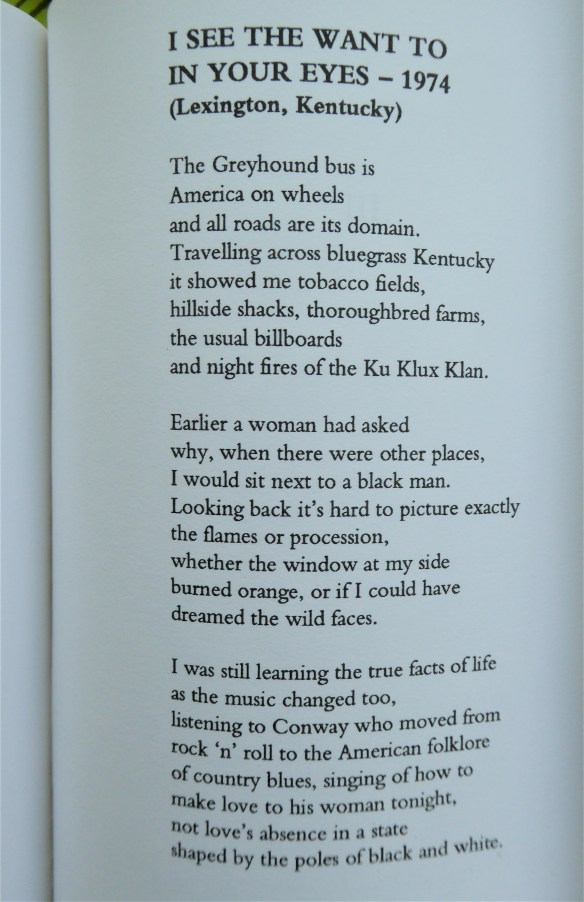
want to

From my collection Nearing the Border, 1998, I originally wrote the poem prior to this as part of a sequence titled Years, recollections of personal experiences based on the years in which they occurred and each prompted by a song of that time.

Even in 1974 on a visit to my family then living in Lexington, I hadn’t expected to encounter such overt racism, nor to see the KKK on a rally as I passed by in a bus. Writing this poem some years later, I was still surprised/shocked by the racism continuing, as sadly I and so many others are here in 2017 amidst the racist tragedy in Charlottesville.

Big Ben

Big Ben rings on the hour.
Big Ben rings on the half hour.
Big Ben rings at midnight with traffic in background. Exterior perspective.
Big Ben rings on the quarter hour.
Big Ben strikes at midnight.
Big Ben strikes at noon.
Big Ben strikes at six.
Big Ben strikes at three.
Big Ben strikes on three quarters of the hour.
London distant city by the River Thames. Distant Big Ben chimes in background at end.

London distant city by the River Thames.


[found list poem from the Big Ben Sounds site – where if you need to you can still hear – with only one manipulation]

No Time for Play

I’ve tried today to write a meaningful observation on Donald Trump’s language over the past few weeks and days, but I have discarded many attempts because others have done so demonstrably better than me – today’s Guardian Opinion, for example; also US Republicans and Generals – and they have a significant voice and audience.

The importance for me stating something personally relevant here is to recognise there is one kind of language/expression of his that is dangerous and disturbing yet it can and should be ridiculed and satirised. I try to do this most often through a found poetry that appropriates the words he uses and then randomises and rearranges these to highlight what I see as the dumb reality of their original form. Obviously not on my own, but I harbour a thought that such ‘creative’ reflections can have their own contribution to play [acknowledging the pun] in sustaining a commentary of why this man is unfit to be President of the USA [acknowledging the platitude].

Trump’s most recent many sides observation doesn’t seem to me to bear this kind of creative playfulness as a method for exploration and exposure. Indeed, its existence means my idea for further creative working on his recent war rhetoric is redundant: I certainly can’t be playful with that after the impact of what the President has spoken, and also not said, in response to events in Charlottesville.

Of course my decision-making on this is of little importance, but it is the most meaningful comment I can make on Trump’s recent language when I cannot find anything else to say.


Trump in Goading Lawsuit

Donald Trump took to the witness stand for the first time today in his lawsuit against Kim Yong-un, claiming the North Korean leader goaded him into behaving like a complete asshole.

The North Korean leader has filed a counter-suit against the President of the United States stating that Trump’s war rhetoric was in danger of making the American sound more of an irrational despot than Kim has been for years.

Both claims are being considered at the trial.

On the third day of testimony, Trump said that his current, definitely still current Press Secretary, had witnessed the goading in a secret Skype conference the two world leaders had had recently regarding who was the bigger twat.

‘He goaded my ass,’ Trump said. ‘He goaded the bare cheek of my ass right in front of my Press Secretary and the other mindless sycophants who were in the conference room with me,’ he further asserted.

The lawyer of the North Korean leader questioned Trump about the possibility of any goading making him look a bigger asshole than he already was.

The trial was later suspended when the Judge ruled there would need to be time to reconcile differences of linguistic interpretation of the words asshole and ass as well as establish the size of such whatever the epistemological conclusions and to seek specialist advice on when exactly either Trump or Kim Yong-un could be considered to be irrational and bereft of reason and whether this had anything to do with innate assholeness or if this could be a goaded-into proclivity.