
I am pleased to have a poem in the collection The Gospel According to Archbishop Makeshift [some details here] and recommend this review if you are further interested.
I have just completed marking a school [centre] of a largish number of GCSE English Literature responses on my paper. That’s two essays each on respectively a chosen prose/play and then prose context question.
I mark an H tier paper, so that is notional D to A* grades, or as it is now in actual marking on scripts, levels 2 to 6. I of course have no idea specifically, but my school is quite likely a ‘bog-standard’ comprehensive [and I ape the term from a while back ironically, and sneeringly], and most likely an academy though this accounts for little. All of the students have responded to, respectively, questions on An Inspector Calls and Of Mice and Men.
And it has been wonderful.
The H tier, I acknowledge, targets a certain level of ability [and thus fits into that C/D pass/fail dichotomy to a degree – see previous here and here] and there is an implicit level of competence. For me, it is so much more than this. The students from this one school – replicated up and down the country – to a person write clearly and well and knowingly and convincingly and empathetically and very often exceptionally. At the ‘business’ end [we apply SPaG] they are all eminently readable and accurate, and at the ‘meaning’ end/level are engaged and informed and bright and unbelievably able to say the same kinds of things [how could you not when answering the same questions on the same texts?] in so many differing and nuanced and, yes again, knowing ways. It is phenomenal.
And I love it.
In reference to the two previous posts I have linked immediate above, I am writing this to once again dispel anyone’s belief that GCSE exams – this one certainly – are designed to fail students. Every single one of the 171 scripts I have marked have demonstrated the students’ ability to convey their knowing of and engagement with the texts they have read and studied. The nature of testing does, of course, assert its parameters – the question setting has a focus – but I think it would be at best churlish and at worst obnoxious to argue that this is in any way designed to limit or penalise or diminish in any way the student responses. But I’ll leave that there.
As the final year in which American texts can be responded to in such GCSE English Literature examinations, and in this centre’s case Steinbeck’s Of Mice and Men, I have been particularly aware of the continued way in which this one text appeals so perfectly to students as readers, understanders, appreciators and responders. This year’s context on the final scene between George and Lennie [spoiler alert in the unlikely event anyone reading this hasn’t read the ending of the novella!] and George’s killing of Lennie has prompted in so many ways the most emotive of empathetic responses. This is naturally the informed response to the power of Steinbeck’s writing. But there is an added puissance to that whole engagement knowing this is the last time there will be such responses.
Considering the quality of responses I have been outlining from this one school – itself a microcosm of all schools, and I couldn’t resist – the quality will be sustained over future years with other texts because it is the teaching and learning and student responses that prevails.
I have written elsewhere [not on this blog] about the intrusion of the literacy strategy on the way students have been taught to write about texts, but I haven’t seen this from this school. The Of Mice and Men context could lend itself to a proliferation of references to ‘pathetic fallacy’, but I have only seen one, thank goodness. And in light of the recent KS2 English GPS tests, I was amused today to read one candidate refer – oddly – to the coordinating conjunction ‘But’ [that is an intrusion from afar at this level now, but one fears for a few years down the line…] yet this again has been an absolute aberration.
This is a celebration of an examination I have enjoyed marking for probably 30 years. There have been changes in Specification, and I started on what was called the Generic paper so open questions asked on any text and tested at all levels, and I have throughout that entire time never ceased to be privileged to read the work of this country’s students. And to feel that as an examiner, and working within the teacher-led spirit of this GCSE, I have been able to reward the students’ responses to the best of their ability and the best of mine within a terminal exam framework that was never my first choice.
As the examination goes online, and for other reasons, I may not be continuing. So I look forward to the other centres I am yet to mark this year.
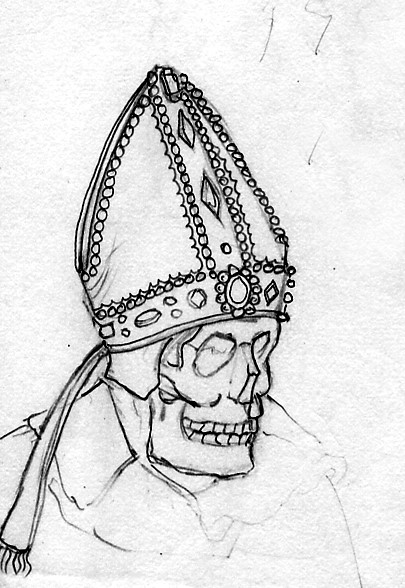
‘Archbishop Makeshift says he is someone you should admire if you didn’t know better’
‘Sometimes
it is okay to perpetuate the hoax of sincerity’
– Dean Young ‘ Tomas, I’m Still Among the Living’
New poems about the elusive and opinionated Archbishop Makeshift by Greg Fiddament, Daniel Y. Harris, Irene Koronas, Mike Ferguson, H.L. Hix, Paul Sutton, Sarah Cave, Martin Stannard, Aaaron Ken, Charlie Baylis and Rupert M Loydell, with cover images by A.C. Evans.
Available from Analogue Flashback Books, c/o Stride, 4B Tremayne Close, Devoran, Cornwall TR3 6QE, England
UK orders £5 (cheques payable to ‘Rupert Loydell’)
USA orders $12 bills only.
Originally posted February, 2015:
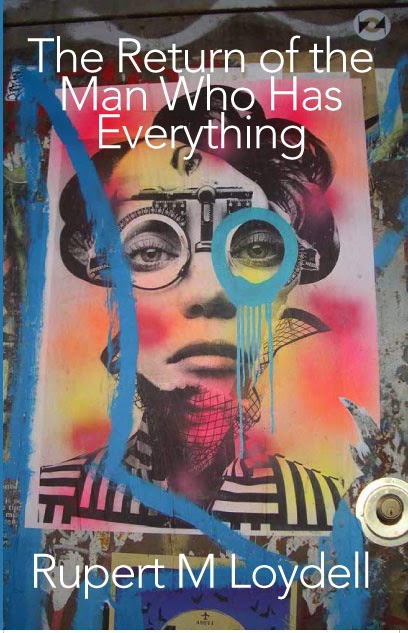
Waiting for the Plumber
Rupert Loydell needs things fixed but he knows this isn’t going to happen. Being broken is a natural order of things in his world and even the poetry – trying to weave the threads of disarray and disintegration into meaningful material – will not cope with the sheer amount of disrepair. Water is leaking in from somewhere, life is getting wet, and the plumber will not come.
But there is a will to make do, to make it better, and even fix what can be fixed as in the poem Broken Circuitry where
‘Now that we know how to fix the car
I keep a spanner under the seat’
As discerning readers we know the car and spanner are obviously a car and spanner and clearly not a car and spanner. Reality and metaphor will not sort themselves out, and the paradox of living with such ennui and triumph [I think I am being figurative/hopeful in overstating the latter] becomes the narrative for all of the poems in this collection that reject the coherence of narrative.
Much of that pervasive ennui is exemplified in the two poems Stay Home and Moodometer, the second an ironic creation because it doesn’t take too complex a gadget to gauge the emotions being consistently expressed. However, I do think an approximation to ‘triumph’ – such mood/feeling/spirituality has to be relative to the suffering – can be found in the poem Staying Afloat:
‘…..Varnish over the screws,
the truth and don’t worry about the small split
in the side of the hull: once in the water
it will swell up and everything will be alright.
There are stripes of pink and blue sky
in the sea towards St Ives, there are spots
in front of my eyes and the sun has not yet
burnt through the morning haze. We will
break our journey here, rest a while and then
move on. At last we are ready to sail.’
The way the poems as a whole express such tensions and occasional resolutions is through the noise and voices that are everywhere, the ‘general hubbub of the world’ [Karaoke Voice Removal]: those from unknown places, in a pub, within his head, the words speaking aloud from a letter, the TV/radio, lyrics in a song, words shouted or suggested from a book of poems, the confused sound of narrative – Loydell extrapolates from this babel the most conversational of heartfelt [though he would reject this term, read here] to apocalyptic truths about love and writing and work and death, and the rest. He writes poems that are ‘Climbing the walls to heaven/gym ropes to hell’ in order to reach those truths [Ill-Matched].
There are patterns in his technique. At times it is subtle, as in O Children where the lyricism moves into the direct observation of everyday, mundane life in the shift of a few lines. Elsewhere it is playful, as in the recurring jokiness of starting lines, for example, ‘I like the idea of siestas/but they only send me to sleep’ [Lipgloss & Shine] – and there are a number of other boom-booms like this; then it is evocation, as in ‘The fat man and his girl are in the angel’s doorway/blocking my line of sight as a moonlight voice/sings about winter’ [Premonition], and there are the teases, as here, ‘….If you think of madness/as not being sane then I am going mad’ [Photosynthesis] where this insertion in the poem of a seemingly off-the-cuff aphorism has a casualness made poignant by the shocking platitude of the line, and what Loydell has revealed about himself – well, whatever self he is occupying at that point from the great variety at his exposal/disposal – in almost all of the poems.
But perhaps he is just angry. Fed up. Bored. Honest.
All the poems in this compelling collection illustrate these opening observations in varying degrees of content and mood. Catching Up is about the collage of writing/life, piecing together extracts and the disconnected found, like piecing together the disparate experiences that make up who we are – but only at the moment of composition? It is making poetic sense of the ‘ghost society that inhabits/our subconscious’, but as fleeting perhaps as the spectre that drifts in and out of what we hear and experience on any ordinary, repeated day [and that, I acknowledge, is quite a pompous line, something Loydell always avoids and why these poems are so convincing in their conversational flow and directness].
Waiting for Luke is about having a drink before a book launch he may or may not attend – such is the uncertainty at every level, it seems, of his life in these poems – but then suddenly he writes ‘….And why/does the depression that so many of us share/break up marriages and tear the world apart?’ That could sound a little trite out of context, but it comes after a series of similar questions that occupy the ordinariness of the event recalled and yet their collective weight of uncertainty is quite – I could say profound, and it is, but it doesn’t sound so which makes it real for the reader and therefore empathetic.
That further empathy for the reader of my age is how the poems concern themselves with the other dissolution – getting older. Under the Radar bothers itself with how things change and how it is harder to keep up with this. It links the world of work that never pays enough, nor rewards enough in other ways, to considering – more implicitly than explicitly – why we endure this and other diminishings in our lives:
‘…..Meanwhile
the door lock became a swipe card
and the whole marking system changed.
The journey toward summer is more
convoluted and confused, no slipping
out under the radar this time it seems.’
There would appear to be the explicit consideration of that link between work, pay and well-being in the poem Fourteen Days to Pay, but it isn’t as simplistic, nor naff, as that. This is a poem again about the passing of time and experiences and the ability to experience, so there is that persistent sense of loss, but also being ‘safe’ in the immediacy of counting the days before pay to settle the bills whilst also being hugely aware within that domesticity of how redundant these pay-offs – literally and figuratively – are in the larger scheme of things. This mix of realities is summed up in the closing lines:
‘…..The trouble with growing up
is growing old and knowing that we do,
the trouble with listing your troubles
is that however many times you read them
you still don’t understand exactly
how they work out the final bill.’
Lest this seem overly morose material – which it is not as a collection, and the humour constantly buffers/counters – there is the next poem to write in full as it defines quite simply, and again without any pretence, a more accepting outlook:
Ahead of the Game
I have already marked
next year’s submissions
but am worried about
timetabling the year after.
I have rehearsed tomorrow
until it has replaced today
and have forgotten to say
goodnight. You do not seem
to think it important, but
I wait for every kiss and touch,
have been visiting the future
to see how it goes. Look:
that’s me, way over there.
I haven’t changed at all,
have decided not to die.
And there’s another boom-boom to remind of the lightness [not that any of these apparent excusing caveats are intended as such, and Loydell is rightly confident in whatever the moodometer wants to hear in his work], the ‘Gravity was everywhere back then/but I didn’t let it get me down’ from The Taller You Are The Shorter You Get, a poem that seems constructed from a variety of sources, as so much of his work always is, presumably the title here from the album by band My Dad is Dead.
It seems to me that the real mix of moods is articulated though the cohesive wrestling with being weary and being creative – a simplistic pole to draw here as near conclusion, but that has been the core dynamic as I have read. I have lived comfortably with these poems over the last few days, always wanting to read more, always seeming to connect with those variously manifesting moods and being compelled to do so by that conversational creativity which informs these poems as a whole [important to state as Rupert Loydell’s work to date is expansive in the way it can be experimental – another term he would reject in the same interview referenced earlier – and stylistically varied]. My actual conclusion will be a mention of the poem On the Other Side of the Mountain – the intention to tempt others to want to read as well – and it is the observation that this poem is perhaps the most lyrically conversational exposition of the existential I have ever read.
Take that to the edge and enjoy.
You can buy the book here.
Coming again
like a Greek chorus
in preparedness
and stoicism,
lips stiffened the
previous year,
the insidiousness
of grey optimism
as relentless
as rain repeating –
rain is
repeating –
but also as an
echo of not because
of weather, even
occasional sunshine
bests the expectations.

Shown last night, I thought this was a spirited modern production retaining the spirit of the original in its fun and fantasy as well as explorations on the meaning of love, this latter deserving its contemporary extensions.
It was definitely a little bit of Dr Who and a little bit of Baz Luhrmann’s R&J, with an obvious pinch of Hannibal. I liked the iPad clones and other modern technology inserts, as well as the in-jokes that went with this: the TV programme A Comedy of Errors. What a hoot to be in the know; however, this wasn’t the more complex to know.
The more complex, though no doubt many will see it as having been puerile, where the innuendos highlighted by emphasis and/or editing in the text [or even inserted – I don’t know it that well] which I thought were playful and witty.
I am not always a fan of Matt Lucas but his Bottom was wonderfully varied; Nonso Anozie was powerfully apt as Oberon, and Maxine Peake was perfect as Titania. Harry Potter as Lysander was quite amusing.
I also simply thought it was refreshing to see a prime time Bank Holiday Monday television spot going to Shakespeare rather than any of the more expected popular crap options that are out there, though I will be hoping that the wonderful watchers on Goggle Box – which isn’t crap – who quite like much of that other actual crap will nonetheless share my enthusiasm for this Bard’s BBC outing.
I discovered this today, and it links to my poem and post here Fishing in which I describe a memorable day on [actually above] what I am sure was the Niobrara River.
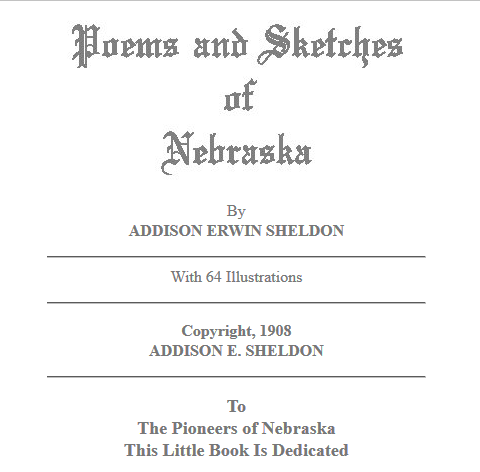
Sheldon’s poem does evoke the wide open spaces that I recall as a child when traveling to the town of Niobrara, and it documents the loss of an age where there was more freedom and independence, but also a wildness and lawlessness of frontier days. It is a longish poem to read, but it is interesting as a narrative that celebrates and laments:
These star-high canyon walls looks grim
I own,—till one gets wonted,—
The black pines rockin’ on the rim
Like Indian ghosts enchanted :—
And yet there doesn’t grow fer me
On mountain, plain or prairie
No spot so friendly and so free
As Poor’s Ranch, Niobrara.
Lonesome? I reckon not,—y’ see
There aint no lack o’ rustle,—
The talkin’ of the pines to me
Beats all Chicago’s hustle,—
And ridin’ out across the range
From March to Jenooary,—
There’s nothin’ lonesome-like or strange
Along the Niobrara.
Saddle and blanket comrades, they
Hev vanished from the border,—
More on the shoot than on the pray
An’ yit fur law and order :—
The hoss thief trail from Long Pine Glen
They tracked to canyons scary,
Fur Middleton and Kid Wade men
Hid on the Niobrara.
You knew Tim Jones, of Bear Creek Ranch—
What was his queer alias?—
He killed a preacher up the branch
Fer tryin’ to make him pious;—
His Texas wife swooped down on Tim
livin here with Sarah.—
There wan’t no use o huntin’ him
Next day on Niobrara.
Jim Murray then,—Jim Dahlman now,—
Who shared our bunk an’ bacon,
Has quit a roundin’ up the cow
And gone to pres’dent makin’
It makes the old gang chuckle when
They read of him a tryin’
To rope them Wall Street hulls an’ then
Sail tip the Bay with Bryan.
I wonder ‘f when in politics
He minds that little flurry
We had at old White River Nick’s
Beyond the Niobrara?
John Shore—who used to throw a calf
To beat all human natur’—
Throwed the S-preme Court—an’ don’t laugh—
Down in the Legislatur’;
Poor John! He’s crossed the other side
Snake River sand hills dreary—
One good man more will never ride
Along the Niobrara.
That Gordon outfit Black Hills trail
Goes yonder gully—riggin’——
Black Hills or bust—they’d never fail
To reach the Deadwood diggin’—
But just beyond the Boilin’ Springs—
The old U. S. Calvary
Bonfired their wagons, grub and things
Beside the Niobrara.
Bill Irwin an’ the Stetter Boys,
Who kep’ us all a guessin’
Which one could raise the roughest noise
To earn the outfit’s blessin’,—
Has quit the range an’ settled down
As tame as a canary;—
You’d never b’lieve they’d shoot a town
Along the Niobrara.
What changes come—the Texas Trail—
Abilene!—An’ Ogalalla!—
The dry drives, where the water’d fail,—
The quicksands where ‘twas shallow:
The old North Platte hell-roarin’ high,—
The longhorns’ floatin’ ferry—
And last,—the pines agin the sky
Upon the Niobrara.
The fur-off, early round-up day,
Where all was open ridin’.—
No barb wire fences in the way—
No railroad cut or sidin’—
No land detective’s sneakin’ frills
A spottin’ the unwary—
But jest the cattle an’ the hills
An’ rushin’ Niobrara,
Old days is gone—the place seems dear—
The canyon an’ the river;
Heaven aint no furder off from here,—
An’ I can’t stay forever:
Like mirage lakes of alkali
I’ve seen above the prairie—
I’l look above when I shall die
Fir Poor’s Ranch, Niobrara.
The distinction between Appearance and Reality is a key philosophical exploration and argument from Plato to Bradley, and many others. My poetry chapbook Precarious Real [here] deals with this in its serious and satirical ways, but I think I could have perhaps titled it differently as Pie and Mash.

The image above of today’s quick meal [bought with no unreasonable expectations of quality or amount] does nonetheless exemplify rather brilliantly the disparity between appearance and reality at one actual level when you get through the packaging and see the paltry size of the contents.
Somewhat ironically, the photo I have taken has got the perspective wrong because the pie certainly and the mash to a degree actually do look as large as the picture on the package. Trust me: they aren’t. They are comically minute. I should have put the package cover in the foreground, but this all simply adds to the cosmic dichotomy.
I do think the herb liquor [that’s the frozen block of green in the back right compartment] is going to elicit more of a linguistic questioning of its reality…
My exam papers haven’t arrived yet, and the grass is still too damp to cut….
I have many objections to the KS2 English SATs GPS [SPaG], and here are just two from this year’s, but repeating what I have objected to in the sample papers:

This obsession with teaching the semi-colon at an early age is ridiculous, as is to test it like this, and as I have written before, the overuse – quite often inaccurate – of the semi-colon in GCSE English Writing papers [students taught to ‘hit’ assessment criteria about sophisticated use of SPaG, for example] is a further example of this nonsense. The sentence There are Roman ruins near our village and they are being excavated next week is a far better exemplar for good writing.
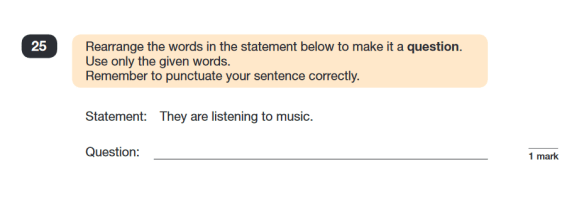
Dull, dull, dull. Why not write the sentence They are listening to music? and get students to respond [in all kinds of ways] to why and how this is different to Are they listening to music?
One could construe that I am being mischievous – well, I am, but also 100% accurate [about the only certain ‘accuracy’ in these nonsensical tests] – but the following question and answer demonstrates how this idea of finite ‘correctness’ [excuse paradox, but the DfE clearly don’t understand this concept, apart from as a construct] is untenable as a means of measuring language and writing learning in students:

Here’s my answer: You may bring sandwiches or juice and water for the trip, but glass bottles are not allowed.
In a mark scheme that comically – though appalling – gives copious guidance on what to do if students write answers outside of provided spaces or similar ‘errors’, it is completely unable/unwilling to address how to respond to answers that are – wait for it – ‘outside the box’ [couldn’t resist] but in language terms still ‘correct’, and therefore illustrates the fundamental problem. And what I mean, of course, is that this one question/answer does not exist on its own: it is the model for most of the test. Here is the ‘correct’ response to earn 1 mark:

Because I am stupid and useless, my answer could not gain 1 mark, though it makes absolute sense, both linguistically and as communication, even if the instruction in my version to bring food or drink is a tad draconian – like the tests.
I could, and might [but I start GCSE examining imminently….], unravel a few more, but this is probably enough to make the point for anyone prepared to see it immediately.
Michael Rosen continues his stellar analysis of these tests themselves on his blog and elesewhere, and one seemingly simple and yet colossal example of further bad practice he exposed was the question that asks students to provide the antonym for the word ‘fierce’.
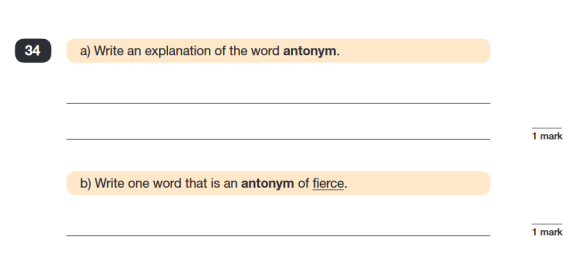

As Rosen points out, no single word out of context has an antonym [words rarely, if ever, possess this neatness, though paired examples like black/white occur], and the idea of there being a ‘correct’ or ‘accurate’ or ‘true’ antonym to reward as an answer in a necessarily narrowed mark scheme is more craziness.
I picked this analysis up on Facebook and was intrigued to see teachers offering ‘answers’ – many in jest, obviously, but a surprising number engaging in the process earnestly, though one can understand why if they have had to teach this crap and are affected by it.
That said, one of the more interesting proofs of how stupid this question is would be in considering the possible ‘answers’ of calm and timid. Here’s the rub: can you imagine two words that as potential antonyms to the word fierce are therefore necessarily also synonyms which could be more different to one another in what they actually imply/mean! Obviously, this is what makes language so exciting, and as I have argued elsewhere, if you really felt the need for such tests [but let’s actually just imagine it as teacher set/teacher assessed], what could be more illuminating that allowing students to write sentences using the words timid and calm to reflect their alternative meanings…or acting them out…..or talking about them…..

