She is deadheading
and drops to the grass
the pinched out
and picked off for
further colourlessness.
I see her paralleling
what will come to pass
and is now about
time lived before
eventual decisiveness.
She is deadheading
and drops to the grass
the pinched out
and picked off for
further colourlessness.
I see her paralleling
what will come to pass
and is now about
time lived before
eventual decisiveness.
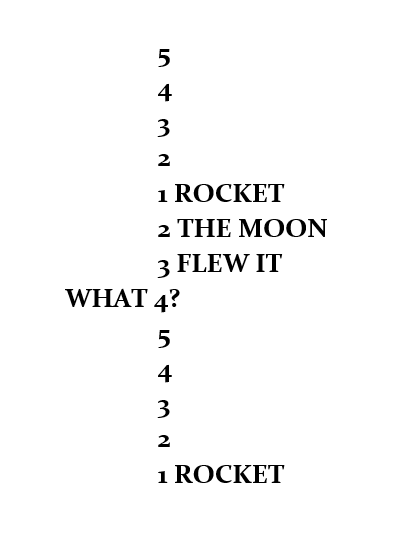
In some celebration/recognition of the 5oth anniversary of Apollo 11 and the first manned mission to land on the moon, launched on this day in 1969, I am posting this poem which I always used to lead with when introducing concrete poetry to my students.
I cannot remember the author – apologies – and even with online research I have been unable to locate: apart from others having memories but also being none the wiser. If anyone…
I would just write the numbers on the black board [oh yes, many years ago] and then ask the students what they thought this ‘poem’ might be about. Of course, calling it a poem was the first tease, but someone would always eventually suggest a countdown – this prompted if needs be by my reading aloud – and then there was the vertical numbering before words were added so a rocket might be suggested, and that was the first route into exploring how concrete poetry can take the shape and other elements of the thing/event/item/idea it describes. Adding the words was always a great reveal – a little ruse, if also crucial, that worked to engage.
And this was the essential purpose. I would, however, also reflect on that line ‘What 4?’ because this does matter. Even in the early 80s when I was first teaching we were some way down the space road from 1969, so it was an apt question about the cost in a world riven with poverty and disadvantage. Then there was the final line and a suggestion of an ongoing commitment. I’d make reference to how poetry can have important messages to make/explore, but not necessarily.
This was mainly all about making poetry experimental and fun and I have fond memories of using this first example and launching the ideas of others.
even if the life is cruel
is your last sentence written
[on its own at the top
of an otherwise empty page]
as I work up through the script
marking pages as ‘seen’
ready for that other marking,
later, when judging
chronologically what has led
to this apocalypse.
Assuming you have
answered all, I know
it is Laskey’s poem,
so I hope – at the age of sixteen –
you will look for the snow
to trod and mess about in,
throw a big round one at
nobody in particular,
and laugh at the cruelty
that might have been.
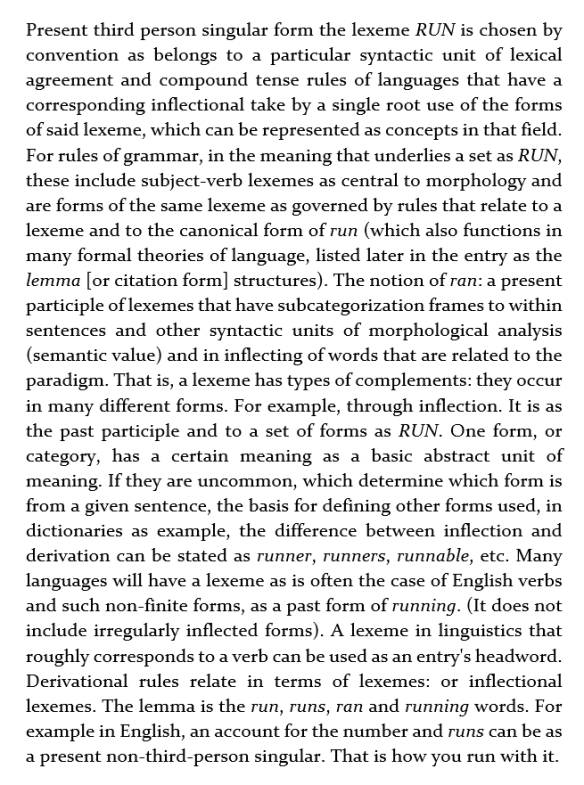
Dear teachers,
I have been telling
off your students,
but the off
is you
for teaching them
linguistic things
that are
in their minds
just things, really,
to imagine sound
better [let’s not
examine as adjective,
as adverb, as noun
as verb]
than ‘better’
or what is
correct.
This is a ‘rotten’
thing to do,
which is not
a lexeme,
even if it is
or could be,
but is definitely
corrupting
as a thing to
teach students.
Dear student,
I have returned,
and lemma
and lemme
and – apologies for not getting this right –
let me
tell you something:
‘lexeme’ is a word
but word
is a better word
when that is what
you really mean.
Ungatz
I don’t remember a single birthday
growing up.
There are photographs,
and there will have been things
and much love
as well as some parties with friends,
but I don’t recall one celebration.
I do for my twenty first,
a big event at the time,
and the pewter mug with
its transparent base
for looking through.
Also my fortieth
and sixtieth, more recent than
childhood, obviously, but for
other reasons.
I’d like to go back to an early birthday
and sing to myself in a foreign language
to suggest just one change.
Any would do.
Shooting Your Luck
When Lucky is telling
whoever is on the other end of the phone
about shooting a mocking bird
I think of Harper Lee, naturally,
and then those unknown birds in a nest
with my own BB gun.
I would have been younger,
but that’s no excuse, and I recall clearly
the sun shining
though now I’ve mentioned it
I also seem to remember another time
in the woods near my home,
a young adult, and again
carving her name in my upper arm
like the other when just eleven.
Yet the only mortality here
are those past deaths, then the two scars,
one a misspelling, now disappeared.

1
The dynamic verb
is adjectival, as expression,
which is ironic
because errant, pedantically speaking,
but also oxymoronic
in being applied correctly to
a word,
which is a verb,
and is dynamic in what it alludes to,
yet not in the meaningful way
intended,
which isn’t,
though is here now,
paradoxically.
Dear student, that is today’s
dynamic lesson.
2
Dear student,
about this expression:
‘The (abstract) nouns two days’ –
no, this is as concrete as time gets,
calculated as precisely as this [though not by minutes
and seconds, I concede],
and their love has not been gulped by a ‘dynamic verb’
but by water
that is literal and then metaphoric
and never – never – resolved by the
twee joining/unison/touch of wings
because actual love is not ever this finessed by feathers.
3
Dear student,
in the future
you must get your tenses right
as tense verb
is an inversion of something
learned in the past
but forgotten in the present.
And does ‘had’
need this classification?
When they had that love,
then it was tense with anticipation.
4
or not as much as what he loves her
is the most honest expression you
have shared
like what they did not, or her to him,
which you called ironic
and I, being older, would call despair,
dear young, earnest, learning student:
[asyndetic list].
 gravyfromthegazebo