
ST LL MI SING
Image
4

source:


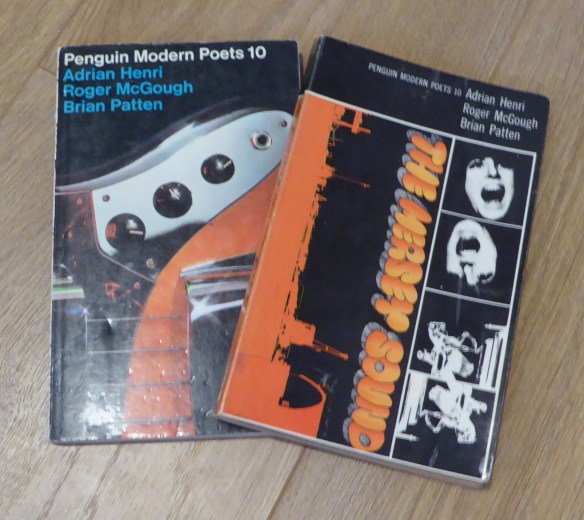
I enjoyed very much the BBC4 poetry programme Sex, Chips & Poetry: 50 Years of the Mersey Sound last Friday, a celebration of the 1967 Penguin Modern Poets 10 publication of Adrian Henri, Roger McGough and Brian Patten.
While I am of that generation influenced by the playful, political and irreverent poetry these three presented, I wasn’t immediately affected by it in ’67. I have written before, but in brief I was first aroused by poetry that meant more to me that school study in about 1969, initially by a zany and engaging supply English teacher at my secondary modern in Ipswich who played The Fugs’ musical rendition of William Blake’s Ah Sunflower to the class. This then led to Allen Ginsberg and other Beat poets; also lyrics of the time by The Beatles and Hendrix.
I came to The Mersey Sound in ’69 or ’70, already writing my naïve approximation of poetry freed of convention and meaning, or that is how I grasped hold of it then. Having lived in England for only three years, I won’t have picked up on specific references to Liverpool and a broader British/working class culture, not that I had comprehended the deeper cultural references in the work of Ginsberg and the American writers, though an American myself, but only 15 years old in 1969.
Yet it was all liberating as the programme managed to convey. The treat in watching was in the heavy dose of archive footage as well as McGough and Patten reflecting on this today. Of the three, I have followed the work of McGough most closely [two reviews here].

In my early teaching career I did often use poems from this book, poems like Love Is…, Poem for Roger McGough, At Lunchtime A Story of Love, Why Patriots are a Bit Nuts in the Head, My Busconductor, What the Littlegirl Did, Vinegar, Let Me Die a Youngman’s Death, and Little Johnny’s Confession. All of these came back to me as I skimmed through the titles, and there is a genuine nostalgic reverie at how much I enjoyed reading for myself and to classes – these weren’t for study, by the way.
Reading again now, and having been reminded by the programme, I note how Henri was the most experimental. I also had forgotten his use of listing in his poems, and as I so often work with this approach, especially my teaching resources for current and previous National Poetry Day creative writing ideas, I was drawn again to his wonderful Without You,
Without you every morning would feel like going back to work after a holiday,
Without you I couldn’t stand the smell of the East Lancs Road,
Without you ghost ferries would cross the Mersey manned by skeleton crews,
Without you I’d probably feel happy and have more money and time and nothing to do with it,
Without you I’d have to leave my stillborn poems on other people’s doorsteps, wrapped in brown paper,
Without you there’d never be sauce to put on sausage butties,
Without you plastic flowers in shop windows would just be plastic flowers in shop windows,
Without you I’d spend my summers picking morosely over the remains of train crashes,
Without you white birds would wrench themselves free from my paintings and fly off dripping blood into the night,
Without you green apples wouldn’t taste greener,
Without you Mothers wouldn’t let their children play out after tea,
Without you every musician in the world would forget how to play the blues,
Without you Public Houses would be public again,
Without you the Sunday Times colour supplement would come out in black-and-white,
Without you indifferent colonels would shrug their shoulders and press the button,
Without you they’d stop changing the flowers in Piccadilly Gardens,
Without you Clark Kent would forget how to become Superman,
Without you Sunshine Breakfast would only consist of Cornflakes,
Without you there’d be no colour in Magic colouring books,
Without you Mahler’s 8th would only be performed by street musicians in derelict houses,
Without you they’d forget to put the salt in every packet of crisps,
Without you it would be an offense punishable by a fine of up to £200 or two months’ imprisonment to be found in possession of curry powder,
Without you riot police are massing in quiet sidestreets,
Without you all streets would be one-way the other way,
Without you there’d be no one to kiss goodnight when we quarrel,
Without you the first martian to land would turn round and go away again,
Without you they’d forget to change the weather,
Without you blind men would sell unlucky heather,
Without you there would be
no landscapes/no stations/no houses
no chipshops/no quiet villages/no seagulls
on beaches/no hopscotch on pavements/no night/no morning/
there’d be no city no country
Without you.
Adrian Henri
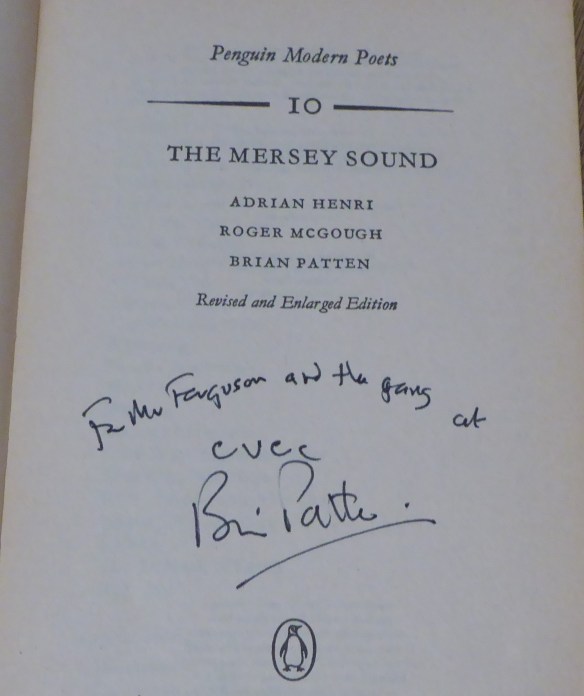
I had also forgotten that Brian Patten signed a copy of the 1982 edition to me and the English team where I worked, though I can’t remember exactly when, or where. Too much of enjoying the 70s I guess…
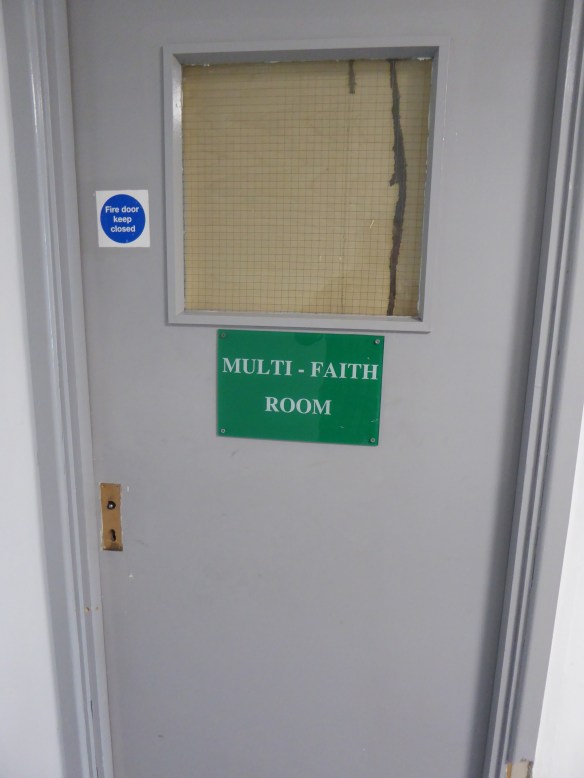
At an M5 Services: window screened; handle removed –
I attended the Uncut Poets with Harry Guest last night at the Phoenix Arts Centre. This was part of the Exeter Poetry Festival and I did particularly want to see Harry read.
My poem that follows seems the most apt way to characterise the evening. I could only stay for the first part, but as Harry read during this, that was perfect. I also enjoyed the other open-mic performers I saw where the eclecticism of such a night is given its free voice.
The poem is as the evening was, with only the very slightest licence. The dancing above was a little annoying, but also hilarious – not the dancing itself, I’m sure, but its second-hand intrusions.

Poetry Reading with Harry Guest
I wrote this one in my head…
At the front, the fold-away table’s legs are
taped together to stop any words from
collapsing and falling to the floor.
A poet sitting next to me – we are all writers,
surely – has friends currently out in Baghari
as I read the text message over her shoulder.
Another to my right and in the front row has
one loaf of wholemeal bread in a carrier bag
from which she could later recite her slices of life.
The first reader has secreted a series on molluscs
to now un-shell and let crawl around our seats.
Open-mic number two is introduced –
James Taylor! – and a swift correction follows
of his surname, then the cover-up joke on how
he might serenade us with You’ve Got a Friend,
the bum note of irony immediate when
James introduces the first poem titled No 13 from
a sequence about his loneliness and depression.
Harry reads after the fifth, first of the two invited
writers with his surname aptly as one Guest.
His words fill the room with softly spoken
certainties, his own and translations mainly from
the French, Jean Cassou’s Trente-trois sonnets
composés au secret, poems composed in his head
when in Vichy prison. Harry’s love of language
also resists the boundaries of what it is that divides,
even tonight where in the performance room above,
busy feet of the Bharatanatyam dancing competes.
I leave at the break, miss the next five and other guest,
but I have a poem to recall at home and transcribe.
One of Harry’s more recent poems The Last Intruder – superb – is posted at the excellent Stride magazine here.
This land is your land, this land is my land
From California to the New York island;
From the red wood forest to the Gulf Stream waters
This land was made for you and me.
As I was walking that ribbon of highway,
I saw above me that endless skyway:
I saw below me that golden valley:
This land was made for you and me.
I’ve roamed and rambled and I followed my footsteps
To the sparkling sands of her diamond deserts;
And all around me a voice was sounding:
This land was made for you and me.
When the sun came shining, and I was strolling,
And the wheat fields waving and the dust clouds rolling,
As the fog was lifting a voice was chanting:
This land was made for you and me.
As I went walking I saw a sign there
And on the sign it said ‘No Trespassing’.
But on the other side it didn’t say nothing,
That side was made for you and me.
In the shadow of the steeple I saw my people,
By the relief office I seen my people;
As they stood there hungry, I stood there asking
Is this land made for you and me?
Nobody living can ever stop me,
As I go walking that freedom highway;
Nobody living can ever make me turn back
This land was made for you and me.
Words and Music by Woody Guthrie
© Copyright 1956 (renewed), 1958 (renewed), 1970 and 1972 by Woody Guthrie Publications, Inc. & TRO-Ludlow Music, Inc. (BMI)
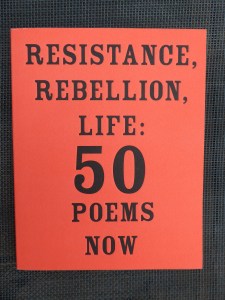
Like this little collection, big with a collective voice,
and here’s a small elephant voice,
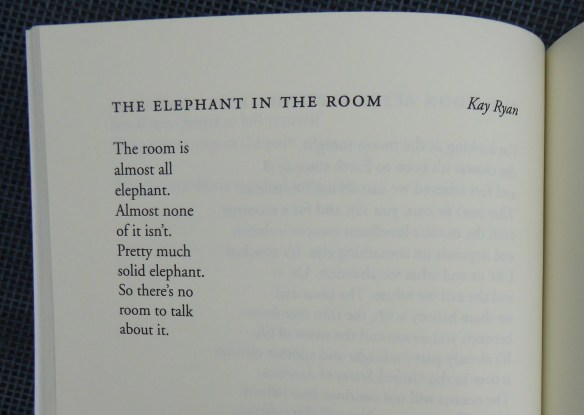
Details here.

 gravyfromthegazebo