Ophelia’s Sun Haiku

Ophelia’s sun
is a Sahara dust orange
of October sky

P1010602

Social and other media feeds were wonderfully rife yesterday with pictures of and speculations about the orange dot of a sun in the UK sky, framed so by Saharan dust brought up with the whip of Hurricane Ophelia’s waning but still powerful winds.

I quoted lines from Coleridge’s Hymn before Sunrise…, and the picture above taken at Ottery St Mary, on the Coleridge Memorial Trust Facebook page,

Thou first and chief, sole sovereign of the Vale!
O struggling with the darkness all the night,
And visited all night by troops of stars,
Or when they climb the sky or when they sink:
Companion of the morning-star at dawn,
Thyself Earth’s rosy star, and of the dawn
Co-herald: wake, O wake, and utter praise!

but this morning I also quoted there the following, with an acknowledgement to Malcolm Guite, author of Mariner: A Voyage with Samuel Taylor Coleridge, these apter lines he tweeted from The Rime of the Ancient Mariner,

All in a hot and copper sky,
The bloody Sun, at noon,
Right up above the mast did stand,
No bigger than the Moon


The Good Platitude

Amanda Spielman of Ofsted has of late made a number of platitudinous and therefore grating ironic observations about the damage done in schools when there is too much focus on exam ‘success’ and targets-chasing.

In a similar but significantly alternative way, there is an irony in the platitudinous correlation being sought for confirmation in research reported in Schools Week today by

…the Education Endowment Foundation (EEF) and the Royal Society of Arts (RSA) announced five trials to test the impact of different “cultural learning strategies” as part of the ‘Learning about culture’ programme.

Surely this link is already well-documented and proven by both decades of external research and the overwhelming evidence of classroom manifestations, this latter by those who have bothered to practice and observe?

It is probably a part of the sub-headline which prompted my mild ire – new trials to assess whether skills like music, drama and journalism can boost their [children] achievements at primary school – because it seems to me the correlation between creative pursuits and learning in education is meant to be much broader than ‘achievements’ which are inextricably linked to testing regimes. Perhaps it is simply an inappropriate choice of words.

What I did like [though again there is no fundamental need to ‘prove’] is the observation about how developing the skills of teachers as writers is being linked to improving students’ writing,

‘The craft of writing’ will meanwhile investigate whether developing teachers’ skills as writers improves year 5 pupils’ motivation and confidence with writing. The project, developed jointly by Arvon, the University of Exeter and the Open University, will see teachers working with professional writers.

I have followed this work in blog postings from tutors and teachers, but this has also been glaringly obvious to me for many years: English teachers in particular need to be writers themselves to fully appreciate how students become writers.

Is that too bold a statement? No, it is another platitude as far as I am concerned. But a good one.


Ophelia Coming

22554903_10155766657928544_8808166373690052722_n

Somewhere in one of its many wars and perhaps
fearing death – or worse, celebrating its creation –
this floating terror had a skull tattooed on its
blue middle, faded and seemingly bullet-holed now
by years of travel and travail and then this beaching
in its own cessation. It’s a zooids’ presage for today’s
looming storm, Hurricane Ophelia floating up from
the south, misplaced like our Portuguese man and
a false steward to threats we usually just imagine

anyway. We are so safe. Here in the stones, on the
shore, on the pathways, and in our comfortable homes.
In this case, we are the more deceived. There is no
emblem but what we are sometimes pumped up to see,
here in the substance of froth; our skulls of real bones.

[picture by painter and photographer Nick Dormand]

Dunelm School Academy Programme

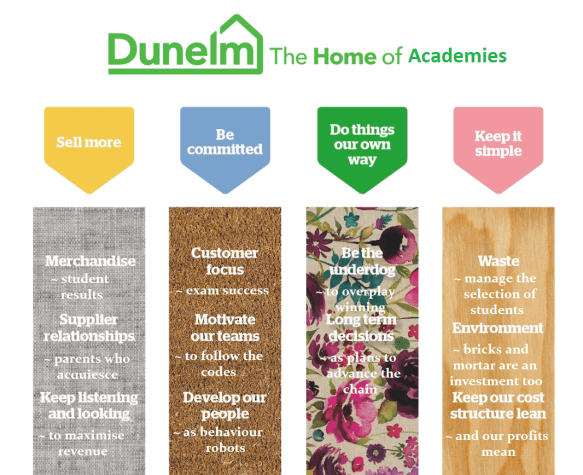
As reported in the DfE Ministerial Meetings for June, 2017, the then Parliamentary Under Secretary of State for the School System Lord John Nash met with Dunelm ‘to discuss potential academy sponsorship’.

This blog has attained an early draft of a visual representation of the discussion and thinking about how this UK’s major retailer in home furnishings and fittings might best apply its expertise to educational development for UK students and teachers:

dunelm academy

Give and Take

lead

It is a small terrier, as near as I can place the type, and being walked on one of those extending leads where the owner can let it roam ahead in great arcs of sniffing and peeing. The couple with the dog are elderly, she using a stick and he keeping a matched slow pace, not out of caring attachment but because of his own lack of speed. The pet’s wandering is essentially random and free, the lead proving no more than an illusion of control.

That is evident when the mutt tries a bite as our paths cross, me overtaking the sluggishness of the couple’s strolling and the dog moving over from its lengthy slack.

‘Oh, I don’t know why he did that,’ she bursts out after me, the excuse of this being an abnormal action rather than an unreserved apology getting on my nerves immediately.

‘Bad dog,’ the man mumbles, seemingly unable to reel the pooch back in, a mechanism of the lead having lost whatever taut coiled spring is meant to oversee its existential distances.

I stop and wait for them to catch up. The dog is now sticking his nose into the grass on the other side of the path, its small mongrel’s aggression already subsided, or just forgotten.

‘I get this a lot,’ I say. ‘And I don’t know why,’ not angrily, but annoyed. Upset even.

‘But’s in not like our Charlie to do that,’ the lady tells me, unconvincingly.

‘There’s a woman who lived up the lane from me whose dog used to attack whenever I was out walking there. It was a Jack Russell and old and always came snarling and snapping at me.’

I don’t mention she also had a useless, variable lead or the fact she ushered her pet alongside a mobility scooter. If I did that, I’d have to add how she would gingerly step out to pick the mad thing up if it was becoming too aggressive, and this increased my disgust.

‘She’s moved away but I’ve not recovered from it. I’ve always loved dogs but that experience of meeting her nasty one a few times has got to me. I’m cautious now. Maybe also a little scared.’

‘Oh Charlie isn’t mean or aggressive,’ the woman says.

I give her a look of incredulity rather than trying to explain. The couple’s dog now saunters back over to me, tail wagging.

‘You see?’ the man asks.

‘He’s come over to say hello and sorry for being grumpy,’ the woman drools.

I bend down slowly, not entirely giving up on dogs. I raise my hand gradually, carefully, and then move it over the now friendly head, resting my thumb and a single finger behind each ear to massage gently in the way my border collie from years ago found soothing and comforting.

The man and woman look on smiling and appeased; comfortable as well.

The dog yelps – squeals, in fact – and snaps at me, but I have moved my hand quickly and am already striding away. I hear it snarling and the man snapping too,

‘Bad dog, bad dog.’

I think it is the woman who calls after me,

‘We are sorry. He never normally acts like that,’ I just catch her saying, but I am quickly beyond any clarity.

Whilst I don’t play all that much these days, the guitar fingernails are still long on my petting hand, and I stuck the index one hard and quick into the soft spot behind the dog’s right ear.

We can all be little shits at any point in any day, wandering out in our individual arcs of random give and take.

European Disunion of Metaphor

claudboris - Copy

In the battle of articulating a position on Brexit by the use of metaphor, Jean-Claude Juncker would seem to have won with a flush to Boris Johnson’s paltry pair.

Yesterday, the Eton and Oxford educated British Foreign Secretary bumbled out the following mess of an articulation,

…I say to get the thing…the great ship down the slipway and on the open seas…and looking for some urgency…time to put a bit of a tiger in the tank and get the thing done..

which was as clear as a pane of glass hit by the spread of an airborne cow-pat.

Today, in the other poker hand, the secondary school educated President of the European Commission, also speaking figuratively in English, articulated his Brexit observation as follows,

If you are sitting at a bar and ordering 28 beers and then suddenly some of your colleagues are leaving, it’s ok but they have to pay, they have to pay

which at the very least tapped into the wider experience of us all and was sustained across a singular referencing.

Gender Segregation in Schools

From the report in today’s Schools Week about a faith school’s sex segregation and the High Court ruling declaring this unlawful:

Ofsted were highly critical of the school in their report last summer, arguing that separating pupils who attend the same school was not in line with the values of British society nor prepared them for modern life.

The appeal had the backing of the Equality and Human Rights Commission.

Agreed. So how does this square with single sex schools? Surely the context of ‘who attend the same school’ is not a defining factor? Not if we extrapolate that boys and girls attend the same society?


A Little Tooth by Thomas Lux [and The Writer’s Almanac]

I like this short, simple poem:

A Little Tooth

by Thomas Lux

Your baby grows a tooth, then two,
and four, and five, then she wants some meat
directly from the bone. It’s all

over: she’ll learn some words, she’ll fall
in love with cretins, dolts, a sweet
talker on his way to jail. And you,

your wife, get old, flyblown, and rue
nothing. You did, you loved, your feet
are sore. It’s dusk. Your daughter’s tall.

“A Little Tooth” by Thomas Lux from The Drowned River. © Houghton Mifflin, 1997.

This is up today at The Writer’s Almanac site, here. If you sign up to its email newsletter, you’ll get a poem emailed to you each day. Hosted by Garrison Keillor, who reads each poem posted as well as the daily literary news, and it is an effortless parcel of daily joy to receive every day. If you don’t like the poem of that day, wait for the next one.