‘The Co-ordinates of Doubt’ by Daniel Y. Harris and Rupert M. Loydell – Knives Forks and Spoons Press

co-ord1

Not yet on a numerical par with the likes of the Rocky/Star Wars film franchises, Messersarounders Harris and Loydell have here produced a second in their series of poetic collaborations [well, it has only just become a series at this double landmark, but word is afoot that three other poetic screamplays are already in the bags of potential presenters] and the poems in this volume continue their explorations of human nature and the nature of its articulation.

As the blurb on the back page of this new volume tells us, these ‘anthropoetjests’ [a new and apt nomenclature appropriated from the mysterious Professor Some Diurnal Awe] follow a journey of lament and comic challenging of this – not quite good cop/bad cop but sad cop/mocking cop.

When the sequence opens with two dark accounts of an apparent apocalypse, the anticipation of an occasional optimistic view seems thwarted. Landslide teases with its descriptive beauty of a darkened place, and an ominous sense of forced change in a world lived is immediately established. Just as immediately, the following poem Black Crow introduces us to a saviour of sorts, Phillip J Jackdaw, yet any hope he can retrieve things from the darkness is comically revealed in his surname and the fact he was wrong. Such is the mess of this occupied world of the writers’ creation.

With such believable – and not so much so – absurdity, the only hope is more of the same. In Looking South, there is hope but only in finding death in the future, and Timeslip laments the further loss of lost identity. It is as if Hughes’ Crow has flown in with wings so enlarged from time’s blackness that flapping is the rush of thought and ink in all others’ imagining. And it is at times just as darkly enlightening.

In the world now inhabited by Harris and Loydell, light and dark are one and the same, and being alive is a good question,

‘Alive, certainly, like the stench of rotting flesh, but human? Doubts
remain. Was Roxanne still human? Roxanne, the ectomorph with the
possum nose, the one they called Gidget-the-Broom, was she still
one of us? Who are we?’
[Safety Zone]

Where there is room to salvage something of the past, it is in the sad beauty of lament,

‘The early morning mist always softens the day and mood, makes me
remember other places where the sun rose late or early, or the city
was so hot we never got to sleep. Late night coffee on the hotel roof,
walks under moonlight, the campsite in France where it always
rained. I miss everything, know I will miss this when I am over it. I
am very much looking forward to looking back.’
[Lament]

Living is making do with what assuages, like ‘those healing creams, lubricants and corked cambiums’ [Sidetracked] and an acceptance that being alone is the best we can get from being alone, ‘You can choose to maroon yourself between tides and pretend you are alone’ [The Island].

But I digress. In this is being, and being many things to keep us guessing about who we are, what we have done, and what we can remember of this. The cast-list is as legendary, ‘I am Saint Bernard Mazzola-Iniquity, bastard nephew of Girolamo Francesco Maria Mazzola. I am draped in gold-leaf halo, aureola, mandorla and almond-shaped vesica piscis’ [Psalm] as it is anyone, ‘…I am in a time loop for centuries, revisiting the moment we make love, made love, will make love; the moment after you have left me, softly saying goodbye’ [New Skin].

And after this? This is just the beginning. After this, the poems loop back on one another, create new characters and mysteries, revisit and rewrite the truth and lies of what has been written before. Mrs Jackdaw becomes ascendant; the supply to living improves,

‘It’s good chiasma when we make the leap from 5 mbps to 12 mbps
while shaving. Of course we know that hell is fast and configured
never to decay in flakes of rust’
[Flakes of Rust]

and routine is as it always was,

‘Back to school, back against the wall, back to the future, to the
impossibility of ghost loops and living memories, of pictures re-
enacted in the future’
[Time Machine]

Even Phillip returns, a skulk of a reprise elaborated by his aphoristic sayings. Then you realise this isn’t darkness, though you probably saw the light already.

Stepping outside this reviewing ruse, I’ll conclude by observing these poems by Daniel and Rupert are delightfully dark, interactive with one another, vibrant in their fictions, and plaintive in their realities. And much more. As you read on, those loops, refractions and refinements begin to take on new[er] meanings and it is a genuinely exciting journey. The first read introduces the surprises, and a return makes you all the more surprised.

Highly recommended. Further details [with samples] and how to purchase here at the excellent Knives Forks and Spoons Press



Freedom Lyrics – Robert Wyatt

I have posted before song lyrics that in my opinion take on a literary significance because of what they say and how they say it, though this is clearly open to debate, not least the kind aroused by Bob Dylan’s recent award of the Nobel Prize for Literature.

Continuing with this, in the lead-up to National Poetry Day on the 28th September and this year’s theme of Freedom, I am going to post a selection of song lyrics that address the theme and which do so with thoughtfulness for both meaning and expression – no baby baby baby songwriting magic 3s in any of these!


Free Will and Testament

Given free will but within certain limitations,
I cannot will myself to limitless mutations,
I cannot know what I would be if I were not me,
I can only guess me.

So when I say that I know me, how can I know that?
What kind of spider understands arachnophobia?
I have my senses and my sense of having senses.
Do I guide them? Or they me?

The weight of dust exceeds the weight of settled objects.
What can it mean, such gravity without a centre?
Is there freedom to un-be?
Is there freedom from will-to-be?

Sheer momentum makes us act this way or that way.
We just invent or just assume a motivation.
I would disperse, be disconnected. Is this possible?
What are soldiers without a foe?

Be in the air, but not be air, be in the no air.
Be on the loose, neither compacted nor suspended.
Neither born nor left to die.

Had I been free, I could have chosen not to be me.
Demented forces push me madly round a treadmill.
Let me off please, I am so tired.
Let me off please, I am so very tired.

© Robert Wyatt

Aasta May, 5th May, 1927 – 14th September, 2005

mom

Aasta May, Mom

Sharing a love of words, I should have shared
more time valuing the long and short of it all – vowels

beautifully balanced across a name, that balancing
in saying I could leave when I might have remained,

then living so far away it would always be down to
language keeping us close, expressions of closeness

never lost when stretched across years and miles. Reading
between the lines of that stretch was another act of poise,

but there were no shortcomings then or now, and these
words will not be chimed to be more than sound.

Not yet. Your words to me always honest and true –
poetry and letters to a son in England, an amalgam

of our roots and a selfless faith in the future, showing
me how to keep it simple: always Mom, not Mum.

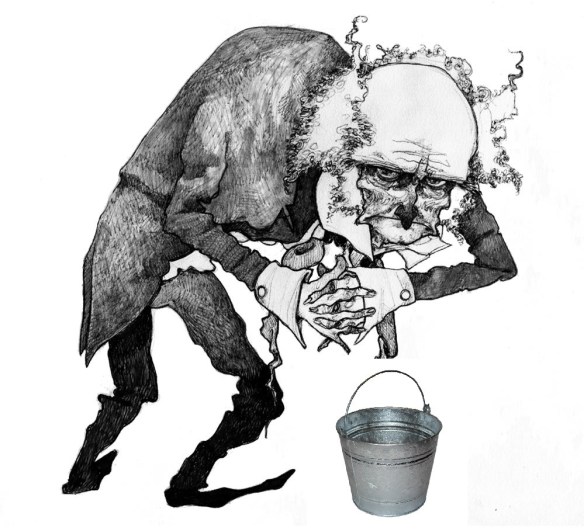
Gradgrind’s Bucket

gradgrind's bucket

As someone who has for years in the job and lately on this blog been consistently argumentative about those things in education that I distrust and detest, I hadn’t realised until yesterday just how naïve I have been.

The recent revelations about the Great Yarmouth Charter Academy and its rigid rulebook [and it isn’t opinion to call ‘rigid’ an understatement] has opened up a can of worm-ridden references to further examples of this quite common trajectory in our free-market education system, in the UK as a relatively modern phenomena and further afield where it is more common and established.

I can’t possibly summarise this: I haven’t the time nor the investigative information. As mentioned in a previous post, I do recommend the insights and information provided here @warwickmansell, and The Guardian [OK, obviously] has provided a consistent commentary from a ‘liberal’ perspective on those ‘extreme’ examples of where education is and has been heading for some years now.

I am a liberal. I was a liberal teacher. By that I mean I did not believe and never practised the kinds of draconian discipline exemplified in the GY Charter Academy Induction Programme booklet where – to take the obvious example currently being circulated by those opposed to it: if students claim they feel sick in class they are given a bucket in which to vomit.

Interestingly, the kind of ‘liberal’ teacher I was did embrace many of the general observations – or half observations – contained in the GYCA booklet. Here’s just one: At Charter teachers [sic – this document is no slave to the accurate use of a comma] and pupils are on the same team / and all the pupils know they must do exactly what the team captain says [my forward slash]. And this is the gist of the rulebook: an aphorism that sounds liberal and correct about an equal partnership – what I would want to call ‘mutual respect’ – and yet its greater weighted second part emphasises the total inequality in that relationship. When that following of the team captain [the teacher, naturally] includes forced smiling, forced handshakes, forced ways to sit/look/act in a classroom, forced ways to walk in a corridor, forced ways to look when walking in a corridor and much more ludicrously similar, we see the truth behind its claims about countering Teachers and Pupils [as] two opposing teams. In the Charter Academy [Inspiration Trust] gospel, they are one team led by an absolute ruler.

My liberal teacher ideology accepted entirely how there needed to be classroom control, and that low-level misbehaviour and worse from any students was detrimental to all students and therefore unacceptable. This is common sense. That the Charter Academy ideology takes this simple reality of classroom management and makes a prison rulebook out of it is where the scary danger of it all takes its actual shape.

I could but don’t need to delineate the trajectory of the 22 pages of the ‘original’ GYCA booklet any further on this [see later]. What I meant earlier about feeling naïve about all of this is how unaware I have been regarding the prevalence of such ideologies and practices in UK [and International] schools already. A posting today from @warwickmansell on ‘No Excuses’ Charter Schools in the USA makes a frightening [to me] comparison with the GYCA and what it preaches and enacts. Recent revelations about St Olave’s in London and the dismissal of ‘underperforming’ students gained its most worrying significance when it became clear how prevalent this practice was – and across all sectors of education.

I have my doubts about ReseachEd because of previous pontifications from those involved in it and, for example, the things invited guests at its just finished September conference like Gibb and Spielman have said. In recently undertaking more research, I recognise that it does have some broad support as well as its critics. That ‘broad’ support, however, seems to come from ‘leaders’ [looking at Twitter profiles] rather than teachers and this is a cause for concern. I think my naivety here is how I have tended to blame political interference as one of the most detrimental impacts on education, but this seems to be coming more from ‘within’ these days. I have written satirically here about one of the contemporary founders of much/many of these educational movements, Doug Lemov. But this is the tip of the proverbial and thus my confession of both an increasing anxiety about it all but also a personal inability to grasp the whole in the way many others do.

So I fall back on my own experiences as a teacher. Before closing on a summation of that, I will just inject one seemingly odd proclivity of mine in the classroom that would on the surface find a neat slot in rule no 2132 of any Carter Academy rule book: no leaning back in chairs. I hated this and did not allow it. And my students knew this. And they responded to my simple hand gesture to stop it! School chairs simply snapped out of their sockets if this was allowed.

Oh the tyrant in me. The point is this was done with considerable good humour. There were no threats, no punitive consequences, no insults, and no recriminations. It seems silly to have to even mention like this, but in a sense the good silliness of one good rule has to be placed against the truly bad to highlight that badness. And it’s easier than dismantling every bad rule in the GYCA booklet – even in its revised format published today [edited to 14 pages and not ending on the rhetorical rousing of the poem Invictus by William Ernest Henley]!

I’m trying to be human about all of this, though I don’t in truth think there are two sides to most of the doctrines and their specific manifestations in the kinds of draconian schools and ideologies I am questioning. The rigidity of the strictures in a GYCA rule book is unacceptable. The robotic behaviours it promotes is all about control and not about student development, both as learners and as people.

More importantly, I did as a teacher and now as an observer remain humane about my attitude to teaching and learning. I cannot imagine motivating and supporting and teaching students without that regard. And this would seem to be anathema to the Charter Academy and similar ideologies. And I do not understand it.

The Grenfell Alphabet by Ruth Valentine

I received my copy today of this affecting chapbook honouring the lives and their loss in the Grenfell Tower disaster. It is sold in aid of the Grenfell Tower Fund.

P1010505

It is a poetic lament that is clever without being clever-clogs, and the ruse of working through the alphabet mirrors poignantly the moving through the tower’s floors. Each vignette presents both the individual and the collective, prompted primarily by its alphabetic letter but obviously moving beyond this each time. The items imagined provide a rich visual tapestry to reflect the rich diversity of those who lived and were lost there, and the themes of sharing and journeying and expectations and family can be seen in this extract,

P1010506

Ruth Valentine’s blog is here and there is a contact icon to find out about availability and how to order.

Chewing Gum Pupils

Interesting online debates percolating about the Great Yarmouth Charter School and its new Head Barry Smith’s strict rules and regulations.

Trenchant questioning is being sustained by Warwick Mansell @warwickmansell. This is a large, serious debate, but considering the stringency of the rules presented by the school for this new year of operation, I was struck by the laxity – and consequent comic line – in the lack of an accurate use of the apostrophe for Rule No 4 about chewing gum [checked against various newspaper reportings of it, including the natural ally MailOnline]:

4. No chewing gum on site. If found with chewing gum pupils will be placed in isolation. Your children will avoid detentions, isolations, or confiscations if you are a supportive parent.

Nebraska 25: ‘Walking at Noon Near the Burlington Depot in Lincoln, Nebraska’ by Ted Kooser

On the rat-gray dock
of the candy factory,
workers in caps and aprons
as white as divinity
sit on their heels and smoke
in the warm spring sunlight
thick with butterscotch.

In the next block down,
outside a warehouse,
its big doors rolled and bolted
over the dusty hush
of pyramids of cartons,
two pickets in lettered vests
call back and forth, their voices
a clatter of echoes.

A girl sits in her car,
an old tan Oldsmobile
broken down over its tires,
and plays the radio.

On the grill of a semi
smelling of heat and distance,
one tattered butterfly.

And an empty grocery cart
from Safeway, miles from here,
leans into its reflection
in a blackened window, a little
piano recital of chrome
for someone to whom all things
were full of sadness.


Wonderful, unconnected snapshots of five observations about an ordinary town on an ordinary day, made special by their poetic honesty and simplicity, but also that closing stanza where the line ‘a little/piano recital of chrome’ suddenly shines, and just before the sudden melancholia is referenced.

Ofsted Blessing

One further item from Schools Week yesterday reporting on the ResearchEd conference attended by Gibb and Spielman, where the latter is stated to have indicated that schools’ book scrutiny will soon be conducted off-site with scanned examples sent to remote Inspectors, if you’ll excuse the pun, not that The Spiel noticed when it slapped her in the face. She is quoted as saying,

“There’s rather good scanning quality now, so the views of other inspectors, remote from the live inspection, could be drawn in to test out the judgments of inspectors on site,”

For someone who seems to want to play-down the reality of the tensions in being tested, it is a contradictory selling point to laud this as a means also of inspecting the Inspectors.

Ofsted Blessing

Your books are being scanned from afar
by the Ofted shine-a-light inspection star.

This is the New Age check on your marking,
and while it might seem like a scary barking

up Big Brother’s watching, withering tree,
think of it as a techno-blessing of scrutiny.

The Glib, The Spiel and ResearchEd

Schools Minister Nick Gibb and Ofsted Chief Amanda Spielman speaking at this weekend’s ResearchEd conference: here’s a duo of enlightened [wait for it] speakers to set the sprinkler system into overdrive in a room with even the remotest spark of interest in what either might have to say about education.

My main wonder is if The Glib had waited around for The Spiel to deliver the line about her ‘tear my hair out’ angst when schools still refer to grading a single lesson – The Glib, if indeed there, blushing bright red from the bald top of his ignorant head.

Earlier, The Glib had complained about teachers in their ‘ivory towers’ not coming to/taking an interest in a conference run by the organisation set up by the [former?] DfE fake-guru Tom Bennett – he of the banning films and banning making posters and banning anything he just happened to dislike in classrooms because he was in a position to say daft things as if they made eminent sense even when they didn’t.

‘Ivory towers’? Oh the irony knelling from the ding-donging of Gibb’s polished turd of great height.

I can only react to reports of these stupid things said by stupid people [today’s Schools Week and TES], but without having any sense that I need to be any more considering than this, I genuinely detest the drivel of these kinds of pontifications.

The Spiel has been here before: saying things that sound sensible when they are loaded with the most grotesque irony because it attacks schools and their teachers and leaders who have suffered the nonsenses of years and years of various government and Ofsted dictates about the very things she now rejects – with good sad reasons for them to tear out more than their hair at the diminishing and destruction of this – and so saying such offensively ironic things now is truly, truly dreadful.

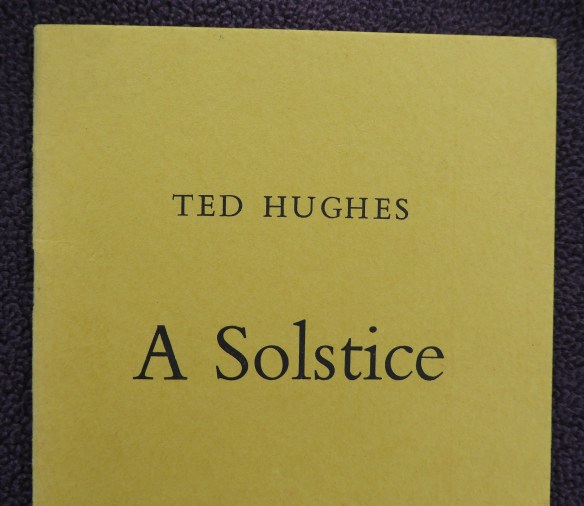
Ted Hughes – A Solstice: The Sceptre Press, 1978

P1010499

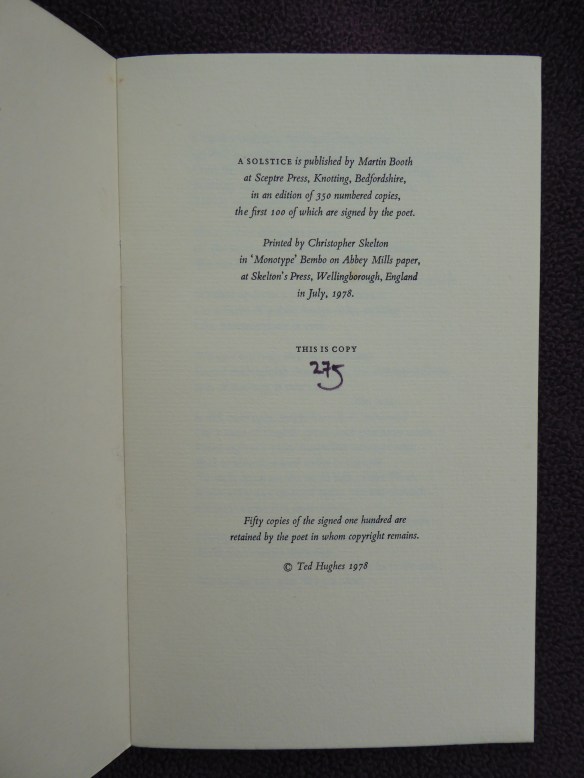
My copy isn’t signed, but it is numbered,

P1010500

Where The Thought-Fox is such a memorable metaphor for the creative spirit and act of writing, this poem about the killing of a fox is brutally extravagant in its description. I don’t believe there is any irony in that description and in the beauty of the fox as portrayed, even after its death,

Then bundle him and his velvet legs
His bag of useless jewels

The poem is classically Hughes: the excess of compound words shooting out its salvo of detail,

P1010501

and the absolute poetic capture of the sound of a jay,

P1010502