Steven Tuohy, John Western and Me

P1010492 - Copy

In browsing and revisiting my poetry books, especially from the past, I have dusted off these entirely personal works and recall fondly those early days of my poetic beginnings.

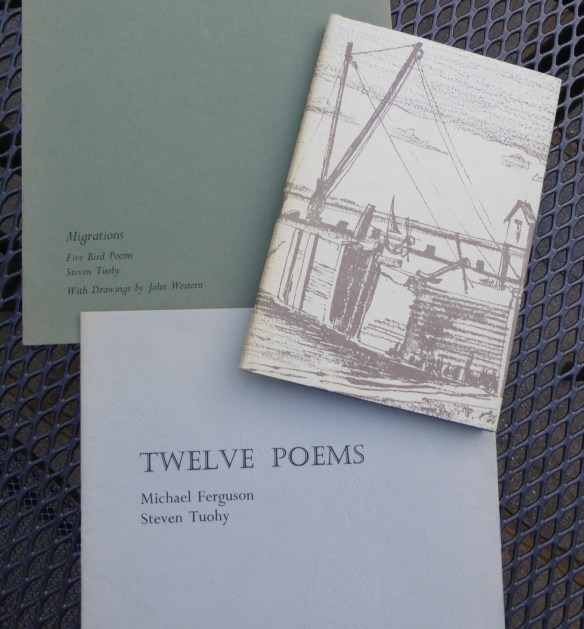
I came across the work of Steven Tuohy whilst we were both at college. A local writer, his work with Suffolk artist John Western was concerned almost exclusively with water and birds: Steven writing that muscular, descriptive poetry of Hughes [and a little of Gunn] so popular and influential at the time; John with his pencil drawings of the Suffolk landscape as well as the birds. Their two books that I have are Migrations, self-produced 1972, and Estuary, Oxford Polytechnic, 1977.

P1010493

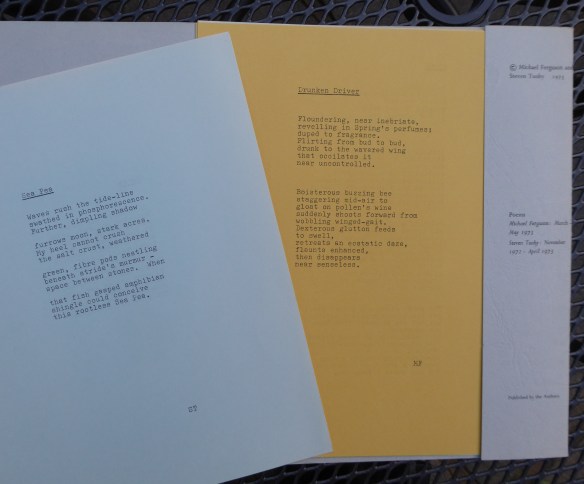
I was a novice, and Twelve Poems is both my first ‘published’ work and an example of a naïve style: trying to ape some of Steven’s crisp captures of the natural world while at the same time transmitting, oddly, an archaic style – a love of the Romantics and a fair degree of 1970’s poetic romanticism where I couldn’t even spell ‘oscillate’ correctly, but the meaning was all that mattered…

P1010496

Steven and I self-published, and though I have not been in contact since then nor able to find any more recent information online [John Western drowned in the River Deben in 2003], I am grateful for the support he gave me at the time, not least allowing his mature work to appear with my fledgling attempts. As Chairman of our college Literary Society I remember we used our funds to pay for the cover, and printed from a Gestetner [or similar] for the inserts – I was also involved in producing the college magazine – and I recognise the typeface from my typewriter of the time where a bit of nous and Typex on the stencil could have sorted that spelling error. Money for the sale of the pamphlet went to a charity.

Fox News List Sonnet

I knew Fox News was being removed from showing in the UK, but I hadn’t realised it is already gone. Obviously good, though I did dip in now and again to see what the rednecks were thinking and saying. However, at the risk this could have ever persuaded someone vulnerable, it is best disappeared from here at least. With today’s news about National Action, this load of noxious gas doesn’t need any further fueling.

It does give me the opportunity to reprise my poem about Fox News, first published at International Times in April, 2015. Eschewing the Shakespearean or Petrarchan models, I went instead for the more apt Scatological:

Fox News List Sonnet [*]

Fox News: shit that sticks to the bottom of shoes
Fox News: facts and figures to ignore and abuse
Fox News: slobber at the end of an afternoon snooze
Fox News: sensationalist suggestion that simmers and stews
Fox News Deadline: better on time than the truth you lose
Fox News: aberrant cell from the primordial ooze
Fox News: detection that ignores all of the clues
Fox News: bits and pieces a piss-artist spews
Fox News: polka appropriation of genuine blues
Fox News Headline: Terrorists Not Iceberg Sink Titanic Cruise
Fox News: candourless in cunning this Canidae eschews
Fox News: determined only in the lies they choose
Fox News: whose existence corrupts poetry’s muse
Fox News: so shit lining bowls of unflushable loos

[*] News Flash: Karl Rove adamant he has irrevocable proof that sonnet is 13-line poem that never rhymes;
[*] writer cites penultimate line as ultimate disclaimer

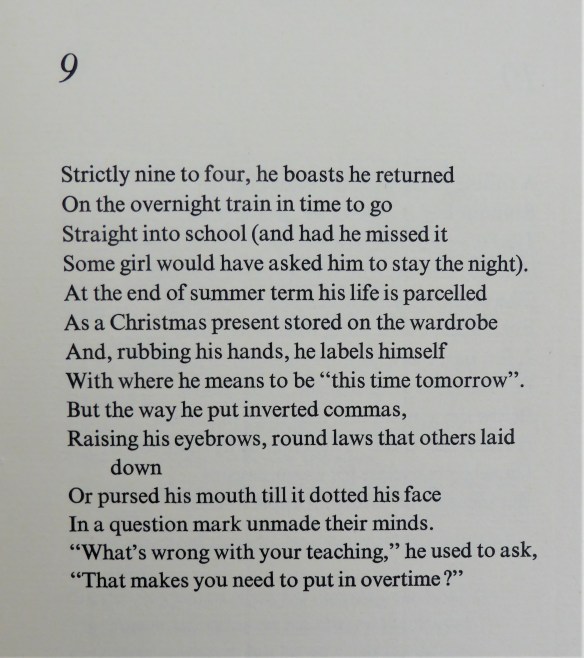
Stanley Cook – Teaching Poems

P1010470

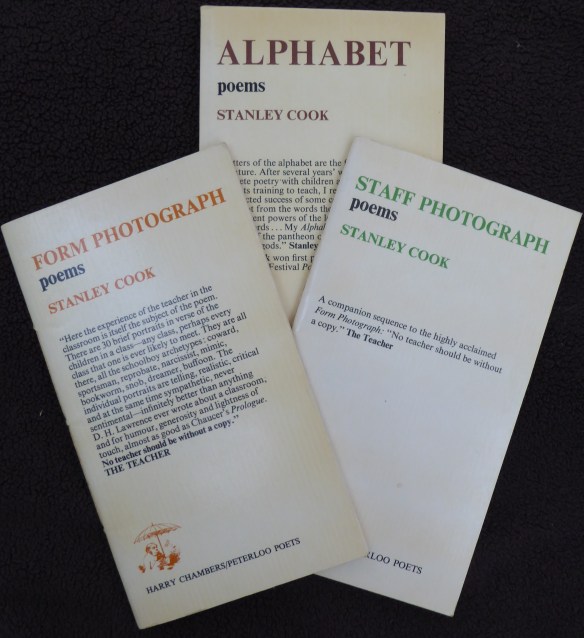
Form Photograph was first published in 1971, but reprinted in 1976 when both Staff Photograph and Alphabet Poems were published. I used examples from Alphabet Poems on some of my teaching practices in the late 70s, so probably 1977-78, prompts for student writing and this is where it all began. I also presented poems from Peter Redgrove’s From Every Chink of the Ark, 1977, where he too employed the alphabet as stimulus for his own writing [and I think I was quite adventurous using all of this: the energy and enthusiasm of the newbie!].

Cook’s staff and student poems reflect their time and are honest and direct to reflect realities one might avoid addressing so confessionally today. That’s probably as it should be, but I admire the openness of its era.

I’ll post one poem about a teacher, real or composite. As my former teaching colleagues return this week to work after their well-earned summer holidays, this one struck a chord even if it is about the end of summer term rather than a return after the break [and re. ‘had he missed it’, I recall a colleague and friend who claimed a few years ago he ‘missed’ the ferry and thus the first training day* at the beginning of the autumn term]. There is a little criticism in the stereotype presented, but the last two lines make some sense when I think of the huge extra commitment teachers have always made but especially so over recent years.

Today it is raining and I’m sure if I was returning to the job I would want it to continue. I always hated the first day back when the sun would suddenly decide to rage down, especially if I had just returned from a holiday saturated by a typical English summer. *Training Days: what a monumental waste of time when all you wanted to do was get ready for the immediate days to come: meet with the team, get the classroom sorted and the resources organised. All those presentations of ‘we have done well, but…..’, that dreadful and diminishing caveat, and the invited guests to demonstrate how they couldn’t do the job themselves and now instruct as invited guests.

P1010471

This is an wonderfully assertive appraisal of the life and work of Stanley Cook here.

Water and Waste by Peter Reading, Outposts Publications

As I started browsing [see previous post]…

P1010465

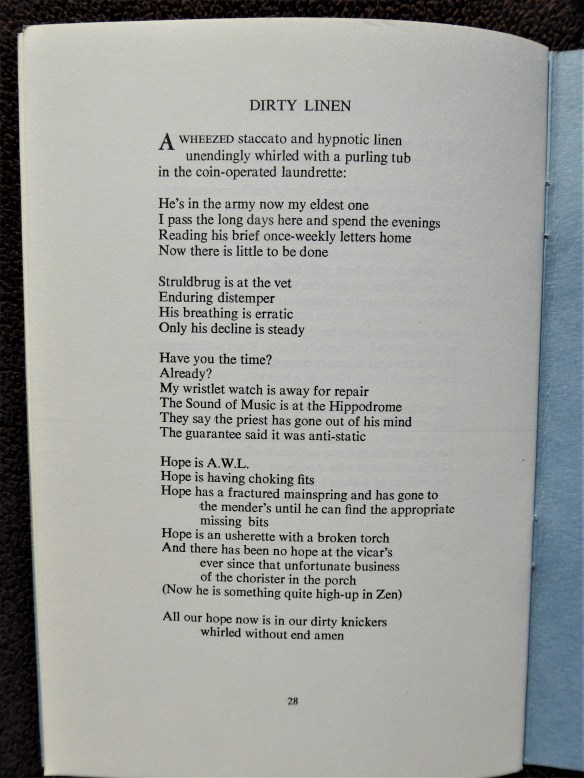
This is the wonderful Peter Reading’s first collection of poems, published in 1970 when he was 24 years old. Outposts Publications was run by Howard Sergent, himself a wonderful man and supporter of poets: as I have written here, he was always kind and supportive of me as a young writer, though he never published my poetry and instead took one of my reviews. I thought this statement from Sergeant neatly exemplifies his sense of engagement with contemporary writers, and it is impressive to look at previous Outposts magazines to see its many now famous and respected poets,

P1010467

The poems in this collection from Reading demonstrate much of what his work would mature into – the playfulness with but also knowing use of complex language, the knowing references too – though overall they have a formality of form which of course he would employ later on for precise purposes but which here reflect some adherence to expectations. Just a little. The poem Dirty Linen is the last from this booklet, and it does present Reading’s trademark telling wit,

P1010466

reading - Copy

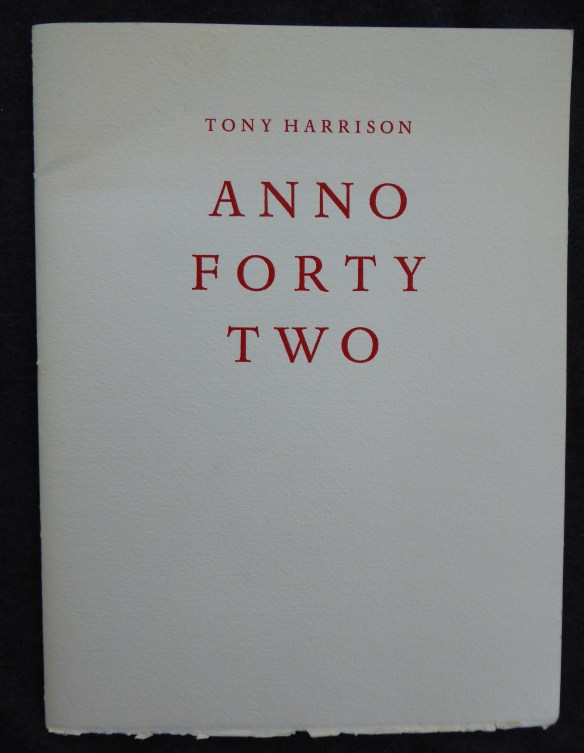
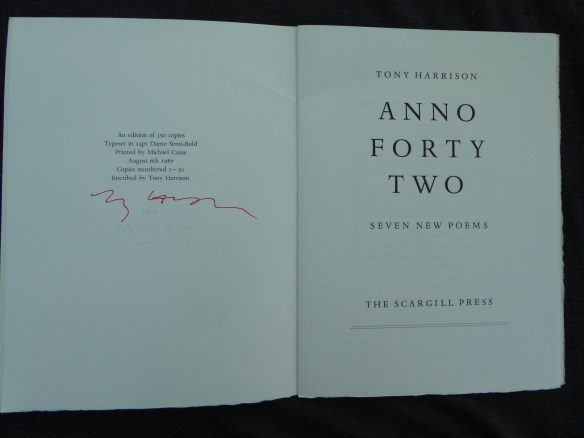
Anno Forty Two by Tony Harrison, printed by Michael Caine

a

I have been clearing some books out for discarding, this quite a difficult and nostalgic process as I am loath to get rid of books collected over the years – even when nor read for years or indeed ever, and those that have had some significant impact on me in the past – though the only one as such which I still decided to pass on to the charity shop was The Handyman’s Handbook which did inform years of my DIY from the late 1970s through the 80s. That said, when I posted a picture and brief farewell message to the book on Facebook, one of my daughter’s asked to have. That was a close call.

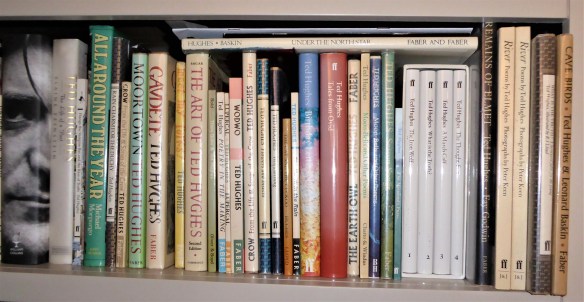
I’ve also been generally browsing books, especially my poetry shelves and came across this which I hadn’t looked at for some time. It is another beautifully hand-produced pamphlet by Michael Caine, whose work and one of my other treasures, Peter Reading’s Shitheads, is reviewed here.

This too simply looks and feels so special. It is a powerful set of seven poems by Tony Harrison about the apocalyptic ending of the Second World War. Mine is numbered 100 out of an edition of 350 printed in 1987.

Michael Caine lives and works in France and more of his exquisite collection of remaining books can be seen here.

b

c

Nail Your Colours to No More Marking

colour demo

This is a grave new world of assessment. In my post yesterday I referenced via an article in Schools Week the assessment company No More Marking [a ruse of a title if I have ever heard one] and as is so often the case with me, such has rankled my sensibilities about teaching, learning and assessment.

There are two things I want to quote from the No More Marking website for any interested readers to check out and judge for yourselves [I think you are entitled to judge for yourself, without access to a graph/matrix/model….].

The first, which I found mildly amusing, is their ‘Colours Test Demo’, here, which is meant to prove the hypothesis as follows [and quoted in yesterday’s posting]:

Marking does not work when it involves any degree of human judgement. This is due to a simple principle.

“There is no absolute judgment. All judgments are comparisons of one thing with another”. (Human Judgment: The Eye of the Beholder by Donald Laming, p.9).

I can confirm that when I completed the demo I had been unable to retain the information needed to make the ‘correct’ judgement about the sequence of colours. I am flummoxed by how this relates to and proves that I cannot effectively compare and comment on writing from across a range of writing? With 30 years of human teaching experience I feel I have an expertise to do so [accepting there will be variations in aesthetic appeal/expectation – what makes writing, especially creative, what it is in its infinite variety] and by extrapolation I reckon that if I had experienced the sequence of squared colours used for 30 years I would then be able to sequence them precisely as originally sequenced.

Second, and to leave readers with, is the following. On the one hand, in not understanding this I could just be hugely out of my comfort zone in not comprehending the mathematics/statistics of it all [and of course I am!]; on the other, it could just be totally ridiculous, an emperor’s new clothes of assessment gobbledygook that sums up its meaninglessness to me as a human English teacher in its meaningless to me as a human English teacher. I will of course be making a found poem out of this stuff:

Following a series of pairwise judgements we can establish a measurement scale using a statistical model. The most commonly used model is the Bradley Terry model (Hunter, 2004) which predicts the outcome from any comparison. The statistical model enables us to build a measurement scale without having to make all the possible pairwise comparisons that would otherwise be required.

The measurement scale that results from a CJ study has some powerful characteristics. The Bradley Terry model is algebraically equivalent to the Rasch model (Rasch, 1960), so the measurement scale shares the advantages of a Rasch measurement scale. The scale is linear, robust to missing data, has estimates of precision, detects misfit, and the parameters of the objects being measured can be separated from the measurement instrument being used.

A CJ scale can therefore be examined in terms of its reliability and consistency: a high value of reliability would suggest we could replicate the scale. The linear scale means that CJ studies can be anchored together using a sub-set of common items, which can be useful, for example, in measuring progress over time. Misfit to the model can be detected both for objects being measured and for the judges doing the measurement. An object may misfit if there is no consensus amongst judges over the quality of the object. A judge may misfit if their judgements are not consistent with the overall measurement scale. Misfit is useful in understanding the traits under consideration and the interactions between judges and the traits (Pollitt, 2012).

© No More Marking [colour chart and quoted sections] – https://www.nomoremarking.com/aboutcj


The Balls of Finite Outcomes

As a former secondary school English teacher and Head of Department I had to suffer the annual assumed assessment and judgement of ‘stagnant’ – or worse – student progress from Key Stage 2 to Key Stage 3.

I was and always will be on the defensive about this. One of my more considered rejections [above and beyond a simple disregard for the miserable nonsense of KS 2 and 3 external testing in English] was the nature of KS3 English testing, when it existed, which did suddenly require students to read and write quite differently to the discrete kinds of testing at KS2, though this too suffered the ludicrous narrowing of prescriptive expectations for student responses.

As reported in today’s Schools Week, a new organisation No More Marking has reported forty-two per cent of year 7 pupils either stood still or “regressed” in English, based on their assessment software [no comment on this methodology, yet…].

It is too soon to simply reject, yet again, such an ‘assessment’ organisation and its assertions, but also too soon to warm entirely to the company’s director of education Daisy Christodoulou who is reported to have stated the following:

Year 7 may also have “particular issues” around transition, she said.

“They’re suddenly studying a lot more subjects, they’ve got lots of new teachers, new peers – there’s a lot more going on there.”

No More Marking tested more than 28,000 year 7 pupils using “open-ended” questions in English and maths, which could not be revised for and required a creative grasp of concepts…

This is sensible about the personal and social phenomena of the transition for most students, but I do also wonder especially at the seemingly poignant reference to students needing a creative grasp of concepts to respond to their open ended questioning.

At KS2 testing in English, and therefore the explicit teaching to this, there is absolutely nothing that encourages being creative or independent or anything other than robotic in dealing with the discrete and closed nature of, in particular, Grammar, Punctuation and Spelling testing.

Suddenly at KS3 in English, students will be reading and writing much more widely – like they used to at KS2 lest colleagues there think I am denigrating their curriculum. I’m not. The target culture that judges so clinically at KS2 would seem to have narrowed the curriculum to the robotics of test preparation, as reported so thoroughly – from schools, not the DfE – over recent years.

Obviously as I write I do not know what the exact nature of the No More Marking assessment is. That said, I have to conclude on a note of worry and concern when I quote the following guiding principle from the No More Marking organisation:

Marking does not work when it involves any degree of human judgement. This is due to a simple principle.

“There is no absolute judgment. All judgments are comparisons of one thing with another”. (Human Judgment: The Eye of the Beholder by Donald Laming, p.9).

Laming has shown that at best our judgments are ordinal. We can place things in an order, but scarcely more than this. Ask two people to apply a mark scheme and you will most likely get different marks. Ask people to place two scripts in order, and you will get more consistency.

Having just come through the process of examining GCSE with regular standardisation through seeding, I am not a novice when it comes to questioning personal judgements [and haven’t been before the online seeding process]. That said, I can’t imagine assessing English properly without it – unless, of course, we think English teaching and learning is only concerned with finite outcomes,

excusing the complete bollocks of the last two words in the above paragraph.


National Poetry Day’s Freedom

NPD

The ideas offered here are to support students writing poems for this year’s National Poetry Day. All provide structures and models to aid writing list poems: these are straightforward and impactful with the repetitions building detail, pace and overall meaning.

These ideas are also essentially writing aids. Students can and should talk through overall thoughts about the theme of Freedom and how each creative writing idea presents this, but the focus is on the practical activity of writing – hopefully getting quickly into the spirit and crafting of the approaches.

Click on the links below. This will take you to a pdf copy of the individual resource that can then be downloaded.

Please feel free to share as widely as you can with other teaching colleagues:

0National Poetry Day – TN

1Freedom to

2Freedom to

3Freedom to

4Freedom to

5Freedom is Randomised

6Freedom is Randomisedb

7Freedom is Where

8Liberty poem

9liberty poem edited

The following PowerPoint has 5 slides in support of the above resources [the Tagore poem is resourced from the internet and I sincerely hope it is entirely accurate in its original Bengali language]:

National Poetry Day PP

The following is an additional resource, added today [10.9.17]:

10People of the World

11A Song poem

freedom