
Read it here.

Read it here.
[22nd May, 2017]
It is occupying the time of early evening
in a warm May back garden
as if a lone child at its own party,
making a racket singing and springing from the
Himalayan birch to the other tree –
the cheap one –
a wren I rarely see in the day but now making
branches jerk surprisingly for such a tiny thing
by pushing off in its manic lively flights.
Above and beyond in the screen of conifers
pigeons are fighting,
the flap of wings
like a monster’s applause,
then a single white feather drifts out and
down from the wall of green and
rests on the roof of the shed beneath
in its horrific fall.
Schools Week has reported here that DfE figures [not that I could find them on the Gov UK site] predict creative subjects at GCSE are and will continue to decline as Ebaac subjects continue to grow, these latter becoming mandatory and therefore part of a school’s central measurement for success.
So, for example, teacher training courses for Geographers have increased whilst those for creative subjects have fallen. Students of the future will know where the Cairngorms are but not understand Coleridge’s artistic maxim on ‘suspension of disbelief’, or how to write a story. A horror story.
And if only we could apply Coleridge’s adage to this reality, though of course it is better to see it for what it is.
No Ansel Adams
but the snapshots we captured
through the open car window
on our eight megapixel cell phones
on the side of the road off an exit ramp
as truck taillights streaked eastbound
opposite the earth’s rotation
in startling calm that evening
a mere dot-glow above dun fields
Look, life is like this, filled
with moments of meaning
paid attention to or not
but we tried we lingered
and sure enough it is here
looming in memory-mind
the fat orange ball above horizon
inching up into blank navy air
the full moon in early spring
we drove toward in silence
~ from Rock. Tree. Bird. © The Backwaters Press, 2017.
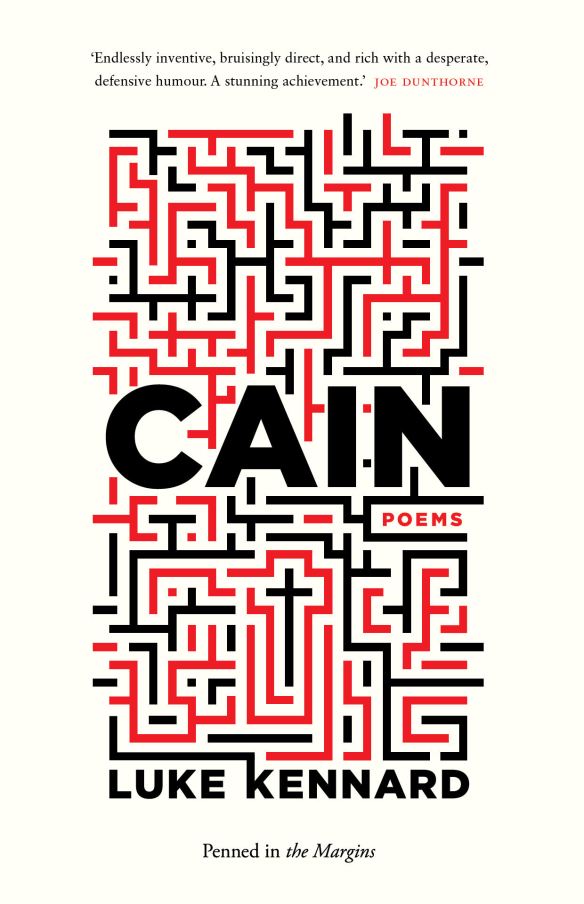
Luke Kennard’s Cain is, as so many others have already observed, an innovative, playful and resource-rich poetic experiment in defining the here and now of alternatives – the alternative narrative of the troubled mind of Cain-as-Everyperson who seeks redress and redemption in drawing our attention to a world elusively encapsulated in the form of a bucket and a Chupa Chupa lolly.
As ‘Cain’s Prologue’ lets us know in ‘Book I Gravel Pit’, all interpretations are up for grabs – that is if you can hold on to the coming roller-coaster ride of confessions to a Community Psychiatric Nurse: a helping, caring hand for us all. That is before the further imminent cuts come to get rid of all the support staff.
I was captured from the start, mesmerised by the brightly named colours of 10 of your nail varnishes, and await, having attended these therapy sessions, with a newly acquired optimism to see Cain stocked in Argos. My total immersion came with reading the school-based poems ‘Self-Portrait at Primary School’ and ‘On Being Very Annoying’ where the teacher in me heard the extra click as we all will hear from the multiplicity of vantage points [and anchors] provided throughout this eclectic text.
As the poems continually demonstrate, the enforced distraction from our collective grasp of the world within which we live is endemic and attributed to many things – from a zombified obsession with zombies to watching TV’s reality whilst zombified by, at the same time, watching our mobile phones. It is a virus, and we have all been hacked.
The centrepiece ‘Book II The Anagrams’ is both presentation and poetry/poetry and presentation and is a glorious wishbone of readings waiting to be pulled. Arsehole Theory, here we come tugging. I discovered my blood type is Ahhhhhhhhh!
‘Book III Death Shroud’ further explores the random joy of poetic discourse on this ever-elusive reality, a world as shredded as grated cheese and other food analogies,
You don’t need to explain
a game called Juxtapotatoes.
Just put a potato next to something.
We’ll figure out the rest.
Further details and purchase here.
Pleased again to have a poem here, and appreciate poetry sites like this who support work, especially when it provides a writer the opportunity to share a range of material. Your One Phone Call is tagged as Poetry with a knife edge and I am delighted to slice and dice it up with others, and encourage a wider reading of its cutting contents.
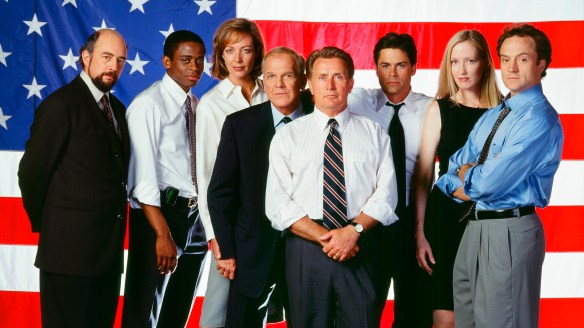
As I continue to plot old episodes of The West Wing against current political events, UK and International [well, Trumpworld], I thought on the day the Labour Party here introduces its general election manifesto with a commitment to spending, if elected, in order to ultimately improve the economy, and is immediately pilloried by the national press for its ‘predictable’ profligacy, I watch tonight’s episode from series 3, Enemies Foreign and Domestic, with this gem of an apt observation:
TOBY [OS]
I just wanted to give you a heads up – the journal’s going to run an editorial
with regard to broken promises in fiscal spending.
[Charlie picks up some papers and returns to the Oval Office]
BARTLET
Oh man, the greatest campaign speech ever about money – FDR promises to
tighten our belts. What’s he do when he gets here – spends more than we knew could be spent. And it’s ’cause he discovered it’s better for long-term growth. [sits down to read]

Pleased to have my poem here.
Part One
Opening poem, ‘Swift’, is observational, recounting the appearance of swifts to signal not just arrival above the village but also their phenomenal flight which can be like flailing before the swift, its flying described so, pulls out of its dive with precision and the watchers’ surprise.
Baker, his partner and a small gathering stare and voice their awed approval. It is an animal/human dichotomy – the former observed and praised by the latter, yet also sharing common ground in this moment, merging in the witnessing of recognition and being able to do so, these swifts
blown wild around us, and we are their witness
It is like the observer and writer who merge too in the moment, in the poem itself.
The next poem, ‘On Arrogance’, explores similarly, but with reversing roles, the natural and human worlds, Baker having brought home an outdoor plant to please my girl, though the ferns soon die having been inhabited by a robin’s nest but also because of too little water as well as too much sunlight and being placed in the wrong pot – nature and human interference merging to the same negative effect.
Kate hadn’t been interested either way, even when the baby robins were born, though these soon enough grew and flew away. It is later that his cat returns home yowling to come back in at the screen door with a mouthful/of bird, and we assume it is a robin and nature has asserted itself with a different kind of awe – here matter-of-fact rather than praised by the writer who is in fact confused by the conclusion of events,
…and all I could think
was Jesus, David, now
what have you done?
In the third poem, ‘Simile’, of this wonderful whole collection, more mergings occur to establish recurring themes and patterns of writing. A moth on the fringe tree is fussing over its bloom, gorging itself full, as Baker puts it satiate, as in sex. Then still, as the good sleep after, insect and human life joined in this first metaphor. The moth and others have their fragile wings dissipated to some dust in their activity – the tree’s petals torn too – and Baker compares this to the fragile grasp of his writing,
Weeks now my words on paper have burned.
Burned and flown, like a soul on fire, with
nothing to show but ash, and the ash flies too.
In the second part of the poem, the focus turns to human activity: terrorism. A brisk reference to a suicide bomber and her killings is linked first to a quote from Whitman
Do you think I could walk pleasantly and
well-suited toward annihilation?
and then back to the moth, a tumbler – presumably for drinking alcohol – and a chain of events, this linking, that concludes with the writer’s attempt to capture and define it all,
A tumbler turns and clicks. The world once more
fills with fire, and the body, like ash, is ash.
Such links, comparisons and contrasts will inform many more poems, both thematically, as I have said, and stylistically. In ‘Fall Back’, that style representation is in the oscillating lines,
A golden rainfall
there is no rain
[* NB above, and elsewhere, WordPress does not preserve the formatting of text as in the book and as I would like to present: a technical hitch]
this pattern repeated for the whole poem though not the direct contradiction. The poem does end, however, with a suggestion of not having captured and defined a moment, the ash, perhaps, of the poet’s constant attempt to make sense of contradictions and differences, not always succeeding.
A major poem in this section is ‘Five Odes on Absence’, poems written with reference to John Clare, as Baker informs us in the ‘Notes’ at the book’s end, but also in the hand-out and fuller explanation when I had the great pleasure to see him read at Exeter University in November, 2016, and reviewed elsewhere on this blog. The extracts from Clare that Baker puts in the poem are written in the code JC used in his letters to Mary Collingwood and composed at Northampton General Lunatic Asylum where he was a resident.
In many ways, Clare’s coded language of missing vowels is used by Baker as a wile for playing with the elusiveness – but also illusion – of meaning. He does so with contemporary references, for example in the first section, with Vogue magazine and its tweets on fashion, or the meaninglessness of fashion assertions, as well as taking a pot-shot at poetic fashion, as ridiculed here,
Because I could not stop for Death – make that
Be a cold sop. I stood at –, You get the
picture.
although the irony of this is how Baker is supremely playful with poetic language and reference as we will see in particular with the book’s main poem ‘Scavenger Loop’.
In the third section of this poem, Baker quotes heavily from Clare’s letters to illustrate the poet’s striving for clarity [the deeper irony from within the coded language] and including this well-known line, now increased in its pathos,
I am the self-consumer of my woes
In the fourth section, the collision between fashion, meaning and intention is further explored,
It’s not enough to tell the truth; you have
to tell it in believable fashion
and this is linked to Twitter, with an intentionally characterless, literal definition of its format,
140 characters or less
which obviously relates to the truncated coding from Clare’s letter.
This is a more detailed and interconnected poem across its five parts then outlined here, but as with the snapshots provided from this book’s opening section, these are sketches of the fuller range and depths there are to read.
Part Two
The front inner fold of the book’s dust jacket has a neatly summative blurb, and a line I like from this is Baker reveals how everything bears the potential to be both invasive and life giving. The first poem in this section, ‘Flood’, doesn’t attribute this duality to a single natural thing, but does connect a wren’s Immensity of song with the flooding of the night not rain but sheets, good and bad, and ends with the negative and positive,
…you want to keep a lot of water
out bright song let
a little in – [*]
A delightful poem where glorious good comes from an archetypal bad situation is ‘Outside’ about Stevie who lives in a silo. This basic accommodation – to say the least – has, however, been transformed by the inventive and eccentric Stevie, fondly documented by Baker. Stevie’s dream is to be free and creative – and he clearly is. In a line that reminds of Frost and his poem ‘Wall’, Baker writes
Say why do walls want windows?
and continues
He’s put glass
around the trees instead, head-high to look
at trees from outside out
The poem ends on this upbeat [excuse the pun] invitation,
….come see Stevie’s crib.
That’s his ten-foot pink polyvinyl penis
teeter-totter beside the birdcage
for tomatoes. Take a ride, he says. All eyes
Part Three
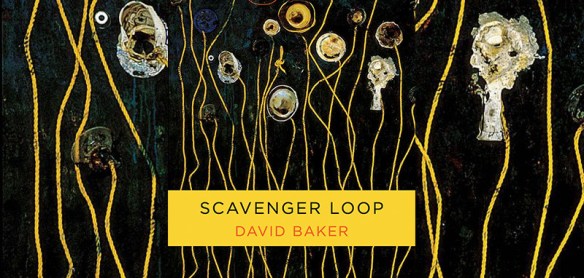
‘Scavenger Loop’ is the whole work in this section. The first instalment is a poem about the scavenger from a county away who is at Baker’s house, one guesses,
to score – his term – whatever he can
the day before
our village “free-for-haul”
is officially underway. [*]
and the account embodies completely the theme of finding good from bad, useful from discarded.
These poem pieces, as I’ll call them, continue throughout to reference a panoply of sources – contemporary, factual, farcical, historical, scientific and imaginative – to illuminate this theme of decay and renewal. This whole poem, but also many others in this book, remind me of the great British poet Peter Reading who also revelled in accessing and utilising the widest referential points in his poetry. Reading explored and employed the most arcane language then linked it to slang/vernacular, manipulating the collide of old and new, conflicting cultural norms, and an often acerbic humour to document our modern world in his writing. Baker is doing similar in ‘Scavenger Loop’ and, like Reading who was concerned with environmental degradation at human hands, he uses references to ecological concerns as well as factual/informed references to co-exist with and flourish in the poetic framing.
The third piece does this by reference to Facebook and a friended friend posting a message Repeal Monsanto/Protection Act and then how its shared status and number of likes give it another kind of status in the new and other world of social media. This is immediately followed by a bifurcated pairing of lines that continue this documentation – presumably culled from factual references – on nature’s cycle of decay and renewal, ending in the lines
The wood returns to the soil as humus
And it progresses. Another piece refers to USDA projected 2013 US corn production then returns to Facebook likes and the modern, abbreviated exclamation OMG, and next the stark she’s dying. The world turns. Again. The interweaving is brave and bravura, I think, and always lively and experimental.
A further piece reminds clearly of Reading, referencing and translating these three words: skawage, escauwage, sceawian, and this is immediately followed by a more ‘formal’ poem, lyrical in its setting, but its subject matter the horrible consequences of a home-stove explosion.
‘Scavenger Loop’ is a stunning whole poem which marches on relentlessly in its creative toing and froing, using mentions as diverse as mathematical calculations to Baker’s signature oscillating lines of light and dark [not as yin yang as this, but overall in exploring].
Part Four
This section opens with the poem ‘Our Ivy’, another about merging and interdependence with the differing views of neighbours on their shared ivy, one of the two dying in his gene swirl (from melas + oma),
as a living leather, who spreads ravenous
until it’s covered the host tree’s whole trunk
and thickens there, blossoms there, pre-
dator
or symbiotic partner, depending… [*]
and there is another Frostian line in the summation of these two and their partnership,
One holds up that pulls the other down
Poems here explore relationships and other gives and takes, and I will close on the book’s final poem, ‘Metastasis’, simply to revel in the craft of this, Baker, as ever, a truly lyrical writer, and here the rhythm of waves ebbing and flowing and breaking are exemplified with such poetic empathy.

Away last week in the Lakes in a wonderful converted barn but without wifi – a known – so enjoyed reading and writing at the kitchen table and outside, writing reviews longhand on actual paper!
 gravyfromthegazebo